What Is an Inverter Generator and How Does It Work?
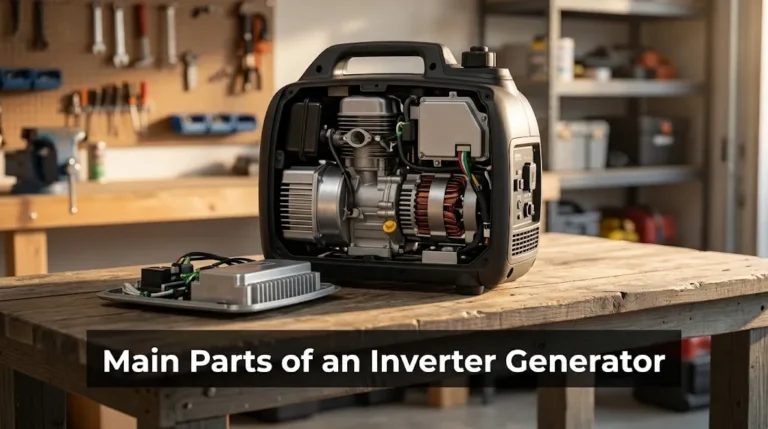
An inverter generator is a fuel-powered generator that cleans up its own electricity before it reaches your appliances. It makes raw alternating current (AC), converts that power to direct current (DC), then rebuilds it as stable, low-distortion AC. That extra step is why it can run quieter, use less fuel at light loads, and safely power laptops, phones, and other sensitive electronics.
What Is an Inverter Generator?
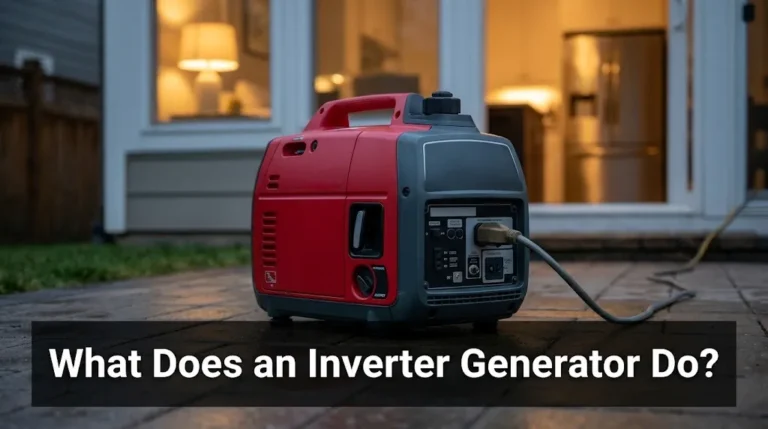
An inverter generator is a portable generator with extra electronics between its alternator and its outlets. A conventional portable generator sends alternator power straight to the outlets. An inverter generator does not. It processes the power first, so voltage and frequency stay steadier when loads change.
The word inverter can cause confusion. A standalone power inverter is different. It takes DC power from a battery and turns it into AC, but it does not generate power on its own. An inverter generator has an engine, fuel, and an alternator. It makes power, then uses inverter electronics to refine it.
Most inverter generators run on gasoline. Some run on propane, and some are dual-fuel, meaning they can use gasoline or propane. The fuel choice changes runtime and storage, but it does not change the basic AC to DC to AC idea.
Think of it this way. A conventional generator is like shouting the same volume whether one person or a whole room is listening. An inverter generator adjusts its voice to the room. The electronics hold the output steady while the engine works only as hard as the load requires.
How Does an Inverter Generator Work, Step by Step?
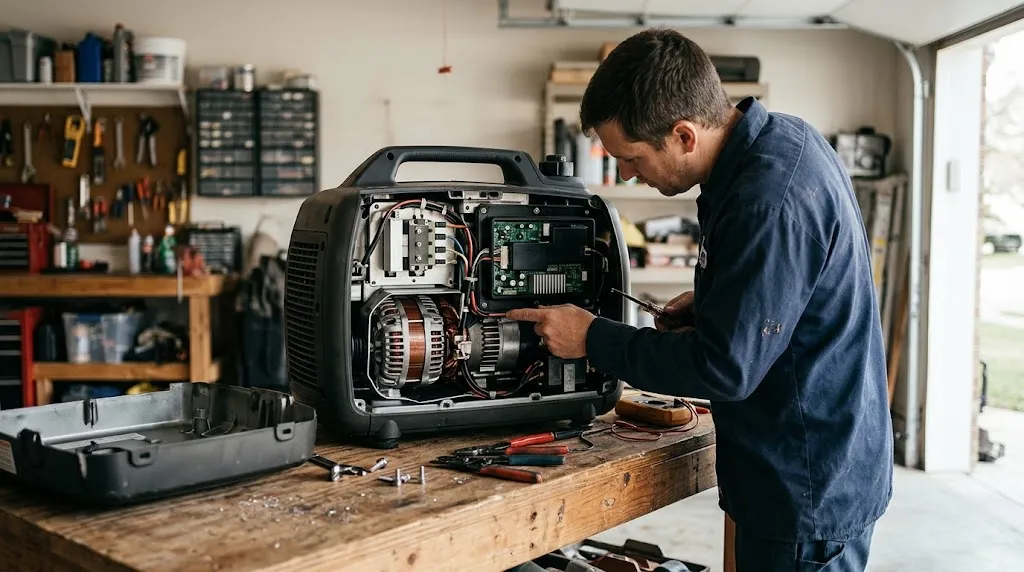
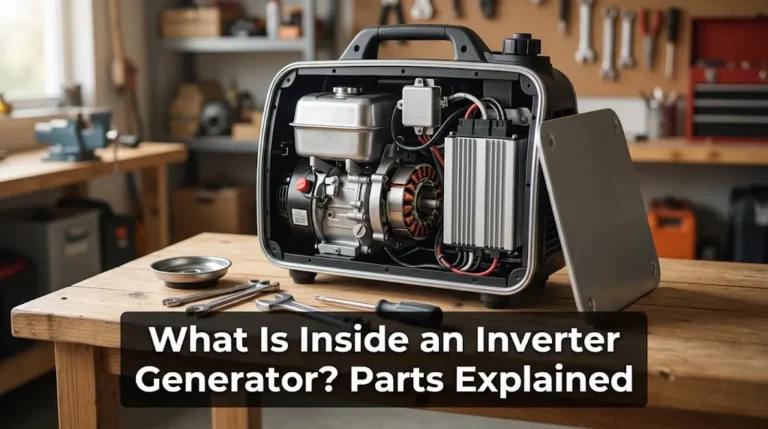
Four stages happen inside the unit, in the same order, every time it runs. You do not need to manage them. The generator handles the switching, but knowing the order helps you understand why its power is cleaner.
Step 1: The engine spins the alternator
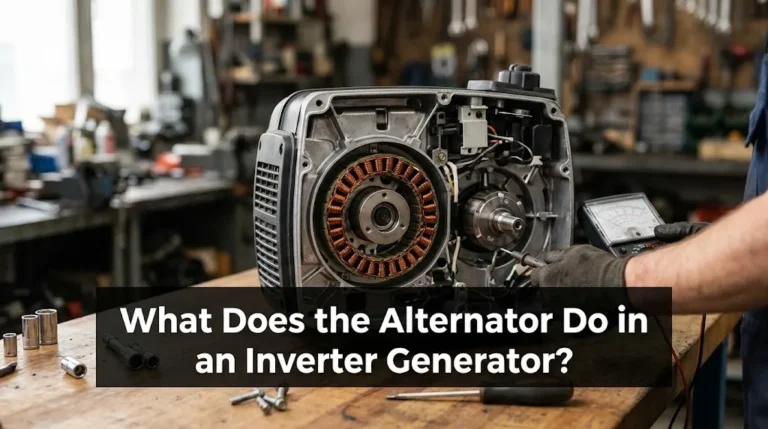
Gasoline or propane burns in a small engine. That engine turns an alternator, which is the part that turns motion into electricity. The first electricity it makes is raw AC. At this point, the power is rough. Its voltage can move up and down as the engine speed and load change.
In a conventional generator, this raw power would go almost directly to your appliances. The engine would have to hold a fixed speed, usually 3,600 revolutions per minute, just to hold the output near 60 hertz, the frequency used by United States household power. An inverter generator breaks that link.
Step 2: A rectifier converts raw AC to DC
A rectifier is an electronic component that converts AC to DC. Direct current, or DC, flows in one direction. It is the kind of power a battery supplies.
This step matters because DC gives the generator a clean starting point. Once the power is DC, the engine speed no longer has to set the final frequency. The electronics downstream can do that job instead.
Step 3: The inverter rebuilds stable AC power
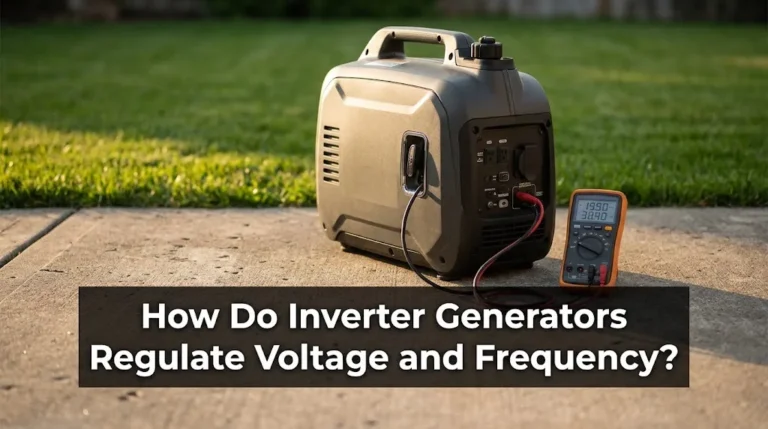
The inverter takes the DC power and rebuilds it as AC power, normally 120 volts at 60 hertz for United States household outlets. It does this by switching the DC power on and off very fast and smoothing the result into a wave.
That wave is called a pure sine wave. A pure sine wave is smooth and regular, close to the shape of power from a wall outlet. Sensitive electronics expect that shape. Rough, jagged power can cause extra heat, buzzing, flicker, or, over time, damage to delicate circuits.
The inverter also holds voltage and frequency steadier than a simple mechanical governor can. When a fridge motor starts, or a microwave cycles on, the inverter works to keep the output from sagging or spiking in the same way.
Step 4: A microprocessor matches engine speed to demand
A microprocessor, a small control board, watches the load. When you plug in only a phone charger, it lets the engine slow down. When you add a larger load, it tells the engine to speed up.
This is the part most owners notice first. The generator gets quieter at light loads. It also burns less fuel, because it is not racing at full speed to charge a phone. At full load, it still has to work hard. The benefit is largest during the long, light-load hours that make up most outages.
Many models have an eco mode or economy switch for this. Turn it on for light, steady loads. Turn it off if a motor-heavy load keeps cycling and the generator seems slow to respond. Your manual is the final word for your model.
The first time I ran a small inverter unit overnight during a winter outage, the thing I did not expect was how little I noticed it. The fridge cycled, the lights stayed steady, and the engine dropped to a low hum between fridge cycles instead of droning at full speed all night. That quiet stretch is what makes an inverter easy to live with when the power is out for days, not just hours.
What Is THD, and Why Does Clean Power Matter?
Total harmonic distortion, or THD, measures how far a power wave strays from a perfect sine wave. It is shown as a percentage. Lower is cleaner.
Quality inverter generators commonly produce under 3% THD. Some produce under 5%, which is a widely used rule of thumb for power that is safe for sensitive electronics. Conventional open-frame generators often produce far more, commonly in the 10% to 25% range, depending on the model and load.
High THD does not mean a conventional generator will instantly break everything you plug in. Power tools, heaters, and many simple motors tolerate rougher power well. The risk is higher for devices with microprocessors, chargers, and sensitive power supplies: laptops, routers, smart TVs, gaming consoles, and medical devices such as a CPAP machine.
Check the spec sheet, not just the marketing words. If a manufacturer claims clean power but does not publish a THD figure, treat that claim with care. A published figure, measured across loads, tells you more than the word clean on a box.
For background on how manufacturers describe this process, see Honda’s explanation of how an inverter generator works. For an independent view of the trade-offs, see Consumer Reports on the pros and cons of inverter generators.
Inverter Generator vs. Conventional Generator
The table below sums up the real differences. No type wins on every point. The right choice depends on what you will run and how long you will run it.
| Feature | Inverter generator | Conventional generator |
|---|---|---|
| Power quality | Pure sine wave, often under 3% THD | Rougher wave, often 10% to 25% THD |
| Engine speed | Varies with load | Fixed speed, usually 3,600 RPM |
| Noise | Quieter, especially at light loads | Louder, even at light loads |
| Fuel use at light loads | Lower, because the engine slows down | Higher, because the engine holds full speed |
| Weight and size | Often lighter and more compact at the same small wattage | Often heavier and bulkier, with an open frame |
| Large power output | Available in larger sizes, but large conventional and standby units often cost less per watt | Strong choice for high-wattage tools and whole-home loads |
| Best for | Electronics, camping, RVs, and quiet home backup | Jobsites, heavy tools, and budget-focused high power |
Noise is measured in decibels, written as dBA. A small inverter at light load can sit in the 50s dBA range, close to normal conversation. A conventional open-frame unit at full speed is often much louder. Check the rating at a stated load and distance. A number with no load or distance attached is hard to compare.
Why Does Variable Engine Speed Save Fuel?
Fuel savings come from the hours you are not at full load. Most outages are not full load all the time. A fridge cycles on and off. Lights stay on. Phones charge, then stop. A conventional generator burns fuel at full speed through all of it.
An inverter generator slows down during those quiet stretches. It still has to start the engine and keep the inverter running, so it is not free power. The saving is real, though, and it shows up as fewer refills during a long outage. That matters when gas stations are closed or lines are long.
Runtime per tank still depends on load, tank size, and fuel type. Do not compare runtime claims unless the load is the same. A runtime quoted at 25% load will look far better than the same unit at 50% load. Read the fine print before you plan around a number.
What Size Inverter Generator Do You Need?
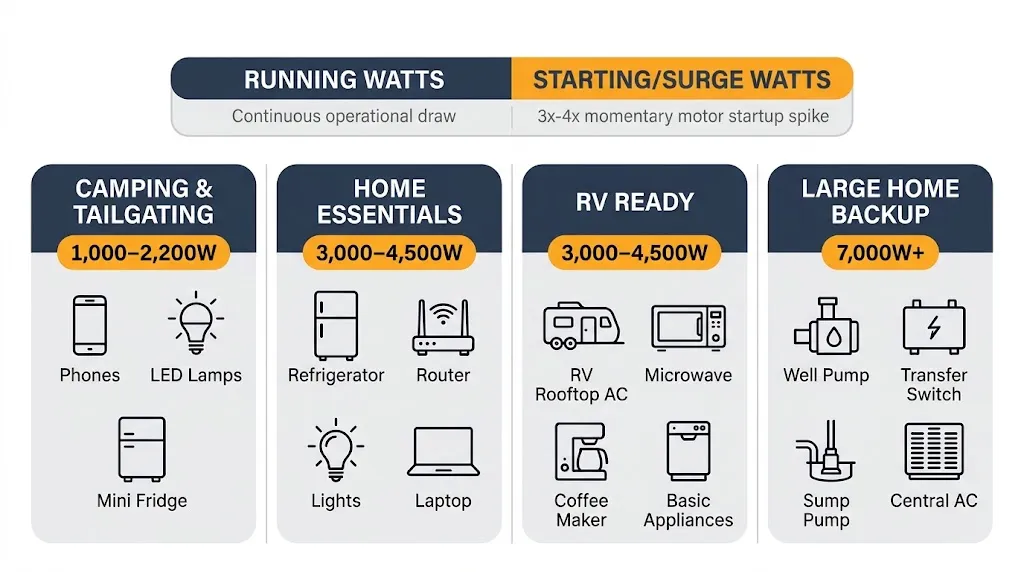
Size is about watts, and watts come in two kinds. Running watts are what an appliance uses while it runs. Starting watts, also called surge watts, are the short burst a motor needs to start. A fridge may run at 150 watts but need 600 watts for a second to start.
Add up running watts for everything you want to run at the same time. Then add the largest single starting wattage, not every starting wattage at once, unless two motors will start together. Leave headroom. A unit running flat out all night will be louder, hotter, and shorter-lived than one running at 70% to 80% of its rated output.
Here is a simple worked example. A fridge at 150 running watts, LED lights at 60 watts, phone chargers at 20 watts, and a laptop at 65 watts total 295 running watts. When the fridge motor starts, add its extra surge: 600 starting watts plus the other 145 watts gives a peak of 745 watts. A 1,000 to 2,000 watt inverter covers that with room to spare. Add a microwave at 1,000 watts, and the picture changes fast. That is why a must-run list, written before you shop, beats guessing.
For a fuller sizing walkthrough, see generator sizing for a power outage. If you are still choosing between types, the inverter portable generator buying guide covers the trade-offs in more buying detail.
| Typical use | What it usually covers | Rough size range to check |
|---|---|---|
| Camping and tailgating | Phones, lights, small fan, portable fridge | 1,000 to 2,200 watts |
| Home essentials | Fridge, lights, phones, router, small TV | 3,000 to 4,500 watts |
| RV use | RV fridge, lights, charging, sometimes a small air conditioner | 3,000 to 4,500 watts, with RV-ready outlets |
| Larger home backup | More circuits, well pump or furnace blower, larger loads | 7,000 watts and up, often 240-volt capable |
Those ranges are starting points, not guarantees. Your fridge, air conditioner, or well pump may need more starting watts than a typical chart shows. Read the label on each appliance. When in doubt, size up one step or plan to run large loads one at a time.
Can You Link Two Inverter Generators Together?
Yes, many inverter generators offer parallel capability. Parallel capability means you can connect two compatible units with a parallel kit or cable and combine their output. Two 2,200 watt units, for example, can power a larger load than either one alone.
This is useful when your needs grow. Start with one small, quiet unit for camping. Add a second later for home backup, instead of replacing the first unit outright. The catch is compatibility. Parallel units usually need to be the same brand and series, and sometimes the same model. Check the manual before you buy a second unit with this plan in mind.
For models built for this, see portable generators with parallel capability. If you are shopping for a home unit, an inverter generator for home backup with parallel capability gives you a growth path without jumping straight to a much larger machine.
What Can an Inverter Generator Run, and What Should You Avoid?
An inverter generator can run most household items, as long as the total watts fit and the voltage matches. Laptops, phones, routers, LED lights, TVs, fans, and small kitchen appliances are natural fits. So are CPAP machines, which is why many owners choose an inverter for medical-adjacent backup. For that specific use, see generators for a CPAP machine.
Watch three limits. First, total watts. Overloading trips the breaker or shuts the unit down, and repeated overloads can damage the inverter module. Second, voltage. Many small inverters supply 120 volts only. A 240-volt appliance, such as some well pumps, electric ranges, or large air conditioners, needs a 240-volt capable unit or a different setup. Third, starting surge. A motor that looks small on paper can need three to five times its running watts to start.
Do not plug in anything the manual forbids, and do not assume clean power fixes a wattage problem. Clean power protects electronics from distortion. It does not make a 2,000 watt generator into a 7,000 watt generator. For items that cause trouble on inverters, see what not to plug into an inverter.
Extension cords matter too. Use outdoor-rated cords in good condition, sized for the load and kept as short as practical. A long, thin cord can drop voltage and heat up. Plug the cord into a GFCI outlet, a ground-fault protected outlet, when the generator offers one, especially outdoors.
Is an Inverter Generator Safe to Use?
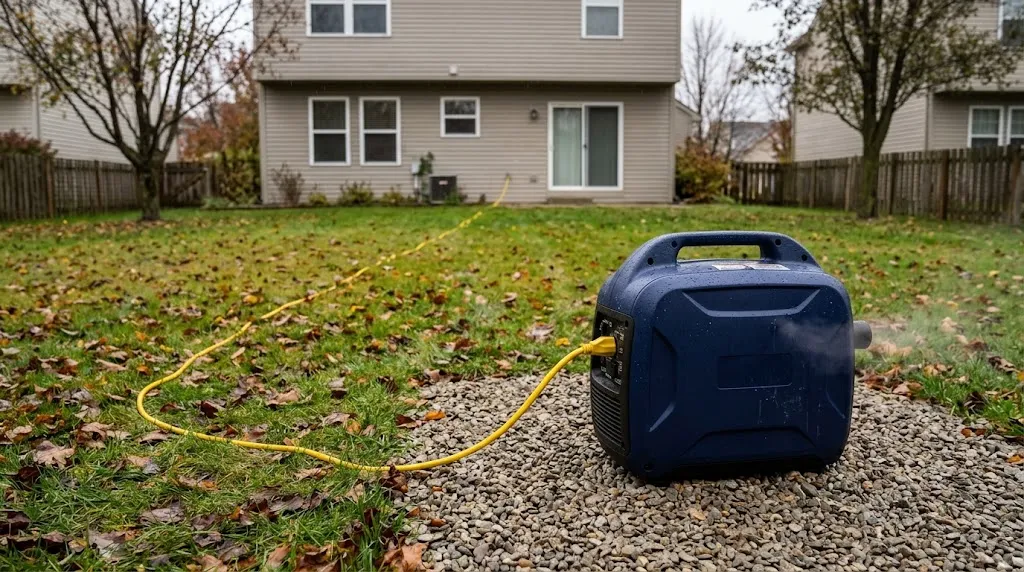
Safety first: An inverter generator still burns fuel and still makes carbon monoxide. Cleaner electricity does not mean cleaner exhaust.
Run it outdoors only, at least 20 feet from your home, with the exhaust pointed away from doors, windows, and vents. Never run it in a garage, basement, shed, or covered porch, even with doors open. Keep battery-powered carbon monoxide alarms inside the home.
Carbon monoxide, or CO, is colorless and odorless. You cannot rely on smell to warn you. A CO shutoff sensor, which stops the engine if CO builds up near the unit, adds a layer of protection, but it does not make indoor use safe. It is a backup, not a permission slip.
For models with that protection, see portable generators with CO shutoff. Check local code and your manual for placement rules in your area. The 20-foot rule is the common United States guidance, and your situation, such as wind direction or nearby buildings, may call for more distance.
Electrical safety matters just as much. Never backfeed your home by plugging a generator into a wall outlet. Backfeeding sends power back through your wiring and can energize utility lines, putting line workers and neighbors at risk. To power house circuits safely, use a transfer switch or an interlock kit installed by a licensed electrician, and follow local permit rules. A transfer switch is a device that safely switches selected circuits between utility power and generator power.
Refuel only when the engine is off and cool. Store fuel in approved containers, away from living spaces, and use fuel stabilizer if fuel will sit for months. Ethanol-free fuel lasts longer in storage than regular gasoline, but it still goes stale. Run the generator under load every month or two, so you find problems on a calm day, not during an outage.
Common Mistakes With Inverter Generators
- Buying on starting watts alone. A unit advertised at 4,500 starting watts may only supply 3,700 running watts. Plan on running watts.
- Ignoring surge. A fridge, freezer, sump pump, or air conditioner needs a burst to start. Size for that burst, plus your other running loads.
- Running it too close to the house. A quiet inverter tempts owners to tuck it near a door for a shorter cord. Keep the 20-foot distance and use a longer cord instead.
- Leaving fuel to go stale. Old fuel is a leading cause of hard starts. Stabilize it, rotate it, and exercise the unit.
- Covering a running unit. A storage cover is not a running cover. Trapped heat and exhaust are dangerous. Use a shelter designed for a running generator, with open airflow, or leave it uncovered in dry weather.
- Overloading with parallel hopes. Parallel capability helps only if the units are compatible and the kit is correct. It does not double every outlet rating.
When Is an Inverter Generator Not the Best Choice?
An inverter is not the answer for every home. If you need to power a whole house, including a 240-volt electric range, a large central air conditioner, and an electric water heater at the same time, a large conventional portable or a standby whole-house generator may fit better. Standby units start on their own, run on natural gas or propane, and can cover more circuits, though they cost more upfront and need professional installation.
Cost per watt is another gap. Small inverters are efficient, but large inverter power often costs more per watt than a conventional unit of the same size. If you rarely run electronics and mostly need raw power for tools, a conventional generator may give you more watts for the same budget.
Repair is a third point. Inverter electronics are more complex than a simple alternator and governor. A failed inverter module can be harder and more expensive to fix than a conventional fault. Buy from a brand with parts and service support you can actually reach, and keep the manual and warranty details with the unit.
None of that makes an inverter a bad choice. It makes it a specific choice: best when clean power, quiet running, fuel efficiency at partial loads, and portability matter more than maximum watts per dollar.
Conclusion
An inverter generator makes power, cleans it up through DC, and rebuilds it as stable AC, while letting its engine slow down when demand drops. That is why it runs quieter, sips fuel at light loads, and suits laptops, medical devices, and other sensitive gear.
Start with your must-run list, add the largest starting surge, and choose the smallest unit that covers it with headroom. If you take one thing from this guide, make it this: size for what you must run, then let clean power and quiet running do the rest. — Michael Turner
If you want quiet, clean power for home essentials, camping, or an RV, a small to mid-size inverter generator is a solid option like this, especially when you need to run electronics without the roar of a conventional open-frame unit.
Frequently Asked Questions
Is an inverter generator safe for laptops and sensitive electronics?
Yes, in most cases, because a quality inverter generator produces a pure sine wave with low THD, often under 3%. That power is close to, and sometimes cleaner than, wall outlet power. Check the published THD figure for your model, and do not overload the unit, since overload can still cause shutdowns or voltage problems.
Can an inverter generator power a whole house?
A small inverter cannot power a whole house at once. A larger inverter, or two units in parallel, can power selected essentials such as a fridge, lights, and chargers. Whole-house coverage, especially with 240-volt loads, usually needs a large portable or standby generator with a transfer switch installed by a licensed electrician.
Why is an inverter generator quieter than a regular generator?
An inverter generator can slow its engine at light loads because its electronics, not engine speed, set the output frequency. A conventional generator must hold full speed all the time to hold frequency. Less engine speed at light loads means less noise and less fuel use, though a large load will still make an inverter louder.
Do inverter generators use less fuel?
Yes, at partial loads, which is how most generators spend most of an outage. The engine idles down when demand is low instead of running flat out. At full load, the advantage shrinks. Compare runtime at the same load percentage, not just the headline runtime, to judge fuel use fairly.
Can I run an inverter generator in my garage with the door open?
No. Carbon monoxide can build up quickly in a garage, even with the door open, and it has no smell to warn you. Run the generator outdoors only, at least 20 feet from doors, windows, and vents, with the exhaust pointed away. A CO shutoff sensor is extra protection, not a reason to run a unit indoors.

Hi, I’m Michael Turner. I own a generator workshop in the United States and founded HomeGeneratorBlog to share practical, hands-on guidance about generator installation, maintenance, troubleshooting, safety, and backup power solutions. My goal is to help homeowners make smarter, more confident decisions through clear and reliable information