What Type of Generator Is Most Efficient? Complete Guide
Quick Answer
For most homeowners, an inverter portable generator is the most fuel-efficient type. Its engine can slow down when electricity demand drops, so it usually burns less gasoline than a conventional generator during light and changing loads.
Which generator is most efficient?
- Best overall: Inverter generators offer excellent fuel economy for typical home backup, camping, and RV loads.
- Heavy continuous loads: Diesel generators can be highly efficient when operated under substantial, steady loads.
- Fuel flexibility: Dual-fuel inverter generators combine variable-speed operation with gasoline or propane choices.
- Whole-house convenience: Natural-gas standby generators are convenient, but convenience does not automatically mean highest fuel efficiency.
- No engine fuel: Solar-charged portable power stations use no gasoline, although battery capacity limits runtime.
My simple rule
- For refrigerators, lights, electronics, camping, and modest backup loads, I would start with a properly sized inverter generator.
Generator efficiency sounds simple until you compare different sizes, fuels, and load levels. A generator that excels at 500 watts may not be the best choice for a 15,000-watt continuous load.
For most homeowners in 2026, inverter technology gives the best balance of fuel economy, quiet operation, and usable portable power.
What Does Generator Efficiency Actually Mean?
Generator efficiency is the amount of useful electrical energy you receive compared with the energy consumed to produce it. For homeowners, fuel economy is usually the more practical measurement.
In other words, you want more useful runtime and electricity from every gallon of fuel.
- Fuel consumption: How much gasoline, propane, diesel, or natural gas the generator burns.
- Load efficiency: How efficiently the generator operates at different electrical loads.
- Runtime: How long the generator operates before refueling.
- Electrical losses: Energy lost through the engine, alternator, inverter electronics, and heat.
- Right-sizing: Whether the generator’s capacity closely matches the equipment you actually power.
A large generator running one refrigerator may deliver poor fuel economy. A smaller inverter model operating comfortably within its capacity can make much better use of its fuel.
Which Type of Generator Is Most Fuel Efficient?
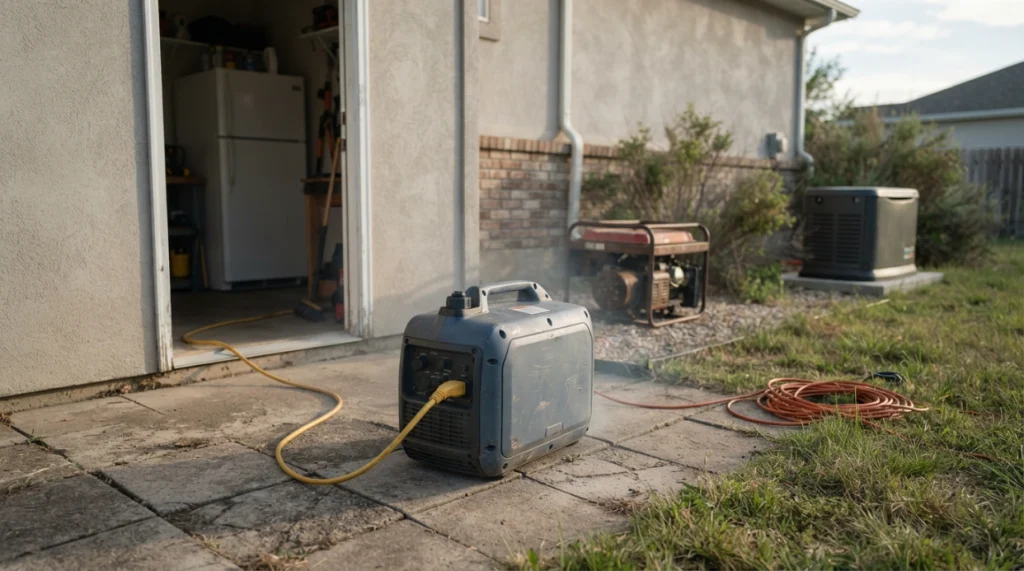
For typical portable residential use, an inverter generator is usually the most fuel-efficient choice. It has a major advantage when your electrical demand changes throughout the day.
Here is how the main generator types compare.
| Generator Type | Efficiency Behavior | Best Load Pattern | Best For |
|---|---|---|---|
| Inverter gasoline | High efficiency at light and changing loads because engine speed can vary | Light to moderate variable loads | Home essentials, RVs, camping, electronics |
| Conventional gasoline | Usually less efficient at low loads because engine speed stays relatively high | Moderate to heavy loads | Tools, larger emergency loads, lower purchase cost |
| Diesel | Excellent efficiency when carrying substantial sustained loads | Long-duration moderate to heavy loads | Commercial, industrial, large backup systems |
| Propane | Good storage characteristics, but typically consumes more fuel volume for equivalent energy | Emergency and intermittent use | Long-term fuel storage and dual-fuel setups |
| Natural-gas standby | Convenient continuous fuel supply, but not necessarily highest conversion efficiency | Automatic whole-house backup | Homes needing automatic outage protection |
Why Are Inverter Generators More Efficient?
Inverter generators can adjust engine speed as electrical demand changes. That difference matters most when you aren’t using the generator near full capacity.
Many small conventional 60 Hz generators depend on relatively constant engine speed to maintain output frequency. An inverter generator electronically controls the final AC output instead.
- Lower engine speed: The engine can slow when electricity demand decreases.
- Less unnecessary fuel: You aren’t constantly producing maximum mechanical power for a small load.
- Lower noise: Reduced engine speed usually means quieter light-load operation.
- Cleaner output: Inverter electronics provide stable electricity suitable for sensitive devices.
Honda explains that its Eco Throttle system changes engine speed according to load. Honda says the system can reduce fuel consumption by up to 40% compared with constant full-speed operation.
That figure is manufacturer-specific, so I wouldn’t apply 40% to every inverter generator. The underlying variable-speed advantage, however, is why inverter models perform well with changing household loads.
Is a Diesel Generator More Efficient Than an Inverter Generator?
Diesel can be more efficient when you need substantial power for long periods. An inverter gasoline generator still makes more sense for many smaller household loads.
The difference comes down to load and generator size, not just fuel type.
- Choose an inverter generator for changing loads, portable backup, electronics, camping, and modest household power.
- Consider diesel for high-output equipment running for many hours under meaningful load.
- Avoid oversizing either type because lightly loaded engines waste potential capacity.
Cummins’ generator guidance shows that large diesel sets achieve better fuel economy under higher loads than under very light loads. Its guidance identifies roughly 70% to 90% loading as an efficient operating region for the large systems discussed.
That doesn’t mean your small portable generator should always run at 90%. Every generator has its own fuel-consumption curve and recommended operating limits.
Does Generator Fuel Type Affect Efficiency?
Yes, but fuel type is only part of the equation. Engine design, load level, generator size, and operating speed can matter just as much.
Gasoline
Gasoline is widely available and works well in portable generators. A modern inverter design can stretch a relatively small fuel tank for many hours under light loads.
If you’re comparing standard gasoline models, this gasoline portable generator guide explains the other tradeoffs worth checking.
Propane
Propane stores much longer than gasoline and doesn’t create the same stale-fuel problems inside a carburetor. That’s valuable for a generator that spends months waiting for an outage.
However, propane contains less energy per unit of volume than gasoline. A generator may therefore consume more fuel volume while operating on propane.
Natural Gas
Natural gas is attractive because a permanently installed standby generator can use a utility fuel line. You don’t need to keep stopping during an outage to refill a portable tank.
Convenience and efficiency aren’t the same thing. Generac’s industrial fuel guidance notes that diesel generator sets can have higher overall efficiency than comparable natural-gas systems.
Solar and Battery Power Stations
A solar-charged portable power station burns no gasoline, propane, or diesel while operating. For phones, lights, laptops, and other small loads, that can make it extremely economical.
I don’t consider it a direct replacement for every engine generator. Battery capacity, charging conditions, inverter output, and appliance starting surges still limit what it can power.
Does Generator Size Affect Fuel Efficiency?
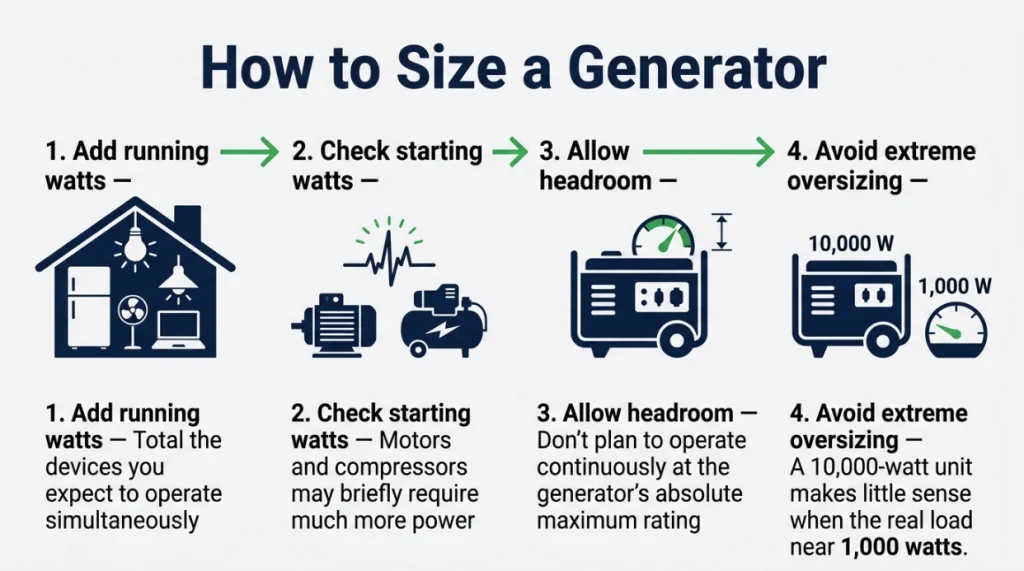
Yes. Buying far more generator than you need can waste fuel, money, and portability.
A large conventional generator still needs energy to keep its engine and alternator turning even when the electrical load is small.
- Add running watts: Total the devices you expect to operate simultaneously.
- Check starting watts: Motors and compressors may briefly require much more power.
- Allow headroom: Don’t plan to operate continuously at the generator’s absolute maximum rating.
- Avoid extreme oversizing: A 10,000-watt unit makes little sense when your real load stays near 1,000 watts.
Air conditioners demonstrate this perfectly because compressor startup creates a short surge. My generator sizing guide for air conditioners explains how to account for that startup demand.
How Can You Make a Generator Use Less Fuel?
You don’t need to replace your generator to improve efficiency. Load management and basic maintenance can reduce unnecessary fuel use.
- Use economy mode: Enable it when your inverter generator’s manual allows it.
- Turn off unnecessary loads: Don’t spend fuel heating water or powering equipment you aren’t using.
- Avoid oversizing: Match generator output reasonably closely to expected demand.
- Keep the air filter clean: Restricted airflow can hurt engine performance.
- Maintain the spark plug: Follow the manufacturer’s inspection and replacement schedule.
- Use fresh fuel: Old gasoline can cause poor running and carburetor problems.
- Service the generator: Follow the oil and maintenance intervals listed in the owner’s manual.
Efficiency also matters over the generator’s entire life. Proper care can prevent the performance problems covered in my portable generator lifespan guide.
What Efficient Generator Would I Choose?
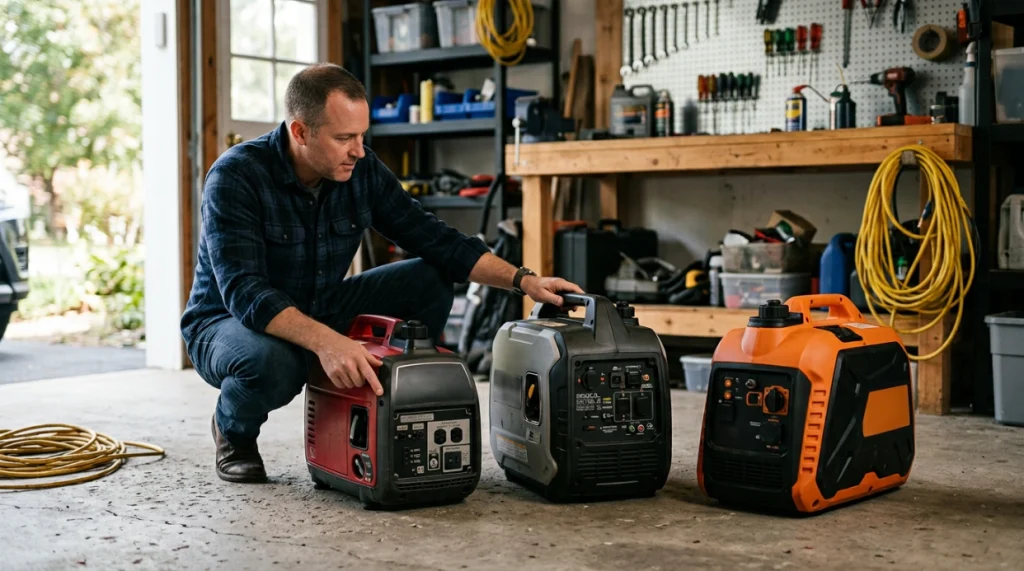
If fuel economy is the priority, I’d focus on inverter models with economy modes and enough output for the intended load. These three illustrate useful approaches.
🏆 Best Overall
Honda EU2200i
★★★★½ 4.8/5
The EU2200i provides 1,800 rated watts and 2,200 maximum watts. Honda lists up to 8.1 hours of runtime at quarter load from its 0.95-gallon tank, making it my efficiency-focused pick for smaller backup loads.
⛽ Best Dual Fuel
Champion 201183 2500W Dual Fuel Inverter
★★★★½ 4.7/5
This model provides 2,500 starting watts and 1,850 gasoline running watts. Champion lists up to 11.5 hours at 25% load on gasoline, plus propane capability and a CO Shield automatic shutoff system.
⚡ Best Higher Running Output
Generac GP2500i
★★★★½ 4.6/5
The GP2500i offers 2,500 starting watts and 2,200 running watts from a compact inverter platform. Generac lists an 8-hour runtime at 25% load, a 1-gallon tank, Economy Mode, and COsense protection.
Frequently Asked Questions
Are inverter generators more fuel efficient than regular generators?
Usually, yes, especially at light or changing loads. An inverter generator can reduce engine speed when demand drops, while many conventional generators maintain a much more constant engine speed to keep output frequency stable.
Is diesel more efficient than gasoline for generators?
Diesel engines can be highly fuel-efficient under steady, substantial loads, particularly in larger generator sets. For small, intermittent household loads, a gasoline inverter generator may still use fuel more practically because its engine speed can follow demand.
Does a bigger generator use more fuel?
Generally, a larger engine requires more fuel to operate, although actual consumption depends heavily on load and generator design. Oversizing is especially wasteful when a large conventional generator spends most of its time powering only a small load.
What is the most economical generator for home use?
A properly sized inverter generator is usually the most economical fuel-powered option for refrigerators, lights, electronics, fans, and similar essentials. Whole-house loads may justify a larger inverter, diesel system, or automatic standby generator depending on outage frequency and fuel availability.
Is a solar generator more efficient than a gasoline generator?
A solar-charged power station uses no engine fuel during operation, which can make it economical for small electrical loads. However, battery storage and solar charging limits make it different from a fuel generator designed to supply large loads continuously.
Final Takeaway
If you want the most efficient generator for normal portable home use, start with a right-sized inverter generator. Its ability to reduce engine speed under lighter loads gives it a major advantage over conventional portable designs.
Diesel deserves consideration for long, heavy-duty operation, while propane and natural gas offer different storage and convenience benefits. Match the generator to your actual load before comparing fuel types.
Whatever model you choose, operate fuel-powered portable generators outdoors. The U.S. Consumer Product Safety Commission warns that generator exhaust contains deadly carbon monoxide.
The CDC recommends keeping portable generators outdoors more than 20 feet from windows, doors, and vents. Fuel savings never matter more than safe generator placement.

Hi, I’m Michael Turner. I own a generator workshop in the United States and founded HomeGeneratorBlog to share practical, hands-on guidance about generator installation, maintenance, troubleshooting, safety, and backup power solutions. My goal is to help homeowners make smarter, more confident decisions through clear and reliable information