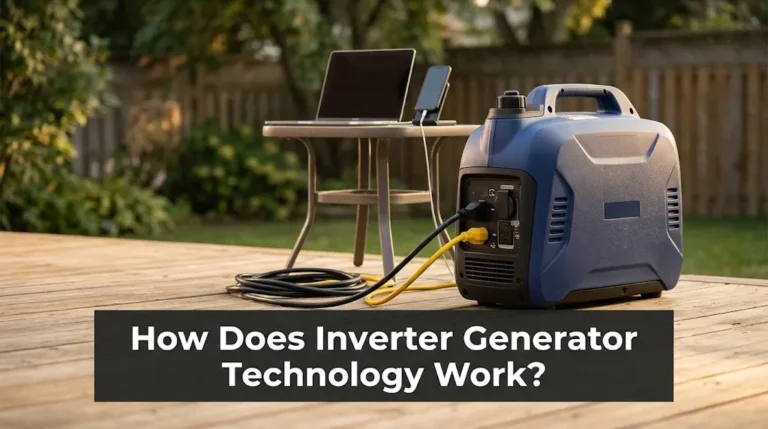
How Does an Inverter Generator Generate Electricity?
Quick Answer: An inverter generator generates electricity in three stages. A small fuel engine spins an alternator to make raw AC power, a rectifier converts that raw AC into DC power, and an inverter module converts the DC back into clean, stable AC power at 120 volts and 60 hertz. A microprocessor controls the whole process and adjusts engine speed to match the load.
The Short Version: Fuel In, Clean AC Out
Every generator starts the same way. Fuel burns, an engine spins, and spinning metal inside an alternator makes electricity.
An inverter generator adds a detour in the middle. It does not send that first, rough electricity straight to your outlets. It cleans it up first.
Think of it like this. A conventional generator hands you the first draft. An inverter generator edits it, then hands you the finished copy. Same fuel, same basic idea, very different quality at the plug.
That extra step is the whole point of the design. It is why inverter generators can run laptops, phones, CPAP machines, and modern fridges without the voltage swings that damage sensitive electronics.
How an Inverter Generator Generates Electricity, Step by Step
The process looks complicated on a diagram. In real life, it happens in a fraction of a second, over and over, as long as the engine runs.
Step 1: The engine burns fuel and creates motion
Gasoline, propane, or in some dual-fuel models either fuel, feeds a small internal combustion engine. The engine burns that fuel and turns a crankshaft. That spinning shaft is mechanical energy.
Nothing electrical has happened yet. This is just controlled burning turned into rotation, the same principle that has powered portable generators for decades.
Fuel choice changes runtime and storage, not the basic electrical path. A dual fuel inverter generator still follows the same AC to DC to AC sequence whether it runs on gasoline or propane.
Step 2: The alternator turns motion into raw AC power
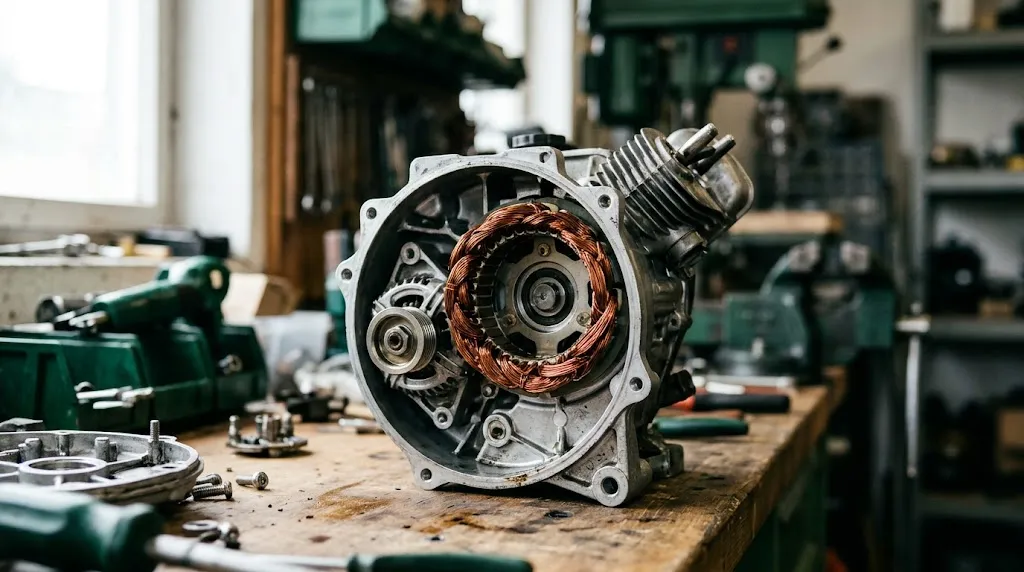
The engine shaft spins the alternator. Inside the alternator, magnets rotate past copper windings. That movement creates alternating current, or AC power.
AC power flows back and forth, reversing direction many times per second. In the United States, household AC reverses 60 times per second. That is the 60 hertz figure you see on generator specs.
At this stage, the power is rough. Voltage rises and falls with engine speed. Frequency wobbles when a load kicks on or off. If you plugged a laptop straight into this raw output, it would get a messy, uneven supply.
Most inverter generators use a compact, high-frequency alternator rather than the large, heavy alternator in an open-frame generator. It can spin faster and make power at a higher frequency, which the electronics then reshape. That is one reason inverter models are smaller and lighter for the same usable output.
Step 3: The rectifier converts raw AC into DC power
Instead of going to the outlets, the raw AC goes to a rectifier. A rectifier is a set of electronic components that only lets current flow in one direction.
The rectifier converts AC power into DC power. DC power flows in one direction only, like the power from a battery. It is easier to control and smooth than raw AC.
Capacitors in this stage help flatten out dips and spikes. The result is not perfect yet, but it is a much steadier base for the next step.
This is the step most people miss when they describe inverter generators. They say the inverter makes the power. In fact, the rectifier has to prepare it first. Without that DC middle stage, the inverter would have nothing clean to rebuild from.
Step 4: The inverter rebuilds clean AC power
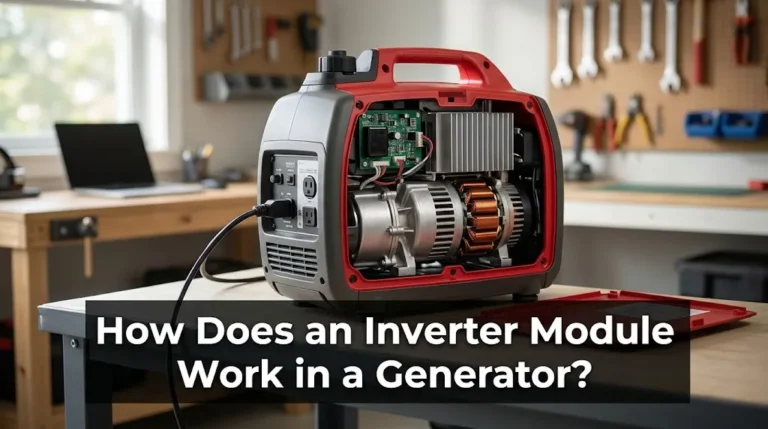
Now the inverter module takes over. It takes the DC power and switches it on and off thousands of times per second, using transistors controlled by a microprocessor.
That rapid switching, called pulse-width modulation, builds a new AC waveform piece by piece. Filters then smooth those pulses into a pure sine wave. A pure sine wave is a smooth, regular curve, the same shape as power from the utility grid.
The output is typically 120 volts at 60 hertz in the United States, held steady even when the engine speed changes. Voltage stays within a tight range. Frequency stays close to 60 hertz.
Honda describes this same sequence on its own inverter generator page: AC to DC, then back to AC, with a microprocessor controlling engine speed and smoothing the output. You can read their explanation in Honda’s guide to what an inverter generator is.
Step 5: The microprocessor matches engine speed to the load
Here is where an inverter generator really separates itself from a conventional model.
A conventional generator must hold its engine at about 3,600 RPM all the time to hold 60 hertz. Load or no load, it roars at full speed. An inverter generator does not have that constraint. The inverter, not the engine speed, sets the output frequency.
So the microprocessor watches how much power you are actually using and tells the engine to speed up or slow down. Phone charger only? The engine idles down, quieter and thirstier for less fuel. Fridge compressor kicks on? The engine throttles up in a second or two.
The first time I ran a 2,200-watt inverter unit through a long evening outage, the thing I did not expect was how often it went quiet. With just a few LED lights and a phone charging, it dropped to a low hum I could talk over. Then the fridge cycled on, the note rose for a minute, and it settled again. That rise and fall is the microprocessor doing its job.
What Each Part Actually Does
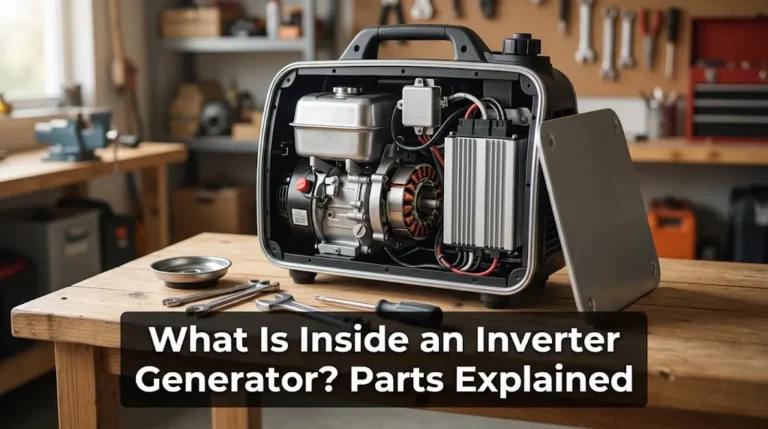
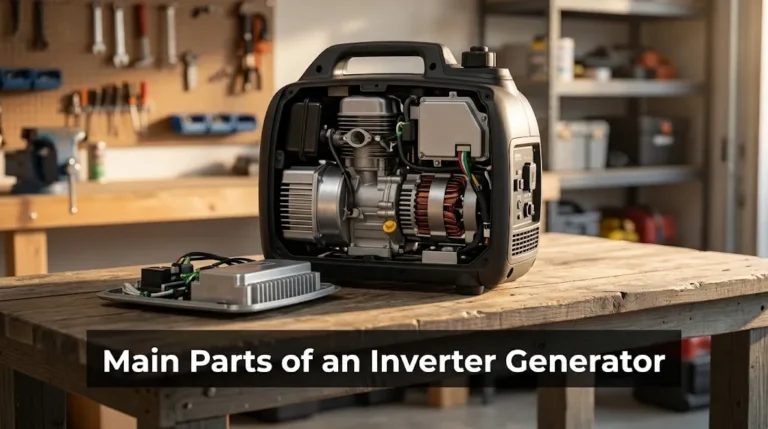
If you open up the process, five parts do almost all the work. Each one has a distinct job, and a failure in any one of them shows up differently at the outlet.
| Part | What It Does | Why It Matters to You |
|---|---|---|
| Engine | Burns fuel and spins the alternator | Sets fuel use, noise, runtime, and maintenance needs |
| Alternator | Turns mechanical motion into raw AC power | Sets the maximum power the unit can make |
| Rectifier | Converts raw AC into DC power | Prepares a steadier base for the inverter |
| Inverter module | Converts DC back into clean, stable AC power | Makes the power safe for sensitive electronics |
| Microprocessor / control board | Monitors load, voltage, and frequency and adjusts throttle | Keeps output steady and saves fuel at light loads |
Outlets, breakers, and overload protection sit after the inverter. They do not make power. They deliver it safely and shut it down if you ask for more than the unit can give.
Why the AC-DC-AC Detour Matters
It seems wasteful to convert power twice. Why not just use the AC straight from the alternator?
Because raw alternator power is tied to engine speed. Change the speed, change the frequency. Change the load suddenly, change the voltage. A conventional generator fights that with a mechanical governor and a heavy flywheel, and it still wobbles.
The AC-DC-AC detour breaks that link. The alternator can spin at whatever speed the load needs. The inverter rebuilds the output at a fixed 120 volts and 60 hertz regardless.
That separation is the core idea. Everything else, quiet operation, fuel savings, clean power, follows from it.
What is a pure sine wave, and why does it matter?
A pure sine wave is a smooth, repeating curve. Utility power looks like that. Most household appliances were designed for it.
A modified sine wave, by contrast, is a stepped, blocky approximation. Some simple tools and heaters tolerate it. Many modern devices do not. Their power supplies, chargers, and control boards expect a smooth wave and can overheat, buzz, or fail on a rough one.
An inverter generator produces a pure sine wave output. That is why it is the usual recommendation for laptops, phones, televisions, CPAP machines, and fridges with electronic controls.
Learn what not to connect before you plug anything in. Our guide to what not to plug into an inverter covers the loads that still cause trouble even on clean power.
What is THD, and what is a good number?
THD stands for total harmonic distortion. It measures how far the output waveform strays from a perfect sine wave. Lower is cleaner.
Many inverter generators list THD under 3 percent. Some list under 5 percent. Conventional open-frame generators often run much higher, sometimes 10 percent or more, with noticeable voltage fluctuation.
For most sensitive electronics, under 5 percent THD is a useful target, and under 3 percent is better. Check the spec sheet for the exact model you own, because the number varies by brand and size. Do not assume every inverter generator hits the same figure.
THD is not the only quality measure. Voltage regulation matters too. A good inverter generator holds voltage within a few percent of 120 volts even when a motor starts. That steady voltage is what keeps a fridge compressor and a laptop charger happy at the same time.
Inverter vs Conventional Generator: Same Fuel, Different Power
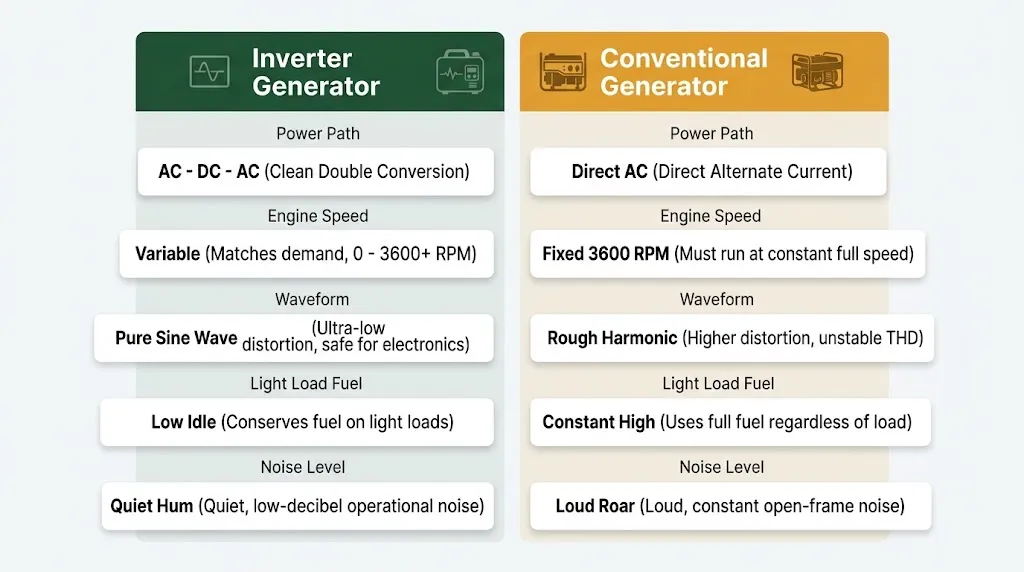
Both types burn fuel and spin an alternator. The difference is what happens after the alternator.
| Feature | Inverter Generator | Conventional Generator |
|---|---|---|
| Power path | AC to DC to clean AC | AC straight to outlets |
| Engine speed | Varies with load | Fixed, about 3,600 RPM |
| Output waveform | Pure sine wave, low THD | Rougher, higher THD |
| Fuel use at light load | Lower, engine slows down | Higher, engine stays at full speed |
| Noise | Quieter, especially at light load | Louder, constant engine note |
| Size and weight | Smaller and lighter for the same usable watts | Larger and heavier |
| Best for | Sensitive electronics, camping, RVs, home essentials | High-wattage tools, construction, whole-home backup |
Neither type is better in every situation. A conventional generator can be the right call for a job site where you need a lot of raw watts for a circular saw and nothing sensitive is plugged in. An inverter generator is the right call when the load includes electronics that need stable voltage and frequency.
If you are still deciding which type fits your home, read our inverter portable generator buying guide before you buy. It walks through sizing, fuel type, and noise in plain terms.
Why the Engine Speed Changes, and Why That Saves Fuel
Eco mode, sometimes called smart throttle or economy mode, is not a separate generator. It is a setting that lets the microprocessor slow the engine when the load is light.
With eco mode on, a small load means a slow engine. A large load means a fast engine. The inverter keeps the output at 120 volts and 60 hertz either way.
That matters for two practical reasons. First, fuel. An engine idling at low speed burns less gasoline per hour than one held at 3,600 RPM. Second, noise. A slower engine is quieter, which matters at a campsite, in an RV park, or outside a bedroom window at night.
There is a trade-off. When a big motor starts, the engine needs a moment to spool up. Most inverter generators handle that surge, but if you run eco mode with a fridge or air conditioner that cycles on and off, you may notice a brief dip or a delay. If a load keeps tripping the overload light in eco mode, turn eco mode off and let the engine run faster. The power stays cleaner under a sudden surge when the engine is already spinning up.
A Real Example: What Happens When You Plug In a Fridge
Numbers make this concrete. Take a 2,200-watt inverter generator running a modern fridge, a few LED lights, and a phone charger.
At rest, the fridge draws about 150 running watts. The lights draw 30 watts. The charger draws 10 watts. Total load is about 190 watts, well under 10 percent of the generator’s rated output. The engine idles low. Fuel use is minimal. Noise is low.
Then the fridge compressor starts. For a second or two, it needs starting watts, often 600 to 800 watts for a standard fridge. The microprocessor senses the surge, the engine throttles up, the inverter holds voltage steady, and the compressor starts. Once it is running, the load drops back to about 150 watts and the engine slows again.
Now add a microwave at 1,000 watts. Total running load jumps to about 1,180 watts, over half the generator’s rated output. The engine runs faster and louder. Fuel use rises. That is normal. The inverter is still holding 120 volts and 60 hertz, but the engine has to work harder to feed it.
This is also why running watts and starting watts are different numbers, and why you should add them up before you buy. Our guide to portable generator AC power output explains how those watts add up at the outlet.
What an Inverter Generator Can and Cannot Power Well
Clean power does not mean unlimited power. An inverter generator still has a rated wattage, and it still has a starting wattage limit.
It powers well: laptops, phones, tablets, televisions, LED lights, CPAP machines, modern fridges and freezers, fans, routers, and small kitchen appliances, as long as total watts stay within the rated output.
It struggles with: large air conditioners, electric water heaters, electric furnaces, well pumps, and other high-starting-watt motors, unless the generator is large enough or two units are paralleled. Those loads need a bigger generator, a soft-start device, or a different backup plan.
Parallel capability helps here. Many inverter generators can be linked together with a parallel kit to double the available watts. The two inverters sync their output so they act as one larger source. Check your model’s manual first. Not every inverter generator supports paralleling, and the two units usually need to be the same or compatible models.
A 2000 watt quiet inverter generator is a common starting point for camping and light home backup, but it will not run a whole house. Size the generator to the loads you actually need, not to the biggest number on the box.
Does an Inverter Generator Make Electricity Differently on Gasoline vs Propane?
No. The electrical path is the same. Gasoline and propane both burn in the engine, the engine spins the alternator, the rectifier makes DC, and the inverter rebuilds clean AC.
What changes is the engine side. Propane usually produces slightly less maximum power than gasoline on the same dual-fuel model, often about 10 percent less. It also burns cleaner, stores longer without going stale, and starts easier in cold weather. Gasoline usually gives you the full rated watts and is easier to find at a gas station during an outage.
Fuel does not change THD or waveform quality in a meaningful way. A dual-fuel inverter generator makes clean power on either fuel, as long as it is running within its rated load.
If you plan to run on propane for long outages, check the runtime per tank in the manual and keep a spare tank. A 20-pound propane tank holds less energy than a full gasoline tank on many small models, so runtime per tank can be shorter even though the power is just as clean.
Signs the Power Is Not Clean, or the Generator Is Overloaded
An inverter generator should hold voltage steady. When it cannot, it tells you.
Watch for these signs. Lights flicker or dim when a motor starts and do not recover quickly. The overload light comes on, or the generator shuts down its outlets. The engine surges up and down repeatedly, even with a steady load. A laptop charger buzzes, a TV flickers, or a fridge compressor struggles to start.
Most of those signs point to overload, not to a bad inverter. Unplug the largest load first, let the engine settle, then add loads back one at a time. Check the rated watts and starting watts for each appliance and add them up.
If the problem happens with a light load, check the basics first. Old fuel, a clogged air filter, a dirty spark plug, or low oil can all make the engine run rough. A rough engine makes rough raw power, and even a good inverter has to work harder to clean it up.
Stop and call a pro if you smell burning, see smoke, hear grinding, or find damaged cords or outlets. Do not open the inverter module yourself. It contains capacitors that can hold a charge after the engine stops, and the electronics are not a homeowner repair.
Safety: Clean Power Does Not Mean Safe Placement
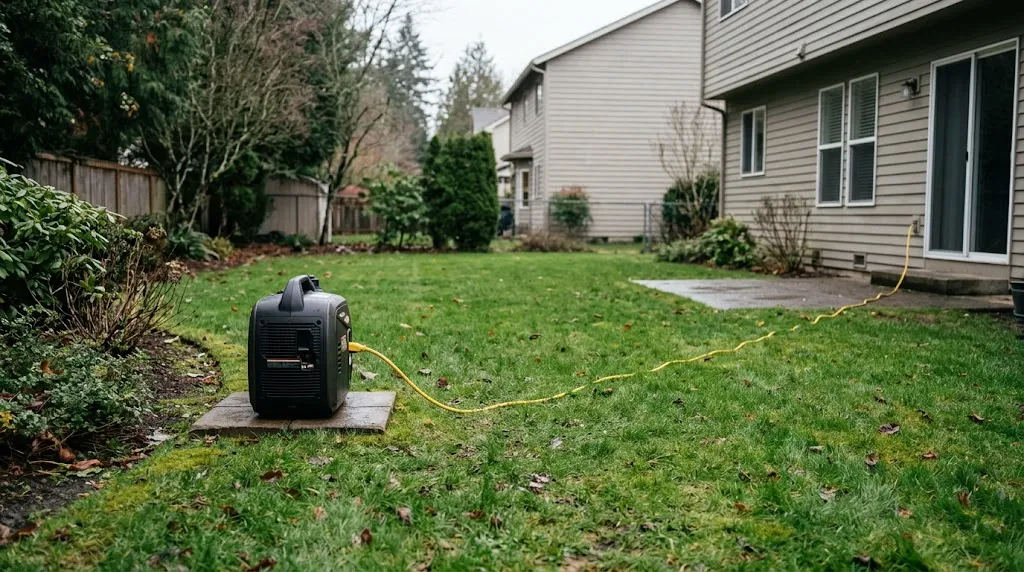
Safety note: An inverter generator still burns fuel and still makes carbon monoxide (CO). CO is colorless and odorless, and it can kill quickly in an enclosed space.
Run any fuel generator outdoors only, at least 20 feet from windows, doors, and vents, with the exhaust pointed away from the house. Use a battery-powered or battery-backup CO detector in your home while the generator runs. The CDC gives the same 20-foot rule in its power outage safety guidance. Never run a generator in a garage, basement, or carport, even with the door open.
Clean power also does not mean you can backfeed your house. Never plug a generator into a wall outlet to power your home wiring. That can energize lines outside your house and injure utility workers. Use extension cords for individual appliances, or have a licensed electrician install a manual transfer switch or interlock kit. Check local code before you connect a generator to house wiring.
Grounding is another point people skip. Follow the manual for your model. Some portable inverter generators are designed to be used without a separate grounding rod when powering cord-connected appliances. Others need one when connected to a transfer switch. The manual, not a forum post, is the authority for your unit.
Conclusion
An inverter generator generates electricity by turning fuel into motion, motion into raw AC, raw AC into DC, and DC back into clean, stable AC. The microprocessor ties it together, adjusting engine speed to the load while the inverter holds voltage and frequency steady.
That extra conversion is why the power is clean enough for sensitive electronics, quieter at light loads, and more fuel-efficient than a conventional generator running at full speed all day. Size it to your real loads, run it outdoors at least 20 feet from the house, and it will do the job it was designed for. I am Michael Turner, and that steady, quiet power is why I reach for an inverter generator first when the lights go out.
If you want that clean, stable power for a fridge, laptop, and lights during the next outage, a quiet inverter generator is the practical place to start. It gives you the AC-DC-AC cleanup described above without the constant roar of a conventional unit.
Frequently Asked Questions
How does an inverter generator generate electricity?
An inverter generator generates electricity in three stages. A fuel engine spins an alternator to make raw AC power, a rectifier converts that AC into DC power, and an inverter module converts the DC back into clean, stable AC power at 120 volts and 60 hertz. A microprocessor controls engine speed and output throughout the process.
Does an inverter generator produce AC or DC power?
It produces both inside the unit, but it delivers AC power at the outlets. The alternator makes AC, the rectifier changes it to DC for cleaning and control, and the inverter changes it back to AC. The AC you use is a rebuilt, pure sine wave version, not the raw AC from the alternator.
Why does an inverter generator convert AC to DC and back to AC?
The conversion breaks the link between engine speed and output frequency. That lets the engine slow down at light loads while the inverter still holds output at 120 volts and 60 hertz. It also lets the electronics reshape the waveform into a clean pure sine wave with low total harmonic distortion.
Is inverter generator power safe for laptops and sensitive electronics?
Yes, in most cases, when the generator is sized correctly and the load stays within its rated watts. Inverter generators typically produce pure sine wave power with THD under 3 to 5 percent, which suits laptops, phones, televisions, CPAP machines, and modern fridges. Check the THD rating for your exact model and do not overload it.
Can an inverter generator run a refrigerator and a microwave at the same time?
It depends on the size. A 2,200-watt inverter generator can usually run a modern fridge at about 150 running watts plus a few small loads, but adding a 1,000-watt microwave pushes the total over half its rated output and may exceed it when the fridge compressor starts. Add running watts and starting watts for both appliances first, and size up or run them one at a time if the total is too close to the limit.

Hi, I’m Michael Turner. I own a generator workshop in the United States and founded HomeGeneratorBlog to share practical, hands-on guidance about generator installation, maintenance, troubleshooting, safety, and backup power solutions. My goal is to help homeowners make smarter, more confident decisions through clear and reliable information