How Does an Inverter Module Work in a Generator?
An inverter module takes rough power from a generator alternator, converts it to direct current (DC), then rebuilds it as clean, stable 120-volt alternating current (AC) at 60 hertz. A microprocessor controls that rebuild thousands of times per second, so voltage and frequency stay steady even when the engine slows down.
What Is an Inverter Module, in Plain English?
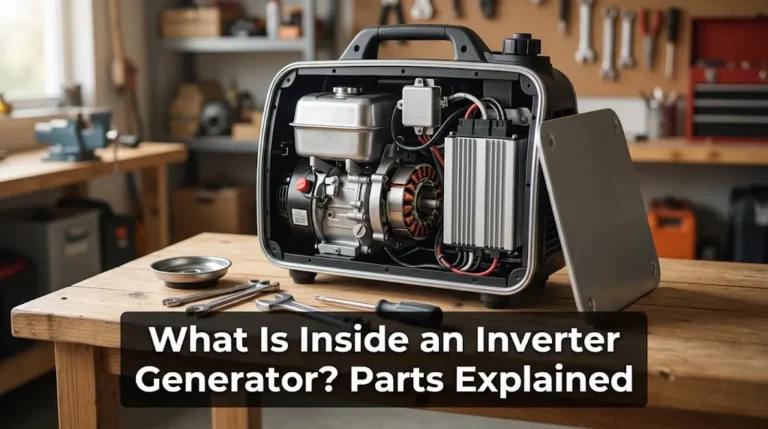
An inverter module is the electronic brain and power-switching heart inside an inverter generator. It is not the engine. It is not the alternator. It sits between the alternator and the outlets, and it decides what the electricity looks like before it reaches your fridge, laptop, or phone charger.
Think of a conventional generator as a hose with no nozzle. Water comes out, but the pressure jumps around. The inverter module is the nozzle and the pressure regulator combined. It takes a messy flow and shapes it into something steady and usable.
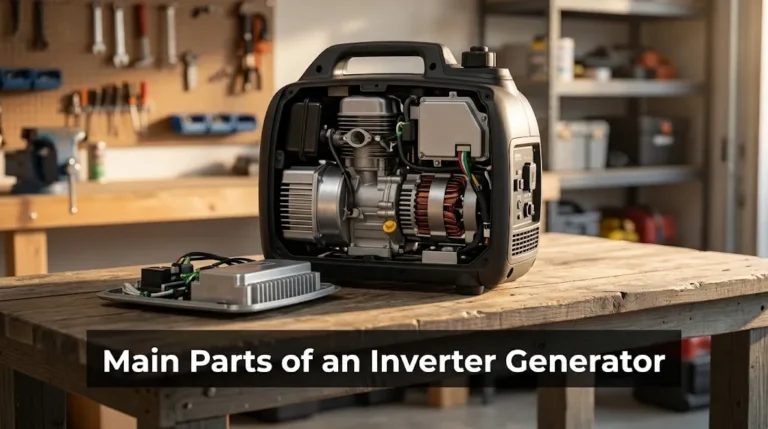
Most modules are a sealed circuit board with a heat sink, a rectifier, capacitors, switching transistors, a filter, and a small microprocessor. You will not see most of those parts. On many models the board is coated in resin. That sealing keeps out dust and vibration, but it also means a failed module is usually replaced, not repaired at home.
If you are still choosing a unit, start with the basics in this inverter portable generator buying guide before you worry about the electronics inside it. The module matters most when you plan to run sensitive gear.
The Short Version: AC to DC to Clean AC
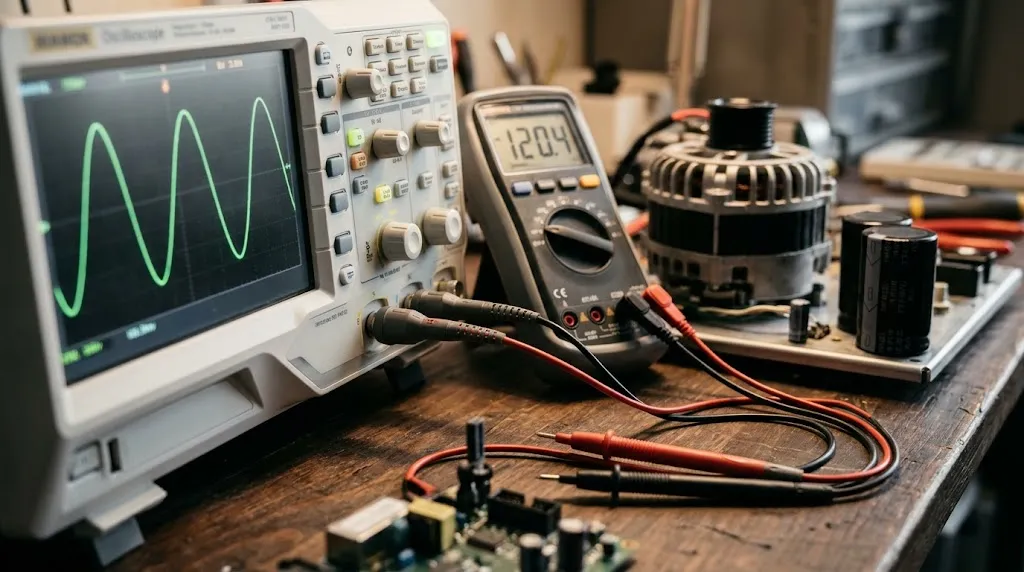
Every inverter generator follows the same three-step path. The names change by brand. The path does not.
| Step | What Happens | What Comes Out |
|---|---|---|
| 1. Raw AC | Engine spins the alternator | High-frequency, rough AC |
| 2. Rectified DC | Rectifier and capacitors smooth it | Steady DC, about 180 to 200 volts |
| 3. Clean AC | Inverter switches rebuild the wave | 120-volt, 60-hertz pure sine wave |
That middle step is the trick. Once power is DC, engine speed no longer sets the output frequency. The module can rebuild 60-hertz AC whether the engine is idling or working hard. A conventional generator cannot do that. It must hold about 3,600 RPM to hold 60 hertz, even when you are only charging a phone.
Stage 1: The Alternator Makes Raw, Rough AC
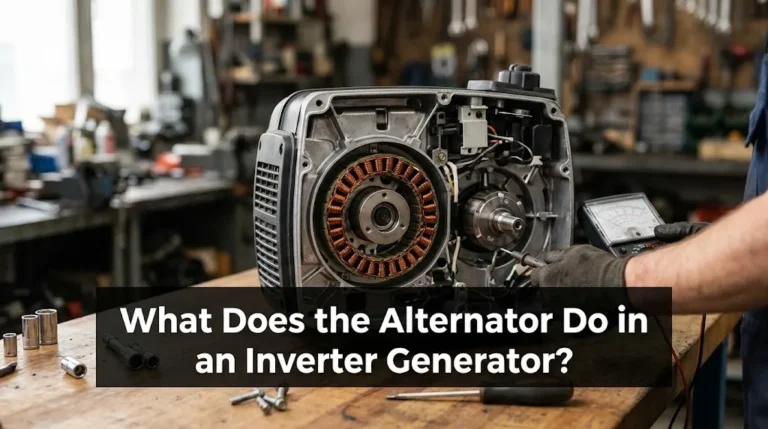
The engine burns gasoline or propane and spins a compact alternator. Inside that alternator, permanent magnets spin past copper windings. That motion makes electricity.
In an inverter generator, the alternator is different from the one in an open-frame unit. It is usually a multi-pole, three-phase design. It makes higher-frequency AC, often well above the 60 hertz your house uses. Voltage and frequency rise and fall with engine speed.
That raw power is useless on its own for a laptop. It is too rough, too variable, and too noisy electrically. So the generator does not send it to the outlets. It sends it straight to the inverter module.
One detail worth knowing: the alternator in most inverter models has no brushes to wear out. Fewer moving electrical contacts means less maintenance and less electrical noise at the source. The module still has to clean the power, but it starts from a better place.
Stage 2: The Rectifier and DC Bus Turn It Into DC
The first part of the module is the rectifier. A rectifier is a set of diodes that act like one-way valves for electricity. AC flows back and forth. Diodes let current through in one direction only. The result is DC, current that flows one way.
That DC is still lumpy. It pulses. So it flows into the DC bus, a section with large capacitors. A capacitor is a short-term storage device. It charges up when voltage peaks and releases energy when voltage dips. Together, the capacitors flatten the pulses into a steadier DC supply.
Think of it as a water tank after a pump. The pump surges. The tank holds water and lets it out at a steady pressure. The DC bus does the same job for electricity.
This stage also isolates the engine from the outlets. A sudden load change, like a fridge compressor starting, hits the DC bus first. The capacitors absorb part of that shock. The microprocessor sees the dip and tells the engine to speed up, but the outlets do not see the raw jolt.
What the Capacitors Actually Do
Capacitors do three jobs here. They smooth ripple, they store a small reserve for short surges, and they help filter electrical noise. If they age or overheat, the DC supply gets rougher. The output wave gets rougher too. That is one reason heat is the enemy of an inverter module.
Good airflow matters more than most owners realise. A blocked vent or a generator pushed against a wall can raise the temperature inside the enclosure. The module has a heat sink and often a fan, but it cannot cool itself if hot air has nowhere to go.
Stage 3: The Inverter Switches DC Back Into a Pure Sine Wave
This is the stage the module is named for. The inverter takes steady DC and chops it back into AC. It does not spin anything. It switches.
Inside are power transistors, usually MOSFETs on smaller units and IGBTs on larger ones. A transistor here works like a very fast light switch. It is either fully on or fully off. It flips on and off thousands of times per second.
By flipping at the right moments, the transistors build a wave that rises, peaks, falls, crosses zero, and repeats in the opposite direction. Done well, that wave looks almost identical to the smooth sine wave from a wall outlet. Done badly, it looks stepped and jagged.
After the switching stage, the power passes through an LC filter, a coil and capacitor pair that rounds off the sharp edges left by switching. The filter is what turns a clever approximation into a clean sine wave your electronics can trust.
The first time I ran a 2,200-watt inverter unit through a long outage, the thing I did not expect was how quiet the change felt. No flicker on the lights when the fridge kicked in. The laptop charger stayed cool. That steadiness was the module doing its job, not the engine.
How PWM Builds the Wave
PWM stands for pulse width modulation. It is the timing trick behind the rebuild.
Picture a series of short DC pulses. Near the start of a wave cycle, the pulses are narrow. Near the peak, they get wider. Near the end, they narrow again. The filter averages those pulses. Wide pulses average to high voltage. Narrow pulses average to low voltage. The result is a smooth curve.
The microprocessor sets the width of every pulse. It can adjust the timing in microseconds. That speed is why the module can hold 120 volts and 60 hertz so tightly, even as load changes.
A pure sine wave inverter uses PWM to approximate a sine wave closely. A modified sine wave inverter uses fewer, cruder steps. Most inverter generators sold for home and RV use today are pure sine wave. Check the spec sheet if you are unsure. It matters for motors, chargers, and audio gear.
MOSFETs and IGBTs: The Switches Doing the Work
MOSFETs are fast and efficient at lower power. IGBTs handle higher current and higher voltage better. A 2,000-watt portable unit will usually use MOSFETs. A 7,000-watt inverter unit may use IGBTs.
Either way, the switches are the hardest-working parts in the module. They switch, they heat up, and they carry the full load current. Overload them for long, and heat builds faster than the heat sink can shed it. That is why an overload light is not a suggestion. It is the module telling you it is protecting itself.
Efficiency is typically 90 to 95 percent through the inverter stage. The other 5 to 10 percent becomes heat. On a 2,000-watt load, that is 100 to 200 watts of heat to move away from a board the size of a paperback. Cooling design matters.
How the Microprocessor Keeps Voltage and Frequency Steady
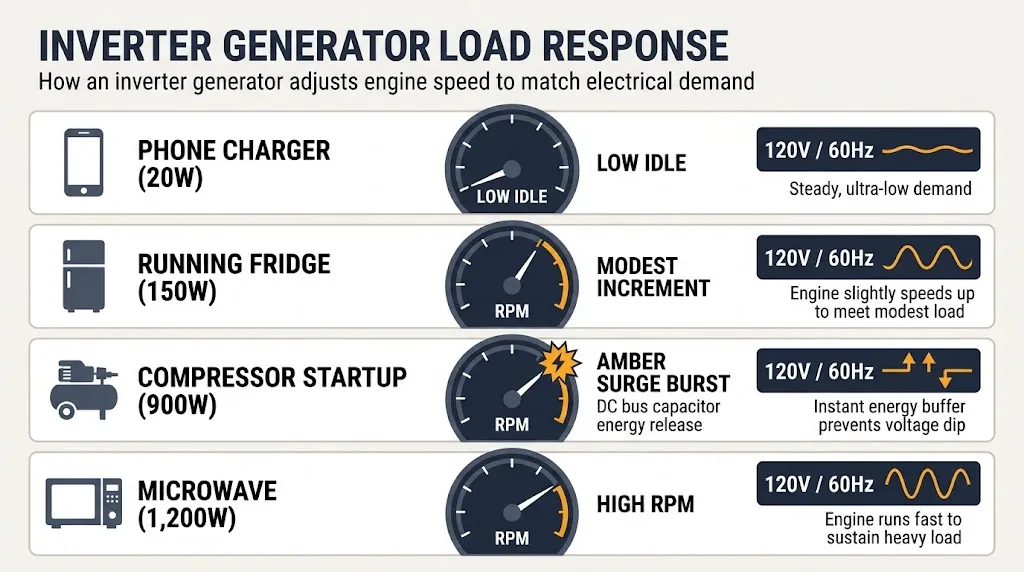
The microprocessor is the controller. It reads voltage and current sensors many times per second, compares the output to the target, and adjusts the switching timing. It also talks to the engine.
When you plug in a new load, current rises. The microprocessor sees it instantly. It widens the PWM pulses to hold voltage up, and it signals the throttle to open. The engine speeds up. When you unplug the load, the reverse happens.
That loop is why eco mode works. In eco mode, the engine idles low under light load. The module still rebuilds perfect 60-hertz AC from whatever DC the alternator supplies. The engine does not need to spin fast to hold frequency. It only needs to spin fast enough to supply enough power.
| Load on a 2,200-Watt Unit | What the Engine Does | What the Module Does |
|---|---|---|
| Phone charger, about 20 watts | Idles low, quiet | Holds 120 volts, 60 hertz |
| Fridge running, about 150 watts | Rises slightly | Holds 120 volts, 60 hertz |
| Fridge starting, about 900 watts briefly | Revs up fast | Uses DC bus reserve, holds voltage |
| Microwave, about 1,200 watts | Runs near full speed | Holds 120 volts, 60 hertz |
The module also handles protection. Overload, short circuit, low oil, and over-temperature can all trigger a shutdown or a warning light. Those cutoffs protect the transistors first. A transistor can fail in a fraction of a second under a dead short. The microprocessor has to act faster than you can reach the switch.
Honda describes this same AC to DC to AC process, controlled by a microprocessor that also controls engine speed, in its guide to inverter generators. Generac puts the result in simple terms too: its inverter models produce clean power with total harmonic distortion under 3 percent. Those two manufacturer pages are useful if you want the maker view alongside this explanation.
Why Clean Power Matters: THD in Real Terms
THD stands for total harmonic distortion. It measures how far a wave is from a perfect sine wave. Lower is cleaner.
Utility power in a house is usually around 5 percent THD. A good inverter generator is under 3 percent. Many are under 2 percent. A conventional open-frame generator can be 10 to 25 percent, depending on load.
High THD does not always cause instant damage. It causes heat in motors, buzz in audio gear, flicker in lights, and stress in chargers and power supplies. Sensitive electronics with small power supplies notice it first. A laptop charger may run hot. A CPAP machine may alarm. A modern fridge control board may misbehave.
That is the practical reason to care about the module. It is not about a number on a spec sheet. It is about whether the power stays clean when the load changes, the engine is cold, or the fuel is old.
| Feature | Inverter Generator | Conventional Generator |
|---|---|---|
| Typical THD | Under 3% | 10% to 25% |
| Waveform | Pure sine wave | Rough sine wave |
| Engine speed | Varies with load | Fixed near 3,600 RPM |
| Frequency control | Electronic, by the module | Mechanical, by engine speed |
| Best for | Laptops, phones, CPAP, TVs | Heaters, lights, simple tools |
For a deeper look at how frequency and voltage behave under load, see this guide to portable generator frequency. It explains why a steady 60 hertz matters even when the engine is not steady.
What the Inverter Module Does Not Do
The module cleans power. It does not create power. It cannot turn a 2,000-watt generator into a 3,000-watt generator. It cannot fix an undersized engine or a weak alternator.
It does not store energy like a battery. The capacitors hold a tiny reserve for milliseconds, not minutes. If the engine stops, the outlets stop.
It does not protect you from carbon monoxide. It does not replace a transfer switch. It does not make backfeeding safe. Those are separate safety issues, and they still apply to inverter models.
It also does not make every load safe. Some devices should not go on an inverter at all, or need a specific check first. Read what not to plug into an inverter before you connect anything unusual, especially medical gear, large motors, or equipment with its own inverter or variable-speed drive.
Inverter Module vs. Inverter Generator vs. Standalone Inverter
People mix up these three terms. They are related, but they are not the same thing.
| Term | What It Is | Power Source |
|---|---|---|
| Inverter module | The circuit board inside a generator | Alternator DC bus |
| Inverter generator | The whole unit: engine, alternator, module, outlets | Gasoline, propane, or diesel |
| Standalone inverter | A separate box that turns battery DC into AC | 12-volt or 48-volt battery |
A standalone inverter and a generator inverter module do similar switching work. The difference is the source. One starts from a battery. The other starts from a spinning alternator, through a rectifier and DC bus. That is why you cannot simply swap one for the other.
When you shop, you are buying the whole inverter generator, not the module alone. A solid option like this inverter generator is judged by its module, its engine, and its cooling together. A good module in a poorly cooled case will still fail early.
How to Tell When the Module Is Failing
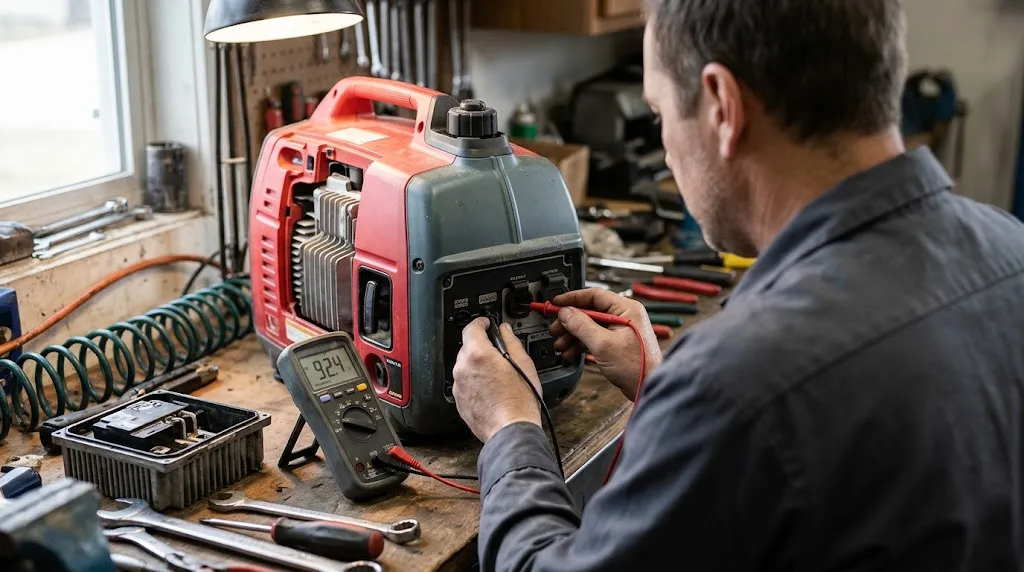
Inverter modules rarely fail without warning. The signs are usually electrical, not mechanical. The engine may run fine while the output is wrong.
| Symptom | Likely Cause | What to Do First |
|---|---|---|
| No output, engine runs | Module, fuse, or breaker fault | Check breakers, test with no load |
| Voltage swings or flicker | Failing capacitors or sensors | Stop using sensitive gear, test voltage |
| Overload light with a small load | Module overheating or shorted switch | Cool down, clear vents, check for a short |
| Burning smell or hot case | Overheated transistors or wiring | Shut down, do not restart |
| Output dies under load only | Weak DC bus or overload | Reduce load, test one device at a time |
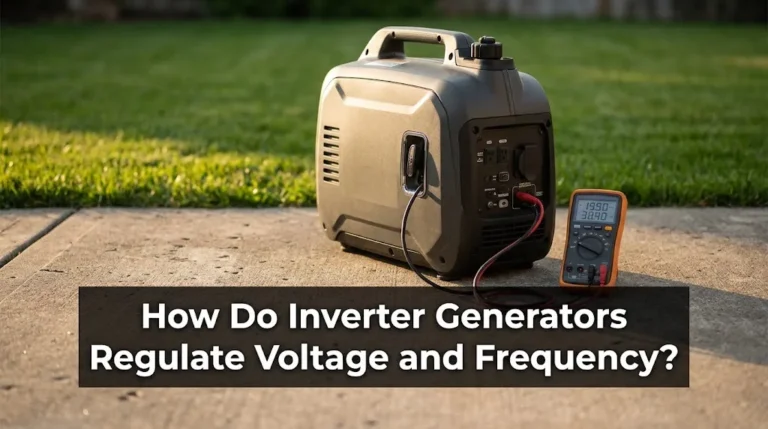
Test with a multimeter if you know how. A healthy unit should hold close to 120 volts under a steady load. If voltage drifts far above or below that, or drops sharply when a small load starts, unplug sensitive electronics. Do not keep running a laptop or CPAP machine on unstable power to see if it gets better. It usually does not.
Stop DIY work and call a qualified technician if you smell burning, see melted plastic, find a swollen capacitor, or the unit trips instantly with nothing plugged in. The module is often sealed in resin. Opening it will not help, and it can void a warranty. A pro can test the module, the alternator windings, and the control board as a system.
One common cause is overload history. A module can survive a brief overload. Repeated overloads, especially in hot weather, wear the switches down. That damage shows up weeks later as flicker or a sudden no-output fault. Keep a margin. If you need 1,900 watts, do not buy a 2,000-watt unit and run it flat out.
How to Make an Inverter Module Last Longer
Heat, overload, and dirty power in are the three killers. All three are partly in your control.
- Give it air. Run the generator outdoors, at least 20 feet from the house, with exhaust pointed away. Keep vents clear. Do not run it inside a closed box or tight shelter.
- Do not overload it. Add up running watts, then add the largest starting wattage. Leave 20 to 25 percent headroom. That margin protects the module more than any other habit.
- Turn eco mode off for big motor starts. Eco mode saves fuel, but it adds a small delay while the engine revs. For a fridge, well pump, or air conditioner, run at full speed first, then switch eco on once the load is steady.
- Use fresh fuel and change oil on schedule. A rough-running engine makes rough raw AC. The module has to work harder to clean it. Ethanol-free fuel and stabilizer help during storage.
- Let it cool before covering it. A hot module under a tight cover traps heat and moisture. Wait until the case is cool to the touch.
- Exercise it monthly. Run it for 20 to 30 minutes under a moderate load. Capacitors and seals age faster when a unit sits unused for a year.
For RV use, the same rules apply, with one extra: check the load before you add a second air conditioner or a microwave on the same circuit. Many RV owners find the best 4500-watt inverter generators for RV useful as a size reference, because that wattage covers a 13,500-BTU air conditioner plus lights and charging with headroom left over.
A Real Example: What Happens When You Plug In a Fridge and a Laptop
Here is a small, real scenario. It is 7 p.m. during an outage. You plug a fridge, a laptop charger, a phone charger, and two LED lights into a 2,200-watt inverter generator.
Running load is about 220 watts. The engine idles low. The module holds 120 volts at 60 hertz. The laptop charger stays cool. The lights do not flicker.
Then the fridge compressor starts. For two seconds, it needs about 900 watts. The DC bus capacitors supply the first surge. The microprocessor widens the PWM pulses and opens the throttle. Engine speed rises. Voltage dips briefly, then recovers. The laptop never notices.
Now add a 1,200-watt microwave. Total running load jumps to about 1,420 watts. That is still under the 1,800-watt running rating of a typical 2,200-watt unit. The engine runs faster and louder. Fuel use rises. The module keeps the wave clean.
Add a 1,500-watt space heater on top, and you are over the limit. The overload light comes on. The module may shut the output down to protect itself. That shutdown is not a failure. It is the protection working. Unplug the heater, reset, and the unit should recover. Run it like that often, and the protection will not save the switches forever.
That same clean output is why many people choose an inverter model for a CPAP machine. The load is small, but the need for stable power is high. See the guide to the best generator for CPAP machine use if medical gear is part of your backup plan. Always follow the device maker guidance as well.
If you are comparing units for this kind of mixed load, a quiet inverter generator in the 3,000-watt range gives you more headroom for a fridge start plus a microwave, without running near its limit all evening.
Conclusion
An inverter module works by turning rough alternator power into DC, then rebuilding it as a clean 120-volt sine wave with fast switching and a microprocessor in control. That extra step is why the engine can slow down, the power stays stable, and sensitive electronics run safely. Keep the load under the rating, keep the vents clear, and the module will do the quiet work it was built for. That is the part Michael Turner would check first on any inverter unit before trusting it with the house.
If you run laptops, a fridge, or medical gear during an outage, a quiet inverter generator with a pure sine wave module gives you the clean, steady power those devices need, without running the engine flat out all night.
Frequently Asked Questions
What does an inverter module do in a generator?
An inverter module converts rough AC from the alternator into DC, then rebuilds it as clean, stable 120-volt AC at 60 hertz. It controls voltage, frequency, and waveform with a microprocessor and fast switching transistors, so the output stays steady even when engine speed changes.
Is the inverter module the same as the inverter generator?
No. The module is one electronic part inside the generator. The inverter generator is the whole unit, including the engine, alternator, module, fuel system, and outlets. A standalone inverter is a separate device that turns battery DC into AC.
Can an inverter module be repaired?
Usually not at home. Most modules are sealed in resin and built as a single replaceable board. A technician can test it and replace it if needed, but opening the sealed board rarely fixes it and can void the warranty.
Why does my inverter generator have no output even though the engine runs?
The engine and the module are separate systems. No output with a running engine often points to a tripped breaker, an overload shutdown, or a failed inverter module. Check breakers first, test with no load, and call a technician if the output stays dead.
Does an inverter module make a generator quieter?
Indirectly, yes. Because the module rebuilds 60-hertz AC electronically, the engine does not need to hold 3,600 RPM all the time. It can slow down under light load, which cuts noise and fuel use. The enclosed case and sound insulation help too.

Hi, I’m Michael Turner. I own a generator workshop in the United States and founded HomeGeneratorBlog to share practical, hands-on guidance about generator installation, maintenance, troubleshooting, safety, and backup power solutions. My goal is to help homeowners make smarter, more confident decisions through clear and reliable information