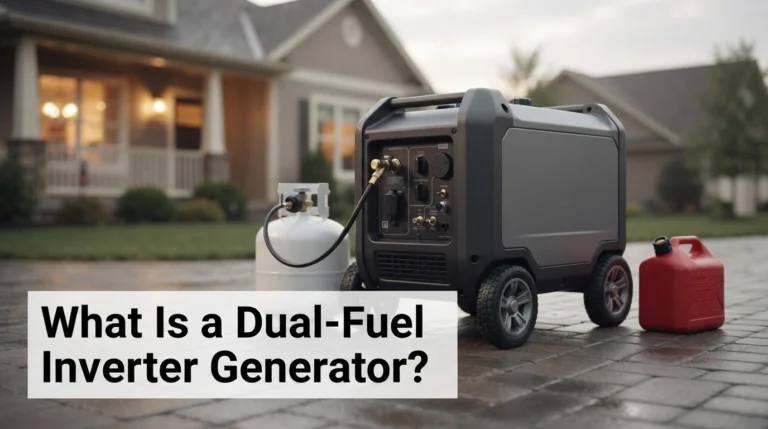
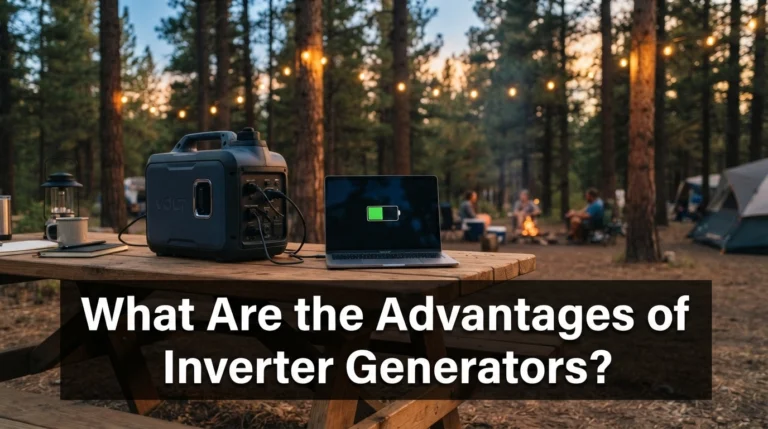
Inverter Generator vs. Standby Generator: Which Is Better for Home Backup?
Quick Answer
For most homes, a standby generator is better for full home backup, while an inverter generator is better for essential backup, lower cost, and portability. A standby unit starts on its own, powers more circuits, and runs on natural gas or propane. An inverter generator needs manual setup, powers fewer loads, and uses less fuel. Choose standby for whole-home cover, and inverter power for fridges, lights, and medical gear. Compare models in our guide to the best standby home generators before you decide.
The core difference in 30 seconds
- Standby wins on power: It can run heat, well pumps, and central air in many homes.
- Inverter wins on cost: It costs far less up front and needs no fixed install.
- Standby wins on ease: It starts in seconds when grid power drops.
- Inverter wins on noise: It runs quieter and sips fuel at light loads.
- Standby wins on runtime: It can run for days on a gas line or large propane tank.
Quick rule of thumb
- Pick standby if you want the house to keep working with no trips outside in a storm.
- Pick inverter power if you want to protect food, phones, lights, and a CPAP on a budget.
- Pick neither until you add up your running watts and starting watts first.
I’ve run both types through real outages, and the choice is less about brand than about how you live when the lights go out.
This guide compares power, cost, noise, fuel, safety, and setup, so you can match the right backup to your home, budget, and outage history.
In This Guide
- What Is an Inverter Generator?
- What Is a Standby Generator?
- Inverter Generator vs. Standby Generator at a Glance
- How Much Power Do You Really Need for Home Backup?
- What Do They Cost to Buy, Install, and Run?
- Noise, Fuel, and Runtime in Real Use
- Safety and Home Hookups: Transfer Switches, Inlets, and CO
- Which Is Better for Your Home?
- How to Choose in 5 Steps
- Frequently Asked Questions
What Is an Inverter Generator?

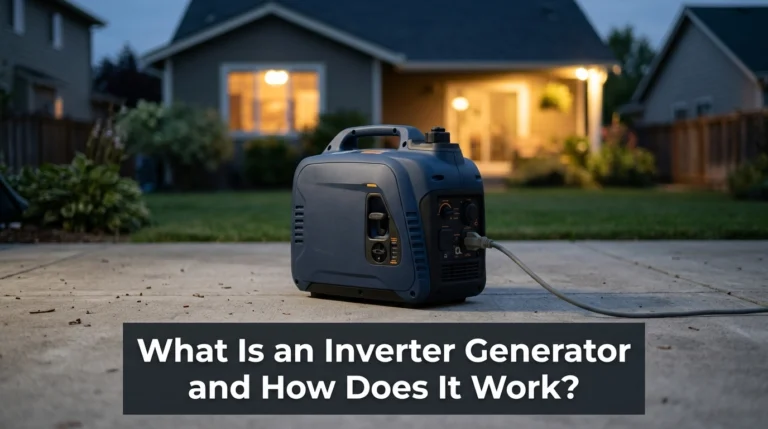
An inverter generator is a portable generator that makes clean, stable power for sensitive electronics.
It turns fuel into raw AC power, changes it to DC, then rebuilds it as smooth AC power.
That extra step keeps voltage and frequency steady when loads change.
How does an inverter generator work in plain terms?
The engine spins a compact alternator and makes high-frequency AC power.
An inverter module then shapes that power into a pure sine wave, the smooth form most electronics expect.
Total harmonic distortion, or THD, is a measure of that smoothness.
Most inverter models keep THD under 3%, which suits laptops, phones, TVs, and CPAP machines.
Check the spec sheet for the exact THD on any model you buy.
What can a portable inverter generator run?
Small models in the 2,000 to 3,500 running-watt range handle a fridge, lights, phones, a laptop, and a CPAP.
Mid-size models near 4,500 to 7,500 running watts can add a sump pump, furnace blower, or small window AC.
Two parallel-capable units can join with a parallel kit to share a larger load.
That kit links two matching generators through special cables and a shared outlet panel.
I used a 3,500-watt inverter unit during a three-day outage to keep food cold and my CPAP running at night.
It worked, but I had to pick loads with care and stagger starts.
Who should choose an inverter generator?
Renters, apartment dwellers with safe outdoor space, campers, and budget buyers fit this type best.
It also suits homes that lose power for hours, not days, and only need key circuits.
You can move it to an RV, job site, or tailgate when the outage ends.
That flexibility is hard to match with a fixed unit.
Learn the basics first in our guide to what an inverter generator is and how it works.
Section Takeaway: An inverter generator gives you clean, quiet, portable power for key loads, but it will not run a whole house on its own.
What Is a Standby Generator?
A standby generator is a fixed, whole-home backup unit that starts on its own when grid power fails.
It sits on a pad outside, wired into your home panel through an automatic transfer switch.
When power drops, it senses the loss, starts, and takes over in seconds.
How does a standby generator work?
The unit runs on natural gas or propane from a line or large tank.
An automatic transfer switch, or ATS, watches grid power and shifts your home to generator power.
It shifts back when grid power returns and stays stable.
Most standby models run at a fixed speed and make 10,000 to 22,000 running watts or more.
That range can cover heat, water, refrigeration, lights, and many large appliances at once.
What does standby backup feel like in an outage?
Your lights may flicker once, then come back on.
You do not haul fuel, pull a starter cord, or run cords through a window in rain.
That matters at 2 a.m. in a storm, or when you are away from home.
My neighbor’s standby unit kept his sump pump and heat running through a long winter outage while he was at work.
My portable unit kept my fridge cold, but I had to babysit fuel and loads all night.
Who should choose a standby generator?
Homeowners with frequent outages, medical gear, well water, sump pumps, or home offices fit this type best.
It also suits larger homes, cold climates, and areas where outages last a day or more.
You need space outside, a gas supply, and a licensed electrician for install.
Local permits and codes often apply, so check them early.
Safety note: Never run a standby or portable generator inside a home, garage, or shed. Keep it outdoors and well away from windows, doors, and vents.
Section Takeaway: A standby generator gives you hands-free, whole-home cover, but it needs a fixed install, gas supply, and a larger budget.
Inverter Generator vs. Standby Generator at a Glance
Both types make backup power, but they solve different problems.
Use this table to see the trade-offs in one place.
| Feature | Inverter Generator | Standby Generator |
|---|---|---|
| Typical power | 2,000 to 7,500 running watts | 10,000 to 22,000+ running watts |
| Start-up | Manual or electric start, set up each time | Automatic in seconds |
| Power quality | Clean sine wave, low THD | Good for most home loads, check THD |
| Fuel | Gasoline, propane, or dual fuel | Natural gas or propane |
| Noise | Quieter, often 50 to 65 dB at light load | Louder, often 65 to 75 dB |
| Install | None, plus inlet or cords | Fixed pad, ATS, gas line, permits |
| Up-front cost | Lower, often $800 to $3,500 | Higher, often $8,000 to $15,000+ installed |
| Best for | Key loads, RV, camping, budget backup | Whole-home backup, long outages |
Prices vary by size, brand, and local labor, so treat these ranges as a guide.
Get a local quote for standby install before you lock in a budget.
If you want a portable-first plan, start with our picks for the best portable inverter generator for home and RV use.
Section Takeaway: Standby wins on power and ease, inverter wins on price, noise, and portability.
How Much Power Do You Really Need for Home Backup?
Start with watts, not with a model name.
Running watts are what a device uses while it runs.
Starting watts, or surge watts, are the short burst a motor needs to start.
How do I add up my loads?
List the items you must keep on during an outage.
Add their running watts, then add the largest starting watts on top.
That total is your minimum size, plus a safety margin of 10 to 20 percent.
- Refrigerator: 150 to 200 running watts, 800 to 1,200 starting watts
- Chest freezer: 100 to 200 running watts, 800 to 1,200 starting watts
- Furnace blower: 500 to 1,000 running watts, 1,200 to 2,000 starting watts
- Sump pump: 800 to 1,200 running watts, 1,500 to 2,500 starting watts
- Window AC: 1,000 to 1,500 running watts, 2,000 to 3,000 starting watts
- CPAP machine: 30 to 100 running watts, no large surge
- Lights and phones: 100 to 300 running watts combined
These are typical ranges, not exact figures for your models.
Check each nameplate or manual for your real numbers.
Can an inverter generator run a refrigerator?
Yes, in most cases a 2,000 to 3,500-watt inverter unit can run a fridge plus lights and phones.
Start the fridge first, then add smaller loads one at a time.
Do not start a fridge and a window AC at the same moment.
That surge once tripped my overload shutoff during a hot outage, and the fridge stayed warm for an hour.
Staggering starts fixed it on the next run.
Can a standby generator run central air?
Yes, if it is sized for the AC starting load.
Central air often needs 3,000 to 5,000 running watts and far more to start.
A soft-start device can cut that surge in some systems.
Ask your HVAC tech and electrician before you size for air conditioning.
Work through your own list with our guide on what size generator to run a house.
Section Takeaway: Add running watts, add the biggest starting surge, then add margin — that math picks your size, not a sales pitch.
What Do They Cost to Buy, Install, and Run?
Up-front price tells only part of the story.
Install, fuel, oil, and upkeep change the true cost over years.
How much does an inverter generator cost?
Most home-use inverter models cost $800 to $3,500, based on size and brand.
You may add a transfer switch or inlet, cords, fuel cans, and a cover.
That add-on work often costs $500 to $1,500 with a licensed electrician.
Fuel cost stays low at light loads, thanks to eco-throttle mode.
Eco mode slows the engine when demand drops, which saves fuel and cuts noise.
How much does a standby generator cost?
A standby unit often costs $5,000 to $9,000 for the unit alone.
Install, ATS, gas work, pad, and permits often add $3,000 to $6,000 more.
Total installed cost often lands at $8,000 to $15,000 or more for a mid-size home.
Large homes and long gas runs push that total higher.
That price buys hands-free cover and higher resale appeal in outage-prone areas.
What about fuel and upkeep over time?
Inverter units need fresh fuel, oil changes, air-filter checks, and spark-plug care per your manual.
Stale gasoline clogs carburetors fast, so use fuel stabilizer or run the tank dry for storage.
Standby units need weekly self-tests, oil and filter service, battery checks, and an annual pro visit.
Natural gas avoids fuel storage, but you still pay for gas use and service.
Propane needs a tank refill plan before storm season.
As of 2026, both types remain common choices, and neither is a one-time buy.
Section Takeaway: Inverter power is cheap to start and easy to store, while standby power costs more up front but saves time and effort in every outage.
Noise, Fuel, and Runtime in Real Use
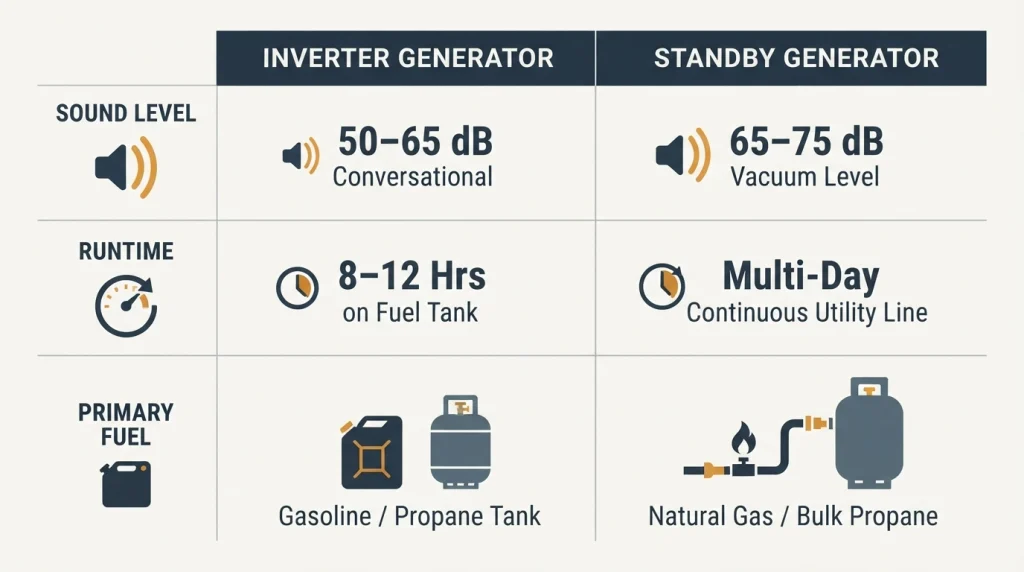
Noise and runtime shape how you live with a generator.
Specs help, but real distance and load change what you hear.
How loud is each type?
Inverter models often rate 50 to 65 dB at 25% load from about 23 feet away.
That is close to normal talk at the low end.
Standby models often rate 65 to 75 dB at full load.
That is closer to a vacuum cleaner, and it carries farther at night.
Check the spec sheet for the test distance, since dB numbers change with distance.
How long can each type run?
A portable inverter unit may run 8 to 12 hours on a tank at 25% load.
Eco mode stretches that time when loads stay light.
Heavy loads cut runtime fast, so plan refills.
A standby unit on natural gas can run for days, as long as gas supply holds.
A standby unit on propane runs until the tank empties, so size the tank for your outage history.
Which fuel is best for home backup?
- Gasoline: Easy to buy, but goes stale in months and needs safe storage.
- Propane: Stores for years, burns clean, but needs tanks and refills.
- Natural gas: No refills or storage, but needs a gas line and pro hookup.
- Dual fuel: Lets you switch between gasoline and propane for flexibility.
I keep propane as my backup fuel for a portable unit because it stores well.
Gasoline works for short outages, but I learned to rotate it or it gums up the carburetor.
Safety note: Store fuel outdoors in approved cans, away from heat and living space. Let the generator cool before you refuel, and never refuel near an open flame.
Section Takeaway: Inverter units are quieter and sip fuel, while standby units run longer with less work, if the gas supply holds.
Safety and Home Hookups: Transfer Switches, Inlets, and CO
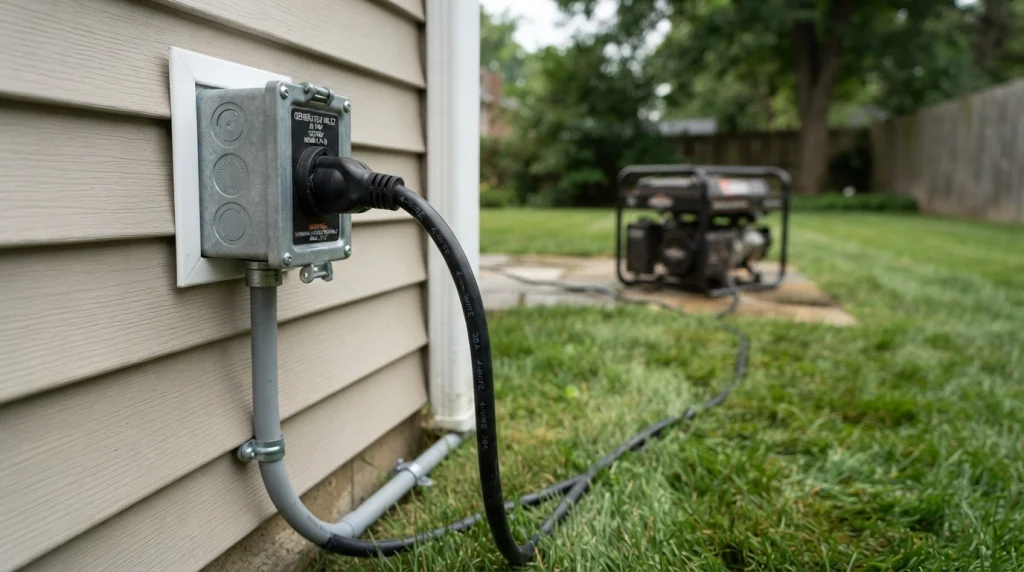
Safe hookups matter more than wattage.
A wrong connection can hurt you, a lineman, or your home wiring.
What is a transfer switch?
A transfer switch is a device that safely shifts your home from grid power to generator power.
It blocks backfeeding, which is power flowing back into grid lines.
Backfeeding can harm utility workers and damage gear.
Standby units use an automatic transfer switch.
Portable units use a manual transfer switch or an inlet box with an interlock kit.
An interlock kit is a panel device that stops the main breaker and generator breaker from being on at once.
How should I connect a portable inverter generator?
Use heavy-duty, outdoor-rated extension cords for single devices.
Use a proper inlet and transfer switch for house circuits.
Never plug a generator into a wall outlet with a suicide cord.
That cord has male plugs on both ends and can kill.
Hire a licensed electrician for any panel work.
See our guide to the best portable generator with transfer switch for safer home setups.
How do I stay safe from carbon monoxide?
Carbon monoxide, or CO, is a colorless, odorless gas from engine exhaust.
It can build up fast in a garage, shed, or near a window.
Run any generator outdoors, at least 20 feet from your home, with exhaust pointed away.
Keep CO alarms with battery backup on every level of your home.
The CDC and the U.S. Consumer Product Safety Commission both stress outdoor-only use and working CO alarms.
Safety note: Use a transfer switch or interlock installed by a licensed electrician. Check your owner’s manual before use, and keep generators outdoors and well away from windows, doors, and vents.
Section Takeaway: A transfer switch, proper inlet, and CO alarms turn backup power from a risk into a safe plan.
Which Is Better for Your Home?
There is no single winner for every home.
Your outage pattern, house size, health needs, and budget pick the winner.
Choose a standby generator if you:
- Lose power often: You face several outages a year, or outages over 24 hours.
- Need whole-home power: You run heat, well water, sump pumps, and central air.
- Use medical gear: You rely on powered medical devices at night.
- Travel often: You want cover while you are away from home.
- Own your home: You plan to stay and can invest in a fixed install.
Choose an inverter generator if you:
- Need key loads only: You want fridge, lights, phones, and CPAP cover.
- Want low cost: You need backup now without a $10,000 install.
- Need portability: You camp, RV, or work away from home.
- Rent your home: You cannot install a fixed unit.
- Face short outages: Your outages last hours, not days.
What if I want both?
Some homes pair a small standby unit for key circuits with a portable inverter unit for travel.
Others start with an inverter unit, then upgrade to standby later.
That staged plan works well if your budget is tight now.
Start with the loads you cannot lose, then grow from there.
Compare home options in our guide to the best generator to buy for home backup.
For safety and energy basics, see guidance from the U.S. Department of Energy and the EPA.
Section Takeaway: Standby fits whole-home, long-outage homes, while inverter power fits budget, portable, and key-load homes.
How to Choose in 5 Steps
Use this short plan to avoid an oversized or undersized buy.
- List must-run loads: Write down fridge, heat, water, medical gear, and lights.
- Do the watt math: Add running watts, add the largest surge, then add 10 to 20 percent margin.
- Pick your type: Choose standby for whole-home cover or inverter power for key loads.
- Check fuel and space: Confirm gas supply, outdoor space, noise rules, and storage.
- Get pro help: Ask a licensed electrician about a transfer switch, inlet, and permits.
Do not buy on peak watts alone.
Running watts decide what you can hold for hours.
Check noise, runtime at 25% and 50% load, tank size, and warranty too.
Section Takeaway: List loads, do the math, pick a type, then confirm fuel, space, and safe hookup before you buy.
Frequently Asked Questions
Can an inverter generator power a whole house?
No, not in most cases. A portable inverter unit in the 2,000 to 7,500-watt range can power key loads like a fridge, lights, and CPAP. It cannot run a full home with central air, electric heat, and a well pump at once.
Is a standby generator worth the cost?
Yes, if you face long or frequent outages. It starts on its own, powers more of your home, and needs no setup in a storm. It costs more up front, but it saves time and stress in each outage.
How long will a standby generator run?
It can run for days on natural gas, as long as the gas supply holds. On propane, runtime depends on tank size and load. Check your tank level before storm season and plan refills early.
Can I run a standby generator and an inverter generator together?
No, do not link them to the same panel. Use one source at a time through a proper transfer switch. You can use an inverter unit for travel or a separate load, but keep the systems apart.
Do I need a transfer switch for an inverter generator?
Yes, if you want to power house circuits. A manual transfer switch or interlock kit keeps the hookup safe and stops backfeeding. Extension cords work for single devices, but they cannot power panel circuits safely.
Which generator is quieter?
An inverter generator is usually quieter. It slows down at light loads with eco mode, which cuts noise and fuel use. A standby unit runs at a fixed speed and is louder, though newer models have sound-reducing enclosures.
Can a standby generator run on propane only?
Yes, many standby models run on propane or natural gas. Propane stores well and works where gas lines are not available. Size the tank for your expected outage length and refill it before storm season.
If you want hands-free cover for your whole home, get a standby quote from a licensed installer.
If you want low-cost cover for key loads, pick a right-sized inverter generator, add a safe inlet, and test it before the next storm.

Hi, I’m Michael Turner. I own a generator workshop in the United States and founded HomeGeneratorBlog to share practical, hands-on guidance about generator installation, maintenance, troubleshooting, safety, and backup power solutions. My goal is to help homeowners make smarter, more confident decisions through clear and reliable information