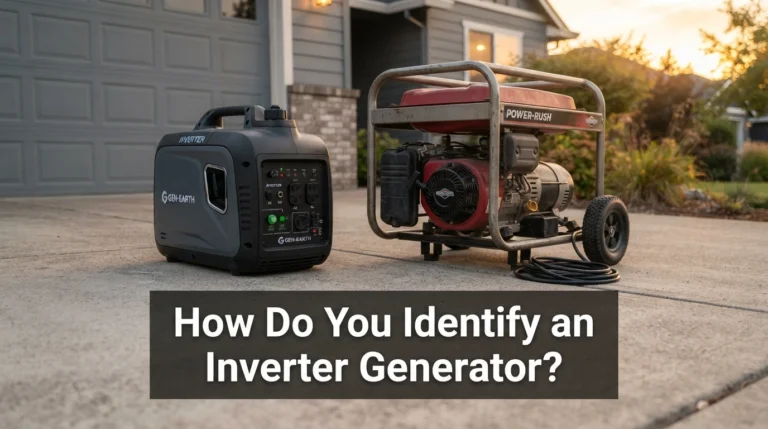
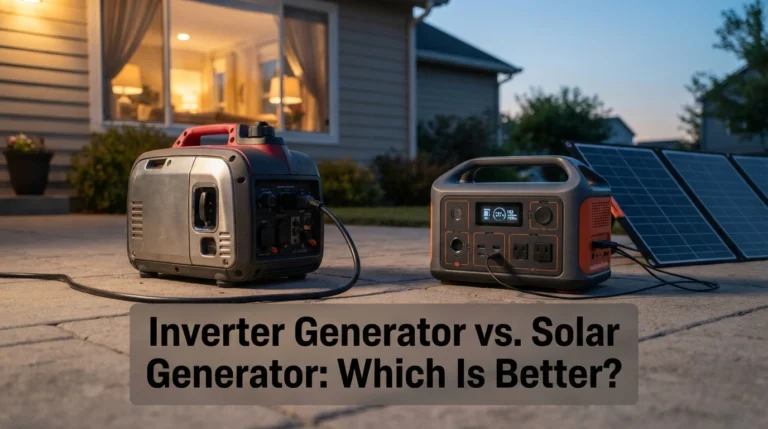
Inverter Generator vs. Silent Generator: What’s the Difference?
Quick Answer
An inverter generator is a type of generator that makes clean, steady power. A silent generator is not a separate type at all. It is a marketing label for a generator sold as quiet, and most quiet models are inverter generators with an enclosed case, eco-mode, and better muffling. If you want quiet power for camping or sensitive electronics, start with a true inverter generator, then check its decibel rating at quarter load.
The short verdict
- Inverter means technology: It converts power to clean sine-wave output that is safe for laptops, phones, and CPAP machines.
- Silent means noise level: It describes how loud a generator sounds, not how it makes power.
- Most overlap: The quietest fuel generators you can buy today are usually enclosed inverter generators.
- Check the dB rating: Compare ratings at the same load and distance, or the numbers will mislead you.
- Watch the watts: A very quiet 2,000-watt model will not run a large RV air conditioner on its own.
Before you buy
- Add up running watts and starting watts for your must-run loads first.
- Test the generator at home before a trip, at the distance you will use it.
- Keep it outdoors, at least 20 feet from your home, with exhaust pointed away.
I’ve stood next to a so-called silent generator at a campsite and still heard it hum through the trees. I’ve also run a small inverter generator through a multi-day outage and barely noticed it from inside the house.
That gap is why this guide goes deeper than the label on the box. You’ll learn what each term really means, how loud each type is in real life, and which one fits camping, RV use, and home backup in 2026.
In This Guide
- What Is a Silent Generator, Really?
- What Is an Inverter Generator?
- Inverter Generator vs. Silent Generator: The Key Differences at a Glance
- How Loud Are They in Real Life? Decibels, Distance, and Campsite Rules
- Which Is Better for Camping, RV Life, and Home Backup?
- How to Choose a Quiet Generator Without Overpaying
- How to Make Any Generator Quieter (Without Unsafe Covers)
- Frequently Asked Questions
What Is a Silent Generator, Really?
A silent generator is a generator marketed as very quiet. There is no separate engine type called a silent generator.
The label usually points to a low decibel rating, an enclosed case, and a muffler that softens exhaust noise. Some brands use “silent,” “super quiet,” or “whisper quiet” for the same idea.
That wording can confuse first-time buyers. A silent generator still burns fuel and still makes noise.
It just makes less noise than a loud open-frame model at the same load. The difference is real, but the word “silent” is not literal.
Is a silent generator the same as a quiet inverter generator?
Often, yes. Most generators sold as silent are inverter generators in a closed, sound-dampened case.
The inverter design helps because the engine can slow down when the load is light. A slower engine is usually a quieter engine.
Some silent models are conventional generators with extra insulation and a better muffler. They can be quieter than a basic open-frame unit, but they rarely match a small inverter model at low load.
Why do brands use the word silent?
Shoppers search for quiet power for camping, RV parks, and close neighbours. Brands answer that search with a simple promise.
“Silent” sounds clearer than “52 dB at quarter load from 23 feet.” It also hides the test conditions behind the number.
That is why you should treat the label as a starting point. The spec sheet, the load level, and the test distance tell the true story.
Section Takeaway: Silent is a noise claim, not a generator type, so always check the decibel rating, load, and distance behind the label.
What Is an Inverter Generator?
An inverter generator is a portable generator that makes clean, stable power through a three-step process. It first makes raw AC power, converts it to DC, then inverts it back to smooth AC power.
That extra step is the whole point. It steadies voltage and frequency, even when the load changes.
An inverter generator is…
An inverter generator is a fuel-powered portable generator that uses inverter electronics to produce a pure sine wave, with low total harmonic distortion (THD), so sensitive electronics run safely.
THD measures how clean the power wave is. Lower THD means a smoother wave and less risk to laptops, phones, TVs, and medical devices.
Most inverter models keep THD under 3%, but check the spec sheet for the model you are considering. Clean power does not mean silent power, though most inverter models are quieter than open-frame models.
How does an inverter generator stay quiet?
An inverter generator can change engine speed to match the load. A light load means a slower, quieter engine.
Many models also have eco-mode, also called economy mode or eco-throttle. Eco-mode lets the engine idle down when you only charge a phone or run a few lights.
The enclosed case helps too. It blocks direct engine sound and directs exhaust through a muffler.
I noticed this during a long outage when I ran a fridge and a CPAP on a small inverter model. The engine rose when the fridge compressor kicked on, then dropped back to a soft hum.
What can an inverter generator run?
A small 2,000-watt inverter generator can run lights, phones, laptops, a fridge, and a CPAP. It can also run a small fan or a TV, one load at a time.
A larger 3,000 to 4,500-watt inverter model can run more at once. It may also handle a window AC or a microwave, if the starting watts fit.
For larger loads, two parallel-capable inverter generators can link together with a parallel kit. That setup doubles the available power without buying one huge, heavy unit.
Safety note: Run any fuel generator outdoors and well away from windows, doors, and vents. Never run it in a garage, even with the door open.
Learn the basics of different types of inverter generators before you pick a size, because suitcase, open-frame inverter, dual-fuel, and large parallel-ready models suit very different jobs.
Section Takeaway: An inverter generator is defined by clean power and variable engine speed, and those two traits are why it is often the quietest fuel option.
Inverter Generator vs. Silent Generator: The Key Differences at a Glance
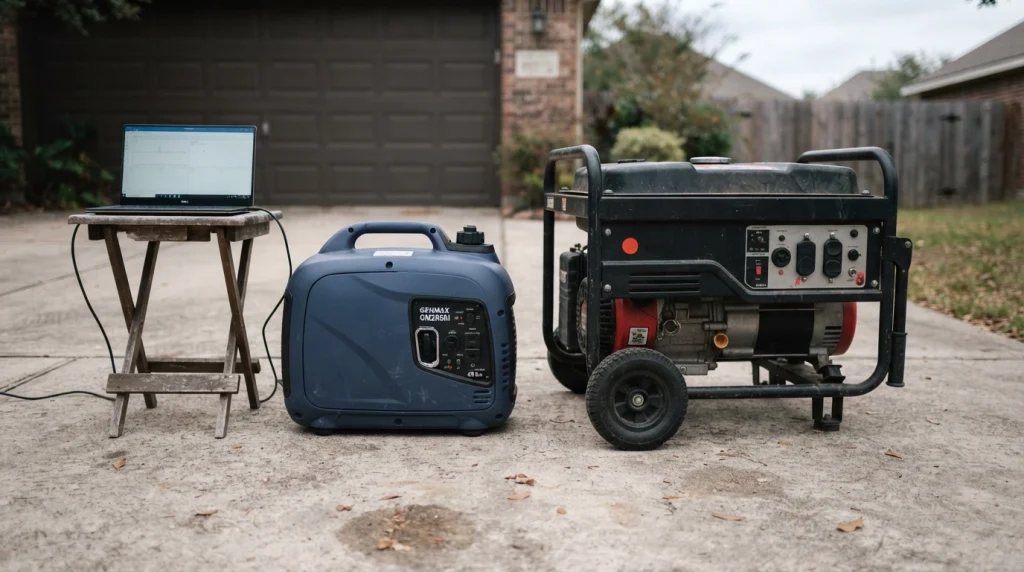
The core difference is simple. Inverter describes how power is made, while silent describes how loud it sounds.
You can have a loud inverter generator and a quiet conventional generator. In practice, though, the quietest fuel generators tend to be inverter models.
Use the table below to compare them side by side. Treat the numbers as typical ranges, not promises for one model.
| Feature | Inverter Generator | “Silent” Generator |
|---|---|---|
| What it means | A generator type with inverter electronics | A marketing label for low noise |
| Power quality | Clean sine wave, usually under 3% THD | Varies; check THD if you need clean power |
| Typical noise | About 50 to 60 dB at quarter load | About 50 to 65 dB, depending on design and load |
| Engine speed | Varies with load, with eco-mode | Varies by model; some run at fixed speed |
| Fuel use | Often efficient at light load | Depends on engine and load |
| Weight and size | Often compact, 40 to 100 pounds for common sizes | Can be compact or large, depending on watts |
| Best for | Camping, RV, electronics, light home backup | Any use where low noise matters most |
| Typical price | Higher per watt than open-frame models | Higher if it uses inverter tech and soundproofing |
Which one makes cleaner power?
An inverter generator wins here, by design. Its electronics smooth the output before it reaches your devices.
A silent conventional generator may still produce rougher power. That can be fine for a power tool or a heater, but it is less ideal for a laptop or a CPAP.
If the listing does not state THD, treat that as a gap. A true inverter listing should state it clearly.
Which one uses less fuel?
An inverter generator often uses less fuel at light load. Eco-mode lets it sip fuel while it charges phones or runs lights.
A silent conventional model may still run at full speed, even with a small load. That burns more fuel and makes more noise than it needs to.
Runtime also depends on tank size and load. A larger tank can run longer, but it adds weight and fuel storage needs.
What about size and weight?
Small inverter generators are easy to carry, often with a single handle. That makes them a good fit for camping and tailgating.
Large silent generators can be heavy, even with wheels. They may suit home backup better than a hike-in campsite.
Check the dry weight and the wheel kit before you buy. A quiet generator you cannot move is not useful.
Section Takeaway: Compare inverter vs. silent on power quality, noise at the same load, and watts, not on the label alone.
How Loud Are They in Real Life? Decibels, Distance, and Campsite Rules
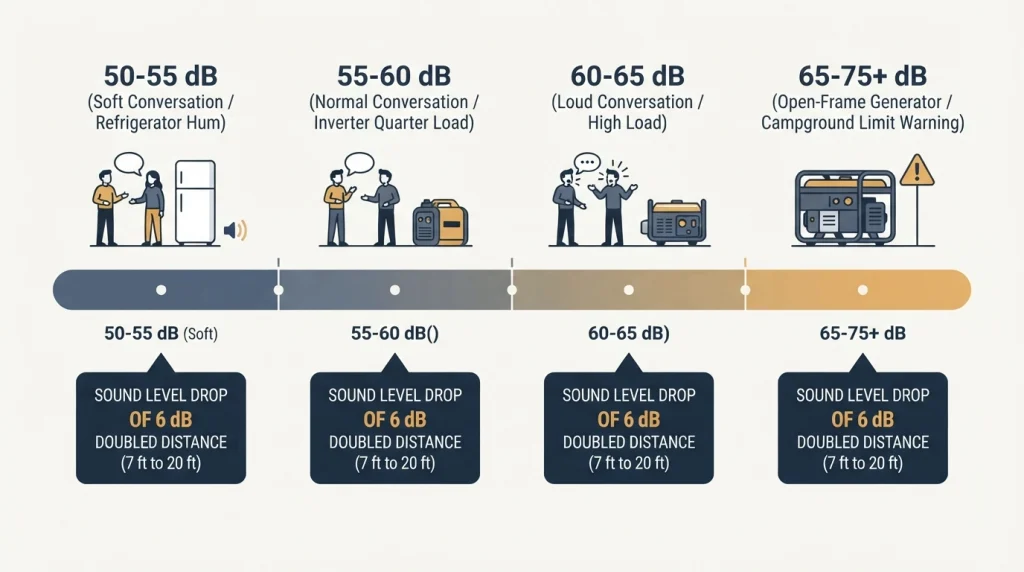
Decibels, written as dB, measure sound level on a log scale. A small rise in dB can sound much louder than the number suggests.
A 10 dB rise sounds roughly twice as loud to most people. That is why a 60 dB generator can feel far louder than a 50 dB model.
Always compare dB ratings at the same load and distance. A rating at quarter load from 23 feet is not the same as a rating at full load from 7 metres.
What do typical generator noise levels sound like?
Use these rough comparisons to picture the sound, not as exact test results. Your site, load, and distance will change what you hear.
- 50 to 55 dB: Soft conversation, or a quiet fridge hum from a few feet away.
- 55 to 60 dB: Normal conversation, or a microwave running nearby.
- 60 to 65 dB: A loud conversation, or a vacuum from another room.
- 65 to 75 dB: A loud open-frame generator at moderate load, easy to hear across a yard.
- 75 dB and up: Very loud, hard to talk over, and likely to draw complaints at a campsite.
Most small inverter generators sit in the 50 to 60 dB range at quarter load. Larger inverter models rise as load rises, often into the low 60s.
Open-frame conventional generators often sit in the high 60s to mid 70s at similar loads. That gap is why neighbours notice them first.
How does distance change the noise?
Sound drops fast as you move away. Doubling the distance can cut the level by about 6 dB in open air.
That is why placement matters so much. A generator 20 feet away sounds much quieter than the same unit at 7 feet.
Point the exhaust away from tents, RV doors, and seating areas. Use a long, heavy-duty extension cord rated for the load, and keep connections dry and off the ground.
What do campsites and RV parks allow?
Many campsites set quiet hours, often from late evening to early morning. Some limit generator use to a few hours per day.
RV parks may also set a dB limit or ban open-frame generators. Check the park rules before you arrive, not after you set up.
I learned this the hard way at a busy campground. My neighbour’s open-frame unit ran past quiet hours, and the ranger asked him to shut it down.
My small inverter model stayed within the rules, but I still kept it low and pointed away. Good etiquette matters as much as the spec sheet.
For practical noise fixes, see how to reduce generator noise before you buy extra gear or build a sound box.
Section Takeaway: A 10 dB gap is huge in real life, so compare ratings at the same load and distance and respect quiet hours.
Which Is Better for Camping, RV Life, and Home Backup?
The best choice depends on what you run, where you run it, and how long you need power. A quiet label alone will not answer those questions.
Start with your loads, then match the generator to them. Noise, weight, and runtime come next.
Which is better for camping?
A small inverter generator is usually the best fit for camping. It is quiet, light, and safe for phones and laptops.
A 2,000 to 2,200-watt model covers lights, charging, a small fan, and a fridge at a campsite. It also fits in a car trunk or RV storage bay.
A silent conventional model can work too, if it is truly quiet and light enough. Check its weight and its dB rating at quarter load before you trust the label.
Which is better for RV life?
RV use needs more power, especially for air conditioning. A single small inverter generator often cannot start a 13,500 BTU RV air conditioner on its own.
Many RV owners use two parallel-capable inverter generators, or one larger inverter model in the 3,500 to 4,500-watt range. A soft-start device can also lower the starting surge, but check your AC manual first.
Noise matters even more in an RV park. A quiet inverter model with eco-mode will keep neighbours happier during the day and during quiet hours.
Which is better for home backup?
For short outages, a mid-size inverter generator can run a fridge, freezer, lights, phones, and a CPAP. It can also run a furnace blower or a sump pump, if the watts fit.
For whole-home backup, a larger conventional, dual-fuel, or standby generator may make more sense. It can run more circuits at once, but it will be louder and heavier.
A transfer switch or interlock kit, installed by a licensed electrician, lets you power chosen home circuits safely. Never backfeed power through a wall outlet.
Safety note: Use a transfer switch or interlock installed by a licensed electrician for home hookups. Check your owner’s manual before use, and keep the generator outdoors.
What size do you need by use case?
| Use case | Typical running watts | Good starting point |
|---|---|---|
| Phone and laptop charging | 100 to 300 watts | 1,000 to 2,000-watt inverter |
| Camping essentials | 800 to 1,800 watts | 2,000 to 2,200-watt inverter |
| RV without AC | 1,500 to 2,500 watts | 3,000-watt inverter, or parallel pair |
| RV with AC | 2,500 to 4,000 watts | 3,500 to 4,500-watt inverter, or parallel pair |
| Short home outage | 2,000 to 4,000 watts | 3,500 to 4,500-watt inverter or dual-fuel |
These are planning ranges, not exact specs for one model. Always add starting watts for motors, and leave a safety margin.
See running watts vs. starting watts to avoid the most common sizing mistake I see, which is buying for running watts and forgetting the surge.
Section Takeaway: Small inverter models win for camping, larger inverter or parallel setups win for RV AC, and home backup needs a watts-first plan.
How to Choose a Quiet Generator Without Overpaying
Start with the job, not the ad. A quiet generator that cannot run your fridge is not a bargain.
List your must-run loads first. Then add running watts and starting watts, and pick a model with headroom.
What should you check on the spec sheet?
- dB at quarter load: Look for the load level and distance used for the test.
- THD: Look for under 3% if you will run laptops, phones, or medical devices.
- Running and starting watts: Make sure both fit your loads, not just one.
- Runtime at 25% and 50% load: Compare at the same load, or the numbers will mislead you.
- Tank size and fuel type: Gasoline is common, while propane stores longer and burns cleaner.
- Parallel capability: Check if you can link two units later for more power.
- Outlets: Look for a 30A RV outlet, USB ports, and GFCI protection where you need it.
Check the weight and the handle design too. A 100-pound generator is not portable for one person, even if it is quiet.
How much should you pay for quiet?
Quiet costs more, because it needs inverter electronics, a closed case, and better muffling. Small inverter models often cost more per watt than open-frame models.
That premium is worth it for camping, RV parks, and close neighbours. It is less important for a remote job site where noise is less of an issue.
Do not pay extra for the word “silent” alone. Pay for a verified dB rating, clean power, and enough watts.
Which brands are known for quiet inverter models?
Honda, Yamaha, Champion, Westinghouse, WEN, Generac, DuroMax, Predator, and Pulsar all sell inverter models in the quiet range. Each brand has loud and quiet models, so check the spec sheet for the exact unit.
Read owner reviews for real-world noise notes, not just the headline dB. Look for comments about eco-mode, full-load noise, and cold starts.
For a shortlist, start with the best portable inverter generator picks, then compare their dB, watts, and runtime side by side.
Section Takeaway: Buy watts and verified quiet first, and treat the silent label as a claim to check, not a feature to pay for.
How to Make Any Generator Quieter (Without Unsafe Covers)
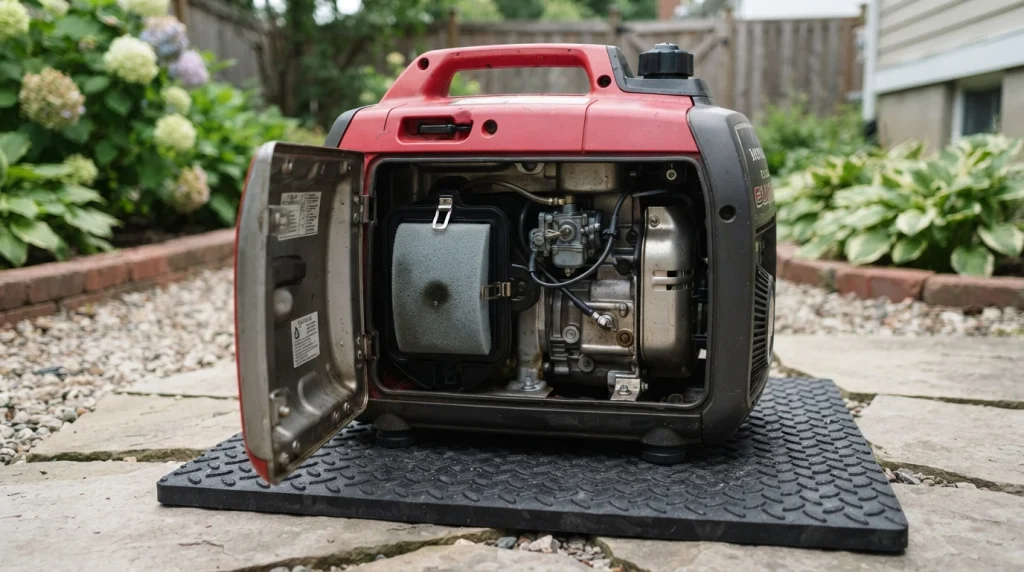
You can lower generator noise without risky hacks. Placement, load, and maintenance matter more than a blanket or a box.
Start with the safe fixes first. They cost little and they work.
Where should you place it?
Place the generator as far as practical from people, tents, and RV doors. Point the exhaust away from living areas.
Use a firm, level surface to cut vibration. A rubber mat under the unit can help, if it does not block airflow.
Keep it outdoors, with clear airflow on all sides. Never place it in a garage, shed, or enclosed tent.
Safety note: Never cover a running generator with a tarp, blanket, or standard cover. It can trap heat and exhaust, and it can cause a fire or carbon monoxide buildup.
Can you cover a generator to make it quieter?
A standard cover will not make a running generator safely quieter. It blocks airflow and traps hot exhaust.
Some owners use a purpose-built, ventilated generator shelter with clear exhaust paths. Even then, follow the maker’s clearance and airflow rules.
If you want a quieter setup, a better muffler, a sound-dampening barrier placed at a safe distance, or a quieter inverter model is safer than a tight cover. Learn what is safe and what is not in can you cover a generator to make it quieter.
What maintenance keeps it quiet?
- Use eco-mode: Let the engine slow down at light load.
- Keep the load steady: Avoid running at full load for hours if you can stagger loads.
- Change oil on schedule: Follow your manual for break-in and oil-change intervals.
- Clean the air filter: A clogged filter can make the engine work harder and louder.
- Use fresh fuel: Stale fuel can cause surging, hard starts, and rough running.
For carbon monoxide safety guidance, check the CDC and the U.S. Consumer Product Safety Commission. For generator safety and energy guidance, see the EPA and U.S. Department of Energy.
Section Takeaway: Distance, exhaust direction, eco-mode, and fresh fuel cut noise safely, while tight covers and enclosed spaces do not.
Frequently Asked Questions
Is a silent generator really silent?
No. A silent generator still makes noise, usually in the 50 to 65 dB range at light load. The label means quieter than a typical open-frame model, not silent. Always check the dB rating, load, and test distance.
Are inverter generators always quiet?
Most are quieter than open-frame models, but not all are equally quiet. A large inverter generator at full load can be louder than a small one at quarter load. Check the spec sheet and real-world reviews for the exact model.
Can a silent generator run a refrigerator?
Yes, if its running and starting watts cover the fridge. A typical fridge needs about 600 to 800 running watts, with a higher starting surge. A 2,000-watt inverter model usually handles it, but check your fridge label first.
Can an inverter generator run a CPAP machine?
Yes, in most cases. An inverter generator makes clean sine-wave power that suits CPAP machines and other sensitive electronics. Check the CPAP power draw, use eco-mode, and keep the generator outdoors with a long cord.
Is a silent generator better than a portable power station?
It depends on your needs. A portable power station is truly silent and needs no fuel, but it has limited stored energy. A fuel generator can run longer with refuelling, but it makes noise and exhaust. For long outages, fuel wins. For short, indoor-safe charging, a power station wins.
How far should a quiet generator be from a tent or house?
Keep it at least 20 feet from your home, tent, or RV, with exhaust pointed away. That distance also helps with noise. Never run it indoors, in a garage, or near open windows, doors, or vents.
Do I need a transfer switch for a quiet inverter generator?
You need one if you want to power home circuits through your panel. A transfer switch or interlock, installed by a licensed electrician, prevents backfeeding. For extension-cord use only, you do not need one, but you still need outdoor placement and safe cords.
If you run sensitive gear, also check the best portable generator for sensitive electronics guide for THD, outlets, and sizing notes.
For independent testing and safety notes, see Consumer Reports before you buy.
Section Takeaway: Silent does not mean noiseless, and the right choice still comes down to watts, THD, dB at the same load, and safe placement.
The real difference is clear now. Inverter is a technology, silent is a noise promise, and the quietest fuel generators are usually both.
Pick your watts first, check the dB rating at quarter load, and test the unit at home before your next trip or outage. Your neighbours, your fridge, and your ears will thank you.

Hi, I’m Michael Turner. I own a generator workshop in the United States and founded HomeGeneratorBlog to share practical, hands-on guidance about generator installation, maintenance, troubleshooting, safety, and backup power solutions. My goal is to help homeowners make smarter, more confident decisions through clear and reliable information