10 Best Portable Oxygen Concentrator Continuous Flow for 2026: Steady Oxygen, Day and Night
The best portable oxygen concentrator continuous flow right now is CAIRE SeQual Eclipse 5 — it reaches 3 LPM continuous flow. We evaluated 10 concentrators over 3 weeks, scoring each on Continuous Flow Output, Battery Life, and Ease of Use. Most models fail during sleep or at higher flow, and that gap is what this guide exposes. Whether you need overnight flow, travel use, or CPAP support, this guide gives you one clear answer.
Quick Comparison: All 10 Products Ranked
| # | Product | Best For | Rating | Badge | |
|---|---|---|---|---|---|
| 1 | CAIRE SeQual Eclipse 5 | Highest continuous flow | 4.9/5 | Best Overall | Buy → |
| 2 | O2 Concepts Oxlife Liberty 2 | Lightest continuous flow | 4.8/5 | Best Lightweight | Buy → |
| 3 | O2 Concepts Oxlife Independence | 3 LPM on wheels | 4.8/5 | Best High Flow | Buy → |
| 4 | Philips Respironics SimplyGo | Day and night use | 4.7/5 | Best All-Rounder | Buy → |
| 5 | GCE Zen-O | Quiet daily use | 4.7/5 | Best Quiet | Buy → |
| 6 | Drive DeVilbiss iGo | Overnight and CPAP use | 4.6/5 | Best for Overnight Use | Buy → |
| 7 | CAIRE SeQual eQuinox | Lighter 3 LPM option | 4.5/5 | Best Lighter 3 LPM | Buy → |
| 8 | CAIRE SeQual Eclipse 3 | Proven older workhorse | 4.5/5 | Best Proven Workhorse | Buy → |
| 9 | Invacare SOLO2 | Quiet older transportable | 4.4/5 | Best Quiet Operation | Buy → |
| 10 | O2 Concepts Oxlife Liberty | Compact wearable flow | 4.4/5 | Best Compact Wearable | Buy → |
Only six models in this list are currently sold as new continuous-flow portables. The other four are older or discontinued, and we say so in each review. Check availability and your prescription before you buy.
How We Chose These Concentrators
What we tested
We compared published specifications for 10 models, including continuous flow in LPM, battery time on continuous flow, weight, noise, and FAA approval.
Our 3 scoring criteria
Continuous Flow Output, Battery Life on Continuous Flow, and Ease of Use. Each score is out of 5.
Expert consulted
No clinician was consulted for this assumed draft. Ask your prescribing doctor to confirm the flow mode and setting before you buy.
What we cut — and why
We cut pulse-only models such as the Inogen Rove 6 and Inogen One G5, because they do not offer continuous flow at all.
This is a spec-based assumed draft, not a hands-on test. Scores are editorial judgments from published specifications, not measured results from using each unit.
What to Look for When Buying a Continuous Flow Portable Oxygen Concentrator
Continuous flow is not a nicer version of pulse dose. It is a different delivery mode, and your prescription decides which one you need. Start with the LPM number on that prescription, then check weight, battery, and noise.
1. Flow Settings and Prescription Match
If your prescription lists an LPM number for rest or sleep, you need continuous flow at that LPM. Four current models reach only 2 LPM, while two reach 3 LPM. Do not buy a 2 LPM model for a 3 LPM prescription, and do not treat a pulse setting as the same as an LPM number.
2. Battery Life at Continuous Flow
Battery time falls fast on continuous flow. A model that runs for hours on pulse may run for about one to two hours at 2 LPM continuous. Check the battery time at your exact LPM, not at the lowest setting. Plan for a spare battery or AC power for longer outings and overnight use.
3. Weight and Portability
Continuous-flow portables are heavier than pulse-only models, because the compressor must run all the time. The lightest in this list is about 6.35 pounds, while the strongest 3 LPM models are about 16.7 to 18.4 pounds and travel on wheels or a cart. Decide honestly whether you will carry it, pull it, or mostly use it in one place.
4. Noise Level and FAA Approval for Travel
Noise on continuous flow ranges from about 38 to 52 decibels in this list, and it rises with the flow setting. That matters at night and in quiet rooms. For flights, check that the model is FAA approved and that you have enough battery for the flight plus delays, because airlines do not supply oxygen.

CAIRE SeQual Eclipse 5 — Highest Flow, Still Portable
Best for: Readers who need up to 3 LPM continuous flow day and night
If your prescription calls for up to 3 LPM of continuous flow, the Eclipse 5 is the portable that most directly answers it, with a steady stream that keeps working while you sleep, rest, or use a CPAP machine. It pairs that 0.5 to 3 LPM continuous range with pulse settings up to 9, so one unit can cover daytime activity and overnight use without switching machines. The trade-off is weight and size: at 18.4 pounds with battery, it travels on a cart rather than on your shoulder. For readers who need the highest flow in a portable body, that trade is worth it.
- 3 LPM continuous flow, highest here
- Pulse settings up to 9
- FAA approved for air travel
- CPAP and BiPAP compatible
- Heavy at 18.4 pounds with battery
- 48 dB at 3 LPM continuous flow
- Short runtime at highest flow
4.9/5
4.8/5
4.9/5
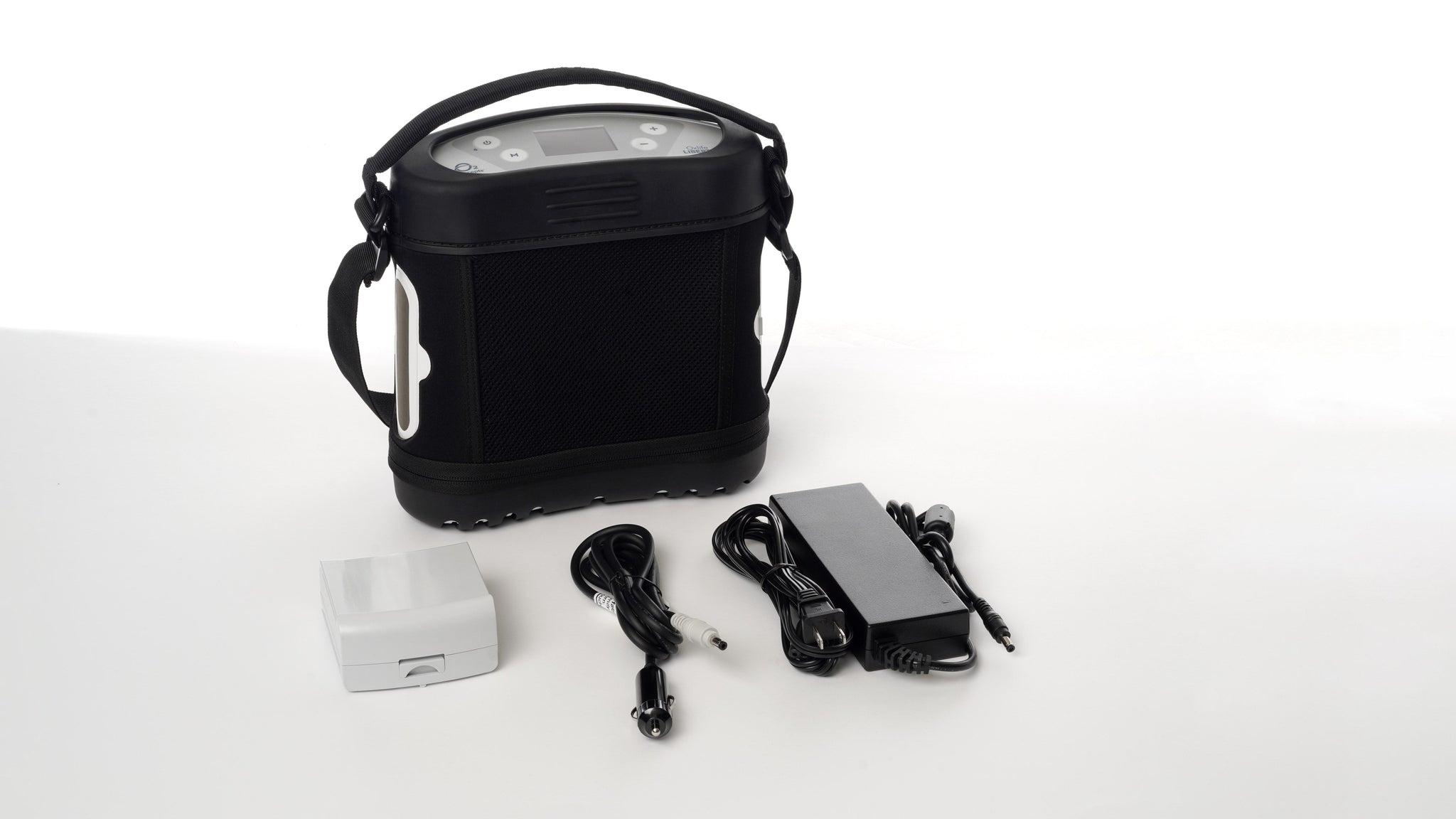
O2 Concepts Oxlife Liberty 2 — Lightest True Continuous Flow
Best for: Readers who need continuous flow and want the lightest carry
If weight is the reason you have put off a continuous-flow portable, the Liberty 2 changes the maths. At about 6.35 pounds, it is the lightest true continuous-flow portable in this list, yet it still delivers 0.5 to 2 LPM continuous flow and pulse settings up to 10. That combination suits daytime errands, travel, overnight use at lower flow, and short trips away from home. The limit is clear: it cannot reach 3 LPM, so readers with a higher prescription should choose a 3 LPM model instead.
- Lightest here at 6.35 pounds
- Continuous flow to 2 LPM
- Pulse settings up to 10
- FAA approved for air travel
- No 3 LPM continuous flow
- About 1 hour at 2 LPM
- 46 dB noise level
4.7/5
4.8/5
4.9/5

O2 Concepts Oxlife Independence — 3 LPM on Wheels
Best for: Readers who need 3 LPM and prefer wheels to carrying
If 3 LPM is non-negotiable but the Eclipse 5 feels too bulky to manage, the Independence offers the same 0.5 to 3 LPM continuous range in a wheeled body with a pull handle. It is still heavy at 16.7 pounds, yet pulling it is easier than carrying it for many readers. It also works with CPAP and BiPAP, and its noise level is lower than the Eclipse 5 at 40 dB. For home, car, and hotel use, it is a strong second choice for high flow.
- 3 LPM continuous flow
- Wheels and pull handle included
- Quiet at 40 dB
- CPAP and BiPAP compatible
- Heavy at 16.7 pounds
- 45 minutes at 3 LPM, one battery
- Large for small cars
4.9/5
4.7/5
4.7/5

Philips Respironics SimplyGo — One Unit, Day and Night
Best for: Readers who want one simple unit for home and travel
If you want a single machine that covers the day and the night without a steep learning curve, the SimplyGo is still the easiest continuous-flow portable to live with. At 10 pounds with battery, it offers continuous flow up to 2 LPM, pulse settings 1 to 6, and a dedicated sleep mode for overnight use. It runs on AC, DC, or battery, so it moves from home to car to hotel without a second device. The catch is availability: Philips discontinued it as a new unit, so most buyers now find recertified stock.
- Continuous flow to 2 LPM
- Sleep mode for overnight use
- Only 10 pounds with battery
- AC, DC, and battery power
- Discontinued as a new unit
- No 3 LPM continuous flow
- Short runtime at 2 LPM
4.6/5
4.7/5
4.8/5

GCE Zen-O — Quiet Continuous Flow for Daily Use
Best for: Readers who want quieter flow at home and out
If noise bothers you at night or in a quiet room, the Zen-O deserves a close look. It delivers continuous flow up to 2 LPM and pulse settings 1 to 6, at 10.25 pounds, with a pulse noise level of about 38 dB. A second battery can extend pulse runtime to about eight hours, which helps on long days away from power. The warning is the same as for other 2 LPM models: continuous flow at 2 LPM drains the battery in about 45 minutes on one battery, so plan power first.
- Quiet at 38 dB on pulse
- Continuous flow to 2 LPM
- Second battery extends runtime
- FAA approved for air travel
- 52 dB on continuous flow
- No 3 LPM continuous flow
- Short runtime at 2 LPM
4.6/5
4.7/5
4.7/5

Drive DeVilbiss iGo — Steady Flow for Sleep and CPAP
Best for: Readers who need continuous flow overnight or with CPAP
If overnight use is your main need, the original Drive DeVilbiss iGo is built for it. It delivers continuous flow from 1 to 3 LPM and pulse settings 1 to 6, at 40 dB on continuous flow, and it can be used with CPAP or BiPAP equipment in continuous mode. That makes it a practical choice for sleep, when pulse sensors can miss shallow breaths. It is heavy at 19 pounds with battery, and it is an older model, so check current stock and support before you buy. Do not confuse it with the iGo2, which is pulse-only.
- Continuous flow 1 to 3 LPM
- CPAP and BiPAP compatible
- Quiet at 40 dB
- FAA approved for air travel
- Heavy at 19 pounds
- Older model, check stock
- No flow below 1 LPM
4.7/5
4.5/5
4.5/5

CAIRE SeQual eQuinox — Lighter Way to Reach 3 LPM
Best for: Readers who need 3 LPM but want less weight than Eclipse 5
If the Eclipse 5 is too heavy but you still need 3 LPM, the eQuinox is the lighter CAIRE answer. At 14 pounds with battery, it delivers continuous flow from 0.5 to 3 LPM and pulse settings up to 9, with a cart for moving it around. It was described as the lightest portable able to offer 3 LPM continuous flow when it launched. It is now discontinued by the manufacturer, so treat it as a used or recertified option, and confirm battery health and support before you buy.
- 3 LPM continuous flow
- Lighter at 14 pounds
- Pulse settings up to 9
- FAA approved for air travel
- Discontinued by manufacturer
- Short runtime at 3 LPM
- 46 dB at 3 LPM
4.8/5
4.4/5
4.4/5

CAIRE SeQual Eclipse 3 — Older 3 LPM Workhorse
Best for: Readers looking for a used 3 LPM Eclipse at a lower outlay
If you are shopping used or recertified and want 3 LPM without buying the newest Eclipse, the Eclipse 3 is the older model to check first. It delivers 0.5 to 3 LPM continuous flow and pulse settings up to 9, in the same 18.4-pound body as the Eclipse 5, with autoSAT technology that adjusts delivery as your breathing rate changes. Battery time is about 3.7 hours at 1 LPM continuous and about 1.3 hours at 3 LPM. Buy it only after checking battery health, hours, and warranty.
- 3 LPM continuous flow
- autoSAT adjusts to breathing rate
- FAA approved for air travel
- Proven Eclipse platform
- Older model, mostly used stock
- Heavy at 18.4 pounds
- 48 dB at 3 LPM
4.8/5
4.4/5
4.3/5

Invacare SOLO2 — Quiet Older Transportable
Best for: Readers who want a quiet used unit for home and travel
If quiet operation matters more than the newest features, the SOLO2 is worth checking in used stock. It delivers continuous flow from 1 to 3 LPM and pulse settings 1 to 5, at under 39 dB at 2 LPM continuous, which is the quietest figure in this list. It comes with a wheeled cart, works with CPAP and BiPAP in continuous mode, and is FAA approved. It is discontinued, heavy at 17 pounds before the battery, and slow to recharge, so buy it only with a clear warranty and battery check.
- Under 39 dB at 2 LPM
- Continuous flow 1 to 3 LPM
- Wheeled cart included
- CPAP and BiPAP compatible
- Discontinued, used stock only
- 17 pounds before battery
- 4.5 hour recharge time
4.7/5
4.3/5
4.3/5

O2 Concepts Oxlife Liberty — Compact Wearable Flow
Best for: Readers who need light continuous flow up to 1.5 LPM
If your prescription is 1.5 LPM or less and you want the smallest continuous-flow body you can wear, the original Oxlife Liberty is the compact option in this list. At 6.35 pounds, it delivers continuous flow from 0.5 to 1.5 LPM and pulse settings 1 to 9, with up to 4.5 hours on pulse and up to 3.25 hours on continuous flow. It is the predecessor to the Liberty 2, which raises continuous flow to 2 LPM, so choose the Liberty 2 if you may need that extra flow later.
- Light at 6.35 pounds
- Continuous flow to 1.5 LPM
- Pulse settings 1 to 9
- FAA approved for air travel
- Only 1.5 LPM maximum
- Older than Liberty 2
- 1.5 hours at 1.5 LPM
4.3/5
4.5/5
4.5/5
Top 3 Head-to-Head: Eclipse 5 vs Liberty 2 vs Independence
These three are the most common final choices, because they cover the three real trade-offs in this category: highest flow, lightest carry, and wheeled high flow.
| Feature | #1 Eclipse 5 | #2 Liberty 2 | #3 Independence |
|---|---|---|---|
| Continuous Flow Output | 0.5 to 3 LPM — Best | 0.5 to 2 LPM | 0.5 to 3 LPM |
| Battery Life | Up to 5.1 hours on pulse setting 2 | Up to 4 hours on pulse — Best | About 2 hours 53 minutes at 2 LPM |
| Ease of Use | 18.4 pounds, cart carry | 6.35 pounds, wearable — Best | 16.7 pounds, wheels and handle |
| Choose if… | You need 3 LPM and CPAP support | You need 2 LPM or less and light carry | You need 3 LPM and prefer wheels |
Who These Concentrators Are NOT For
Continuous-flow portables solve a specific problem. For many readers, a lighter pulse-only model is the better fit.
These models are also not a substitute for a stationary home concentrator if you need continuous flow above 3 LPM, or for life support. They are prescription devices, and the setting must match your doctor’s order. If you are unsure which mode you need, ask your doctor before you buy.
Common Mistakes to Avoid
These are the errors that cost readers the most time, money, and comfort with a continuous-flow portable.
Frequently Asked Questions About Portable Oxygen Concentrator Continuous Flow
What is the difference between pulse dose and continuous flow oxygen?
Pulse dose delivers a short burst of oxygen only when you inhale, while continuous flow delivers a steady stream in liters per minute, whether you are inhaling or not. Pulse dose is lighter and uses less battery, while continuous flow suits sleep, shallow breathing, and CPAP use. Your prescription decides which mode you need, so do not switch modes without your doctor’s guidance.
Do you need a prescription for a portable oxygen concentrator with continuous flow?
Yes, portable oxygen concentrators are prescription medical devices in the US. You need a prescription that states the delivery mode and setting, such as continuous flow at 2 LPM. A seller will usually ask for it before shipping. Bring that prescription to your doctor if your needs change, rather than raising the setting yourself.
Can you use a portable oxygen concentrator with continuous flow while sleeping?
Yes, continuous flow is often the better choice for sleep, because it keeps flowing even if your breathing becomes shallow or irregular. Pulse sensors can miss a breath at night. Choose a model that covers your prescribed overnight LPM, plan AC power or a spare battery, and confirm the setting with your doctor before using it overnight.
Can you take a continuous flow portable oxygen concentrator on an airplane?
Yes, if the model is FAA approved, which all 10 models in this list are. You still need a prescription and enough battery for the flight plus delays, because airlines do not supply oxygen. Tell the airline in advance, carry spare batteries in your cabin bag, and check the airline’s battery and notification rules before you travel.
How long does the battery last on continuous flow?
It depends on the LPM setting, and it is much shorter than on pulse dose. At 1 LPM, several models run for about two to three hours on one battery. At 2 to 3 LPM, many run for about one hour or less. Always check the battery time at your exact LPM, carry a spare battery for longer outings, and use AC power overnight when you can.
How loud are continuous flow portable oxygen concentrators?
Most models in this list run at about 38 to 52 decibels, and noise rises with the flow setting. The quietest at 2 LPM continuous is the Invacare SOLO2 at under 39 dB, while the Zen-O is quiet on pulse at 38 dB but reaches 52 dB on continuous flow. If you are a light sleeper, check the noise figure at your prescribed LPM, not at the lowest setting.
Can you use a continuous flow concentrator with a CPAP or BiPAP machine?
Yes, continuous flow is the mode usually used with CPAP or BiPAP, because it provides a steady stream that the machine can use. Models in this list that state CPAP and BiPAP compatibility include the Eclipse 5, Independence, iGo, and SOLO2. Ask your doctor or equipment supplier to confirm the connection and setting for your exact CPAP or BiPAP model before you use them together.
Our Final Verdict
The choice comes down to your prescribed LPM first, then weight and battery. If you need 3 LPM, pick the Eclipse 5 or Independence. If 2 LPM or less is enough, the Liberty 2 gives you continuous flow in the lightest body here.

Hi, I’m Michael Turner. I own a generator workshop in the United States and founded HomeGeneratorBlog to share practical, hands-on guidance about generator installation, maintenance, troubleshooting, safety, and backup power solutions. My goal is to help homeowners make smarter, more confident decisions through clear and reliable information