Can an Inverter Generator Run a Sump Pump? Sizing, Wattage, Runtime & Safe Backup
Quick Answer
Yes, an inverter generator can run a sump pump if it covers the pump’s starting watts, not just its running watts. Most 1/3 to 1/2 HP sump pumps need 800 to 1,500 running watts and 2,000 to 4,000 starting watts. Pick a generator with at least 3,000 starting watts for a typical 1/2 HP pump, and check your pump label before you buy. See the best generator for a sump pump for models sized for this exact job.
The short sizing rule
- Start with starting watts: A pump motor draws a short surge at startup, often 2 to 3 times its running watts.
- Size for 3,000 watts: A 3,000 to 4,000 starting-watt inverter generator covers most 1/3 and 1/2 HP pumps.
- Turn eco mode off: Eco-throttle can react too slowly to a pump surge, so run at full speed for pump duty.
- Use a short, heavy cord: A 12-gauge, 25-foot outdoor extension cord limits voltage drop on startup.
- Run one pump only: Do not add a fridge, furnace, or well pump to the same small generator at the same time.
If the pump will not start
- Switch eco mode off, unplug other loads, and try again with a shorter cord.
- If it still trips the overload, your generator is too small for that pump’s surge.
I’ve run a sump pump through a storm outage, and the sound that matters most is the pump kicking on every few minutes. That cycle is what keeps a basement dry when the rain will not stop.
This guide goes deeper than a yes-or-no answer. You’ll get real wattage math, a size chart by pump type, safe hookup steps, runtime math, and the mistakes that trip small generators.
In This Guide
- What Size Inverter Generator Do I Need for a Sump Pump?
- How Many Watts Does a Sump Pump Use?
- Can a 2000-Watt Inverter Generator Run a Sump Pump?
- How to Connect an Inverter Generator to a Sump Pump Safely
- How Long Can an Inverter Generator Run a Sump Pump?
- Inverter Generator vs Conventional Generator for a Sump Pump
- What If Your Sump Pump Won’t Start on a Generator?
- Best Setup for Storm Outages: Battery Backup vs Generator
- Frequently Asked Questions
What Size Inverter Generator Do I Need for a Sump Pump?
For most homes, a 3,000 to 4,000 starting-watt inverter generator is the safe pick for a sump pump. That size covers the startup surge of a typical 1/3 or 1/2 HP pump and leaves a small margin.
A larger 3/4 or 1 HP pump needs more headroom. Plan on 4,500 to 5,500 starting watts for those pumps, and check the label first.
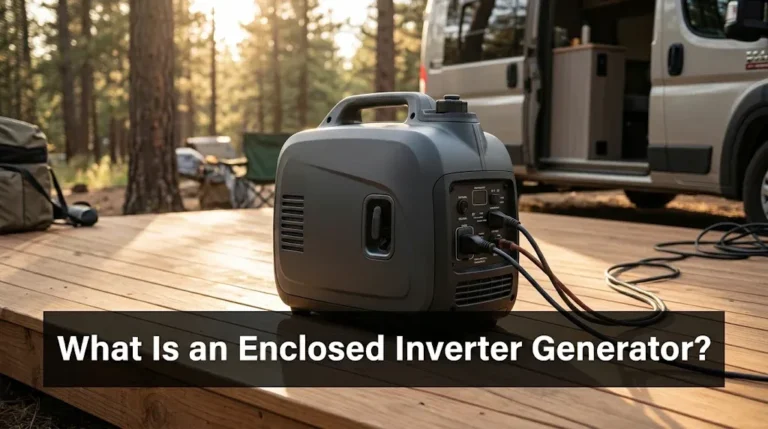
An inverter generator is a portable generator that makes clean, stable power
An inverter generator is a portable generator that converts raw engine power into clean sine wave power. Clean sine wave means smooth, steady AC power that is safe for motors and electronics.
That matters for a sump pump because the motor starts and stops often. Stable voltage helps the motor start cleanly and run without strain.
How to size your generator in 3 steps
- Read the pump label for running watts, amps, and HP, or check the manual.
- Multiply running watts by 2.5 to estimate starting watts if the label lists running watts only.
- Pick a generator whose starting watts beat that number by at least 20%.
I learned this the hard way during a wet spring outage. My 2,000-watt unit ran the pump fine once it was going, but it tripped on the first hard start after a heavy rain burst.
The fix was not a new pump. It was a bigger generator with enough surge headroom for that first second of startup.
Use our sizing guide for what size inverter generator you need if you also plan to run a fridge or a few lights. Add the running watts of every other load to the pump’s starting watts.
Section Takeaway: Size by starting watts, not running watts, and add at least 20% headroom above your pump’s surge.
How Many Watts Does a Sump Pump Use?
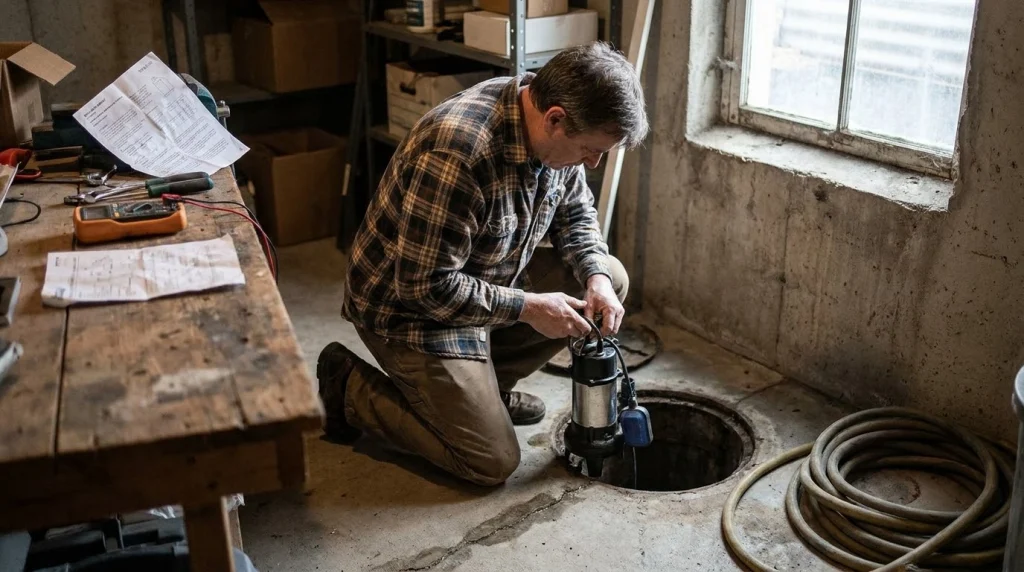
A typical sump pump uses 800 to 1,500 running watts and 2,000 to 4,000 starting watts. The exact numbers depend on HP, pump age, lift height, and how much water it moves.
Older pumps and pumps pushing water up a tall lift use more power. A clean, newer 1/3 HP pump often sits at the low end of the range.
Sump pump wattage by size
| Pump size | Running watts | Starting watts | Generator to aim for |
|---|---|---|---|
| 1/4 HP | 600-800 | 1,500-2,000 | 2,500 starting watts |
| 1/3 HP | 800-1,000 | 2,000-3,000 | 3,000 starting watts |
| 1/2 HP | 1,000-1,500 | 3,000-4,000 | 4,000 starting watts |
| 3/4 HP | 1,500-2,000 | 4,000-5,000 | 5,000 starting watts |
| 1 HP | 2,000-2,500 | 5,000-6,000 | 6,000+ starting watts |
These are typical ranges, not specs for one model. Always check your pump label and your generator spec sheet before you rely on them.
Running watts is the steady power a motor uses while it runs. Starting watts, also called surge watts, is the short burst it needs for the first 1 to 3 seconds.
Why starting watts catch people out
A sump pump does not run nonstop. It starts, pumps the pit down, stops, and starts again when water returns.
Each start is a fresh surge. A generator that can hold the running load may still trip on the fifth or tenth start if the surge is too close to its limit.
That is why starting wattage in an inverter generator matters more than the headline running watts. Read both numbers on the spec sheet, not just the bigger one on the box.
Section Takeaway: Most 1/3 to 1/2 HP pumps need 2,000 to 4,000 starting watts, so match the generator to the surge, not the steady draw.
Can a 2000-Watt Inverter Generator Run a Sump Pump?
Sometimes, but only for a small pump. A 2,000-watt inverter generator can run a 1/4 HP or a light 1/3 HP sump pump if nothing else is plugged in.
It will struggle with most 1/2 HP pumps. The surge alone can hit or pass its starting limit.
When a 2,000-watt generator works
- Small pump: 1/4 HP, with starting watts under 2,000.
- Short lift: Low head height, so the motor works less on startup.
- Clean pump: No debris, no stuck float, and a free impeller.
- No other loads: Pump only, with eco mode off.
If all four are true, a 2,000-watt unit can keep a basement dry in a pinch. It is a backup plan, not a comfortable one.
When it will not work
A 1/2 HP pump with a 3,500-watt surge will trip a 2,000-watt generator on startup. The overload light will flash, and the pump will stall.
A long, thin extension cord makes it worse. Voltage drops over distance, so the motor draws more current to start.
Two pumps are also too much for this size. A primary pump plus a backup pump can surge at the same time after a heavy rain.
Work through how to calculate the generator wattage you need before you buy. Add the pump’s starting watts first, then add running watts for anything else.
Section Takeaway: A 2,000-watt generator suits only a small 1/4 or light 1/3 HP pump on its own; most 1/2 HP pumps need a bigger unit.
How to Connect an Inverter Generator to a Sump Pump Safely
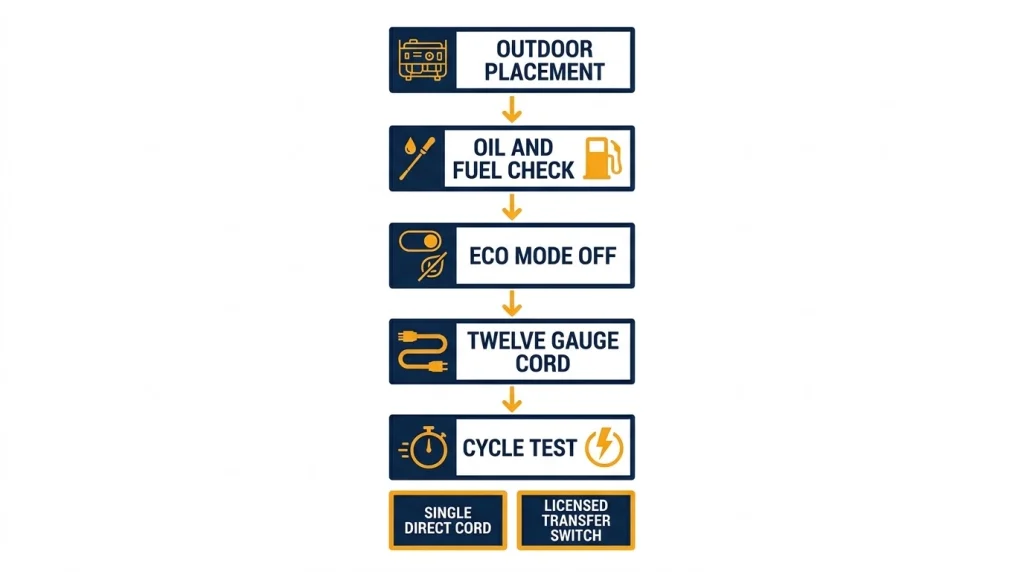
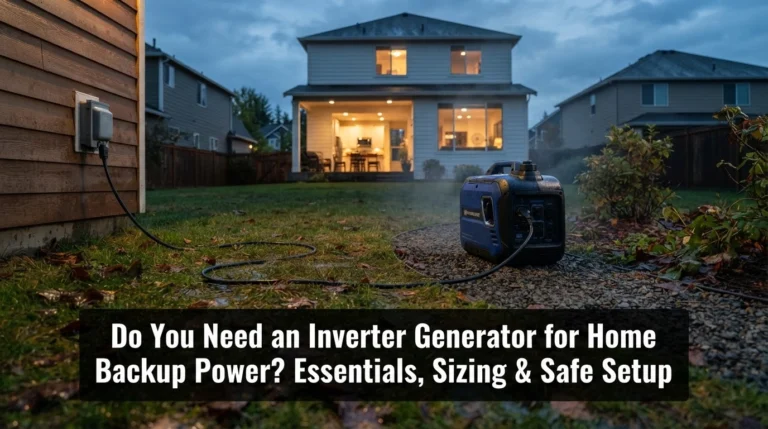
Connect the pump with a single heavy outdoor extension cord, straight from the generator to the pump plug. Do not use a power strip, a light indoor cord, or a backfeed plug into a wall outlet.
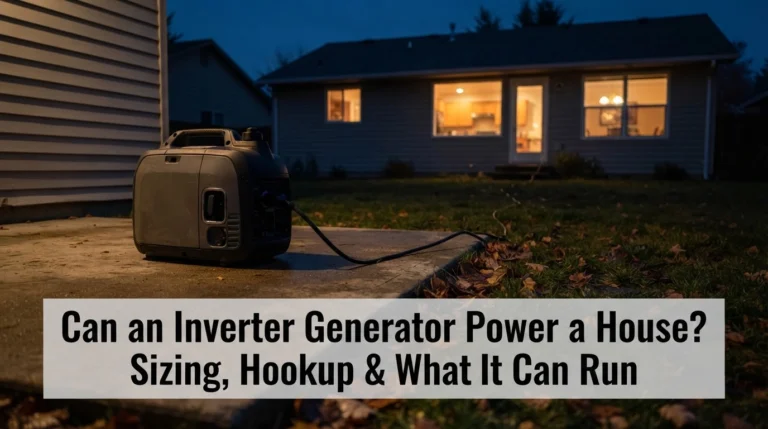
Keep the generator outdoors, at least 20 feet from the house, with the exhaust pointed away from doors and windows. That distance is the core rule for carbon monoxide safety.
Safety note: Run generators outdoors only, well away from windows, doors, and vents. Never run one in a basement, garage, or under a covered porch, and never backfeed your home wiring.
Step-by-step hookup
- Place the generator outdoors on dry, level ground, at least 20 feet from the house.
- Check oil and fuel, then start the generator with no load plugged in.
- Turn eco mode off so the engine is ready for the pump surge.
- Run a 12-gauge outdoor cord through a window or door gap to the pump, and keep the connection dry and off the floor.
- Plug the pump directly into the cord, watch one full pump cycle, and check for a smooth start.
- Keep the cord clear of water, and do not let the generator or the plug sit in a puddle.
Test this setup before a storm, not during one. A dry run in daylight shows you the cord length, the cord path, and whether the pump starts cleanly.
I test mine every spring before storm season. It takes 15 minutes, and it has saved me from a flooded basement more than once.
What about a transfer switch or inlet?
A transfer switch is a panel device that safely connects a generator to home circuits. An inlet is the outdoor plug that feeds that switch.
For a sump pump, a direct cord is often simpler and safer for a portable setup. A transfer switch makes sense if you want the pump on a house circuit with other essentials.
Only a licensed electrician should install a transfer switch, inlet, or interlock kit. Never use a suicide cord or backfeed a dryer outlet, as that can kill a utility worker.
The Consumer Product Safety Commission and the Centers for Disease Control and Prevention both stress outdoor placement and keeping generators away from the home. Follow their guidance, and check your owner’s manual before use.
Section Takeaway: Use one heavy outdoor cord, keep the generator outside and far from the house, and test the full setup before the storm hits.
How Long Can an Inverter Generator Run a Sump Pump?
A sump pump runs in short cycles, so runtime depends on how often it starts, not just the tank size. A 3,000-watt inverter generator with a 1 to 2 gallon tank can often run a 1/2 HP pump for 8 to 12 hours at light duty.
Heavy rain changes that fast. If the pump cycles every 2 to 3 minutes, fuel use climbs and runtime can fall by half.
What affects runtime most
- Cycle rate: More starts mean more surge power and more fuel.
- Load: A pump plus a fridge drains a tank far faster than a pump alone.
- Eco mode: Eco helps between cycles, but turn it off if starts get rough.
- Tank size: A larger tank or a dual-fuel propane setup stretches the night.
Plan fuel for the storm, not for one calm hour. I keep at least 10 gallons of fresh, stabilized gasoline on hand for a multi-day outage, plus oil for a mid-run top-up.
Check oil every 8 to 12 hours of run time, per your manual. Low oil can shut the generator down right when the rain peaks.
For a full outage plan, see best portable generator for emergency preparedness. It covers fuel, cords, and the other essentials to stage with your pump setup.
Section Takeaway: Expect 8 to 12 hours on a typical tank at light duty, less in heavy rain, so stage extra fuel and check oil often.
Inverter Generator vs Conventional Generator for a Sump Pump
An inverter generator is the better pick for most sump pumps. It gives cleaner power, runs quieter, and sips fuel between pump cycles.
A conventional open-frame generator can also run a pump. It is often cheaper per watt, but it is louder and less fuel-efficient at light loads.
| Feature | Inverter generator | Conventional generator |
|---|---|---|
| Power quality | Clean sine wave, low THD | Rougher power, higher THD |
| Noise | Quieter, often 50-60 dB range | Louder, often 70+ dB range |
| Fuel use at light load | Lower, thanks to eco-throttle | Higher, engine runs at fixed speed |
| Cost per watt | Higher upfront | Lower upfront |
| Best for | One pump, overnight, near neighbours | Big pump plus other heavy loads |
THD means total harmonic distortion, a measure of how clean the power is. Lower THD is kinder to motors and electronics.
If your pump has a smart float switch or a control panel, clean power is worth the extra cost. A rough waveform can confuse sensitive controls over time.
Check the U.S. Department of Energy for general backup-power guidance. For independent product notes, Consumer Reports is a useful starting point before you compare models.
Section Takeaway: Choose an inverter for clean, quiet, fuel-efficient pump duty; choose a conventional unit only when you need cheap watts for several heavy loads at once.
What If Your Sump Pump Won’t Start on a Generator?
Start with the simple fixes first. Turn eco mode off, unplug other loads, and shorten the cord.
Most no-start problems are sizing, cord, or pump issues. Work through them in order before you blame the generator.
Checklist for a pump that trips the overload
- Eco mode off: The engine needs full speed to meet the surge.
- Short, heavy cord: Use 12-gauge, 25 feet or less, with no daisy-chained cords.
- One load only: Unplug the fridge, lights, and chargers, then try the pump alone.
- Free the pump: Check the float, clear debris, and make sure the impeller spins freely.
- Check the breaker: Reset the generator breaker and the pump’s GFCI outlet if tripped.
A stuck float is a common culprit after a flood. The pump tries to start under load, draws a huge surge, and trips the generator.
A long 16-gauge cord is another one. It looks fine, but the voltage drop on startup can be enough to stall the motor.
If the pump starts on wall power but not on the generator, the generator is likely too small. If it will not start on either, the pump or its switch needs service.
Safety note: Unplug the pump before you reach into the pit or clear debris. Never work on a pump while it is connected to power.
Section Takeaway: Turn eco off, shorten the cord, run the pump alone, and check the float; if it still trips, you need more starting watts.
Best Setup for Storm Outages: Battery Backup vs Generator
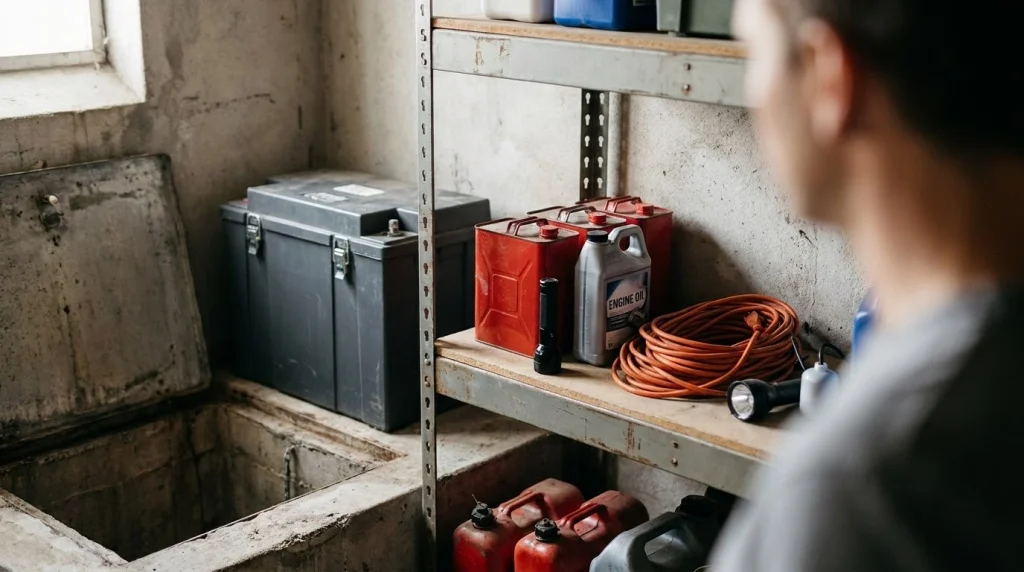
The best setup for most homes is both: a battery backup for instant cover, and a generator for long outages. The battery bridges the gap while you set up the generator.
A battery alone will not last through a multi-day storm. A generator alone leaves a gap if the power fails at 2 a.m. in heavy rain.
How the two work together
- Battery backup: Kicks in at once, runs the pump for a few hours, and needs no fuel.
- Inverter generator: Takes over for the long haul, and can recharge the battery between storms.
- Second pump: A backup pump in the same pit adds cover if the main pump fails.
Test the battery monthly, and replace it per the maker’s schedule. A dead backup battery is worse than no battery, because it gives false peace of mind.
If you have a well pump too, plan for it separately. A well pump often needs far more starting watts than a sump pump, so see the best generator for a well pump before you size one generator for both.
Stage your kit before storm season: generator, fuel, oil, a 12-gauge cord, a flashlight, and a spare float switch. Keep it all in one dry spot near the door you will use.
Section Takeaway: Pair a battery backup for instant cover with an inverter generator for long outages, and test both before storm season.
Frequently Asked Questions
Can an inverter generator run a sump pump and a refrigerator at the same time?
Yes, if the generator covers the pump’s starting watts plus the fridge’s running watts. A 1/2 HP pump plus a fridge often needs 4,000 to 5,000 starting watts, so a small 2,000-watt unit will not do it.
What size inverter generator do I need for a 1/2 HP sump pump?
Plan on 4,000 starting watts for a typical 1/2 HP pump. That covers a 3,000 to 4,000-watt surge with headroom, and leaves a little room for a light or phone charger.
Can I plug my sump pump into a generator with an extension cord?
Yes, use one heavy outdoor cord, 12-gauge and 25 feet or less, plugged straight into the generator. Do not use a light indoor cord, a power strip, or two cords joined together.
Should I turn eco mode on or off for a sump pump?
Turn eco mode off for pump duty. Eco-throttle can react too slowly to the startup surge, which can trip the overload or stall the motor.
Can an inverter generator run a sump pump in the rain?
Yes, but the generator must stay outdoors under a proper running cover or canopy, away from the house. Never run it in a basement or garage, and keep cords and plugs dry and off the ground.
How long will a 3,000-watt generator run a sump pump?
Often 8 to 12 hours on one tank at light duty, when the pump cycles only a few times per hour. Heavy rain with cycles every few minutes can cut that runtime by half, so stage extra fuel.
Do I need a transfer switch to run a sump pump on a generator?
No, a direct heavy cord is fine for most portable setups. A transfer switch is useful if you want the pump on a house circuit, but it must be installed by a licensed electrician.
Closing Takeaway
Yes, an inverter generator can run a sump pump, and it does the job well when you size it right. Pick by starting watts, turn eco mode off, use a short heavy cord, and test the setup before the storm.
For most homes, that means a 3,000 to 4,000 starting-watt inverter generator for a 1/3 or 1/2 HP pump. Pair it with a battery backup for instant cover, stage extra fuel, and your basement will stay dry through the worst of the rain in 2026.

Hi, I’m Michael Turner. I own a generator workshop in the United States and founded HomeGeneratorBlog to share practical, hands-on guidance about generator installation, maintenance, troubleshooting, safety, and backup power solutions. My goal is to help homeowners make smarter, more confident decisions through clear and reliable information