Can an Inverter Generator Run a Television? Wattage, Sizing, Clean Power & Safe
Quick Answer
Yes, an inverter generator can run a television safely. Most modern TVs use only 60 to 400 watts, so even a small 1000-watt inverter generator has plenty of headroom for a TV, a streaming stick, and a router. If you want help picking the right size, start with this guide to inverter generator sizing.
Why it works so well
- Low power draw: A 55-inch LED TV often uses 80 to 150 watts.
- Clean sine wave: Inverter power is stable and safe for sensitive electronics.
- No surge spike: TVs have almost no starting watts, unlike fridges and pumps.
- Quiet operation: You can watch TV without shouting over the generator.
- Long runtime: A small load means many hours per tank in eco mode.
Do this first
- Check the wattage label on the back of your TV, then add 100 watts for a soundbar or streaming device.
- Plug the TV directly into the generator with a short, heavy-duty extension cord.
- Run the generator outdoors, at least 20 feet from your home, with the exhaust pointed away.
I’ve run a TV through a multi-day outage, and it felt like a small win. The lights were out, the fridge was humming on backup power, and my family still got to watch the evening news together.
This guide goes deeper than a simple yes. You’ll learn exact TV wattage by size and type, how to size your generator, how long it will run, and how to protect an expensive OLED or QLED screen.
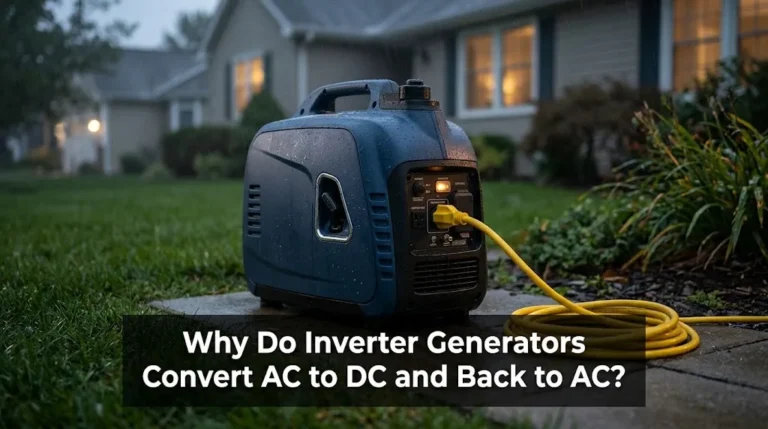
An inverter generator is a portable power source that creates clean, stable electricity for sensitive electronics. It converts raw engine power into a smooth sine wave, much like the power from a wall outlet.
In This Guide
- How Many Watts Does a Television Use?
- Why Are Inverter Generators Safe for TVs?
- What Size Inverter Generator Do You Need for a TV?
- How to Run a TV on an Inverter Generator Step by Step
- How Long Can an Inverter Generator Run a TV?
- Can an Inverter Generator Run a TV and Other Devices at Once?
- Inverter Generator vs Conventional Generator for a TV
- Common Mistakes to Avoid When Powering a TV
- Frequently Asked Questions
How Many Watts Does a Television Use?
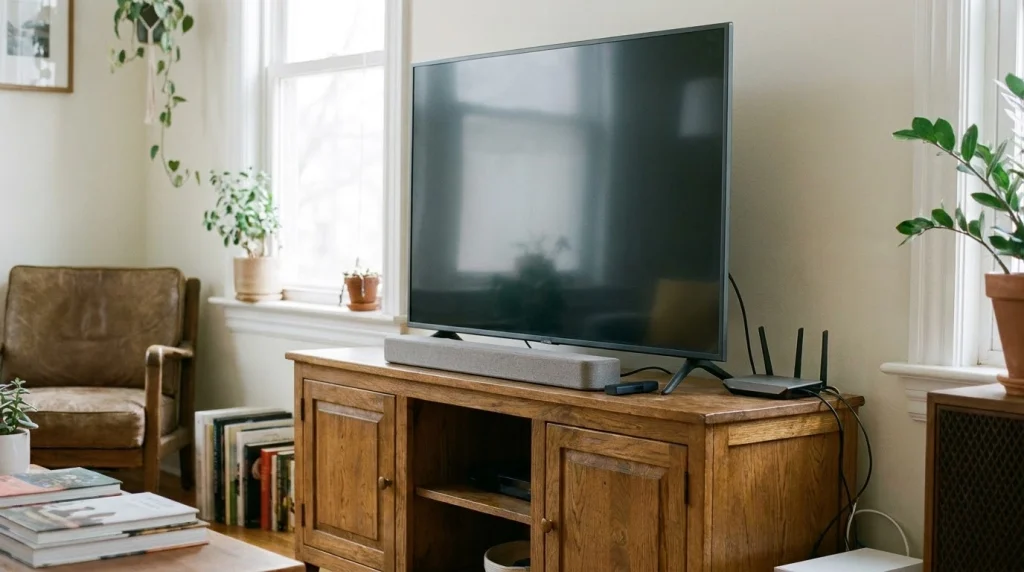
A television uses far less power than most people expect. Most LED TVs draw 60 to 200 watts while running, and even a large 75-inch model often stays under 300 watts.
That low draw is why a TV is one of the easiest loads for backup power. It needs steady power, not a lot of power.
How much power does a TV use by size?
Size matters, but screen type matters more. An older plasma TV can use twice the power of a modern LED TV of the same size.
Use the table below as a starting point. Then check your own TV label for the exact number.
| TV Type and Size | Typical Running Watts | Notes |
|---|---|---|
| 32-inch LED TV | 30 to 60 watts | Ideal for camping and small RVs |
| 43-inch LED TV | 60 to 100 watts | Common bedroom size |
| 55-inch LED / QLED TV | 80 to 150 watts | Most popular living-room size |
| 65-inch LED / QLED TV | 120 to 200 watts | Bright rooms push it higher |
| 65-inch OLED TV | 150 to 250 watts | Bright scenes use more power |
| 75-inch LED TV | 180 to 300 watts | Still easy for a 2000-watt generator |
| 85-inch LED TV | 250 to 400 watts | Add a soundbar and you may hit 500 watts |
| Older plasma TV | 300 to 500 watts | Check the label, it can surprise you |
Brightness is the hidden factor. A TV set to vivid mode in a bright room can use 30 to 50 percent more power than the same TV in cinema or eco mode.
Sound matters too. A built-in speaker adds little, but a soundbar can add 30 to 100 watts.
What about streaming devices, cable boxes, and game consoles?
A TV rarely runs alone. Add the extras before you size your generator.
- Streaming stick: 3 to 10 watts, almost nothing.
- Cable or satellite box: 15 to 40 watts, and it may stay warm in standby.
- Wi-Fi router: 5 to 20 watts, worth keeping on during an outage.
- Soundbar: 30 to 100 watts, depending on size and volume.
- Game console: 70 to 200 watts, with newer consoles at the high end.
- Blu-ray player: 10 to 25 watts.
A typical living-room setup is still light. My own test setup was a 55-inch LED TV, a streaming stick, a router, and a small soundbar.
It drew about 165 watts total. That left a 2000-watt inverter generator barely working.
Section Takeaway: Most TVs use 60 to 400 watts, so check your label, add your streaming device and soundbar, and plan on 150 to 500 watts for a full living-room setup.
Why Are Inverter Generators Safe for TVs?
Yes, inverter generators are safe for modern TVs when you use them correctly. They were built for this kind of load.
A TV is sensitive electronics. It needs clean power, stable voltage, and stable frequency.
What is clean sine wave power?
Clean sine wave power is smooth, steady electricity with very low distortion. Think of it as a smooth wave, not a jagged one.
Your wall outlet supplies a pure sine wave. An inverter generator copies that shape closely.
That matters because a TV power board, processor, and display panel expect that smooth input. Dirty power can cause flicker, buzz, restarts, or long-term damage.
What is THD and why does it matter for a TV?
THD stands for total harmonic distortion. It measures how far the power waveform strays from a perfect sine wave.
Lower is better. Most inverter generators keep THD under 3 percent, which is safe for TVs, laptops, and phones.
Conventional open-frame generators often run at much higher THD. That is why I do not plug an OLED TV straight into a cheap conventional unit without checking the spec sheet first.
If clean power is your top priority, look for a model with low THD. This guide to low-THD portable generators explains what to look for and why it matters for electronics.
Do inverter generators protect against voltage swings?
Yes, in most cases. An inverter generator adjusts engine speed to match the load, then uses electronics to hold voltage and frequency steady.
That stability helps when a fridge compressor kicks on nearby. The TV should not dim, flicker, or reboot.
I learned this during a storm outage. My old conventional generator made the lights pulse when the fridge cycled, and the TV would blink.
The inverter generator did not. The picture stayed steady, even with the fridge on the same unit.
Section Takeaway: Inverter generators are safe for TVs because they deliver clean sine wave power with low THD and stable voltage, which is exactly what modern screens need.
What Size Inverter Generator Do You Need for a TV?
A 1000-watt inverter generator can run most TVs alone. A 2000-watt model is the sweet spot for a TV plus a few extras.
Size it by running watts, not by the big number on the box. That big number is often starting watts.
How do you calculate the size you need?
Add up every device you plan to run at the same time. Then add a 20 percent buffer for safety.
Here is a simple example for a living room:
- 55-inch LED TV: 120 watts
- Streaming stick: 5 watts
- Router: 10 watts
- Soundbar: 50 watts
- Total: 185 watts
That total fits easily on a 1000-watt generator. It also leaves room for phone charging and a lamp.
For a full step-by-step method, use this wattage calculation guide to add up running watts and starting watts for every load.
What size works for each setup?
- 1000 watts: One small to medium TV, streaming stick, and router. Best for camping and tailgating.
- 2000 watts: A large TV, soundbar, router, laptop, and lights. Best all-round choice for home backup.
- 3000 to 3500 watts: TV plus fridge, a few lights, and phone charging. Good for longer outages.
- 4500 watts and up: TV plus fridge, freezer, furnace blower, and more. Best for whole-room backup.
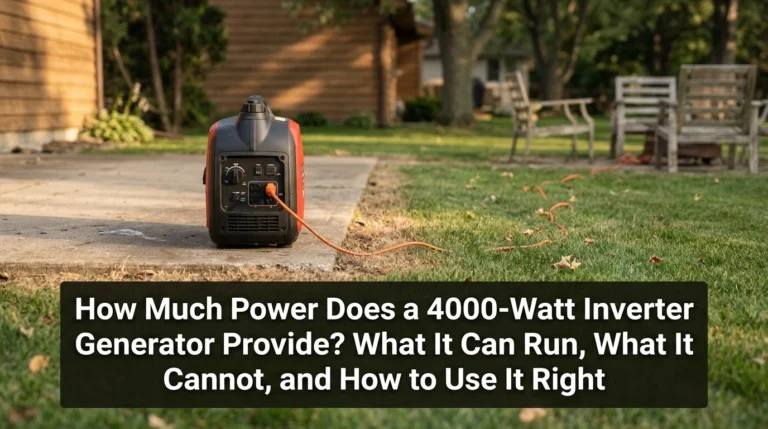
A 2000-watt inverter generator can run a surprising amount. This 2000-watt power guide shows what it can run, what it cannot, and how to use it right.
Do not buy bigger just for a TV. A TV alone does not need 3000 watts.
Buy bigger only if you also want a fridge, freezer, or window AC on the same generator.
Section Takeaway: A 1000-watt inverter generator runs most TVs, a 2000-watt model runs a full entertainment setup, and you should size by total running watts plus a 20 percent buffer.
How to Run a TV on an Inverter Generator Step by Step
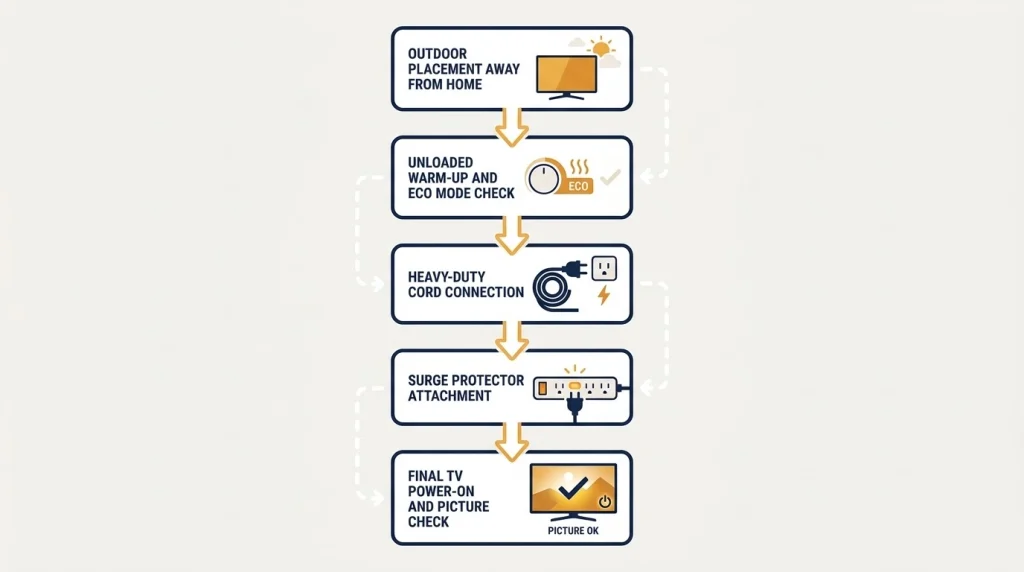
Running a TV on an inverter generator is simple. The setup takes about five minutes once the generator is outside and running.
Follow the steps in order. Start the generator first, then plug in the TV.
Step 1: Place the generator safely outdoors
Place the generator at least 20 feet from your home. Point the exhaust away from windows, doors, and vents.
Never run a generator in a garage, basement, or enclosed porch. Carbon monoxide can build up fast, even with a door open.
Safety note: Run generators outdoors and well away from windows, doors, and vents. Install a battery-powered CO alarm in your home and check your owner’s manual before use.
Step 2: Start the generator and let it warm up
Start the generator with no load plugged in. Let it run for 2 to 3 minutes to stabilize.
Turn eco mode on if you are only running a TV. Eco mode saves fuel and keeps noise down.
Turn eco mode off if the generator surges when you add a large load later. That is common with a fridge compressor.
Step 3: Connect the TV with the right cord
Plug the TV directly into the generator outlet when you can. Use a short, heavy-duty outdoor extension cord if you need distance.
Use a 14-gauge cord for runs under 50 feet. Use a 12-gauge cord for longer runs or higher loads.
Avoid thin indoor cords and daisy-chained power strips. They can overheat and drop voltage.
Step 4: Add a surge protector
Use a quality surge protector between the generator and the TV. It adds a second layer of protection.
Pick one rated for at least 1000 joules. Do not use a cheap strip with no surge rating.
Plug the TV, streaming device, and router into the surge protector. Keep the total load well under the generator rating.
Step 5: Turn the TV on and check the picture
Turn the TV on last. Watch for flicker, buzz, or restarts in the first minute.
If the picture is steady, you are good. If it flickers, check your cord, turn off eco mode, or move the TV to a different outlet.
Section Takeaway: Place the generator outdoors, warm it up unloaded, use a short heavy-duty cord and a surge protector, then turn the TV on last and watch for flicker.
How Long Can an Inverter Generator Run a TV?
A long time. A TV is a light load, so runtime is limited by fuel, not by power.
A 2000-watt inverter generator can often run a 150-watt TV for 8 to 12 hours on a single tank in eco mode. Check your spec sheet for the exact runtime at 25 percent load.
Why does eco mode extend runtime so much?
Eco mode slows the engine when the load is light. A TV draws so little power that the engine can idle down.
That saves fuel and cuts noise. It also means less wear on the generator.
I ran a 55-inch TV, a router, and two phone chargers on a 2200-watt inverter generator during a camping trip. It ran all evening on less than a quarter tank.
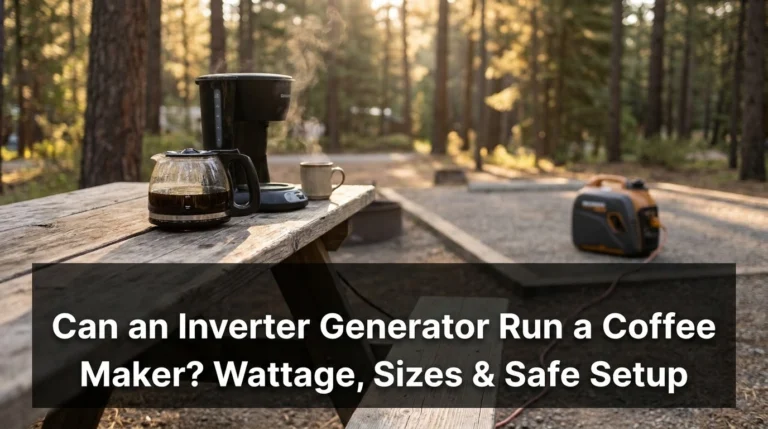
We watched two movies, charged phones, and still had fuel left for the morning coffee maker.
How do you estimate runtime for your setup?
Use this simple math. Divide your generator tank size by its fuel use at your load level.
Most brands list runtime at 25 percent and 50 percent load. A TV setup is often under 10 percent load on a 2000-watt unit, so real runtime can beat the 25 percent figure.
- 1000-watt generator, 1-gallon tank: 6 to 9 hours for a TV alone.
- 2000-watt generator, 1-gallon tank: 8 to 12 hours for a TV and router.
- 3500-watt generator, 2.3-gallon tank: 10 to 14 hours for a TV, fridge, and lights.
Those are general ranges, not promises for a specific model. Check the spec sheet for your generator.
Refuel only after the generator is off and cool. Never refuel a hot or running generator.
Safety note: Let the generator cool for 10 to 15 minutes before refueling. Store fuel in an approved container, away from the running unit.
Section Takeaway: A TV alone can run 8 to 12 hours on a small inverter generator in eco mode, because the load is light and fuel use stays low.
Can an Inverter Generator Run a TV and Other Devices at Once?
Yes, if the total running watts stay under the generator rating. A TV leaves a lot of capacity free.
That spare capacity is useful during an outage. You can keep the news on while you charge phones and run a few lights.
What pairs well with a TV?
- Wi-Fi router and modem: 10 to 30 watts total, keeps streaming working.
- LED lights: 5 to 15 watts each, easy to add.
- Phone and laptop charging: 20 to 65 watts, depending on the device.
- Fan: 30 to 75 watts, useful on a warm night.
- Soundbar: 30 to 100 watts, adds a lot of enjoyment for little power.
A 2000-watt generator can run all of those at once. The total is often under 400 watts.
What should you not add at the same time?
High-draw appliances can overload a small generator fast. Add them one at a time, and check the total first.
- Microwave: 1000 to 1500 watts, plus a surge on startup.
- Space heater: 1000 to 1500 watts, a poor match for a small generator.
- Hair dryer: 1200 to 1800 watts, will trip most 2000-watt units.
- Window AC: 500 to 1500 watts running, with a high starting surge.
If you want a TV plus a fridge, size up. This guide to generators for home essentials helps you plan a realistic outage kit.
For a broader safety view, the Consumer Product Safety Commission shares generator safety guidance for home use.
Section Takeaway: A TV pairs well with a router, lights, chargers, and a fan, but do not add a microwave, heater, or hair dryer to a small generator at the same time.
Inverter Generator vs Conventional Generator for a TV

An inverter generator is the better choice for a TV. A conventional generator can work, but it carries more risk for sensitive screens.
The difference is power quality, noise, and fuel use. For a light, sensitive load, the inverter wins on all three.
| Feature | Inverter Generator | Conventional Generator |
|---|---|---|
| Power quality | Clean sine wave, THD often under 3% | Rougher output, THD often higher |
| TV safety | Safe for OLED, QLED, and LED TVs | Use with care, check THD first |
| Noise | Quiet, often 50 to 60 dB at 25% load | Louder, often 70 dB or more |
| Fuel use at light load | Low, eco mode throttles down | Higher, engine runs at fixed speed |
| Weight and size | Lighter and easier to move | Heavier for the same watts |
| Price | Higher upfront cost | Lower upfront cost |
Running watts and starting watts also work differently here. A TV has almost no starting surge, so the key number is steady running watts.
Learn the difference in this running watts vs starting watts guide before you size any generator.
For energy and backup-power basics, Energy.gov is a useful starting point.
Section Takeaway: Choose an inverter generator for a TV when you can, because it gives cleaner power, lower noise, and better fuel use at light loads.
Common Mistakes to Avoid When Powering a TV
Most TV problems on generator power come from simple setup mistakes. They are easy to avoid once you know them.
I have made a few myself. A long thin cord once made my TV flicker, and I blamed the generator.
The cord was the problem, not the generator.
What mistakes damage a TV or cut power?
- Running the generator indoors: This is dangerous, not just bad for the TV. CO can kill in minutes.
- Using a thin extension cord: A 16-gauge indoor cord can drop voltage over distance.
- Skipping the surge protector: A surge can fry a TV power board in seconds.
- Overloading the generator: Adding a microwave and a TV can trip the breaker mid-show.
- Plugging in before startup: Start the generator unloaded, then add the TV.
- Ignoring stale fuel: Old gas can cause surging, which shows up as flicker.
Check your fuel before an outage, not during one. Fresh fuel and a clean air filter keep voltage steady.
The CDC shares clear carbon monoxide safety guidance for generator use at home.
For independent product and safety notes, Consumer Reports is a helpful reference.
Safety note: Never use a generator in a garage, basement, or near an open window. Use a transfer switch or interlock installed by a licensed electrician for any home hookup.
Section Takeaway: Avoid indoor use, thin cords, no surge protection, and overloads, and your TV will run steady and safe on inverter power.
Frequently Asked Questions
Can a 1000-watt inverter generator run a TV?
Yes, a 1000-watt inverter generator can run most TVs. A 55-inch LED TV uses about 80 to 150 watts, so you still have room for a router and a streaming stick.
Can an inverter generator run an OLED TV?
Yes, an inverter generator can run an OLED TV safely. OLED TVs use more power than LED TVs, often 150 to 250 watts, but the clean sine wave output is ideal for them.
Will a generator damage my TV?
A good inverter generator should not damage your TV. Use a surge protector, a short heavy-duty cord, and a generator with low THD for extra protection.
Can I run a TV and a fridge on the same inverter generator?
Yes, if the generator is big enough. A 2000-watt unit can struggle with a fridge startup surge, so a 3000-watt or larger model is safer for both.
How many watts does a 65-inch TV use on a generator?
A 65-inch LED or QLED TV typically uses 120 to 200 watts. An OLED model of the same size can use 150 to 250 watts, depending on brightness.
Do I need a surge protector for a TV on a generator?
Yes, use a surge protector rated for at least 1000 joules. It protects the TV from voltage spikes when other loads start or stop.
Can I watch TV in an RV with an inverter generator?
Yes, RV use is one of the best fits for this setup. A small inverter generator can power a 32-inch or 43-inch TV, charge phones, and run lights for hours.
Yes, you can run a television on an inverter generator, and it is one of the easiest backup-power wins. Start with your TV wattage, add your streaming device and soundbar, and pick a generator with at least 20 percent headroom.
A 2000-watt inverter generator covers most living rooms with room to spare. It keeps the picture steady, the sound clear, and the fuel use low.
Set it up outdoors, use a surge protector, and enjoy the show. In 2026, a little planning turns a dark outage night into a normal movie night.

Hi, I’m Michael Turner. I own a generator workshop in the United States and founded HomeGeneratorBlog to share practical, hands-on guidance about generator installation, maintenance, troubleshooting, safety, and backup power solutions. My goal is to help homeowners make smarter, more confident decisions through clear and reliable information