Can an Inverter Generator Run a Welder? Sizing, 240V Power & Safe Setup
Quick Answer
Yes, an inverter generator can run a welder, but only if it is big enough, has the right voltage, and can handle the welder’s sharp power spikes. Light 120V MIG and flux-core welders work well on a 4,000- to 5,000-watt inverter generator, while most 240V MIG, TIG, and stick welders need 7,500 watts or more. If you want a shortcut to the right machine, start with our guide to the best generator for welders.
The short sizing rule
- Match running watts: Your generator’s running watts must exceed the welder’s input watts at your chosen amperage.
- Check the outlet: A 240V welder needs a true 240V outlet, not an adapter on a 120V-only generator.
- Allow for spikes: Arc strikes pull a short surge, so leave 20-30% headroom above the steady draw.
- Turn eco mode off: Eco-throttle can lag when the arc starts, so run at full speed while welding.
- Use clean power: Inverter power with low THD protects the welder’s electronics and gives a steadier arc.
If it trips or stalls
- Lower the amperage, shorten the bead, and let the generator recover before the next pass.
- If it still trips, the generator is too small for that welder at that setting.
I’ve run a small MIG welder off an inverter generator on a farm repair, and I’ve also watched a too-small generator shut down mid-bead.
The difference was never the brand on the side. It was watts, voltage, and duty cycle.
This guide walks through real welder wattage, the inverter generator sizes that work, and the setup mistakes that trip breakers. You’ll leave knowing exactly what to buy, what to avoid, and how to weld safely off-grid in 2026.
In This Guide
- What Is an Inverter Generator?
- How Much Power Does a Welder Actually Need?
- What Size Inverter Generator Do You Need to Run a Welder?
- Inverter Generator vs Conventional Generator for Welding
- Can You Run a MIG, TIG, and Stick Welder on an Inverter Generator?
- How to Run a Welder on an Inverter Generator Safely
- What Happens If Your Generator Is Too Small?
- When an Inverter Generator Is Not the Right Choice
- Frequently Asked Questions
What Is an Inverter Generator?
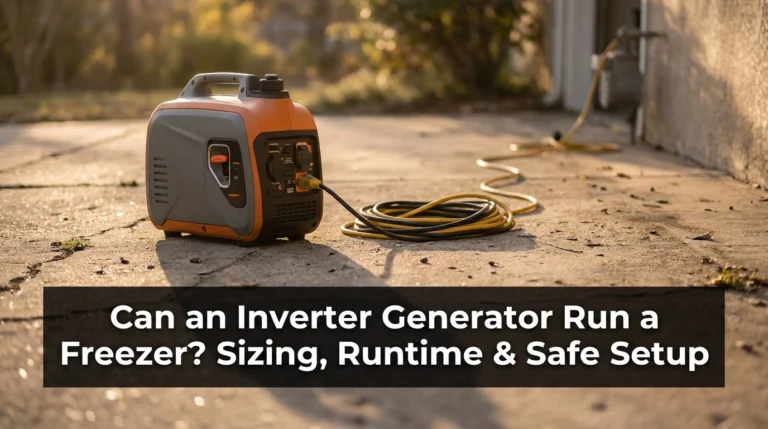
An inverter generator is a portable generator that makes clean, stable power by converting raw AC to DC, then back to pure sine wave AC. That extra step keeps voltage and frequency steady when the load changes.
That stability matters for welding. A welder’s arc starts and stops fast, and it pulls current in sharp bursts.
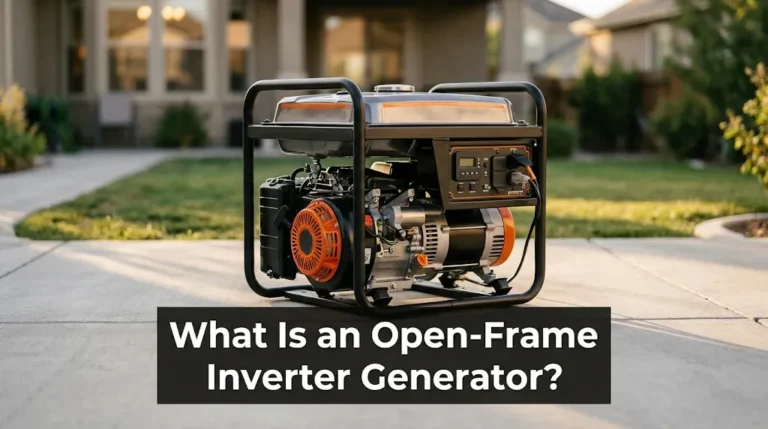
A conventional open-frame generator can sag or surge under that kind of load. An inverter generator reacts faster and holds a cleaner output.
Why clean power helps a welder
Clean sine wave power means the waveform looks like smooth utility power. Low THD, or total harmonic distortion, means less electrical noise.
Most inverter welders list a THD limit in the manual, often under 5%. Check your welder’s manual before you plug it in.
I learned this on a small inverter MIG that kept throwing an error code on a rough open-frame unit. The same welder ran smooth on a quality inverter generator with the same wattage rating.
- Stable voltage: Less arc flicker and fewer restarts.
- Low THD: Safer for inverter-based welders and control boards.
- Quieter operation: Easier to work near a house, shop, or campsite.
- Better fuel use: Eco mode helps at light loads, but turn it off for welding.
Section Takeaway: An inverter generator gives you cleaner, steadier power than a conventional generator, and that clean power is exactly what a modern welder wants.
How Much Power Does a Welder Actually Need?
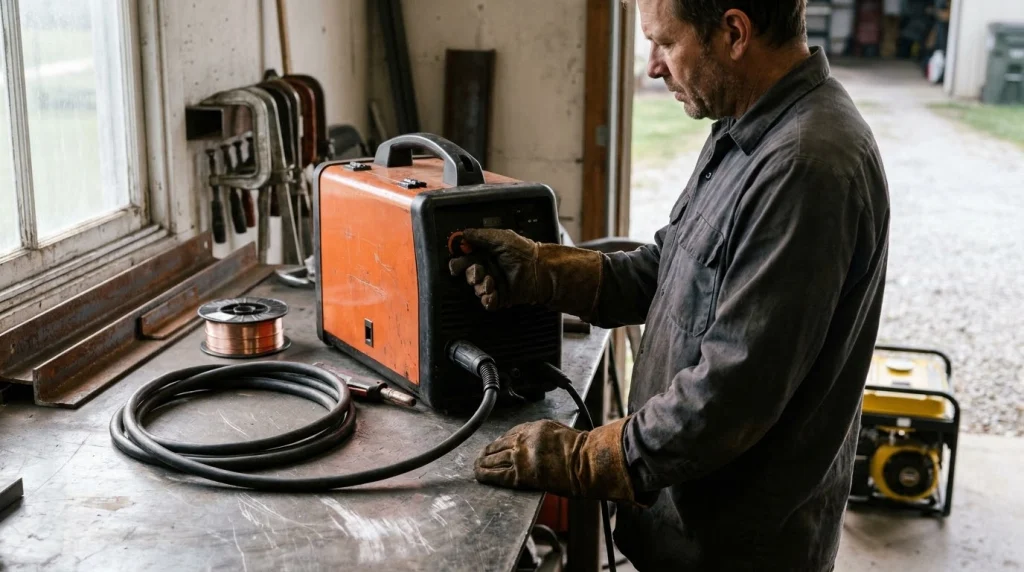
A welder does not draw one fixed wattage. It draws more power as you turn the amperage up, and it spikes when you strike the arc.
That is why the nameplate matters more than the marketing box. Read the input amps and input volts on the welder’s data plate, then do the math.
The simple wattage formula
Watts equal volts times amps. A 120V welder drawing 20 amps needs about 2,400 watts at that setting.
A 240V welder drawing 30 amps needs about 7,200 watts. That jump explains why so many 240V welders overwhelm small generators.
If you want a full walkthrough, use our guide on how to calculate the generator wattage you need before you buy or borrow a unit.
Running watts vs starting watts for welders
Running watts are the steady watts a welder uses while you hold an arc. Starting watts, or surge watts, are the short peak when the arc strikes.
Welders do not surge like a fridge compressor, but they do spike. Plan for that spike, or the generator will trip at the worst moment.
Our explainer on running watts vs starting watts breaks down the same idea for fridges, AC units, and tools.
Typical welder wattage by type
Use these ranges as a starting point only. Your exact model, wire speed, and amperage setting change the draw, so always check the spec sheet.
| Welder type | Typical input draw | Minimum inverter generator | Best for |
|---|---|---|---|
| 120V flux-core, 90-125A | 1,800-2,500W | 3,500W running | Thin steel, farm repairs, light fab |
| 120V MIG, 140A | 2,400-3,500W | 4,000-5,000W running | Auto body, sheet metal, small brackets |
| 240V MIG, 180-200A | 5,000-7,000W | 7,500-9,500W running | Thicker steel, trailers, gates |
| 240V stick, 160-200A | 6,000-8,000W | 9,000-10,000W+ running | Heavy repair, outdoor steel, dirty metal |
| 240V TIG, 200A | 5,500-7,500W | 8,000-10,000W running | Clean, precise welds on steel and aluminum |
Section Takeaway: Size the generator to the welder’s input watts at your real amperage, not to the welder’s output amps alone, and add 20-30% headroom for arc strikes.
What Size Inverter Generator Do You Need to Run a Welder?
The right size depends on three things: welder voltage, welder amperage, and how long you plan to weld. A quick tack weld is not the same as a long bead on thick plate.
Start with the smallest job you actually need to do. Then size up if you want room to grow.
For a 120V welder
A 3,500-watt inverter generator can run a small flux-core welder at low settings. It will feel tight at full power, and it will trip if you push it.
A 4,500- to 5,000-watt inverter generator is the sweet spot for most 120V MIG welders. It gives you headroom, a steadier arc, and room for a grinder between passes.
Do not run the welder and a big grinder at the same time on a borderline unit. Stagger the loads and let the generator settle.
For a 240V welder
A 240V welder needs a generator with a true 240V outlet and enough running watts. Many small inverter generators are 120V only, so check the outlet panel first.
For a 180A MIG, plan on 7,500 watts running or more. For a 200A stick or TIG, plan on 9,000 to 10,000 watts running or more.
If your generator has a 240V outlet, our roundup of the best portable generator with a 240V outlet will help you compare the outlet types and sizes that matter for welding.
Can you parallel two inverter generators?
Yes, if both units are parallel-capable and you use the maker’s parallel kit. Two 3,500-watt units can give you roughly 7,000 watts combined.
Parallel power still stays at 120V unless the kit supports 240V. Check the kit manual, because not every parallel setup makes 240V.
I like parallel setups for camping and home backup, but I prefer one large unit for welding. One engine, one fuel tank, and one set of breakers is simpler on a job site.
For a broader sizing check, see what size inverter generator do I need and match the welder to the size chart there.
Section Takeaway: Choose 4,000-5,000 watts for light 120V welding and 7,500 watts or more for serious 240V welding, and confirm the 240V outlet before you buy.
Inverter Generator vs Conventional Generator for Welding
Both types can run a welder, but they do it in different ways. The best choice depends on your welder type, your budget, and where you weld.
A conventional generator is often cheaper per watt. An inverter generator is cleaner, quieter, and easier on sensitive electronics.
| Factor | Inverter generator | Conventional generator |
|---|---|---|
| Power quality | Clean sine wave, low THD | Rougher waveform, higher THD |
| Noise | Quieter, often 50-65 dB at partial load | Louder, often 70 dB or more |
| Cost per watt | Higher upfront cost | Lower upfront cost |
| Best welder match | Inverter MIG, TIG, and modern stick welders | Old transformer welders, heavy stick work |
| Fuel use | Better at light and mixed loads | Steady at full load, thirstier at light load |
A transformer stick welder is more forgiving of rough power. An inverter welder is not, and it can fault or fail early on dirty power.
If you weld in a neighborhood or near a house, the quieter inverter unit also helps. Your neighbors will notice the difference fast.
Section Takeaway: Pick an inverter generator for modern inverter welders and quiet work, and pick a large conventional unit only when raw watts and low cost matter more than clean power.
Can You Run a MIG, TIG, and Stick Welder on an Inverter Generator?
Yes, but each process behaves differently on generator power. MIG is the easiest to start with, TIG needs the cleanest power, and stick hits the generator hardest.
Match the process to the generator you own, not the other way around. A small generator can still do useful work if you pick the right process and settings.
MIG welding on an inverter generator
MIG is the most forgiving process for generator use. A 120V MIG at 100-130 amps runs well on a 4,000- to 5,000-watt inverter generator.
Flux-core MIG needs no gas bottle, so it suits field repairs. Gas MIG gives cleaner welds, but you must protect the gas from wind.
TIG welding on an inverter generator
TIG needs stable voltage and clean power for a steady arc. A low-THD inverter generator is the right match here.
A 200A TIG at full power can draw 6,000 watts or more, so plan on a large unit. At low amps for thin steel or aluminum, a mid-size unit can work.
Stick welding on an inverter generator
Stick welding is tough, simple, and power-hungry. It tolerates wind, rust, and dirty steel better than MIG or TIG.
A 1/8-inch rod at 120-140 amps can draw 4,000-5,500 watts. A 5/32-inch rod at 170-200 amps can push past 7,000 watts fast.
If you weld mostly with stick, buy the biggest generator you can move and fuel. You will use the headroom every time you strike an arc.
Section Takeaway: MIG is the easiest process on generator power, TIG needs the cleanest power, and stick needs the most watts.
How to Run a Welder on an Inverter Generator Safely
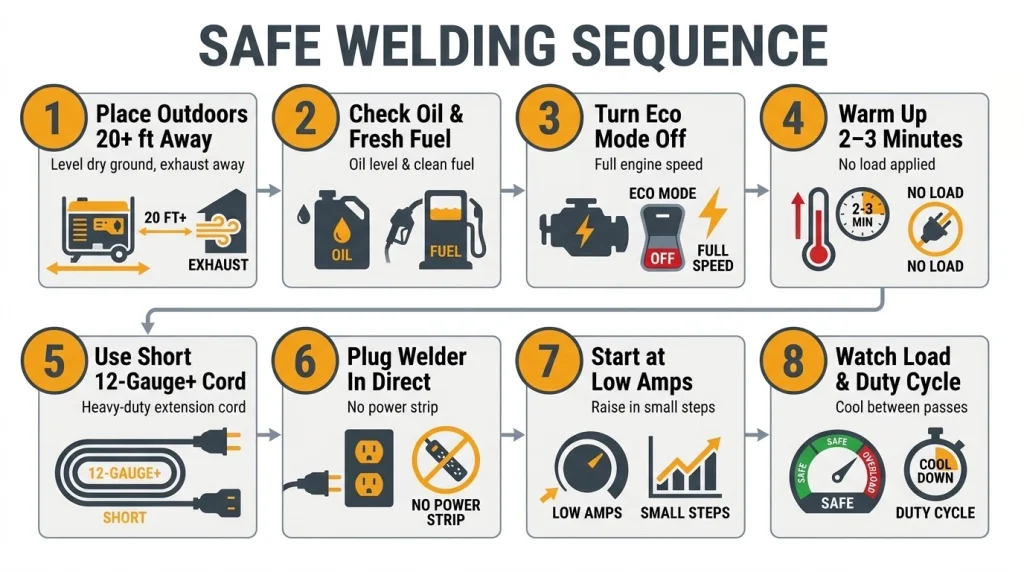
A good setup is simple, but it is not optional. Welding adds heat, sparks, fumes, and high current to a machine that also makes carbon monoxide.
Follow the steps below in order. They take ten minutes, and they prevent most trips, damage, and safety problems.
Safety note: Run the generator outdoors, at least 20 feet from your home, windows, doors, and vents, with the exhaust pointed away. Never run it in a garage, shed, or enclosed shop, even with the door open.
- Place the generator first: Set it on dry, level ground outdoors, away from sparks and flammable material.
- Check oil and fuel: Top up oil to the full mark and use fresh fuel, because stale fuel causes surging under load.
- Turn eco mode off: Let the engine run at full speed before you strike an arc.
- Warm it up: Let it run for two to three minutes with no load.
- Use a short, heavy cord: Use the shortest 12-gauge or heavier extension cord you can, and avoid long, thin cords.
- Plug the welder in direct: Plug it straight into the generator when you can, not through a power strip.
- Start low: Test at a low amperage, watch the arc, and raise the setting in small steps.
- Watch the load: If the engine bogs down or the overload light flashes, stop and lower the setting.
Grounding, cords, and duty cycle
Ground the welder to clean, bare metal close to the weld. A poor ground makes a weak arc and heats the cable.
Respect the welder’s duty cycle, which is the share of ten minutes it can weld at a given amperage. A 30% duty cycle at 140 amps means three minutes of welding, then seven minutes of cooling.
The generator also needs breaks on a hot day. Give it shade, airflow, and time to cool between long beads.
For job-site work, welders often run grinders, lights, and chargers from the same generator. Our guide to the best portable generator for power tools covers that mixed-load problem in more detail.
For safety guidance, see the generator safety information from the U.S. Consumer Product Safety Commission and the carbon monoxide guidance from the CDC. For job-site electrical safety, see OSHA.
Safety note: Keep a fire extinguisher nearby, clear sparks from dry grass and fuel, and wear a welding helmet, gloves, and long sleeves. Let the generator cool before you refuel it.
Section Takeaway: Place the generator outdoors, turn eco mode off, use a short heavy cord, start low, and respect duty cycle on both the welder and the generator.
What Happens If Your Generator Is Too Small?
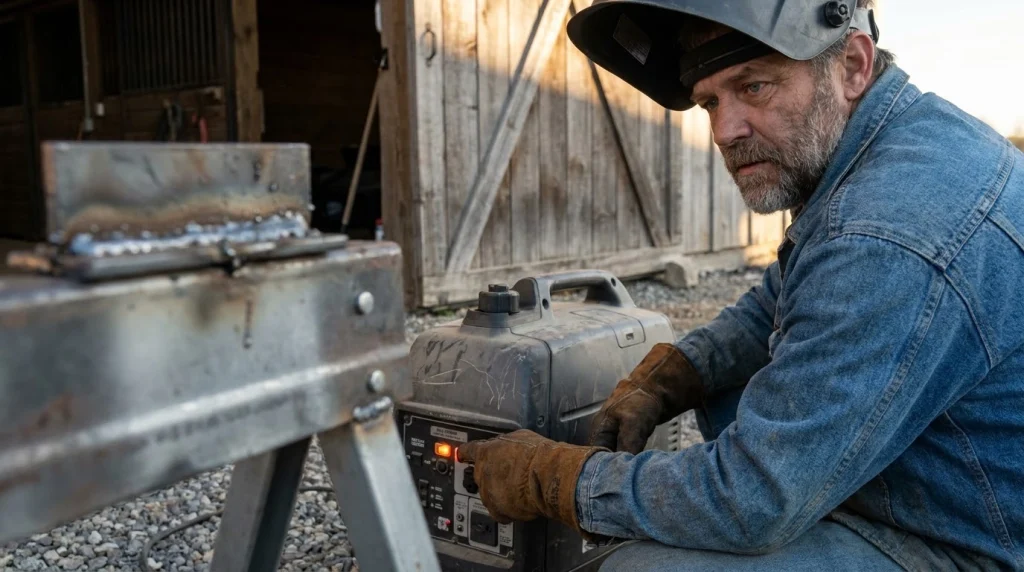
A too-small generator does not just weld badly. It can trip, stall, overheat, and in rare cases damage the welder or the generator.
Watch for these signs early. They tell you to stop before you force the machine past its limit.
- Overload light: The generator trips or flashes overload as soon as you strike the arc.
- Engine bogs down: The engine drops in pitch, surges, or stalls under the weld.
- Weak, sputtering arc: The arc starts, then dies, or it pops and spatters more than usual.
- Breaker trips: The generator breaker or the welder breaker trips after a short bead.
- Hot cords or plugs: A warm plug or cord means too much current for that cord or outlet.
If you see any of these signs, lower the amperage first. Shorten the bead, let the machine cool, and try again at a lower setting.
If the problem stays at low settings, the generator is too small for that welder. Borrow a larger unit, rent one, or switch to a smaller welder for that job.
Section Takeaway: Trips, stalls, and a sputtering arc are not normal, and they mean the generator needs more headroom or the welder needs a lower setting.
When an Inverter Generator Is Not the Right Choice
An inverter generator is a great tool, but it is not the best tool for every welding job. Long, heavy welding is the clearest limit.
If you weld thick steel all day, you need utility power or a large engine-driven welder. A portable inverter generator will run hot, burn fuel fast, and wear out sooner under that load.
- All-day heavy fab: Use shop power or a dedicated welder-generator instead.
- 240V welders over 200A: Most portable inverter generators cannot sustain that draw.
- No 240V outlet: Do not use a homemade adapter to force 240V from a 120V generator.
- Indoor work: Never run any generator indoors, even for a quick weld.
For backup power planning, the U.S. Department of Energy offers general guidance on home energy and generator use. Check your welder and generator manuals first, because they set the real limits for your exact models.
Section Takeaway: Use an inverter generator for mobile, light, and medium welding, and use shop power or a welder-generator for heavy, all-day work.
Frequently Asked Questions
Can a 2000-watt inverter generator run a welder?
No, not for normal welding. A 2,000-watt unit is too small for even a small 120V MIG at working amps, and it will trip on arc strike.
Can a 3500-watt inverter generator run a welder?
Yes, for light flux-core and low-amp MIG work. Keep the amps low, turn eco mode off, and expect limits on thicker metal.
What size generator do I need for a 140-amp MIG welder?
Plan on 4,000 to 5,000 running watts for a 120V 140-amp MIG. That range gives you headroom for arc strikes and a steadier bead.
Do I need a 240V generator to run a 240V welder?
Yes. A 240V welder needs a true 240V outlet on the generator, plus enough running watts for that welder at your setting.
Will welding damage my inverter generator?
It can if you run it overloaded for long periods. Stay within the running-watt rating, keep eco mode off, and let it cool between heavy passes.
Can I run a welder and a grinder on the same generator?
You can, but not at the same time on a borderline unit. Weld first, then grind, or use a larger generator with watts to spare.
Is it safe to weld with a generator in the rain?
No. Keep the generator and the welder dry, work under a proper open-sided shelter, and stop if rain reaches the equipment or cords.
Yes, an inverter generator can run a welder, and it does it best when you size it right. Pick the welder first, read its input watts, then buy the generator with 20-30% headroom and the right outlet.
For light field repairs, a 4,000- to 5,000-watt inverter generator and a 120V MIG is a strong, portable pair. For heavier 240V work, step up to 7,500 watts or more, or use shop power.
Test at low amps, watch for overload signs, and keep the generator outdoors and away from sparks. Do that, and your next off-grid weld will hold.

Hi, I’m Michael Turner. I own a generator workshop in the United States and founded HomeGeneratorBlog to share practical, hands-on guidance about generator installation, maintenance, troubleshooting, safety, and backup power solutions. My goal is to help homeowners make smarter, more confident decisions through clear and reliable information