Are Diesel Inverter Generators Available?
Quick Answer
Yes, diesel inverter generators are available, but they are rare, large, and costly compared with gas inverter models. Most are built for farms, job sites, RVs, and long home-backup runs, not for light camping. If you want clean power for sensitive electronics, check the THD rating first, then compare the size, weight, and fuel use against a diesel portable generator with a conventional design.
The short version
- Yes, but few: Only a small set of makers sell a true diesel inverter model.
- Bigger and heavier: Most units sit in the mid-size to large portable range.
- Clean power: A true inverter model should hold THD under 3%.
- Longer fuel life: Diesel often runs longer per tank at steady load.
- Higher cost: Expect a clear premium over a gas inverter of similar watts.
Before you buy
- Confirm the word inverter in the spec sheet, not just in the product name.
- Add up running watts and starting watts before you choose a size.
- Check the weight, wheels, and lift points before you plan to move it alone.
I have spent a lot of time around gas inverter generators, and I kept asking the same question you are asking now. Diesel sounds like the smart choice for long runs, so why is it so hard to find in inverter form?
This guide answers that question in full, as of 2026. You will learn where diesel inverter models exist, why they are rare, what they can power, and when a gas inverter or a diesel conventional model makes more sense.
In This Guide
- What Is a Diesel Inverter Generator?
- Are Diesel Inverter Generators Available?
- Why Are Diesel Inverter Generators So Rare?
- Diesel Inverter vs Gas Inverter vs Diesel Conventional
- What Can a Diesel Inverter Generator Power?
- How Much Do They Cost, and What Should You Check Before You Buy?
- Are They Good for an RV, Home Backup, or a Job Site?
- Diesel Inverter Generator Maintenance and Safety
- Frequently Asked Questions
What Is a Diesel Inverter Generator?
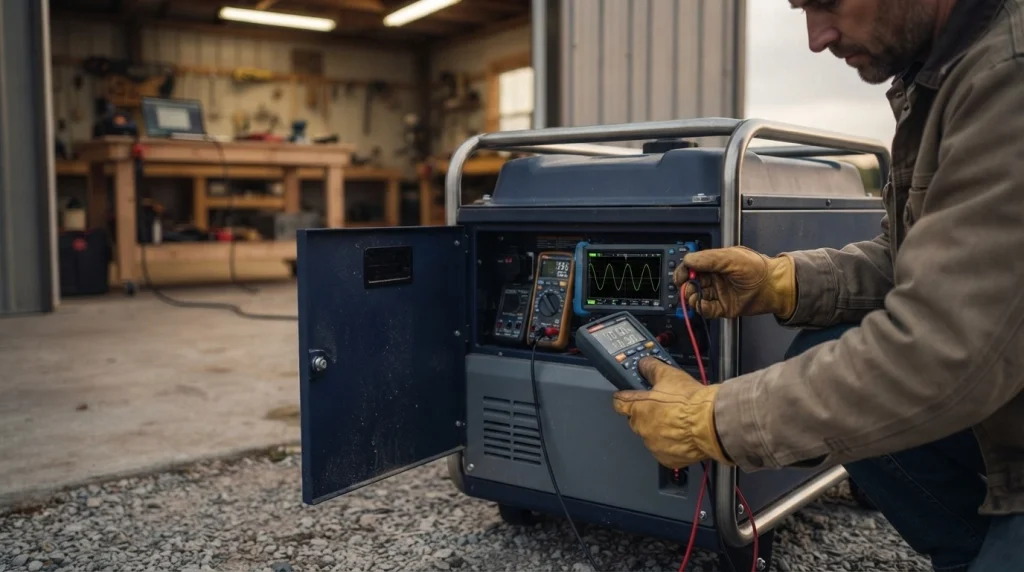
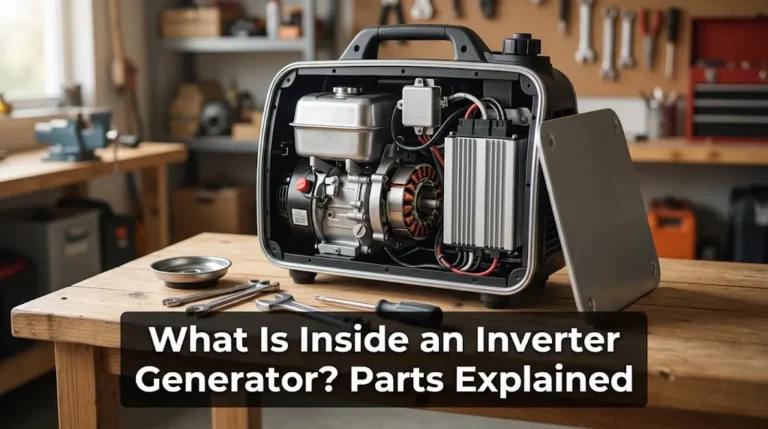
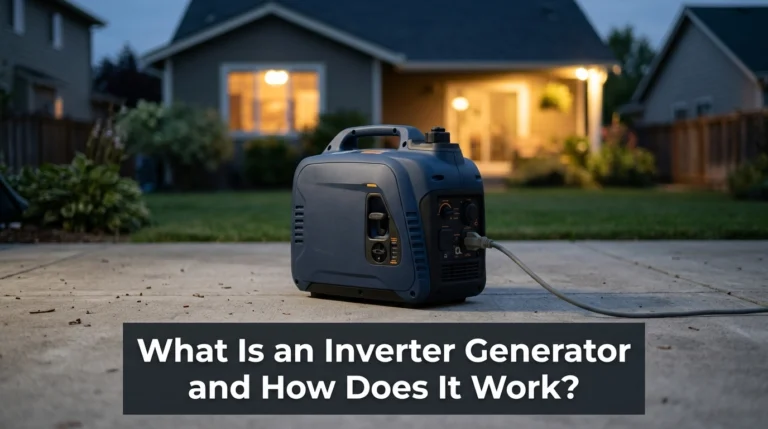
An inverter generator is a generator that makes raw AC power, turns it into DC power, and then rebuilds it into clean AC power. That last step is the key part.
A diesel inverter generator uses a diesel engine to drive that same three-step process. It pairs diesel fuel with inverter electronics, so you get diesel runtime and clean sine wave output in one unit.
Clean sine wave means smooth, stable power that stays close to the shape of utility power. It matters for laptops, phones, CPAP machines, modern fridges, and other sensitive electronics.
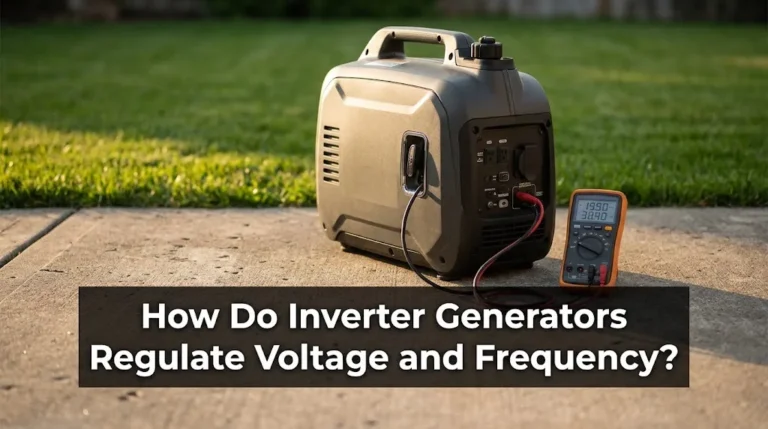
THD, or total harmonic distortion, measures how clean that power is. A true inverter generator should hold THD under 3%.
That figure is the same one I use across this inverter cluster. A conventional generator, by contrast, often runs at 10–25% THD, though some sources list 6–25% for conventional models.
The range varies by model and source, so always check the spec sheet for the exact unit you plan to buy. Do not trust a vague claim of clean power without a THD number.
How does it differ from a regular diesel generator?
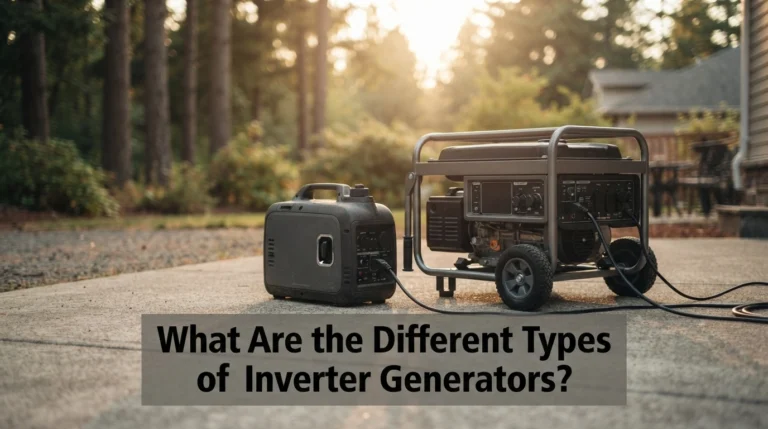
A regular diesel generator, often called an open-frame or conventional model, makes AC power straight from the alternator. Its engine speed stays fixed to hold frequency, even when the load is light.
An inverter model can slow its engine when the load drops. That eco-throttle, or economy mode, can save fuel and cut noise at light load.
The inverter unit also filters and rebuilds the output. That is why it suits electronics that a rough conventional output may stress.
Is a diesel inverter the same as a diesel power station?
No, and the terms get mixed up in listings. A portable power station is a battery with an inverter, and it stores power rather than making it from fuel.
A diesel inverter generator burns diesel to make power on demand. It can run for hours if you keep feeding it fuel, while a power station runs until its battery is flat.
Section Takeaway: A diesel inverter generator is a diesel engine plus inverter electronics, built to give you clean, low-THD power with diesel runtime.
Are Diesel Inverter Generators Available?
Yes, they are available, but the choice is narrow. You will not find a diesel inverter option at every size, in every store, or from every major brand.
Most of the models I have seen sit in the larger portable range. Small, hand-carry diesel inverter units are very rare, and some listings that look small turn out to be conventional diesel units.
That gap is not a trick of search results. It reflects how diesel engines are built, how much they weigh, and who buys them.
Where can you find them?
You will find them most often through specialist generator dealers, farm and trade suppliers, and RV power suppliers. Some appear on large online marketplaces, but stock can change fast.
- Specialist dealers: They carry larger diesel units and can confirm the THD and inverter design.
- RV suppliers: They stock diesel units built for motorhomes and fifth wheels.
- Trade suppliers: They focus on job-site and farm use, where long runtime matters.
- Online marketplaces: They list a mix of true inverter models and mislabelled conventional units.
Ask the seller for the spec sheet before you pay. The words inverter, clean power, and low THD should all appear in that sheet, not just in the title.
Which brands make them?
A few makers build diesel inverter models for trade, farm, and RV use, while the big household inverter brands focus mainly on gas. That split explains why your usual gas inverter search turns up so few diesel results.
I will not name a short list as a buying guide here, because model lines change and some names sell in one region only. Use the spec sheet, not the brand name, to judge a unit.
If a listing cannot show a THD figure, a running-watts figure, and a starting-watts figure, treat it as unproven. A true inverter maker will publish those numbers.
Section Takeaway: Diesel inverter generators exist, but you will need to shop with specialist sellers and check the spec sheet to find a true inverter model.
Why Are Diesel Inverter Generators So Rare?
Diesel engines are strong, but they are also heavy and built for steady, high load. That design fits a large conventional generator well, and it fits a small inverter design less well.
A small gas engine is light, cheap to build, and easy to pair with inverter electronics. A small diesel engine is still heavy, and it needs stronger parts to handle diesel compression.
That weight and cost change the whole product. A maker must charge more, build a larger frame, and sell to a smaller group of buyers.
Weight and size work against small diesel inverters
A diesel engine block, fuel system, and cooling setup add weight fast. Even a mid-size diesel inverter can need two people or a ramp to move it safely.
Gas inverter models in the 1,000 to 2,200 running-watt range can be light enough to carry with one hand. A diesel unit in the same watt range would still feel like a job-site machine.
That is why most diesel inverter models start higher up the watt scale. They aim at buyers who need real power, not a light camp unit.
Demand is smaller than for gas inverters
Most home and camp buyers want a quiet, light gas inverter. They run it for a fridge, a few lights, and a phone charger, then store it in a garage.
Diesel buyers often want long runs, high load, and fuel they already store for a tractor or truck. That is a smaller market, and makers build for it in smaller numbers.
Emissions rules also add cost and complexity for diesel engines. That cost is easier to absorb on a large unit than on a small, low-price inverter.
Noise is a real trade-off
Diesel engines are often louder than small gas inverter engines at the same load. An inverter design and an enclosed case can help, but they do not turn a diesel engine into a whisper-quiet camp unit.
Check the dB rating on the spec sheet, and check the distance it was measured at. A number without a distance tells you very little.
Safety note: Run any generator outdoors, at least 20 feet from your home, with the exhaust pointed away from windows, doors, and vents.
Section Takeaway: Diesel inverter models are rare because diesel engines are heavy, costly, and built for steady load, which suits larger units far better than small portable ones.
Diesel Inverter vs Gas Inverter vs Diesel Conventional
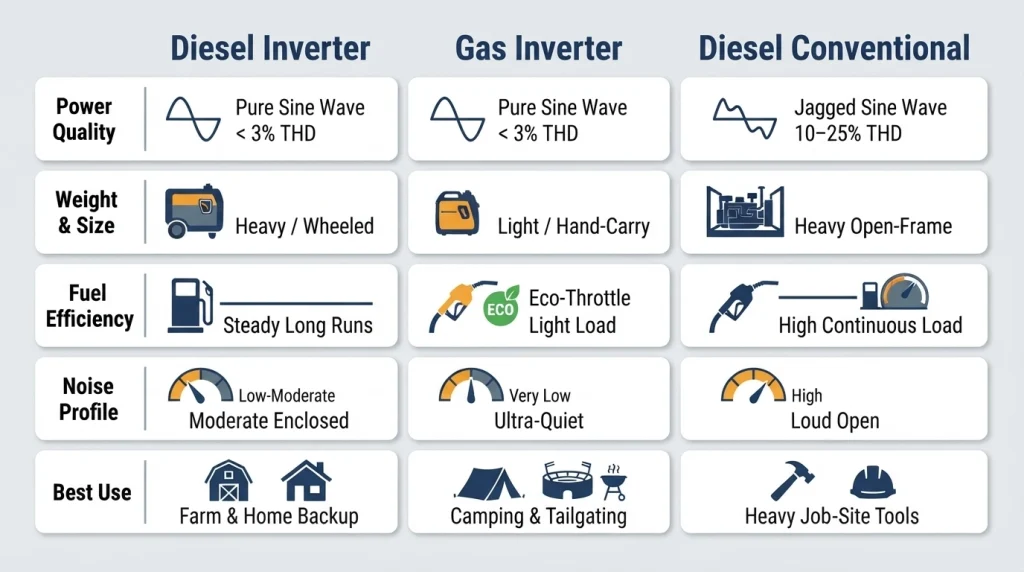
The best choice depends on your load, your fuel, and how long you need to run. A diesel inverter wins on runtime and clean power, but it loses on weight, cost, and choice.
Use the table below to compare the three types at a glance. Treat the watt ranges as typical, and check the spec sheet for the exact model you buy.
| Feature | Diesel inverter | Gas inverter | Diesel conventional |
|---|---|---|---|
| Power quality | Clean sine wave, THD under 3% | Clean sine wave, THD under 3% | Rougher output, often 10–25% THD |
| Typical size | Mid-size to large portable | Small to mid-size portable | Mid-size to large portable |
| Weight | Heavy, often needs wheels | Light to mid-weight | Heavy, often needs wheels |
| Fuel use | Efficient at steady load | Efficient at light load with eco mode | Efficient at steady load, less so at light load |
| Noise | Moderate to loud | Quiet to moderate | Moderate to loud |
| Best for | Long runs, sensitive loads, farm and RV use | Camping, RV, home essentials, electronics | Tools, pumps, and tough loads |
For a closer look at clean-power options, see our guide to the best portable generator with low THD. It will help you compare THD claims across types.
If you already run diesel equipment, a diesel inverter can share your fuel store. That is a real plus on a farm or a remote site.
If you want the lightest, quietest option for a weekend trip, a gas inverter still wins. It is easier to carry, easier to find, and easier to service in most towns.
Section Takeaway: Choose a diesel inverter for long, clean-power runs, a gas inverter for light and quiet use, and a diesel conventional model for tough, non-sensitive loads.
What Can a Diesel Inverter Generator Power?
It depends on size, and size varies a lot in this niche. A mid-size diesel inverter can run a fridge, lights, a CPAP machine, and a laptop with room to spare.
A larger unit can add a well pump, a furnace blower, a sump pump, or a small window AC. The key is to add up starting watts, not just running watts.
Running watts are the steady power a load needs once it is on. Starting watts are the short surge it needs to start, and that surge can be two to three times higher for motors.
A worked example from a farm outage
On a farm call I worked through, the owner needed a fridge, a well pump, lights, and a phone charger during a long outage. He did not need the whole house, just the loads that kept food cold and water flowing.
We listed the loads first. The fridge needed about 700 running watts and about 1,200 starting watts, while the well pump needed about 1,000 running watts and about 2,000 starting watts.
Lights added about 200 watts, and the charger added a small load. The total running load sat near 2,000 watts, but the starting load was far higher if both motors tried to start at once.
We staggered the starts. The fridge started first, then the pump started after the fridge had settled, and that simple order kept the generator from tripping.
That is the lesson I still use today. Size for the biggest start, not for the average load, and start motors one at a time.
What it will not run well
- Whole-home heat: Electric heat and large central AC need far more watts than most portable units can give.
- Two large motors at once: A well pump plus a large AC can trip the overload shutoff if they start together.
- Delicate loads on a rough unit: A conventional diesel unit may stress sensitive electronics, even if it can run a tool.
For more on inverter basics, read our inverter portable generator guide. It explains the AC-DC-AC path in plain terms.
Safety note: Never plug a generator straight into a wall outlet. Use a transfer switch or interlock installed by a licensed electrician.
Section Takeaway: A diesel inverter can run home essentials and farm loads well, but you must size for starting watts and stagger motor starts.
How Much Do They Cost, and What Should You Check Before You Buy?
Diesel inverter generators cost more than gas inverter models of similar watts. The diesel engine, the inverter module, and the heavier frame all add cost.
I will not quote a price here, because prices change and the range is wide. Use the cost as a signal, not as a final test, and compare like-for-like watts and THD.
A low price on a listing that claims diesel inverter power should make you pause. Check the spec sheet before you trust the title.
Check these five items first
- True inverter design: Look for inverter, sine wave, and THD under 3% in the spec sheet.
- Running and starting watts: Both numbers should be clear, with the outlet types listed.
- Fuel tank and runtime: Check runtime at 25% and 50% load, not just at one load.
- Weight and wheels: Check the dry weight, the wheel kit, and the lift points.
- Service and parts: Check who services the engine near you, and how long parts take to arrive.
Also check the oil type, the fuel filter, and the break-in steps in the manual. Diesel engines need clean fuel, and a clogged filter can cause hard starting.
For a diesel-focused buying view, see our diesel portable generator guide. It covers fuel, storage, and long-run use in more depth.
Watch for mislabelled listings
Some listings use inverter as a loose marketing word. Others show a diesel generator with an AVR, or automatic voltage regulator, and call it an inverter model.
An AVR helps steady voltage, but it does not rebuild the waveform like an inverter does. It is not the same thing, and it will not give you the same THD.
If the seller cannot show a THD figure, walk away. A true inverter maker will publish it.
Section Takeaway: Pay for proven inverter specs, not for a title, and check watts, THD, weight, and local service before you buy.
Are They Good for an RV, Home Backup, or a Job Site?
They can be good for all three, but for different reasons. The fit depends on how much power you need, how long you run, and how much weight you can carry.
For an RV
A diesel inverter can suit a larger motorhome, especially one that already runs on diesel. It can share the main fuel tank in some installs, which cuts the need for a separate gas can.
It can also run an RV air conditioner, a fridge, and lights if sized right. Check the AC starting watts first, because that start is often the hardest load.
Weight and noise still matter in an RV park. Check the park rules, the mounting space, and the exhaust route before you commit.
For RV-specific diesel options, see our guide to the best diesel RV generators.
For home backup
A diesel inverter can run home essentials for a long outage, and diesel stores well if you treat it and rotate it. That makes it a strong choice for a rural home with a well pump and a freezer.
It is less ideal for a small flat or a tight suburban lot. The unit is large, the fuel needs safe storage, and the exhaust needs clear space.
Use a transfer switch or interlock for home hookups. That setup keeps your household circuits safe and keeps power from feeding back into the grid.
For a job site
A diesel inverter can run tools and charge batteries while also powering a laptop or a test meter. That mix of tough load and clean power is hard to get from a conventional diesel unit.
It still needs fuel care, oil checks, and a level spot to run on. Keep it dry, keep the exhaust clear, and keep cords off wet ground.
Safety note: Keep the generator outdoors and well away from windows, doors, and vents, and follow the manual for refuelling. Let it cool before you add fuel.
Section Takeaway: A diesel inverter fits larger RVs, rural home backup, and job sites best, where long runtime and clean power matter more than light weight.
Diesel Inverter Generator Maintenance and Safety
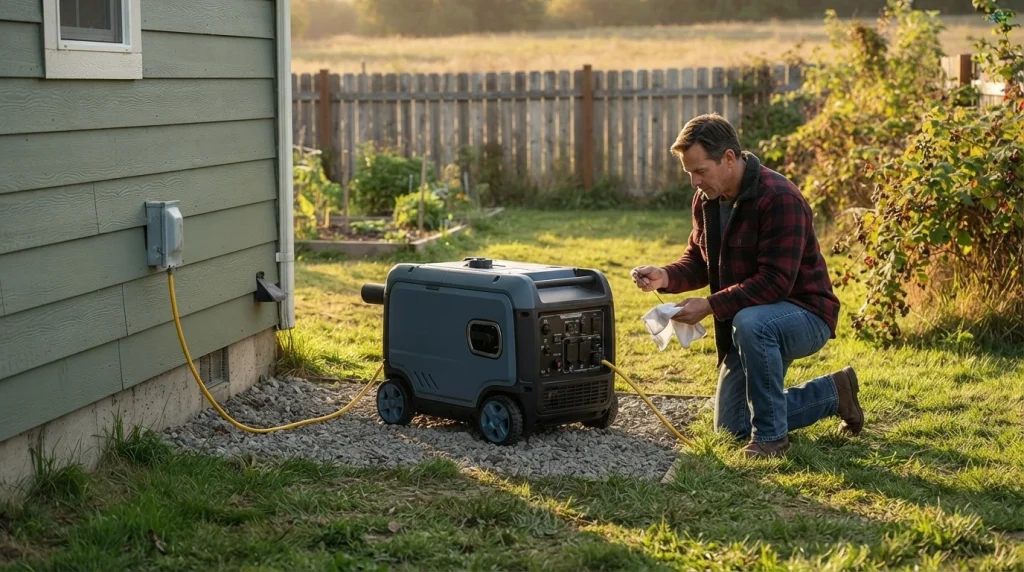
Diesel inverter models need the same care as other generators, with a few diesel-specific steps. Clean fuel is the first rule, because diesel can grow algae and pick up water in storage.
Use fresh fuel, keep the tank sealed, and change the fuel filter on the schedule in your manual. Do not guess at the interval, because the manual knows the engine best.
Simple care steps
- Oil: Check the oil before each run, and change it per the manual.
- Air filter: Check it after dusty work, and replace it when it looks clogged.
- Fuel: Use treated diesel for storage, and rotate stored fuel so it stays fresh.
- Battery: If it has electric start, keep the battery charged and the terminals clean.
- Test run: Run it under load each month, so stale fuel and dead batteries do not surprise you in an outage.
For more on safe placement, the CDC and the CPSC both publish carbon monoxide guidance for generator use. The EPA and Energy.gov also cover fuel and backup-power basics.
Place the unit at least 20 feet from your home, with the exhaust pointed away from the house. Use a battery CO alarm inside, and test it often.
Safety note: Never run a generator in a garage, shed, or enclosed space, even with the door open. Carbon monoxide can build up fast and you cannot see or smell it.
Section Takeaway: Clean fuel, regular oil and filter checks, and 20-foot outdoor placement keep a diesel inverter safe and ready.
If you need long runtime and clean power, a diesel inverter is worth a close look. If you need a light, quiet unit for short trips, a gas inverter will serve you better.
Start with your load list, check the THD, and buy the size that covers your biggest motor start. That order will save you from an overload trip on the first night you need it.
Where to look next
Diesel inverter stock changes fast, so start with a broad search and filter by THD, watts, and weight. Check the spec sheet for each result before you shortlist it.
- Search for diesel inverter generators on Amazon
- Search for portable diesel generators on Amazon
- Search for quiet inverter generators on Amazon
Also compare our best portable inverter generator guide if you want a lighter gas option for camping or short home backup.
Frequently Asked Questions
Are diesel inverter generators available in small sizes?
Very few small models exist, and most true diesel inverter units are mid-size or larger. A small diesel engine is still heavy, so makers focus on larger units where the weight makes more sense.
Are diesel inverter generators quiet?
They are often quieter than a conventional diesel unit, but they are not as quiet as a small gas inverter. Check the dB rating and the distance it was measured at before you compare models.
Can a diesel inverter generator run a refrigerator and a well pump?
Yes, if it is sized for both starting watts and you stagger the starts. Add the running watts, then add the largest starting surge, and keep the total inside the generator rating.
Is a diesel inverter better than a gas inverter?
It is better for long runs and for buyers who already store diesel, but it is heavier and costlier. A gas inverter is better for light, quiet, and portable use.
Do diesel inverter generators need special fuel?
They run on diesel, but they need clean, fresh fuel and a clean filter. Use treated diesel for storage, rotate stored fuel, and follow the manual for fuel care.
Can I convert a diesel generator into an inverter generator?
No, not in a practical way for most owners. An inverter design needs a matched engine, alternator, and inverter module, so it is best to buy a factory-built inverter model.
Where should I place a diesel inverter generator?
Place it outdoors, at least 20 feet from your home, with the exhaust pointed away from windows, doors, and vents. Never run it in a garage or enclosed space.

Hi, I’m Michael Turner. I own a generator workshop in the United States and founded HomeGeneratorBlog to share practical, hands-on guidance about generator installation, maintenance, troubleshooting, safety, and backup power solutions. My goal is to help homeowners make smarter, more confident decisions through clear and reliable information