What Is a Propane Inverter Generator?
Quick Answer
A propane inverter generator is a portable power source that burns propane and uses inverter technology to make clean, stable power for sensitive electronics. It runs quieter and cleaner than a standard open-frame generator, and it avoids stale gasoline problems because propane does not gum up a carburetor. An inverter generator is the right starting point if you want safe power for a fridge, CPAP, laptop, or phone.
Why propane stands out
- Clean power: Inverter output stays under 3% THD in most models, so it suits laptops, TVs, and medical devices.
- Easy storage: Propane stores for years in a sealed tank, with no fuel stabilizer or draining needed.
- Quieter running: Most small units run at 52 to 60 dB at 25% load, about the level of normal talk.
- Simple fuel: You swap a 20-lb tank at a store or refill it, with no gas can or spill risk.
- Lower output: The same unit often makes 5 to 10% fewer watts on propane than on gasoline, so check the propane rating.
Pick it if
- You want backup power for a home, RV, or campsite without storing gasoline.
- You need clean power for sensitive electronics and a fridge during an outage.
I’ve run gasoline and propane units through the same kind of nights, and propane changed how I prep for outages. There’s no gas can to pour, no carburetor to clean in spring, and no stale-fuel surprise when the lights go out.
This guide goes deeper than a short definition. You’ll learn how propane power works, how it compares with gasoline, what size you need, what it can run, and how long a tank lasts.
In This Guide
- What Is a Propane Inverter Generator?
- How Does a Propane Inverter Generator Work?
- Propane vs Gasoline Inverter Generators: Which Fuel Wins?
- What Size Propane Inverter Generator Do You Need?
- What Can a Propane Inverter Generator Run?
- How Long Does a Propane Tank Last on an Inverter Generator?
- Is a Propane Inverter Generator Safe? Pros, Cons, and CO Safety
- Frequently Asked Questions
- The Bottom Line: Is a Propane Inverter Generator Right for You?
What Is a Propane Inverter Generator?
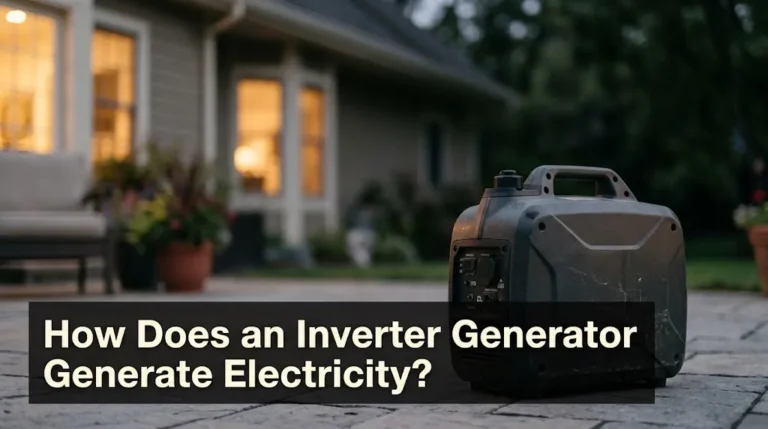
A propane inverter generator is a portable generator that burns propane, or liquefied petroleum gas (LPG), and converts that power into clean, steady AC power through an inverter.
It combines two ideas in one box. Propane is the fuel, and inverter technology is the way it shapes the power.
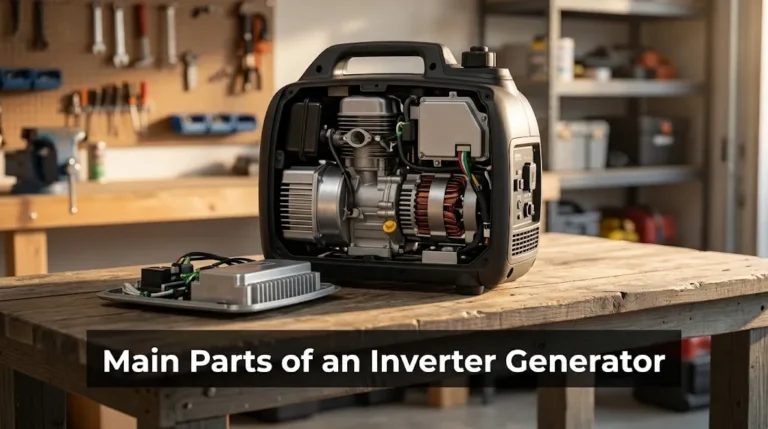
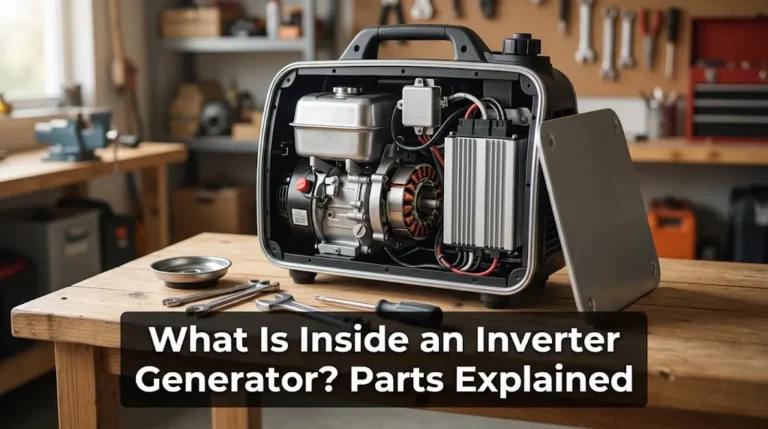
The engine still burns fuel to spin an alternator. The inverter then rebuilds that raw power into a smooth sine wave, the same clean shape your wall outlet gives you.
That clean shape matters for modern gear. Laptops, phones, TVs, CPAP machines, and fridge controls all want stable voltage and frequency.
How is it different from a regular propane generator?
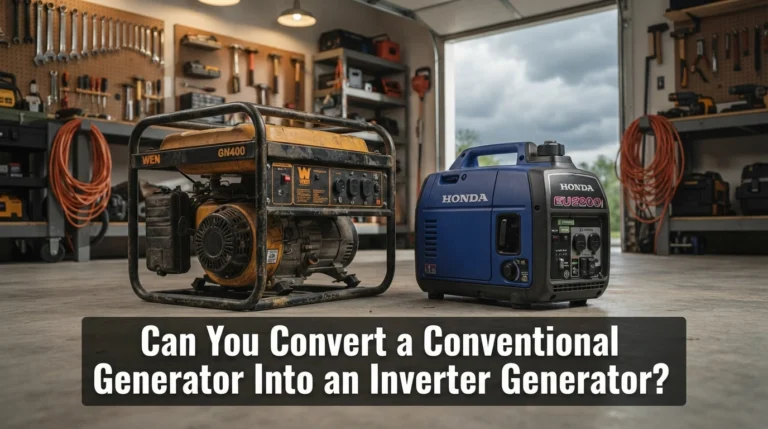
A regular propane generator, often called an open-frame or conventional generator, feeds raw alternator power straight to your outlets. Its voltage and frequency can swing as the load changes.
An inverter generator does not do that. It makes DC power first, then rebuilds it as clean AC at a steady 60 Hz in the US.
The result is lower total harmonic distortion, or THD. THD measures how much the power wave strays from a pure sine wave.
Most inverter generators keep THD under 3%. Conventional generators often run at 6 to 25% THD, though some sources cite 10 to 25% for conventional units, and I use 6 to 25% here to match the range used across this cluster.
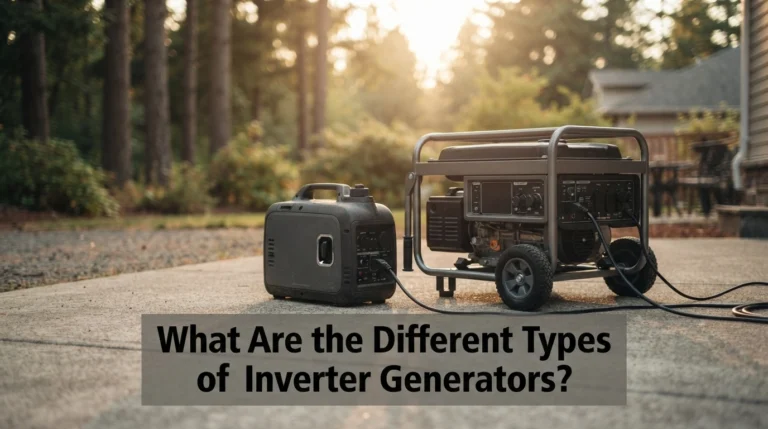
- Propane-only inverter: Runs on propane only, with a simple hose and regulator for a tank.
- Dual-fuel inverter: Runs on propane or gasoline, with a fuel selector switch.
- Tri-fuel inverter: Runs on propane, gasoline, or natural gas, usually with a conversion kit.
- Portable power station: Uses a battery, not fuel, and needs charging from a wall outlet or solar panel.
Most buyers I talk to start with a propane-only or dual-fuel inverter. Propane-only keeps the setup simple, while dual fuel gives you a backup fuel when a tank runs low.
Section Takeaway: A propane inverter generator is a portable power source that burns propane and uses an inverter to deliver clean, stable power under 3% THD, which makes it a strong fit for sensitive electronics and home backup.
How Does a Propane Inverter Generator Work?
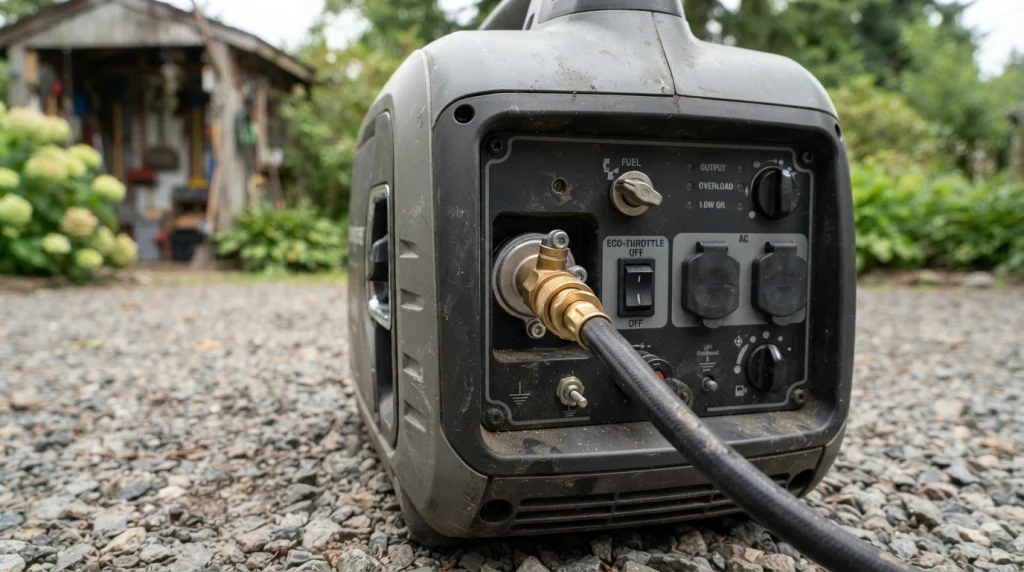
A propane inverter generator follows a three-step path: burn propane, make raw power, then rebuild it as clean power. Each step has one clear job.
Once you see that path, the rest of the unit makes sense. The engine, alternator, and inverter each fix a problem the last one created.
What are the three steps in the power path?
- Burn propane: Propane flows from the tank through a regulator and hose into the engine, where it mixes with air and ignites.
- Make raw AC: The engine spins a compact alternator, which makes high-frequency AC power that is rough and unsteady on its own.
- Rebuild clean AC: The inverter module turns that raw AC into DC, then back into smooth 120V AC at a steady 60 Hz.
The engine speed can rise and fall with the load. That is the key trick of inverter design.
A conventional generator must hold a fixed engine speed to hold frequency. An inverter generator can slow down at light load because the inverter, not the engine speed, sets the output frequency.
Why does eco mode matter on propane?
Eco mode, also called economy mode or eco-throttle, lets the engine idle down when you draw little power. It saves fuel, cuts noise, and reduces wear.
I leave eco mode on for phones, lights, and a fridge at steady load. I switch it off when I start a motor load, like a fridge compressor or a small AC, so the engine can respond fast.
Propane burns cleaner than gasoline in most small engines. It leaves less carbon buildup, and it does not leave varnish in a carburetor during storage.
That is why a propane unit often starts on the first pull after months in a garage. There is no old gasoline to drain or treat first.
Safety note: Run any generator outdoors, at least 20 feet from your home, windows, doors, and vents, with the exhaust pointed away from people and buildings. Check your owner’s manual before you connect a propane tank.
For a deeper look at propane as a fuel, read this propane generator guide on sizing, tanks, and storage. It covers the same fuel system in more detail.
Section Takeaway: A propane inverter generator burns propane, makes raw power with an alternator, then rebuilds it through an inverter into clean, steady AC, and eco mode lets the engine slow down to save fuel and cut noise at light load.
Propane vs Gasoline Inverter Generators: Which Fuel Wins?
Neither fuel wins on every point. Propane wins on storage and clean running, while gasoline often wins on peak watts and easy refills on the road.
Your best choice depends on how you store fuel, how long you run, and what you power. A camper and a homeowner can pick different fuels and both be right.
| Feature | Propane inverter | Gasoline inverter | Dual-fuel inverter |
|---|---|---|---|
| Fuel storage | Years in a sealed tank, no stabilizer | 3 to 6 months without stabilizer, up to 12 months with it | Best of both, if you store both fuels |
| Peak watts | Often 5 to 10% lower than gasoline rating | Highest rating for that model | Gasoline rating is higher, propane rating is lower |
| Runtime per fuel unit | A 20-lb tank often runs a small unit overnight at light load | A 1 to 2 gallon tank often runs 8 to 12 hours at 25% load | Depends on the fuel you choose that day |
| Noise | Similar to gasoline at the same load, often 52 to 60 dB | Similar to propane at the same load | Same, fuel does not change the muffler |
| Maintenance | Less carbon buildup, no stale-fuel carburetor clogs | Needs fuel draining or stabilizer for storage | Follow the manual for both fuel systems |
| Cold weather | Propane pressure drops in deep cold, so keep tanks warm | Starts well in cold if the fuel is fresh | Switch to gasoline in deep cold if propane struggles |
Which fuel is better for long-term storage?
Propane wins here by a wide margin. A sealed propane tank does not go stale, and you can keep it for years without a stabilizer.
Gasoline needs care. It can start to break down in 3 to 6 months, and it can leave deposits in a carburetor if you leave it sitting.
That storage gap is why I keep two 20-lb tanks for home backup. I rotate them through a grill and a generator, so nothing sits unused for years.
Which fuel is cheaper to run?
It depends on local prices, and it changes by season. Propane is often cheaper per hour at light load, while gasoline can be cheaper per watt at full load.
Check the spec sheet for watts on each fuel. A dual-fuel unit may list 4,000 starting watts on gasoline and 3,600 on propane, for example, and that gap changes your sizing math.
If you want both options, this dual-fuel generator guide explains how the selector switch and fuel lines work. It helps you decide if dual fuel is worth the extra cost.
Section Takeaway: Propane wins on storage, clean running, and easy starts after months idle, while gasoline often wins on peak watts, so dual fuel is the flexible middle ground if you want both.
What Size Propane Inverter Generator Do You Need?
Size it by watts, not by brand name. Add up what you need to run, then add a margin for motor starts.
Most first-time buyers pick too small a unit. They count running watts and forget starting watts, then the generator trips when a fridge kicks on.
How do I add up running and starting watts?
Running watts are the watts a device uses while it runs. Starting watts, also called surge watts, are the short burst a motor needs to start.
Use this simple method to size your unit.
- List your must-run loads: Fridge, CPAP, lights, phones, and a fan are a common home set.
- Add running watts: Add the running watts for everything you will run at the same time.
- Add the largest starting watts: Add only the largest single starting load, not every starting load at once.
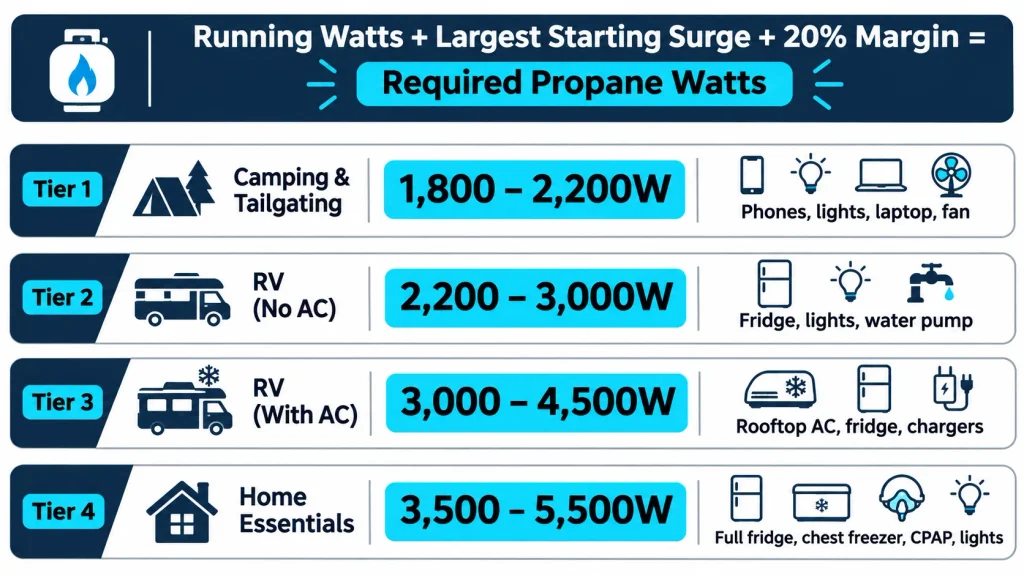
- Add a 20% margin: Multiply the total by 1.2, so the generator does not run at its limit.
Check the propane rating, not just the gasoline rating. A dual-fuel unit can lose 5 to 10% of its watts on propane, and that gap matters at the edge.
What size fits common uses?
| Use case | Typical propane running watts | What it covers |
|---|---|---|
| Camping and tailgating | 1,800 to 2,200 | Phones, lights, small fan, laptop |
| RV, no AC | 2,200 to 3,000 | Fridge, lights, water pump, charging |
| RV with AC | 3,000 to 4,500 | Small AC with soft start, fridge, lights |
| Home essentials | 3,500 to 5,500 | Fridge, freezer, CPAP, lights, phones, fan |
Here is a worked example from my own outage kit. I ran a fridge at 150 running watts and 600 starting watts, a CPAP at 40 watts, LED lights at 60 watts, and phone charging at 20 watts.
That added up to 270 running watts, plus 600 starting watts for the fridge, for a total of 870 watts at the peak moment. A 2,200-watt propane inverter handled it with room to spare, and I still had headroom for a fan.
If you need a shortlist to compare, see the best propane portable generators for home, RV, and camping use. Compare their propane running watts, not just the headline gasoline number.
Section Takeaway: Add running watts for all loads you run at once, add the largest starting watts once, add a 20% margin, and size it on the propane rating, not the gasoline rating.
What Can a Propane Inverter Generator Run?
A propane inverter generator can run most home essentials, RV loads, and camping gear, as long as the total watts fit its rating. It is not a whole-home standby unit.
It shines at small, steady loads. It struggles when you stack big motor loads at the same time.
| Appliance | Typical running watts | Typical starting watts |
|---|---|---|
| Fridge, full-size | 150 to 200 | 600 to 800 |
| Freezer, chest | 100 to 150 | 400 to 600 |
| CPAP machine | 30 to 60 | 40 to 80 |
| Laptop and phone charging | 50 to 100 | 50 to 100 |
| LED lights, several rooms | 40 to 80 | 40 to 80 |
| Window AC, 5,000 BTU | 450 to 600 | 1,200 to 1,800 |
| RV AC, 13,500 BTU | 1,200 to 1,500 | 2,800 to 3,500 |
| Microwave, 1,000W | 1,000 to 1,200 | 1,000 to 1,200 |
These are typical ranges, not specs for one model. Check the label on your own device, and check the spec sheet for your generator before you buy.
Can a propane inverter generator run a refrigerator?
Yes, in most cases it can. A full-size fridge needs 150 to 200 running watts and 600 to 800 starting watts, which fits a 2,200-watt unit with ease.
Keep the fridge closed as much as you can. Each open door lets cold air out and makes the compressor cycle more often.
Can it run an RV air conditioner?
It can, but size matters a lot here. A 13,500 BTU RV AC needs 1,200 to 1,500 running watts and up to 3,500 starting watts.
Many owners use a 3,500 to 4,500 watt inverter, or a soft-start device, to cut that starting surge. Without a soft start, a small 2,200-watt unit will trip on AC start.
Do not run a microwave and an AC at the same time on a small unit. Stagger big loads, and let the generator settle for a minute between starts.
Section Takeaway: A propane inverter generator can run a fridge, freezer, CPAP, lights, and charging with ease, and it can run a small AC only if you size for its high starting watts or use a soft start.
How Long Does a Propane Tank Last on an Inverter Generator?
Runtime depends on tank size, load, and eco mode. A light load can stretch a tank through the night, while a heavy load can drain it in a few hours.
That is why a single runtime number can mislead you. Always ask what load that number assumes.
How long will a 20-lb tank run a small inverter generator?
A 20-lb tank holds about 4.6 gallons of propane. At 25% load, a 2,200-watt inverter often runs 10 to 18 hours on that tank, depending on the model and eco mode.
At 50% load, that same tank may last 7 to 10 hours. At full load, it may last 4 to 6 hours, so plan for a spare tank if you run an AC.
Check the spec sheet for your model. It should list runtime at 25% load on propane, and that is the number to compare across models.
My own overnight test used a different load mix than the other guides in this cluster. I ran a fridge, a CPAP, LED lights, and phone charging on a 2,200-watt propane inverter through an 18-hour outage.
The tank still had propane left in the morning, and I swapped to a fresh tank for the next night without any rush. Eco mode stayed on, and the fridge cycled on and off as normal.
How do I store propane tanks safely?
- Store tanks outdoors: Keep them upright, in a shaded spot, away from heat and open flame.
- Keep valves closed: Close the valve when the tank is not in use, and fit the cap over the valve.
- Check for leaks: Brush soapy water on the hose and fittings, and look for bubbles before each use.
- Never store indoors: Do not store a propane tank in a garage, basement, or living space.
- Keep a spare: Keep one spare 20-lb tank full, so a tank change does not end your backup power.
In cold weather, propane pressure can drop. Keep the tank out of deep cold if you can, and switch to gasoline on a dual-fuel unit if the propane flow feels weak.
Safety note: Never use a propane tank indoors, and never refill a tank yourself unless you are trained to do it. Have tanks refilled or swapped at a licensed propane dealer.
Section Takeaway: A 20-lb tank can run a small propane inverter for 10 to 18 hours at 25% load, but runtime falls fast at higher loads, so check the spec sheet at 25% load and keep a spare tank full.
Is a Propane Inverter Generator Safe? Pros, Cons, and CO Safety
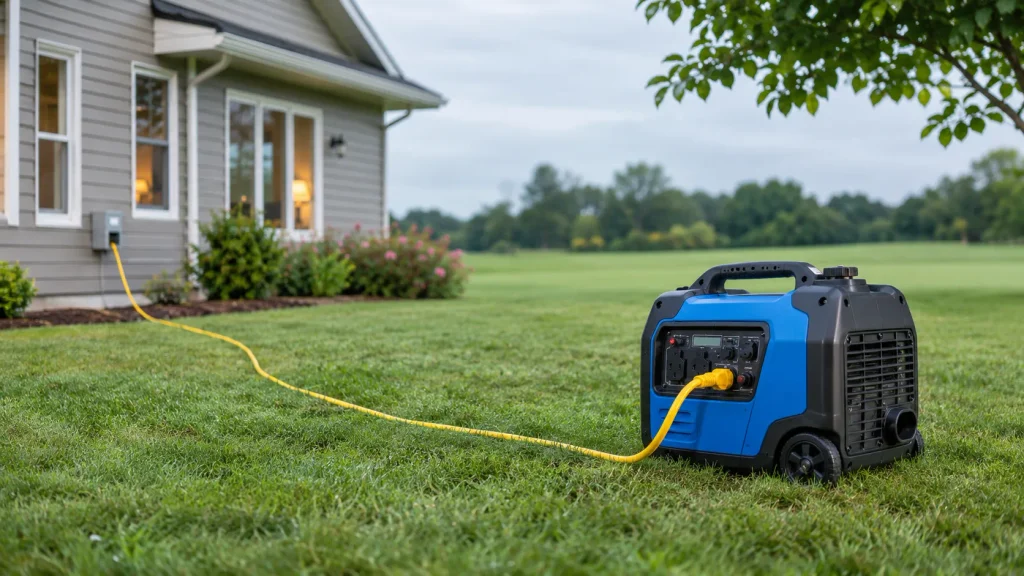
Yes, a propane inverter generator is safe when you run it outdoors, keep it 20 feet from your home, and follow the manual. Propane itself is safe in a sealed tank, but the exhaust still holds carbon monoxide.
That last point is the one to respect most. A quiet inverter can fool you into thinking it is harmless, and CO has no smell or color.
What are the pros?
- Clean power: Under 3% THD in most models, safe for laptops, TVs, and CPAP machines.
- Easy storage: Propane does not go stale, and it does not clog a carburetor.
- Quieter: Most small units run at 52 to 60 dB at 25% load, which helps at a campsite.
- Cleaner exhaust: Propane burns with less soot and carbon buildup than gasoline.
- Simple fuel swaps: You can swap a tank in minutes, with no gas can to pour.
What are the cons?
- Lower watts on propane: Expect 5 to 10% fewer watts than the gasoline rating on a dual-fuel unit.
- Tank weight: A full 20-lb tank weighs about 37 pounds, which is heavy to carry far.
- Cold-weather pressure: Propane flow can drop in deep cold, which can cut power.
- Fuel cost: Propane prices vary by region and season, so check local refill costs.
- Not whole-home power: It will not run a central AC, electric water heater, and oven at once.
How do I run it safely?
Place the generator outdoors, at least 20 feet from your home, with the exhaust pointed away from windows, doors, and vents. That 20-foot rule is the core guidance from the CDC and the CPSC for portable generators.
Use a battery CO detector in your home during an outage, and test it before storm season. A detector gives you a warning if wind shifts exhaust toward the house.
Use a transfer switch or interlock kit installed by a licensed electrician for home hookups. Never backfeed power through a wall outlet, and never run a generator in a garage, even with the door open.
For home wiring and hookup rules, the U.S. Department of Energy and the EPA publish general safety and energy guidance worth reading before you wire a backup setup. Follow your local code and your manual first.
Safety note: Never run a generator indoors, in a garage, or under a covered porch. CO can build up fast in a closed space, even with a door or window open.
Read the carbon monoxide safety guide before your first outage run. It covers placement, detectors, and what to do if an alarm sounds.
Section Takeaway: A propane inverter generator is safe outdoors at 20 feet from your home with a CO detector in place, and its main trade-offs are lower watts on propane and tank weight, not power quality.
Frequently Asked Questions
Can a propane inverter generator run on natural gas?
Only if it is built for it or fitted with a tri-fuel kit. A propane-only unit cannot run on natural gas without a conversion kit, and a kit may void the warranty, so check the manual first.
Do propane inverter generators need oil changes?
Yes, they still need oil changes. Propane burns cleaner, but the engine still needs oil, and most manuals call for a first change after 20 to 25 hours, then every 50 to 100 hours after that.
Are propane inverter generators quiet?
Yes, most small models are quiet for a generator. They often run at 52 to 60 dB at 25% load, about the level of normal talk, and eco mode makes them quieter at light load.
Can I use a propane inverter generator indoors?
No, never use it indoors, in a garage, or in a tent. The exhaust holds carbon monoxide, which has no smell or color, so run it outdoors at least 20 feet from your home.
How do I connect a propane tank?
Connect the regulator hose to the tank valve, hand-tighten it, then open the valve slowly. Brush soapy water on the fittings and look for bubbles, and close the valve if you see any.
Can I parallel two propane inverter generators?
Yes, if both models are parallel-capable and you use the correct parallel kit. Pairing two units can double your watts, but check the manual, as not every propane model supports it.
The Bottom Line: Is a Propane Inverter Generator Right for You?
A propane inverter generator is a strong pick if you want clean power, easy storage, and quiet running for a home, RV, or campsite. It fits a fridge, CPAP, lights, and charging with ease, and it starts after months idle without a carburetor fight.
It is not the right pick if you need whole-home power or the highest peak watts for a large AC. Size it on its propane rating, keep a spare 20-lb tank full, and run it outdoors at 20 feet with a CO detector in place.
As of 2026, I still keep propane as my first backup fuel for short outages and camping. It is simple, it stores well, and it lets me focus on what I need to power, not on fuel care.
Start with your watt list, pick a size with a 20% margin, and test it before you need it. A short test run in daylight will teach you more than any spec sheet can.

Hi, I’m Michael Turner. I own a generator workshop in the United States and founded HomeGeneratorBlog to share practical, hands-on guidance about generator installation, maintenance, troubleshooting, safety, and backup power solutions. My goal is to help homeowners make smarter, more confident decisions through clear and reliable information