What Appliances Can a 2000-Watt Inverter Generator Run? Full Wattage Chart, Safe Combos & Limits
Quick Answer
A 2000-watt inverter generator runs a modern fridge, LED lights, a laptop, a CPAP machine, a TV, a fan, and a phone charger at the same time. It does not run a full-size RV air conditioner, an electric water heater, or a space heater with those loads. For the full picture, see how much power a 2000-watt inverter generator provides.
Safe combos that fit
- Home outage core: Fridge, 5 LED lights, phone charger, and laptop use about 400 to 700 running watts.
- Night health kit: CPAP, phone charger, and a small fan use about 150 to 300 running watts.
- Camping comfort: LED lights, laptop, small fan, and phone charging use about 200 to 400 running watts.
- Kitchen, one at a time: A coffee maker or microwave can work alone, but not with a fridge starting at the same moment.
- Leave headroom: Keep total running watts under about 1,600 to 1,800 watts for steady, quiet use.
Do this first
- Add the running watts of everything you want on at once, then add the largest starting watts on top.
- Start motor loads one at a time and wait a few seconds between each start.
I have run a 2000-watt inverter generator through a three-day outage, on campsites, and at a tailgate. It kept food cold, phones charged, and a CPAP running all night.
It also taught me its limits fast. A window AC and a coffee maker together tripped the overload in seconds.
This guide gives you real wattage numbers, safe combos, and the loads to avoid. You will know exactly what fits in 2,000 watts before you plug anything in.
In This Guide
- What Does 2000 Watts Actually Mean?
- What Appliances Can a 2000-Watt Inverter Generator Run? Full Wattage Table
- What Can You Run at Home During an Outage?
- What Can You Run While Camping or in an RV?
- What Can You Run for Work, Tailgating, and Small Tools?
- What Can a 2000-Watt Inverter Generator NOT Run?
- How Do You Add Up Watts Without Tripping the Overload?
- How Long Will a 2000-Watt Inverter Generator Run?
- How to Run It Safely and Make It Last
- Frequently Asked Questions
What Does 2000 Watts Actually Mean?
A 2000-watt inverter generator usually delivers 2,000 starting watts and about 1,600 to 1,800 running watts. Check the spec sheet, because the exact running watts vary by model.
An inverter generator is a portable generator that makes clean, stable power safe for laptops, phones, and medical devices. It converts raw engine power into a smooth sine wave, which is the steady wave shape your electronics expect.
That clean power is measured by total harmonic distortion, or THD. Low THD means less risk of glitches, buzzing, or damage to sensitive gear.
Running watts vs starting watts
Running watts are the steady watts an appliance uses while it runs. Starting watts, also called surge watts, are the short burst a motor needs to start.
A fridge may run at 150 watts but need 600 to 1,200 watts for a second when its compressor kicks on. That burst is why a generator can trip even when the steady load looks small.
- Use running watts for your total load.
- Add the largest starting watts once, on top of that total.
- Keep the sum under 2,000 watts, and the running total under about 1,800 watts.
If you want the full math, read the difference between running watts and starting watts before you size a load.
Section Takeaway: Plan for 1,600 to 1,800 running watts, not 2,000, and always leave room for one motor to start.
What Appliances Can a 2000-Watt Inverter Generator Run? Full Wattage Table
The table below uses typical ranges, not one exact model. Your fridge, microwave, or fan may use a little more or less, so check its label.
Use it to build a combo, not to guess. Add the running watts, then add the biggest starting watts once.
| Appliance | Running watts (typical) | Starting watts (typical) | Fits on 2,000W? |
|---|---|---|---|
| Modern fridge (18-22 cu ft) | 100-200 | 600-1,200 | Yes, with headroom |
| Chest freezer (5-7 cu ft) | 100-200 | 600-1,000 | Yes, alone or with lights |
| LED lights (5 bulbs) | 40-60 | 0 | Yes |
| Laptop + charger | 50-100 | 0 | Yes |
| Phone / tablet charger | 10-25 | 0 | Yes |
| TV (32-55 inch LED) | 80-200 | 0 | Yes |
| CPAP machine | 30-100 | 0-150 | Yes |
| Box fan / pedestal fan | 50-100 | 100-200 | Yes |
| Microwave (700-1,000W rated) | 1,000-1,500 | 0 | Yes, alone only |
| Coffee maker (drip) | 800-1,200 | 0 | Yes, alone only |
| Electric kettle | 1,200-1,500 | 0 | Yes, alone only |
| Sump pump (1/3 HP) | 800-1,000 | 1,300-2,000 | Borderline, test first |
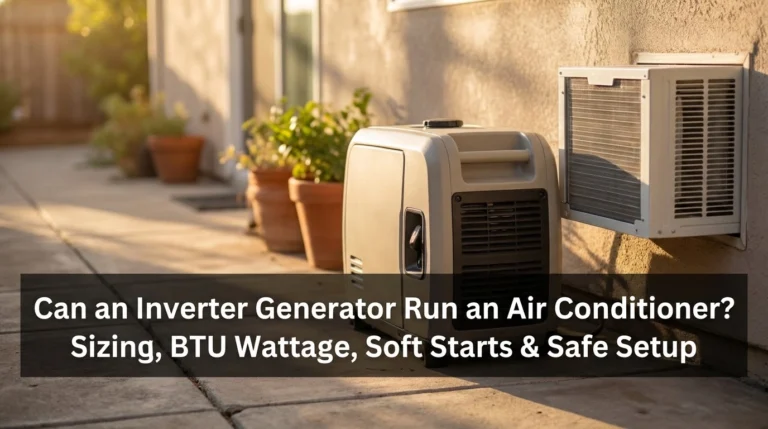
| Window AC (5,000 BTU) | 500-700 | 1,200-1,800 | Sometimes, alone only |
| RV air conditioner (13,500 BTU) | 1,200-1,500 | 2,800-3,500 | No, without soft start |
| Space heater | 1,500 | 0 | No, with other loads |
| Electric water heater | 1,500-4,500 | 0 | No |
The pattern is clear. Low-watt electronics and lights fit easily. Heat and big motors eat the budget fast.
A fridge plus a freezer sounds safe at 300 running watts. Add both compressors starting at once, and you can hit 2,000 watts in a blink.
Section Takeaway: Small loads stack well, but one heat appliance or one big motor can use most of your 2,000 watts by itself.
What Can You Run at Home During an Outage?

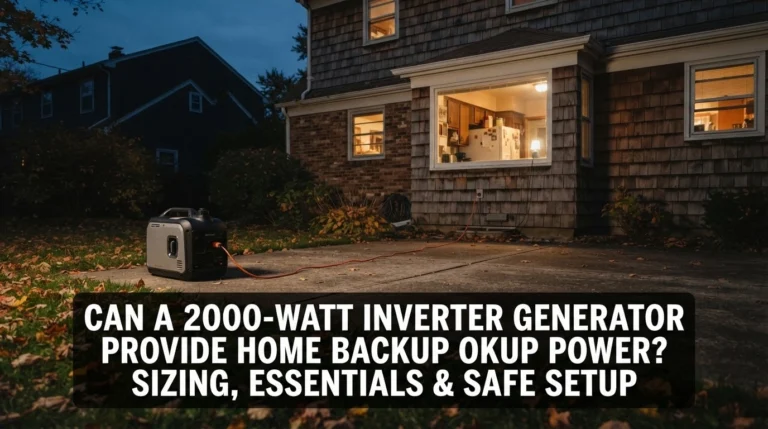
At home, a 2000-watt inverter generator is a essentials machine, not a whole-house machine. It keeps food safe, lights on, and phones working.
During my last multi-day outage, my core load was a fridge, five LED lights, a laptop, and two phone chargers. The running total stayed near 500 watts, and the generator stayed quiet in eco mode.
A safe home combo for most outages
- Fridge: 150 running watts, up to 1,200 starting watts.
- LED lights: 50 running watts for a whole room.
- Laptop and phones: 75 to 125 running watts combined.
- TV: 100 to 150 running watts for news and updates.
- Fan: 75 running watts for airflow on a warm night.
That combo runs at about 450 to 600 watts. It leaves room for the fridge compressor to start without tripping.
What about a furnace, sump pump, or well pump?
A gas furnace blower often uses 400 to 800 running watts, so it can fit with lights and a fridge if you keep other loads off. Check the blower label first, because older furnaces draw more.
A sump pump is harder. Its starting watts can reach 2,000 watts alone, so test it before a storm, not during one.
A well pump usually needs more than 2,000 starting watts. Plan for a larger generator or a parallel kit if a well pump is a must.
Safety note: Run the generator outdoors, at least 20 feet from windows, doors, and vents, with exhaust pointed away from the house. Never plug it into a wall outlet. Use a transfer switch or interlock installed by a licensed electrician for any home hookup.
For sizing help, see what size inverter generator you need and match your outage list to the right size.
Section Takeaway: For an outage, protect the fridge, lights, phones, and one comfort load, and rotate heat appliances one at a time.
What Can You Run While Camping or in an RV?
Camping is where a 2000-watt inverter generator shines. The loads are small, the power is clean, and the noise stays low in eco mode.
On a quiet site, I ran lights, a laptop, phones, a small fan, and a 12-volt battery charger. The total stayed under 400 watts, and no one at the next site complained.
Camping loads that fit well
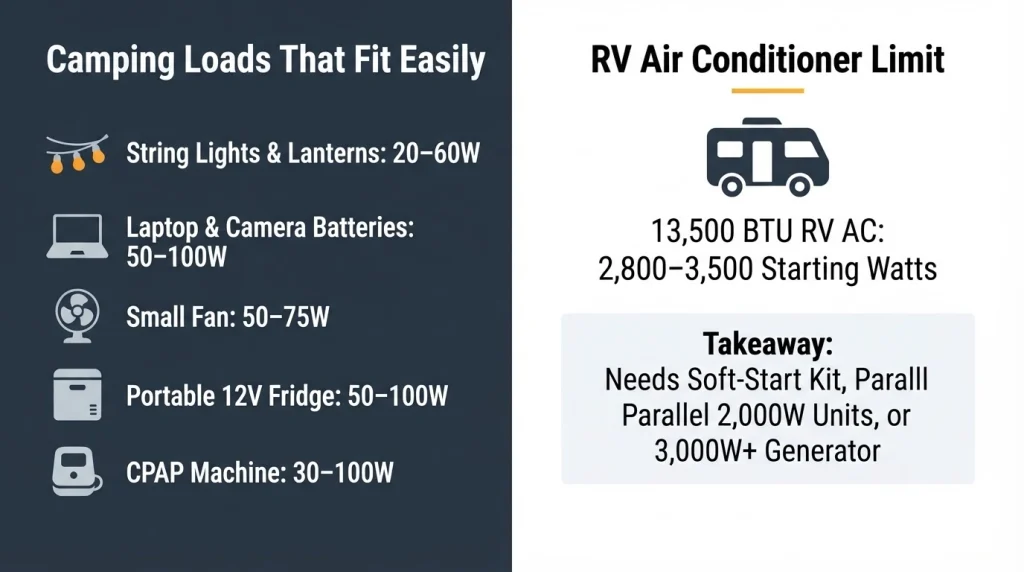
- String lights and lanterns: 20 to 60 watts total.
- Laptop and camera batteries: 50 to 100 watts while charging.
- Small fan: 50 to 75 watts for a tent or trailer.
- Portable fridge (12V / 45-65W): 50 to 100 watts, with a small start surge.
- CPAP: 30 to 100 watts, a good overnight load.
Can it run an RV air conditioner?
A standard 13,500 BTU RV air conditioner usually needs 2,800 to 3,500 starting watts. A single 2000-watt unit will not start it on its own.
A soft-start kit can lower that start surge, and some small 5,000 BTU window units can run alone. Even then, keep every other load off while the AC starts.
For most RV owners, the honest answer is to parallel two 2000-watt units or step up to a 3000-watt or larger inverter generator for AC. Check your AC label and your generator manual before you try it.
Section Takeaway: Camping loads fit with room to spare, but RV air conditioning is the one load that usually needs a bigger setup.
What Can You Run for Work, Tailgating, and Small Tools?
A 2000-watt inverter generator works well for light work and fun, not for heavy job-site tools. Battery chargers, lights, and small electronics are its sweet spot.
At a tailgate, I ran a TV, a small speaker, phone chargers, and LED lights. The coffee maker waited until the TV was off, and nothing tripped.
Loads that work one at a time
- Drill battery charger: 100 to 300 watts.
- Small circular saw: 1,200 to 1,500 watts, alone only.
- Work lights (LED): 50 to 150 watts.
- Slow cooker: 200 to 300 watts on low.
- Electric grill (small): 1,200 to 1,500 watts, alone only.
Large tools with big motors, like a table saw or an air compressor, often need 2,000 starting watts or more. They belong on a larger generator.
If tools are your main use, compare the best 2000-watt portable generators and check each model’s running watts and outlets before you buy.
Section Takeaway: Use a 2000-watt unit for chargers, lights, and one heat or motor tool at a time, and leave heavy tools to a larger generator.
What Can a 2000-Watt Inverter Generator NOT Run?
Knowing the no-list saves you from a tripped breaker at the worst moment. These loads either draw too much steady power or need too large a start surge.
Do not plan on these together
- Full RV air conditioner: 2,800 to 3,500 starting watts.
- Electric water heater: 1,500 to 4,500 running watts.
- Space heater on high: 1,500 running watts, with no room left.
- Central air conditioner: Far above 2,000 watts.
- Electric stove or oven: 2,000 to 5,000 watts per burner or element.
- Well pump: Often 2,000 to 4,000 starting watts.
- Large air compressor: Often 2,000 starting watts or more.
A microwave plus a fridge can also fail. The microwave alone uses 1,000 to 1,500 watts, and a fridge start on top can push you past 2,000 watts.
The fix is simple. Run heat loads alone, unplug the fridge for two minutes if you must, then plug it back in after the microwave finishes.
Section Takeaway: If it heats water, heats air, or cools a whole RV, it likely needs more than 2,000 watts.
How Do You Add Up Watts Without Tripping the Overload?
Wattage math takes two minutes, and it saves hours of frustration. I do it on paper before every outage, and I keep the list taped to the generator.
Use the label on each appliance when you can. If the label lists amps only, multiply amps by 120 volts to get watts.
The 5-step check I use
- List every appliance you want on at the same time.
- Write its running watts next to it.
- Add those running watts together.
- Add the largest starting watts once, for the biggest motor in the list.
- Check that the running total is under 1,800 watts and the grand total is under 2,000 watts.
Here is a worked example. Fridge 150 watts, lights 50 watts, laptop 75 watts, TV 125 watts, and fan 75 watts add up to 475 running watts.
Add the fridge start of 900 watts once. The peak is 1,375 watts, which fits with room to spare.
For a deeper walkthrough, use how to calculate the generator wattage you need and run your own list through the same steps.
Section Takeaway: Add running watts, add the biggest start once, and keep 200 to 400 watts of headroom.
How Long Will a 2000-Watt Inverter Generator Run?
Runtime depends on load, tank size, and eco mode. A lighter load runs much longer than a heavy load on the same tank.
Most 2000-watt inverter generators hold about 1 gallon of fuel. At 25% load, many run 8 to 10 hours. At 50% load, that often drops to 4 to 6 hours.
Eco mode, also called economy mode or eco-throttle, slows the engine when the load is light. It saves fuel and cuts noise, and it works best for lights, laptops, and CPAP use.
Turn eco mode off for a fridge start or a microwave. The engine needs full speed to meet that sudden surge.
- Light load (400 watts): Longest runtime, quietest sound.
- Medium load (1,000 watts): Good balance for fridge plus lights and laptop.
- Heavy load (1,600 watts): Shortest runtime, loudest sound, least headroom.
Check your spec sheet for runtime at 25% and 50% load. Those two numbers tell you more than any ad claim.
Section Takeaway: Light loads can stretch a tank to a full night, while heavy loads can cut runtime in half.
How to Run It Safely and Make It Last
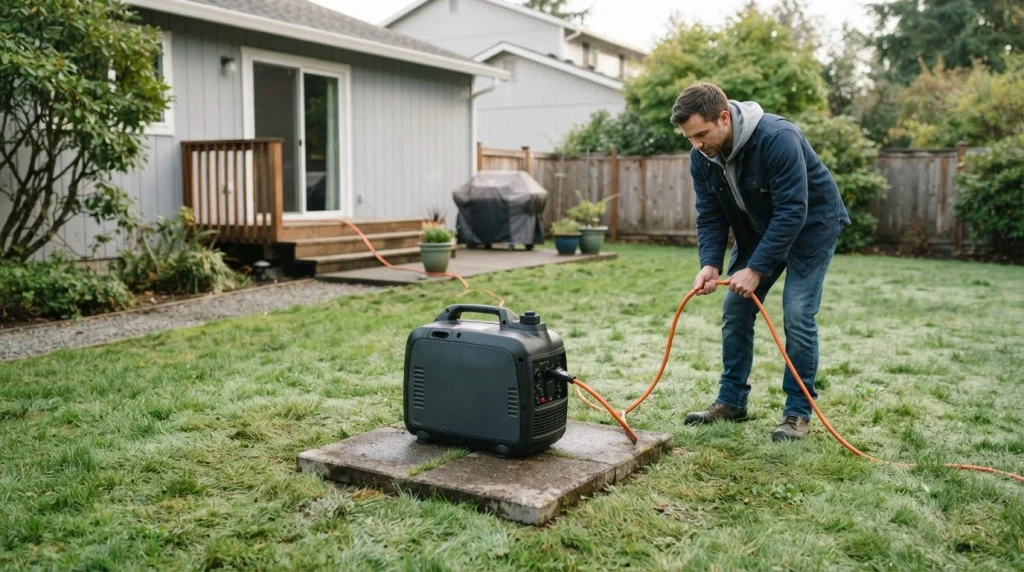
A 2000-watt inverter generator is safe when you respect fuel, carbon monoxide, and cords. Most problems come from stale fuel, a bad cord, or running it too close to the house.
Carbon monoxide is colorless and odorless, and it can build up fast indoors. The CDC and the CPSC both warn against running any generator inside a home, garage, or enclosed porch.
Safety checks before every start
- Place it outside: At least 20 feet from the house, exhaust away from windows and doors.
- Use a CO alarm: Put a battery-powered alarm inside, near sleeping areas.
- Use the right cord: A heavy-duty, outdoor-rated extension cord, as short as you can manage.
- Let it cool: Turn it off and let it cool before you refuel.
- Keep fuel fresh: Use fresh gasoline and a stabilizer, and follow your manual for storage.
Safety note: Never run a generator indoors or in a garage, even with the door open. Use a transfer switch or interlock installed by a licensed electrician for home power, and check your owner’s manual before use.
For care basics, change oil per your manual, run it monthly for 10 to 15 minutes, and drain or stabilize fuel before long storage. A clean carburetor starts far easier than a gummed-up one.
Price and size still matter for a first buy. See how much a 2000-watt inverter generator costs to match your budget to the features you need.
The U.S. Department of Energy also offers general guidance on safe home backup power and energy use.
Section Takeaway: Place it outside, use a good cord, keep fuel fresh, and follow the manual, and a 2000-watt unit will last for years.
Frequently Asked Questions
Can a 2000-watt inverter generator run a refrigerator and freezer at the same time?
Yes, if both are modern and efficient, and you start them one at a time. Their combined running watts are often 200 to 400 watts, but a double compressor start can trip the overload.
Can a 2000-watt inverter generator run a microwave?
Yes, a 700-watt microwave often draws 1,000 to 1,200 watts, so it can run alone. Turn off the fridge and other large loads first, and turn eco mode off.
Can a 2000-watt inverter generator run a CPAP machine all night?
Yes, most CPAP machines use 30 to 100 watts, which is a light load. Use clean inverter power, keep the generator outside, and run a safe outdoor cord to the bedroom.
Can a 2000-watt inverter generator run a window AC unit?
A small 5,000 BTU window AC can sometimes run alone, with 500 to 700 running watts and a 1,200 to 1,800-watt start. Keep all other loads off and test it before you need it.
Can a 2000-watt inverter generator run a TV and laptop?
Yes, a TV and laptop together use about 130 to 300 watts. That leaves plenty of room for lights, phones, and a fridge.
Is 2000 watts enough for home backup?
It is enough for essentials like a fridge, lights, phones, laptop, and CPAP. It is not enough for whole-house heat, central AC, a well pump, or an electric water heater.
Can I parallel two 2000-watt inverter generators?
Yes, if your model is parallel-capable and you use the correct parallel kit. Two units can give you about 3,200 to 3,600 running watts, enough for a small RV AC in many cases.
A 2000-watt inverter generator is the right size when your list is built around essentials. Pick your core loads, add the watts, leave headroom for one motor start, and run heat loads one at a time.
Test your combo before an outage or a trip. Start the biggest motor first, listen for strain, and adjust the list until it runs smooth and quiet.

Hi, I’m Michael Turner. I own a generator workshop in the United States and founded HomeGeneratorBlog to share practical, hands-on guidance about generator installation, maintenance, troubleshooting, safety, and backup power solutions. My goal is to help homeowners make smarter, more confident decisions through clear and reliable information