Can a 5000-Watt Inverter Generator Power a Small House? Sizing, Loads & Safe Hookup
Quick Answer
Yes, a 5000-watt inverter generator can power a small house for essential loads. It can run a refrigerator, lights, fans, phones, a laptop, a furnace blower, and a sump pump in most cases, but it cannot run a whole house at once. Learn what a 5000-watt inverter generator can run before you plug in a heavy load.
What works best on 5,000 watts
- Essential circuits first: Fridge, freezer, lights, and medical devices come before comfort loads.
- One big load: Run the fridge or a small window AC, not both at full power.
- Start-up matters most: Motors need extra starting watts for a few seconds.
- Safe hookup only: Use an inlet and interlock, or heavy-duty extension cords.
- Fuel plan needed: Keep enough fresh fuel for the outage you expect.
Do this first
- Add up running watts, then add the largest starting wattage on your list.
- Keep the total under 4,000 running watts for a safe margin.
- Place the generator outdoors, at least 20 feet from the house.
I’ve run a small house on a 5000-watt inverter generator through a two-day outage. The fridge stayed cold, the lights stayed on, and my phone stayed charged.
The trick was not power. It was choice. I picked the loads that mattered and left the rest off.
This guide shows you that same math. You’ll learn what a 5000-watt inverter generator can run, what it cannot run, how long it lasts, and how to hook it up safely in 2026.
In This Guide
- What Counts as a Small House for Generator Sizing?
- What Can a 5000-Watt Inverter Generator Run in a Small House?
- How Many Watts Does a Small House Actually Need?
- Running Watts vs Starting Watts: Why the Fridge Matters More Than the TV
- What Can a 5000-Watt Inverter Generator Not Run?
- How Do You Connect a 5000-Watt Inverter Generator to a Small House Safely?
- How Long Will a 5000-Watt Inverter Generator Run a Small House?
- 5000-Watt vs 3000-Watt vs 7500-Watt: Which Size Fits a Small House?
- How Do You Choose the Right 5000-Watt Inverter Generator?
- Frequently Asked Questions
What Counts as a Small House for Generator Sizing?
A small house is not just a small floor plan. It is a house with a small electrical load.
Most people mean a home under about 1,200 square feet. That size often has one refrigerator, one heating system, a few lights, and a modest set of outlets.
But two homes with the same floor plan can need very different power. One may have gas heat and a gas water heater. The other may have electric heat, an electric stove, and a central AC unit.
That difference changes everything. Gas appliances cut your generator load by thousands of watts.
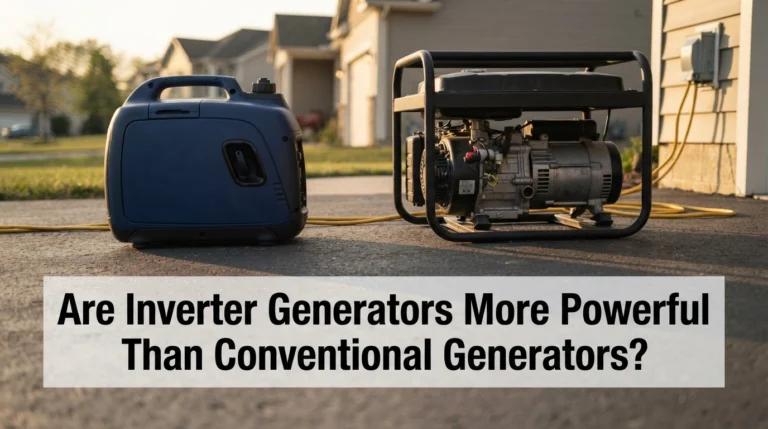
An inverter generator is a portable power source that makes clean, stable electricity
An inverter generator is a portable generator that converts raw engine power into clean sine wave power. Clean sine wave power means smooth, steady voltage that is safe for phones, laptops, and modern fridge controls.
Total harmonic distortion, or THD, measures how clean that power is. Inverter generators usually keep THD low, often under 3%.
That matters in a small house. You will plug in sensitive electronics during an outage, not just lights.
What makes a house “small” for backup power?
Use load, not square feet, to judge your home. Count the circuits you must keep on, then count the ones you can live without.
- Must-run loads: Refrigerator, freezer, sump pump, furnace blower, CPAP machine, and medical devices.
- Comfort loads: Lights, fans, TV, laptop, phone chargers, and a microwave for short use.
- Heavy loads: Central AC, electric water heater, electric stove, electric dryer, and well pump.
- Hidden loads: Garage door opener, Wi-Fi router, security system, and a second fridge in the garage.
A small house with gas heat and no central AC fits a 5000-watt inverter generator well. A small house with all-electric heat does not.
Check your main breaker panel before you buy. Note which circuits are 120-volt and which are 240-volt.
Many 5000-watt inverter generators offer both 120-volt and 240-volt outlets. Some smaller models offer 120-volt power only.
That detail decides whether you can feed a 240-volt furnace, well pump, or water heater circuit. Check the spec sheet for your model.
Section Takeaway: A small house means a small essential load, not just a small floor plan, and gas heat makes 5,000 watts go much further.
What Can a 5000-Watt Inverter Generator Run in a Small House?
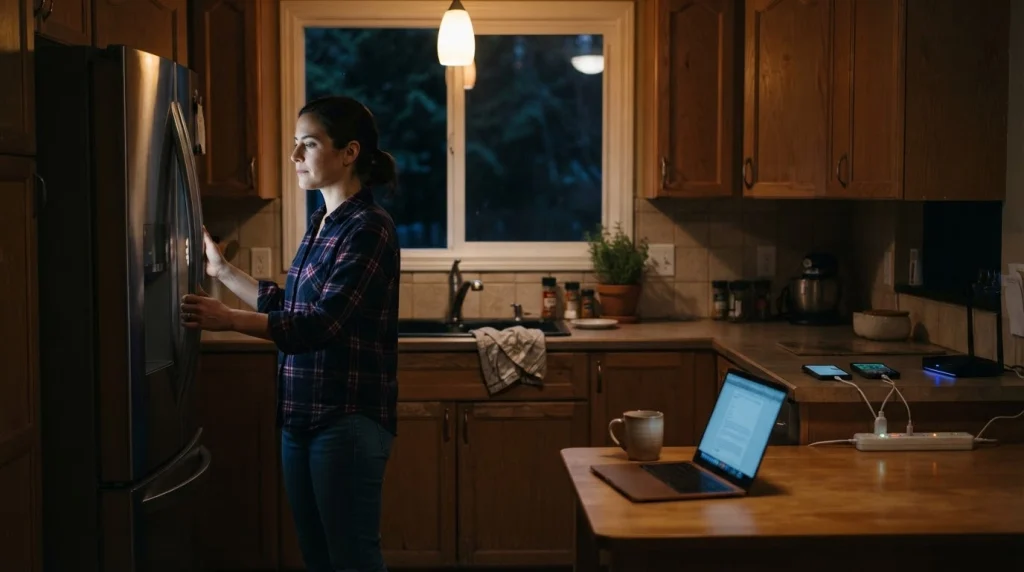
A 5000-watt inverter generator can run the core of a small house. It cannot run the whole house like a standby generator.
Think in circuits, not rooms. You will power a few key circuits and rotate the rest.
I ran my fridge, freezer, lights, Wi-Fi, laptop, and a CPAP machine on one unit. I added the microwave only after I turned off the freezer for a few minutes.
That rotation kept the load under 4,000 watts. The generator stayed quiet and steady.
Typical appliance watts for a small house
Use these ranges as a planning guide. Your exact model may use more or less power, so check its label.
| Appliance | Running Watts | Starting Watts |
|---|---|---|
| Refrigerator | 150-800 | 1,200-2,200 |
| Chest freezer | 100-400 | 800-1,200 |
| Furnace blower (gas heat) | 400-900 | 1,000-2,000 |
| Sump pump (1/3 HP) | 800-1,050 | 1,300-2,150 |
| Window AC (8,000 BTU) | 600-1,000 | 1,800-2,200 |
| Microwave (1,000W) | 1,000-1,500 | 1,000-1,500 |
| LED lights (whole house) | 100-300 | 100-300 |
| Laptop + phones + Wi-Fi | 100-250 | 100-250 |
| CPAP machine | 30-100 | 30-100 |
Notice the pattern. Lights and electronics use very little power.
Motors use the most power at start-up. That start-up surge is what trips an overload.
A realistic essential load for a small house
Here is a load I have run in real life. It stays well under 5,000 running watts.
- Fridge: 200 running watts, after start-up.
- Freezer: 150 running watts, after start-up.
- Furnace blower: 600 running watts on gas heat.
- LED lights: 150 running watts for the main rooms.
- Wi-Fi, laptop, and phones: 150 running watts.
- Sump pump: 900 running watts when it cycles on.
That total is about 2,150 running watts. It leaves room for a microwave or a small window AC for a short time.
Start the biggest motor first. Let it settle, then add the next load.
Do not start the fridge, freezer, and sump pump at the same second. Stagger them by a minute or two.
Section Takeaway: A 5000-watt inverter generator can run the essentials of a small house, but you must stagger motor starts and rotate heavy loads.
How Many Watts Does a Small House Actually Need?
Most small houses need 3,000 to 5,000 running watts for essentials. Some need less, and some need far more.
Your number depends on heat, water, and cooling. Those three systems drive the total.
A gas furnace needs only the blower motor. An electric furnace can need 5,000 to 10,000 watts on its own.
A city water supply needs no pump power. A well pump can need 1,000 running watts and 2,000 starting watts.
Do the wattage math in three steps
First, list every appliance you must run. Write its running watts from its label or manual.
Second, add those running watts together. That is your base load.
Third, find the largest starting wattage on your list. Add that extra surge to your base load, not every surge at once.
For example, a base load of 2,500 watts plus a fridge start-up of 1,500 extra watts equals 4,000 watts at that moment. A 5000-watt inverter generator can handle that peak.
If your math tops 4,500 running watts, you need a bigger plan. You can cut loads, use a larger generator, or pair two units with a parallel kit.
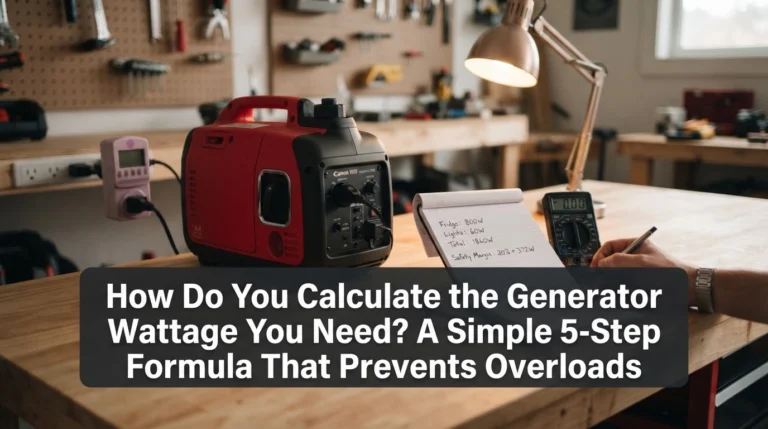
To calculate the generator wattage you need, use your own appliance labels, not a generic chart alone.
Why you should leave a 20% margin
Generators run best below their max rating. A 5000-watt unit is not meant to run at 5,000 watts all day.
Heat, altitude, and fuel type can cut real output. Propane often delivers about 10% less power than gasoline on dual fuel models.
Keep your steady load near 4,000 watts or less. That margin keeps voltage stable and extends engine life.
It also gives you room for a surprise. A sump pump can kick on while the fridge compressor starts.
That overlap is normal. A margin turns it from a trip into a non-event.
Section Takeaway: Add your running watts, add your largest start-up surge, and keep the steady total under 4,000 watts for a 5000-watt unit.
Running Watts vs Starting Watts: Why the Fridge Matters More Than the TV
Running watts are the power an appliance uses while it runs. Starting watts are the extra power a motor needs for a few seconds to get moving.
Your TV needs no starting surge. Your fridge, sump pump, and furnace blower do.
That is why a small house can trip a generator even when the steady load looks low. The surge is the hidden load.
How starting watts work in real life
A fridge may run at 200 watts. It may need 1,200 to 2,200 watts for two or three seconds when the compressor starts.
A sump pump may run at 900 watts. It may need 2,000 watts at start-up.
A window AC may run at 800 watts. It may need 2,000 watts to start the compressor.
If two motors start at once, those surges stack. That is the moment most overloads happen.
Learn the difference between running watts and starting watts before you size any backup plan.
How to stop overload shutdowns
- Start big motors first: Start the fridge, then the freezer, then the sump pump.
- Use eco mode with care: Eco mode saves fuel, but it can lag on a sudden surge.
- Turn off eco mode for motor loads: Run at full speed when a compressor may start.
- Unplug before you start: Plug in heavy loads one at a time, not all at once.
- Watch the overload light: If it flashes, shed a load fast and restart the generator.
I learned this during a summer outage. My window AC surged while the fridge started, and the generator shut down.
I restarted it, turned off eco mode, and started the AC first. It ran fine for the rest of the night.
Section Takeaway: Starting watts decide whether a 5000-watt inverter generator holds the load, so stagger motor starts and turn off eco mode for heavy loads.
What Can a 5000-Watt Inverter Generator Not Run?
A 5000-watt inverter generator cannot run a whole house at once. It cannot run every heavy appliance together.
That limit is not a flaw. It is the trade-off for quiet, clean, portable power.
Know the limit before an outage. You will make calmer choices when the power goes out.
Loads that usually exceed 5,000 watts
- Central AC (3-ton): 3,000-3,500 running watts, with a 5,000+ watt start-up surge.
- Electric water heater: 3,000-4,500 running watts, with no room left for a fridge.
- Electric stove: 2,000-3,000 watts per burner, and far more with the oven on.
- Electric dryer: 2,500-5,000 running watts on its own.
- Electric furnace: 5,000-10,000 watts, which can exceed the generator alone.
- Well pump (1 HP): 1,000-2,000 running watts, with a 3,000+ watt start-up surge.
You can run some of these alone for a short time. You cannot run them together with a fridge, freezer, and heat.
A central AC is the most common surprise. Many buyers assume 5,000 watts covers it.
It may start a small central AC with a soft-start kit. It will not run it plus a full house load in most cases.
Check your AC label and ask an electrician about a soft start if cooling is a must. Do not guess on a 240-volt load.
What to do instead
Use a window AC or portable AC for one room. It uses far less power than central AC.
Heat water in small batches. Use a kettle or a microwave for a short time, not a full electric tank.
Cook with a gas grill, a camp stove, or one small burner at a time. Keep the fridge closed while you cook.
For a well pump, run it in short bursts to fill a tank. Then turn it off and run the rest of the house.
Section Takeaway: A 5000-watt inverter generator cannot run central AC, electric heat, and an electric water heater together, so plan one heavy load at a time.
How Do You Connect a 5000-Watt Inverter Generator to a Small House Safely?
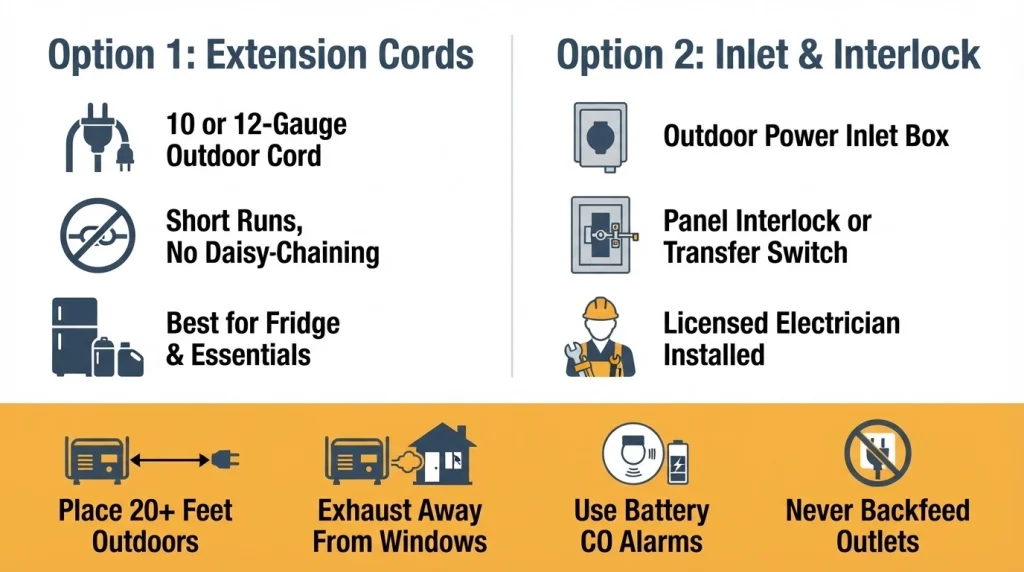
You have two safe ways to power a small house. You can use extension cords, or you can use a proper inlet and interlock.
Never use a double-ended “suicide cord” to backfeed a house outlet. It can kill a line worker and damage your generator.
That cord has live prongs on both ends. It is illegal in most places and unsafe in every place.
Option 1: Heavy-duty extension cords
Extension cords are the simplest safe method. They work well for a fridge, lights, and a few devices.
Use a 12-gauge or 10-gauge outdoor-rated cord. Keep runs short, and never daisy-chain cords.
Run the cord through a door or window, but do not pinch it in the door. A pinched cord can overheat.
Plug in only what the cord can carry. A 12-gauge cord can handle about 15 amps at 120 volts.
Safety note: Run generators outdoors and well away from windows, doors, and vents. Never run a generator in a garage, even with the door open.
Option 2: Generator inlet and interlock kit
An inlet is an outdoor power socket wired to your breaker panel. You plug the generator into the inlet with a proper generator cord.
An interlock kit is a metal plate on your panel. It stops the main breaker and the generator breaker from being on at the same time.
That lockout protects line workers. It also stops power from flowing back to the grid.
A transfer switch does the same job with a separate switch panel. It lets you pick which circuits get generator power.
Use a transfer switch or interlock installed by a licensed electrician. Check your owner’s manual and local code before you use it.
For more on sizing, see what size inverter generator do I need for your home and load list.
CO safety and placement
Carbon monoxide is colorless and odorless. It can build up fast near a house.
Place the generator at least 20 feet from the house. Point the exhaust away from windows, doors, and vents.
Use battery-powered CO alarms inside the house. Test them before storm season.
The CDC and the CPSC both stress outdoor placement and working CO alarms. Follow their guidance, not a shortcut.
Safety note: Use a transfer switch or interlock installed by a licensed electrician. Never backfeed a house outlet with a double-ended cord.
Section Takeaway: Use extension cords for a few loads, or an inlet and interlock for whole-panel backup, and never backfeed a house outlet.
How Long Will a 5000-Watt Inverter Generator Run a Small House?
Runtime depends on load, tank size, and fuel type. A lighter load means a longer run.
Most 5000-watt inverter generators hold 3 to 4 gallons of fuel. At 25% load, many run 10 to 14 hours on a tank.
At 50% load, that run time often drops to 7 to 10 hours. At full load, it can drop to 5 to 7 hours.
Check the spec sheet for your model. Do not trust a single runtime number without the load level.
How to stretch fuel during a long outage
- Use eco mode: Eco mode slows the engine when the load is light.
- Run the fridge in cycles: Keep it cold, then turn it off for an hour if food stays cold.
- Turn off lights you do not need: LED lights use little power, but every watt counts.
- Charge devices in batches: Charge phones and laptops together, then unplug the chargers.
- Keep fuel fresh: Use fuel stabilizer and rotate stored fuel every few months.
Stale fuel is the top cause of hard starts. I have seen a clean generator fail to start because the fuel sat for a year.
Store gasoline in approved cans, away from the house. Store propane tanks upright and outdoors.
Refuel only when the generator is off and cool. Let it cool for a few minutes before you open the cap.
Safety note: Refuel outdoors, away from open flames, and let the generator cool before you add fuel. Check your owner’s manual before use.
How much fuel should you keep?
Plan for at least 24 hours of essential power. That often means 8 to 12 gallons of gasoline for a 5000-watt unit at light load.
For a three-day outage, plan for 20 to 30 gallons. That sounds like a lot, and it is.
Propane stores longer than gasoline. A dual fuel model lets you use propane when gasoline runs low.
Keep a log of fuel use during your first outage. It will make your next plan far more accurate.
Section Takeaway: A 5000-watt inverter generator can run a small house for 10 or more hours at light load, but fuel planning decides how long you really last.
5000-Watt vs 3000-Watt vs 7500-Watt: Which Size Fits a Small House?
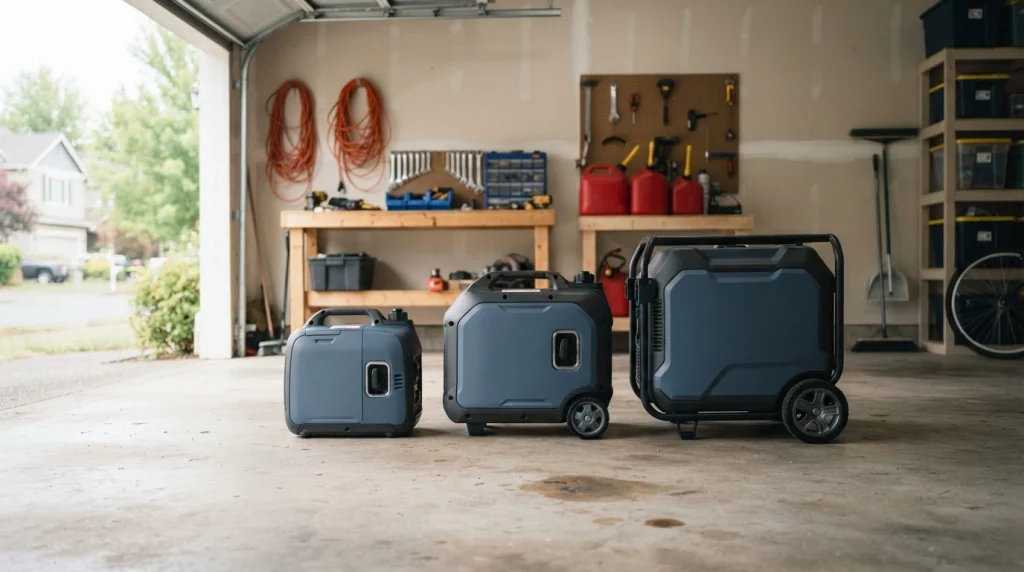
Size is about your load, not your pride. A bigger generator costs more, weighs more, and burns more fuel.
A smaller generator is quieter and easier to move. It may also trip when the fridge starts.
Pick the smallest size that covers your essential load with a margin. That is the sweet spot.
| Generator Size | Best For | Typical Essential Load | Main Limit |
|---|---|---|---|
| 3000 watts | Fridge, lights, and devices | 2,000-2,500 watts | Struggles with sump pump + fridge |
| 5000 watts | Small house essentials | 3,000-4,000 watts | No central AC + full house |
| 7500 watts | Larger small house, well pump | 5,000-6,000 watts | Heavier, louder, more fuel |
A 3000-watt inverter generator can run a fridge, lights, and phones. It often trips when a sump pump starts while the fridge runs.
A 5000-watt inverter generator covers that combo in most small houses. It also leaves room for a furnace blower or a window AC.
A 7500-watt inverter generator can run more at once. It can handle a well pump, a fridge, and heat with less juggling.
But it weighs more and costs more. It also burns more fuel at light load if you do not use eco mode.
For more on home sizing, see what size generator for home backup and how load changes the answer.
Parallel capability is another option. Two 3000-watt units can join to make about 6,000 watts.
That setup is flexible, but it needs a parallel kit and two fuel tanks. It also costs more than one 5000-watt unit in many cases.
Section Takeaway: For most small houses, 5,000 watts is the sweet spot, with enough headroom for motors and too little waste for light loads.
How Do You Choose the Right 5000-Watt Inverter Generator?
Do not buy on watts alone. Buy on outlets, noise, fuel, weight, and support.
A 5000-watt unit with the wrong outlets will not feed your panel. A loud unit will annoy you and your neighbors.
Read the spec sheet like a checklist. Compare models side by side before you buy.
Check these specs first
- Running watts: Look for 4,500-5,000 running watts, not just peak watts.
- Starting watts: Look for 5,500-6,500 starting watts for motor loads.
- Outlets: Look for 120V/240V, 30-amp, and GFCI outlets if you need them.
- THD: Look for under 3% THD for clean power to electronics.
- Noise: Look for a dB rating at 25% load and at a set distance.
- Runtime: Look for runtime at 25% and 50% load, not just one number.
- Fuel type: Gasoline is common, dual fuel adds propane flexibility.
- Weight: Many 5000-watt units weigh 100-130 pounds, so check wheels and handles.
Brands like Honda, Yamaha, Champion, Westinghouse, WEN, Generac, DuroMax, Predator, and Pulsar all make models in this class. Compare their spec sheets, not just their ads.
Check parts and service near you. A good warranty means little if no one can service it.
See the best 5000-watt portable generators to compare models in this size class.
Noise, maintenance, and break-in
Noise is measured in decibels, or dB. A quiet inverter generator may run near 60 dB at 25% load from 23 feet away.
That is about the level of normal conversation. An open-frame generator can be far louder.
Break in a new generator before an outage. Follow the manual for the first oil change, often after 5 to 25 hours.
Change oil on schedule, clean the air filter, and check the spark plug. Use fresh fuel and a stabilizer.
The EPA and Energy.gov offer general guidance on safe generator use and home energy planning. Use their pages as a starting point, then follow your manual.
Section Takeaway: Choose a 5000-watt inverter generator by running watts, outlets, THD, noise, and service support, not by peak watts alone.
Frequently Asked Questions
Can a 5000-watt inverter generator power a small house during an outage?
Yes, it can power essential loads in most small houses. It can run a fridge, freezer, lights, furnace blower, sump pump, and devices if you manage loads and stagger motor starts.
Can a 5000-watt inverter generator run a refrigerator and freezer at the same time?
Yes, in most cases. Start the fridge first, let it settle, then start the freezer. Their combined running watts are usually under 1,000 watts after start-up.
Can a 5000-watt inverter generator run central air conditioning?
Usually no, not with a full house load. A 3-ton central AC can need 3,000 running watts and a 5,000+ watt start-up surge, which leaves little room for other loads.
Can a 5000-watt inverter generator run a well pump?
It can run many small well pumps, but check the pump size first. A 1/2 HP pump is easier to start than a 1 HP pump, and a soft-start kit can help in some cases.
How long will a 5000-watt inverter generator run on one tank?
Many models run 10 to 14 hours at 25% load and 7 to 10 hours at 50% load. Check your model spec sheet, because tank size and load change the result.
Do I need a transfer switch for a 5000-watt inverter generator?
You need a transfer switch or interlock kit if you want to feed house circuits through the panel. Extension cords are safe for a few appliances, but they cannot power hard-wired circuits.
Is a 5000-watt inverter generator enough for a small house with electric heat?
Usually no. Electric heat can need 5,000 to 10,000 watts on its own, so a 5000-watt unit may not cover heat plus a fridge and other essentials.
Yes, a 5000-watt inverter generator can power a small house for the loads that matter most. It will not run everything at once, and that is fine.
Pick your essentials, do the wattage math, and hook it up safely. Keep fuel fresh, test the setup before storm season, and keep a CO alarm in the house.
When the next outage hits, you will not guess. You will know what to run, what to wait on, and how long you can last.

Hi, I’m Michael Turner. I own a generator workshop in the United States and founded HomeGeneratorBlog to share practical, hands-on guidance about generator installation, maintenance, troubleshooting, safety, and backup power solutions. My goal is to help homeowners make smarter, more confident decisions through clear and reliable information