Do Inverter Generators Have 50-Amp RV Outlets? Yes — If You Pick the Right Size
Quick Answer
Yes, some inverter generators have 50-amp RV outlets, but most small and mid-size models do not. You will usually find a true 50-amp RV outlet on larger inverter generators rated at 7,000 running watts or more. Check the best portable generators with a 50-amp outlet before you buy, because the plug shape alone does not prove the generator can carry a full 50-amp load.
What to check in 10 seconds
- Outlet type: Look for a NEMA 14-50R outlet, the large four-prong outlet used by 50-amp RVs.
- Running watts: A true 50-amp service at 120/240 volts can deliver up to 12,000 watts, so a 3,000-watt generator cannot match it.
- Voltage: A 50-amp RV needs 120/240-volt split-phase power, not 120 volts only.
- Breaker size: The outlet should sit behind a 50-amp breaker, not a 30-amp breaker with a bigger plug.
- Your real load: Most RVs never pull a full 50 amps at once, so match the generator to your air conditioner, fridge, and other loads.
If yours has no 50-amp outlet
- Use a listed 50-amp to 30-amp dogbone adapter, run fewer loads at once, and never force a plug to fit.
- Parallel two compatible inverter generators only with the maker’s parallel kit, and only if the combined output covers your load.
I’ve stood in a campground at dusk, RV cord in hand, staring at a generator panel that had every outlet except the one I needed.
That moment taught me a simple lesson. The plug matters, but the power behind it matters more.
This guide explains which inverter generators have a 50-amp RV outlet, what size you really need, and how to connect safely without tripping breakers or damaging your RV.
In This Guide
- What Is a 50-Amp RV Outlet?
- Do Inverter Generators Have 50-Amp RV Outlets?
- What Size Inverter Generator Do You Need for a 50-Amp RV?
- Which Inverter Generators Have a 50-Amp Outlet?
- 50-Amp vs 30-Amp RV Outlet: What’s the Real Difference?
- How to Connect a 50-Amp RV to an Inverter Generator
- Can You Use an Adapter If Your Generator Has No 50-Amp Outlet?
- What to Check Before You Buy
- Common Mistakes to Avoid With 50-Amp RV Power
- Frequently Asked Questions
What Is a 50-Amp RV Outlet?
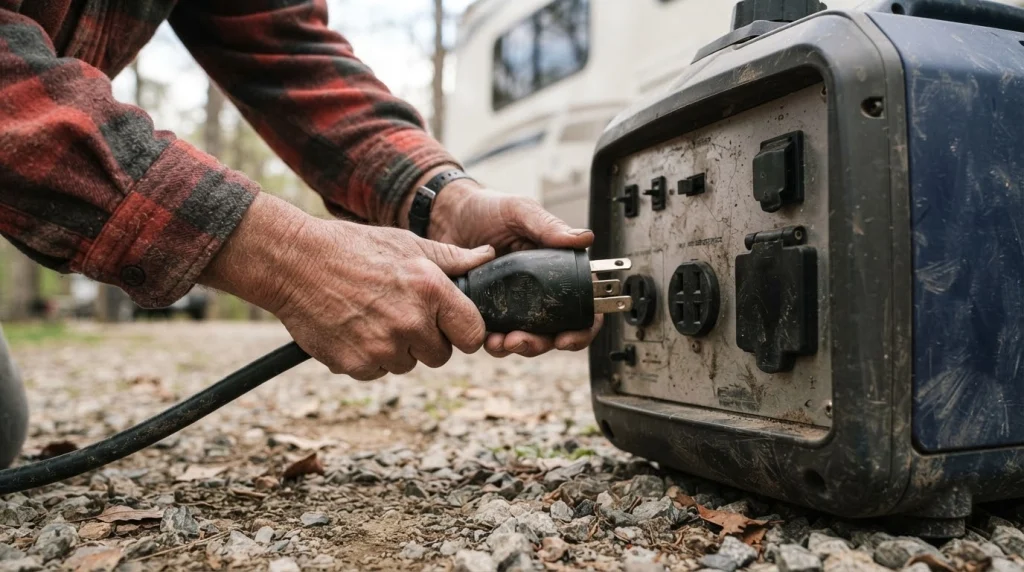
A 50-amp RV outlet is a NEMA 14-50R receptacle that supplies 120/240-volt split-phase power to a large RV.
It has four prongs: two hot legs, one neutral, and one ground. That design lets the RV split power across two 120-volt legs.
Each leg can carry up to 50 amps. Together, they can deliver up to 12,000 watts at full load.
Most 50-amp RVs never use all 12,000 watts at once. They use the extra capacity for two air conditioners, a microwave, a water heater, and other loads running together.
The shore-power cord for a 50-amp RV is thick and heavy for a reason. It carries far more current than a standard household extension cord.
How do you spot a NEMA 14-50R outlet?
Look for a large, round-ish outlet with four slots. Two are angled, one is straight, and one is round for ground.
It looks nothing like a normal 120-volt household outlet. It also looks different from a 30-amp RV outlet, which has only three prongs.
Check the label beside the outlet on the generator panel. It should read “14-50R” or “50A 125/250V.”
If the label is worn or missing, check your owner’s manual. Never guess from the shape alone.
Section Takeaway: A 50-amp RV outlet is a four-prong NEMA 14-50R outlet that delivers 120/240-volt power, and its real value is the extra capacity for running several large RV loads at once.
Do Inverter Generators Have 50-Amp RV Outlets?
Yes, some inverter generators have 50-amp RV outlets, but they are the exception, not the rule.
Most inverter generators in the 2,000 to 4,500-watt range have only 120-volt outlets. They may include a 30-amp twist-lock outlet, but not a 14-50R.
That makes sense when you do the math. A 3,500-watt generator cannot supply 12,000 watts, so a 50-amp outlet would promise power it cannot deliver.
Larger inverter generators change the picture. Models rated at 7,000, 9,000, or 10,000 running watts often include a 14-50R outlet.
Some of those models are dual-fuel or tri-fuel inverter generators. They still use inverter technology for clean power, but they sit in a bigger, heavier frame.
Why do so few inverter generators offer one?
Inverter generators are built for quiet, clean, portable power. Size and weight stay low on most models.
A 50-amp outlet needs a bigger alternator, a bigger inverter module, and heavier wiring. That adds cost, size, and weight.
Many buyers also do not need it. A small travel trailer with a 30-amp service runs fine on a 3,000 to 4,500-watt inverter generator.
Makers save the 50-amp outlet for their large RV and home-backup models. That is where the demand sits.
I learned this the hard way on a trip with a friend’s fifth wheel. My compact inverter generator ran the lights and fridge fine, but it had no way to feed the 50-amp cord directly.
We used an adapter and managed loads carefully. It worked, but it was not the same as a direct 50-amp connection.
Section Takeaway: Yes, large inverter generators can have a 50-amp RV outlet, but you will rarely find one below about 7,000 running watts, so check the panel and the spec sheet before you assume it is there.
What Size Inverter Generator Do You Need for a 50-Amp RV?
The short answer is: size the generator to your loads, not to the 50-amp label on your RV.
A 50-amp RV can draw 12,000 watts. Most RVs do not draw that much in normal use.
Start by listing your biggest loads. A 13,500 BTU air conditioner often needs 2,800 to 3,000 watts to start and 1,200 to 1,500 watts to run.
A 15,000 BTU air conditioner needs more. It can draw 3,500 watts at startup and 1,500 to 2,000 watts while running.
Add your fridge, converter, microwave, water heater, and any second air conditioner. Then add a safety margin of 20 percent.
What size works for most 50-amp RVs?
- 7,000 to 7,500 running watts: A good fit for one air conditioner, fridge, lights, and light kitchen use.
- 9,000 to 10,000 running watts: A better fit for two air conditioners or heavy simultaneous use.
- 12,000 running watts: The only size that can truly match a full 50-amp service, and few portable inverter generators reach it.
- 5,000 running watts: Often enough with an adapter and careful load management, but not a full 50-amp replacement.
Check the running watts, not the starting watts, on the spec sheet. Running watts tell you what the generator can sustain.
Starting watts only cover a short surge. An air conditioner compressor needs that surge, then settles to a lower running draw.
If you want a deeper load list for common RV appliances, see what a 5000-watt inverter generator can run at the same time. It helps you see where the limits sit.
For a full sizing walkthrough, the best portable generators for RV camping guide also covers real RV loads, not just lab numbers.
Section Takeaway: Most 50-amp RV owners do well with 7,000 to 10,000 running watts, but only a 12,000-watt unit can match a full 50-amp service, so size to your air conditioners and other big loads first.
Which Inverter Generators Have a 50-Amp Outlet?
Large inverter generators from the major RV and portable-power brands are the most likely to include a 14-50R outlet.
Look in the 7,500-watt and larger class first. That is where makers add the 50-amp outlet, a 30-amp twist-lock, and several 120-volt outlets on one panel.
Some models in the 9,500 to 12,000-watt range also add remote start, a digital load meter, and low-THD clean power for sensitive electronics. Those features help in an RV, but they do not replace proper sizing.
Do not rely on a product name or a photo. Open the spec sheet and find the outlet list.
What does the outlet list usually show?
- Small inverter generators, 2,000 to 3,500 watts: Two 120-volt household outlets, sometimes a 12-volt DC outlet, and a parallel port.
- Mid-size inverter generators, 4,000 to 6,500 watts: Household outlets plus a 30-amp 120-volt twist-lock, sometimes a 30-amp RV outlet.
- Large inverter generators, 7,000 watts and up: Household outlets, a 30-amp twist-lock, and often a 50-amp 14-50R outlet.
- Very large inverter generators, 10,000 watts and up: A full panel with 14-50R, 30-amp, and multiple 120-volt outlets.
| Generator size (running watts) | 50-amp RV outlet? | Best for |
|---|---|---|
| 2,000 – 3,500 | Almost never | Lights, charging, small fridge |
| 4,000 – 5,000 | Rare | One small AC with adapter |
| 6,500 – 7,500 | Sometimes | One AC, fridge, kitchen loads |
| 9,000 – 10,000 | Often | Two ACs, heavy RV use |
| 12,000 | Usually | Full 50-amp service |
Weight rises fast in this class. A large inverter generator can weigh 200 pounds or more.
Plan for wheels, a ramp, and a second person to load it. A 50-amp outlet does not help if you cannot move the unit safely.
Section Takeaway: Shop in the 7,000-watt and larger class for a 50-amp RV outlet, confirm the 14-50R on the spec sheet, and plan for the extra weight that comes with it.
50-Amp vs 30-Amp RV Outlet: What’s the Real Difference?
A 30-amp RV outlet is a three-prong NEMA TT-30R outlet that supplies 120 volts only.
It can deliver up to 3,600 watts. That is enough for one air conditioner and basic loads, but not for two air conditioners at once.
A 50-amp RV outlet supplies 120/240 volts across two legs. It can deliver up to 12,000 watts, or about 3.3 times more power.
The difference is not just the plug shape. It is voltage, capacity, and how many large loads you can run together.
Can a 50-amp RV run on a 30-amp outlet?
Yes, with a dogbone adapter, but with limits. The RV will only get 3,600 watts from a 30-amp source.
You will need to run one air conditioner at a time. You will also need to stagger the microwave, water heater, and other big loads.
Many RVers do this at older campgrounds with only 30-amp pedestals. It works fine when you manage loads.
The reverse is also true. A 30-amp RV can plug into a 50-amp outlet with an adapter, but it will only draw what it needs.
If your generator has 240-volt capability, read how an inverter generator can provide 240V power before you connect. The voltage setup matters as much as the plug.
Section Takeaway: A 30-amp RV outlet gives you 120 volts and 3,600 watts, while a 50-amp outlet gives you 120/240 volts and up to 12,000 watts, so the 50-amp service is built for larger RVs with more simultaneous loads.
How to Connect a 50-Amp RV to an Inverter Generator
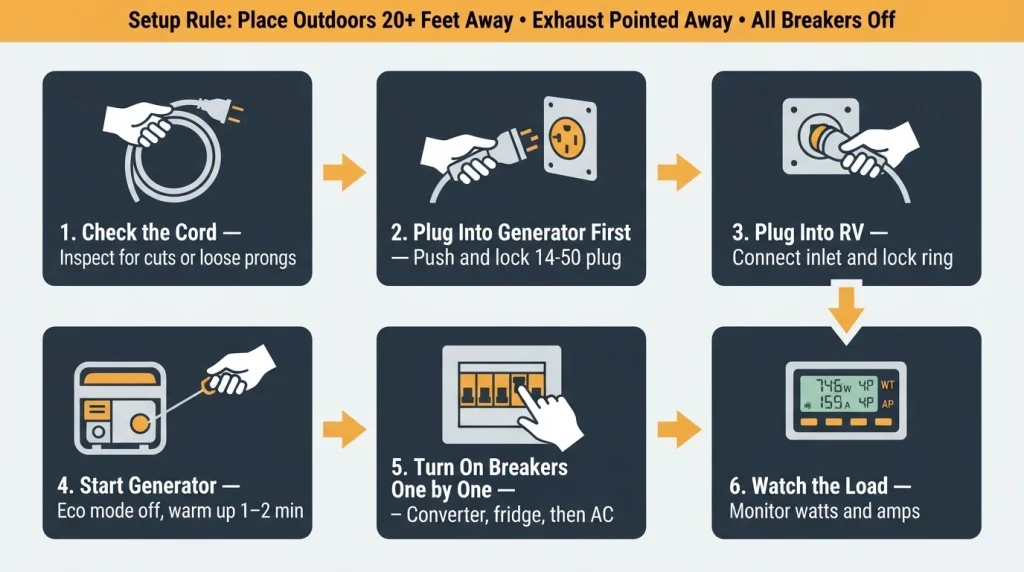
Connecting a 50-amp RV is simple when you follow the right order. Rushing it is where most mistakes happen.
Start with the generator off and all RV breakers off. That prevents a sudden load spike at startup.
Place the generator outdoors, at least 20 feet from the RV, with the exhaust pointing away from doors and windows. Never run it in a garage, under an awning, or inside a storage bay.
What are the connection steps?
- Check the cord: Inspect your 50-amp shore cord for cuts, melted plugs, or loose prongs.
- Plug into the generator first: Push the 14-50 plug fully into the generator outlet and twist or lock it if the outlet requires it.
- Plug into the RV: Connect the other end to the RV inlet and lock the ring.
- Start the generator: Start it with eco mode off for the first load, then let it warm up for a minute or two.
- Turn on RV breakers one at a time: Start with the converter, then the fridge, then the air conditioner.
- Watch the load: Check the generator display for watts or amps, and listen for strain.
Use a heavy-duty RV cord rated for 50 amps. A light extension cord will overheat and can melt.
Keep the cord off the ground where possible. Avoid puddles, sharp edges, and hot exhaust.
Safety note: Never backfeed your RV or home through a modified cord, never bypass a breaker, and always follow your owner’s manual. If you are unsure about the wiring, have a qualified electrician or RV technician check it first.
For more on safe hookups, Consumer Reports offers general generator safety and buying guidance that is worth reading before a big trip.
Section Takeaway: Plug in with the generator off, start it, then switch RV loads on one at a time, and always use a true 50-amp cord outdoors with clear exhaust space.
Can You Use an Adapter If Your Generator Has No 50-Amp Outlet?
Yes, you can use an adapter, but the adapter does not create more power.
A 50-amp to 30-amp dogbone adapter lets your 50-amp cord plug into a 30-amp outlet. It limits you to the 30-amp circuit.
A 50-amp to 15-amp adapter is even more limited. It is fine for charging batteries and running lights, but not for an air conditioner.
Use only listed, RV-rated adapters. Cheap, unlisted adapters can overheat and damage the plug.
What about paralleling two generators?
Paralleling can help if both units are the same model or are listed as compatible. You connect them with the maker’s parallel kit.
Two 3,500-watt inverter generators in parallel can give you about 7,000 watts. That is a big step up from one unit.
Even then, you may not get a true 50-amp 14-50R outlet. Some parallel kits include a 50-amp outlet, but many do not.
Check the kit’s outlet list before you buy a second generator just for that reason. The kit, not the generator alone, decides what you can plug in.
Load management still matters with an adapter. Learn how to run multiple appliances at once on an inverter generator without tripping the breaker.
Section Takeaway: An adapter lets you connect, but it does not add watts, so treat a 30-amp adapter as a 3,600-watt limit and manage your air conditioner and kitchen loads around it.
What to Check Before You Buy
Do not buy on watts alone. A big number on the box can hide a missing outlet.
Read the spec sheet line by line. Look for “NEMA 14-50R,” “50A 125/250V,” and “120/240V” in the same listing.
Check the breaker panel photo if the listing has one. The 50-amp outlet should have its own breaker and label.
What else should you check?
- Total harmonic distortion (THD): Look for under 3 percent for clean power to RV electronics.
- Fuel type: Gas, propane, or dual-fuel changes runtime, fuel storage, and cold-weather starts.
- Runtime: Check runtime at 25 percent and 50 percent load, not just at idle.
- Noise level: Large units are louder than small ones, so check the decibel rating at 25 feet.
- Weight and wheels: A 50-amp-capable unit is heavy, so check the wheel kit and lift handles.
- Warranty and service: Check the warranty length and where you can get parts.
Think about your RV type too. A large fifth wheel with two air conditioners needs more than a small travel trailer.
See the best portable generators for a 5th wheel if you tow a big rig. The load profile is different from a small camper.
Check your RV manual for the air conditioner startup draw. That number often decides the generator size.
AAA also publishes general RV trip and vehicle-care guidance that can help you plan fuel, towing, and roadside stops around a large generator.
Section Takeaway: Confirm the 14-50R outlet, 120/240-volt output, running watts, THD, runtime, and weight on the spec sheet, and match them to your RV’s air conditioner load before you spend.
Common Mistakes to Avoid With 50-Amp RV Power
The most common mistake is assuming a 50-amp plug means 50 amps of power. It does not.
A plug is only a connector. The generator’s engine, alternator, and breaker decide how much power you actually get.
Another mistake is starting everything at once. Two air conditioners, a microwave, and a water heater can trip even a large generator.
Start loads one at a time. Let each one settle before you add the next.
What mistakes trip breakers most often?
- Running the water heater on electric: Switch it to propane when the air conditioner is running.
- Using a long, thin extension cord: Voltage drops, heat builds, and the generator works harder.
- Forgetting the converter draw: A converter charging low batteries can pull 500 to 1,000 watts on its own.
- Ignoring altitude: Generators lose power at high altitude, so a unit that works at sea level may struggle in the mountains.
- Skipping maintenance: A dirty air filter or old fuel can cut output when you need it most.
Do not use a “cheater” cord that ties two 120-volt outlets together to fake 240 volts. It is unsafe and can damage your RV.
Do not run the generator in rain without a proper cover. Water and a 50-amp outlet are a bad mix.
For general outdoor power and emissions guidance, EPA resources explain why clean, efficient operation matters for portable engines.
For RV care basics, Car Care Council guidance can help you keep the RV and its electrical system in good shape between trips.
Section Takeaway: Treat the 50-amp outlet as a capacity limit, not a promise, start loads one at a time, use a proper 50-amp cord, and never use a homemade adapter to fake 240 volts.
Frequently Asked Questions
Do all inverter generators have a 50-amp RV outlet?
No. Most inverter generators do not have one. You will usually find a 14-50R outlet only on larger models rated at 7,000 running watts or more.
Can a 5,000-watt inverter generator run a 50-amp RV?
It can run part of a 50-amp RV with an adapter, but it cannot supply a full 50-amp service. You will need to run one air conditioner at a time and manage other big loads.
What size inverter generator do I need for a 50-amp RV with two air conditioners?
Plan for 9,000 to 10,000 running watts or more. Two 15,000 BTU air conditioners plus a fridge and converter can draw 5,000 watts or more while running.
Can I plug my 50-amp RV into a 30-amp generator outlet?
Yes, with a listed 50-amp to 30-amp dogbone adapter. You will be limited to 3,600 watts, so stagger your air conditioner, microwave, and water heater.
Is a 50-amp RV outlet the same as a 50-amp dryer outlet?
No, they look similar but are wired differently. An RV 14-50R outlet supplies 120/240 volts for an RV panel, while a dryer outlet has a different use and wiring. Never swap them without checking the manual.
Do I need a 50-amp outlet to run my RV air conditioner?
No. A single air conditioner can run from a 30-amp outlet or a large enough 120-volt outlet with an adapter. The 50-amp outlet helps when you want to run two air conditioners and other loads together.
Can I parallel two inverter generators to get a 50-amp outlet?
Sometimes, if the maker’s parallel kit includes a 14-50R outlet. Paralleling adds watts, but it does not always add the outlet, so check the kit’s panel before you buy.
Do inverter generators have 50-amp RV outlets? Yes, the right large models do, as of 2026.
Pick a unit with a true NEMA 14-50R outlet, 120/240-volt output, and enough running watts for your air conditioners. Then connect with a proper 50-amp cord, start loads one at a time, and enjoy the extra capacity without tripping breakers.

Hi, I’m Michael Turner. I own a generator workshop in the United States and founded HomeGeneratorBlog to share practical, hands-on guidance about generator installation, maintenance, troubleshooting, safety, and backup power solutions. My goal is to help homeowners make smarter, more confident decisions through clear and reliable information