What Is the Best Inverter Generator for Boat Use? Quiet, Compact & Marine-Safe Picks
Quick Answer
What is the best inverter generator for boat use? For most boats, a quiet 2,000 to 2,500-watt enclosed inverter generator is best — light enough to carry on deck, clean enough for electronics, and strong enough for a battery charger, fridge, and lights. Start by comparing the best inverter generators in that size range, then match weight, noise, and fuel type to your boat.
Best Choice by Boat Type
- Small day boats: A 2,000-watt model covers charging, lights, and a small fridge without taking up deck space.
- Cabin cruisers: A 2,500 to 3,500-watt dual-fuel model handles a charger, galley gear, and fans at once.
- Liveaboard use: A 3,500-watt+ unit or two paralleled units gives headroom for air conditioning on hot nights.
- Quiet anchorages: Look for 52 to 58 dB at quarter load and a strong eco mode.
- Saltwater boats: Pick an enclosed case, covered outlets, and a CO shutoff sensor.
Non-Negotiable Safety Rule
- Never run a portable generator inside a cabin, engine compartment, or enclosed cockpit — carbon monoxide kills quickly on boats.
I’ve carried generators down docks in the dark, wedged them on swim platforms, and learned the hard way that boat power is different from house power.
Space is tight, decks move, and exhaust has nowhere to go. This guide shows you how to pick a size that actually fits your boat, your loads, and your nights at anchor in 2026.
In This Guide
- Can You Use an Inverter Generator on a Boat?
- What Size Inverter Generator Do You Need for a Boat?
- What Features Matter Most for Boat Use?
- Which Type Is Best: Gas, Dual-Fuel, or Paralleled?
- Where Should You Place and Run It on a Boat?
- How Do You Connect a Generator to a Boat Safely?
- What Mistakes Do Boaters Make Most Often?
- Frequently Asked Questions
Can You Use an Inverter Generator on a Boat?
Yes, you can use a portable inverter generator on many boats for temporary power on deck. You cannot treat it like a built-in marine generator.
A built-in marine generator is installed below deck with proper exhaust, cooling, and ignition protection. A portable unit is not.
An inverter generator is a portable generator that makes clean, stable power by converting AC to DC and back to AC. That clean power has low total harmonic distortion, so phones, laptops, and modern chargers run safely.
That matters on a boat. Most of what you plug in now is electronics, not just a simple light bulb.
Why inverter power beats conventional power on water
Conventional open-frame generators are louder, heavier, and rougher on electronics. They also burn more fuel at light loads.
Inverter models throttle down in eco mode. At anchor, that means less noise and longer runtime from a small tank.
I learned this on a weekend trip when an old open-frame unit drowned out conversation on deck. We switched it off and sat in the dark.
The quiet inverter we borrowed the next season changed the whole trip. We could charge batteries and still hear the water.
Safety note: Portable generators are not ignition-protected for gasoline engine compartments. Never store or run one where fuel vapors can collect, and follow guidance from the U.S. Coast Guard Boating Safety site and your boat manual.
Section Takeaway: Use an inverter generator as on-deck, temporary power only. Its quiet, clean output is ideal for boats, but it does not replace a properly installed marine generator.
What Size Inverter Generator Do You Need for a Boat?
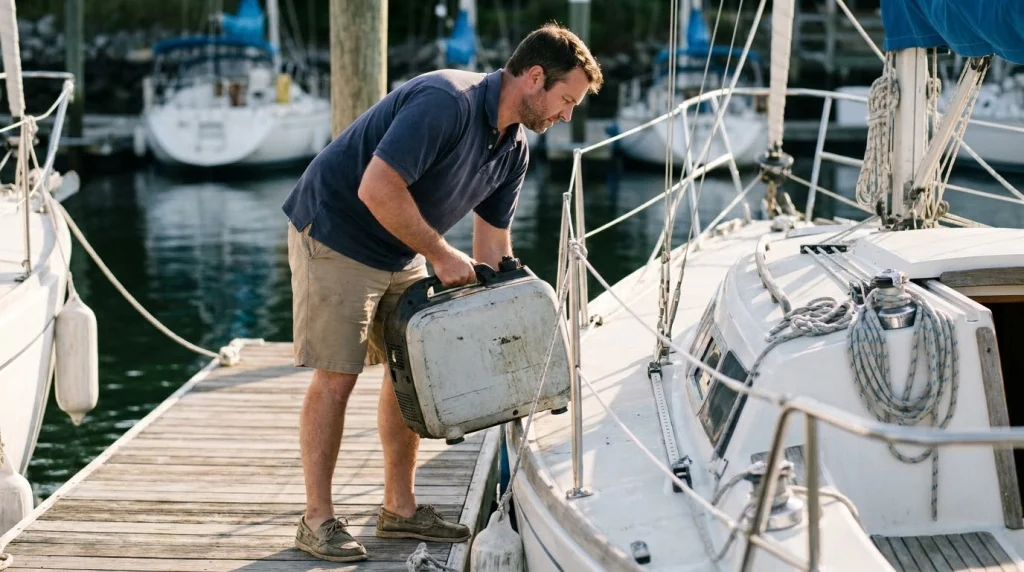
Most recreational boats need 2,000 to 3,500 running watts. Smaller boats often need less, and air conditioning pushes you to the top of that range.
Start with your real loads. Add the running watts for everything you want at the same time, then check starting watts for motors and compressors.
- Battery charger: 200 to 800 watts, depending on bank size
- Marine fridge: 100 to 200 running watts, higher at startup
- LED cabin lights: 20 to 60 watts total
- Phones and laptops: 50 to 150 watts
- Small microwave: 800 to 1,200 watts
- Portable marine AC: 1,200 to 1,800 running watts, much higher at startup
If your list looks like charger plus fridge plus lights, a 2,000-watt unit is plenty. Our guide to what appliances a 2000-watt inverter generator can run shows common combos that work well together.
Add a microwave or AC and you need more headroom. Running a generator at 90% load all night is loud and hard on the engine.
Sizing by boat type
| Boat Type | Typical Loads | Best Size | Weight Range |
|---|---|---|---|
| Fishing / day boat | Charger, lights, electronics | 2,000W | 38-50 lb |
| Weekend sailboat | Charger, fridge, fans, laptops | 2,200-2,500W | 45-60 lb |
| Cabin cruiser | Above + microwave, TV | 3,000-3,500W | 60-85 lb |
| Cruiser with AC | Above + air conditioning | 3,500W or paralleled pair | Varies |
Weight matters more on a boat than at home. A unit you cannot lift safely onto a rocking deck is the wrong unit, no matter its watts.
Section Takeaway: Size for your simultaneous loads, not your wish list. For most boats, 2,000 to 3,500 watts is the sweet spot between power, weight, and quiet runtime.
What Features Matter Most for Boat Use?
For boat use, prioritize low noise, light weight, CO shutoff, covered outlets, and long eco-mode runtime. Those five features matter more than extra outlets you will never use.
Noise carries across water. A loud generator annoys every boat near you and ruins your own evening.
- Noise under 60 dB: Look at the quarter-load rating, not just the headline number
- CO shutoff sensor: Shuts the engine down if carbon monoxide builds up nearby
- Enclosed case: Cuts noise and helps shed light spray, though it is not waterproof
- Parallel capability: Lets you link two small units instead of lifting one heavy unit
- Fuel efficiency: 8 to 12 hours at quarter load saves dock trips and deck storage
- 12V DC and USB ports: Handy for direct charging without adapters
If quiet is your top concern, our tips on how to reduce generator noise help, but placement and load matter most. A smaller load in eco mode is always quieter.
Corrosion is the slow problem. Rinse salt spray off the case, store the unit dry ashore when you can, and check cords for cracked insulation.
The EPA also notes that cleaner, fuel-efficient engines reduce emissions in marinas. Eco mode helps there too.
Which Type Is Best: Gas, Dual-Fuel, or Paralleled?
Gasoline is simplest for most boaters, dual-fuel adds flexibility if you already carry propane, and paralleled twins are best when you need AC power without a heavy single unit.
Many boaters already use propane for a grill or galley. A dual-fuel model can share that supply and stores cleaner for long periods.
Propane gives slightly fewer watts than gasoline on most models. Check both ratings before you buy, not just the big number on the box.
| Option | Best For | Trade-Off |
|---|---|---|
| Single gas 2,200W | Most day and weekend boats | No AC headroom |
| Dual-fuel 3,000-3,500W | Cruisers that carry propane | Heavier, lower watts on propane |
| Paralleled pair | AC use, flexible loads | Two engines to maintain |
| Solar power station | Silent charging only | Cannot sustain large loads |
The same logic we use for RVs applies here. See how setups compare in our guide to the best portable generators for RV camping — boats and RVs share the same space, noise, and shore-power problems.
Independent testing from sources like Consumer Reports is useful for noise and runtime comparisons. Use it to confirm manufacturer claims before you spend.
Where Should You Place and Run It on a Boat?
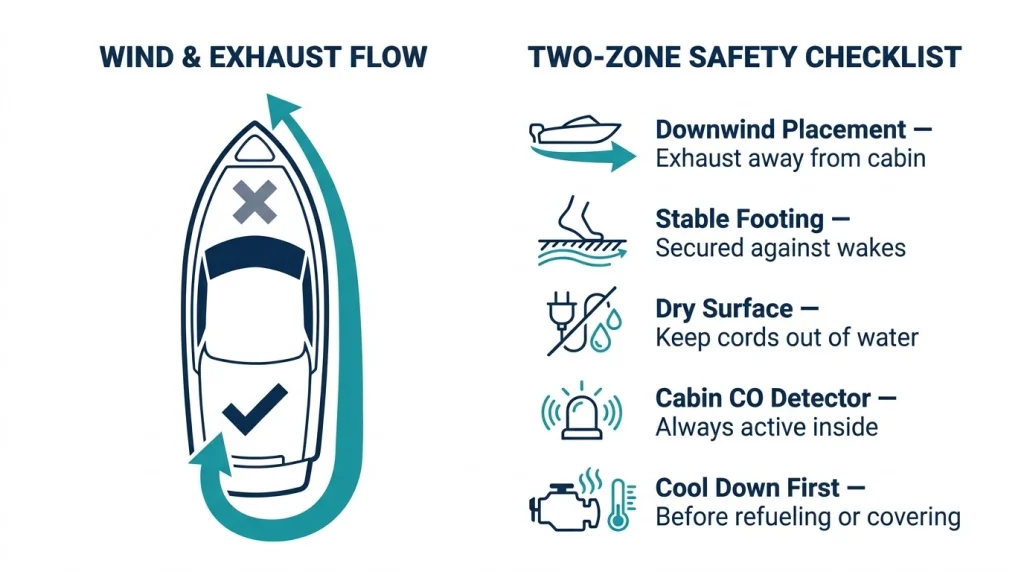
Place it outdoors on a stable, dry, downwind spot on deck, with exhaust pointing away from cabins and people. Never place it below deck.
The swim platform is common, but only if it stays dry and stable. A wet, bouncing platform is a bad place for a hot engine and a fuel tank.
- Downwind placement: Wind should carry exhaust away from the boat, not into it
- Stable footing: Secure it so wakes and waves cannot slide it
- Dry surface: Keep outlets and cords out of standing water
- CO detector: Keep a working marine CO detector in the cabin at all times
- Cool down first: Let it cool fully before refueling or covering
Safety note: Carbon monoxide is odorless and can collect in a cabin even when the generator is outside. If anyone feels dizzy, sick, or unusually tired, shut it down and get fresh air at once.
At a marina, check the rules first. Some marinas ban portable generators on docks or require shore power only.
Our camping guide covers similar outdoor placement rules in detail. The advice in can you use an inverter generator for camping applies at anchor too — distance, wind, and dry ground matter.
Section Takeaway: Outdoor, downwind, dry, and stable is the only safe setup. If you cannot meet all four, do not run it.
How Do You Connect a Generator to a Boat Safely?
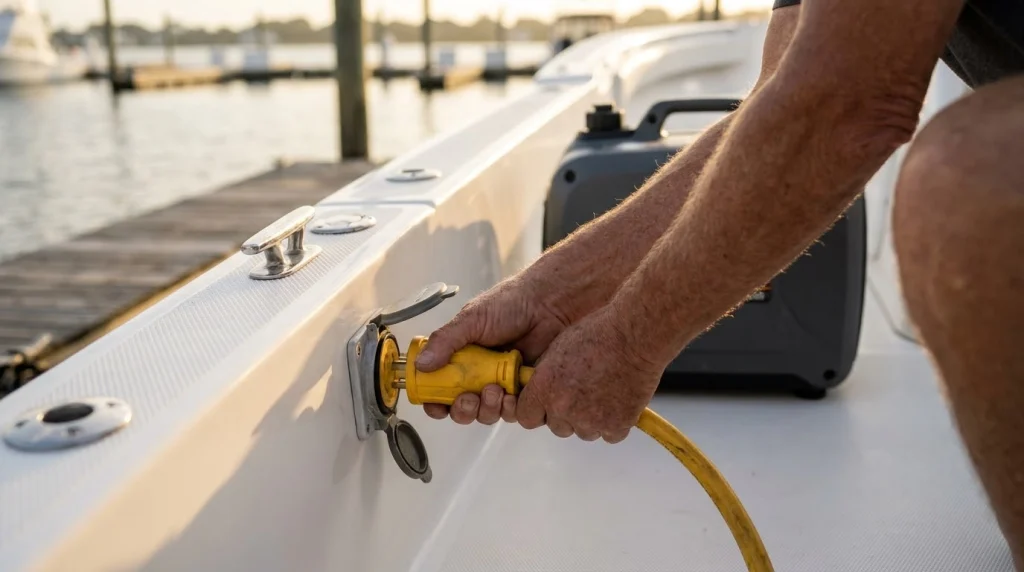
The safest simple method is to plug loads directly into the generator or use a proper shore-power cord through your boat’s shore-power inlet with the correct adapter and transfer setup. Never backfeed a panel with a homemade cord.
Direct plug-in works for a charger, a fan, or a small appliance. It avoids wiring mistakes and is easy to shut down fast.
For whole-boat power, talk to a marine electrician first. Boat grounding and neutral bonding differ from house wiring, and a mistake can create shock risk in the water.
- Start the generator with no loads connected and let it stabilize.
- Connect the heaviest load first, then add smaller loads one by one.
- Watch total watts and keep a 20% headroom buffer.
- Disconnect loads before you shut the engine down.
- Let it cool, then store fuel safely ashore or in a vented locker approved for fuel.
If you camp and boat with the same unit, the models in our roundup of the best portable inverter generators for camping cross over well. Light weight and quiet eco mode help in both places.
Safety note: Never refuel a hot or running generator on a boat. Move fuel handling to a stable, ventilated spot, clean spills at once, and keep a marine fire extinguisher within reach.
What Mistakes Do Boaters Make Most Often?
The most common mistakes are running a generator in an enclosed space, buying too heavy a unit, and ignoring saltwater corrosion. All three are easy to avoid with a short checklist.
I once helped a neighbor at the marina who bought a 100-pound unit for a small center console. It never left the truck.
He traded it for a 45-pound model and actually used it. That is the lesson I repeat most often.
- Too big to carry: Test the lift at home before your first trip
- No CO detector: A portable generator without a cabin detector is an incomplete setup
- Wet connections: Spray and rain plus worn cords create shock risk
- Stale fuel: Old gasoline is the top cause of hard starting after storage
- No maintenance: Salt air speeds corrosion on plugs, filters, and fasteners
Run the unit under load once a month in the off-season. Fresh fuel, a clean filter, and a dry storage spot will save you a dead generator on your first spring trip.
Section Takeaway: Buy the lightest quiet unit that covers your real loads, protect it from salt and water, and never compromise on carbon monoxide safety.
Frequently Asked Questions
Can I run an inverter generator inside my boat cabin if I open a window?
No, never run a portable generator inside a cabin, even with windows open. Carbon monoxide can build up to lethal levels in minutes and linger in enclosed spaces. Always run it outdoors on deck, downwind, with exhaust pointing away from people and openings.
What size inverter generator will run a boat air conditioner?
Most small marine or portable AC units need a 3,000 to 3,500-watt inverter generator to handle startup surge, or two smaller paralleled units. Check your AC starting watts in its manual first. A soft-start device can lower that surge on some systems.
Is a dual-fuel generator better for boats?
It can be, if you already carry propane for cooking or heating. Propane stores longer without going stale and burns cleaner. Remember that most dual-fuel models produce fewer watts on propane than on gasoline, so size for the propane rating.
Can an inverter generator charge boat batteries?
Yes, through your boat’s AC battery charger or a suitable smart charger plugged into the generator. That is one of its best uses at anchor. Avoid cheap direct 12V outputs for large banks — a proper charger is faster and safer for battery life.
How quiet does a boat generator need to be?
Aim for 52 to 58 dB at quarter load at about 23 feet, which is typical for enclosed inverter models. Sound carries far over water, so a few decibels make a big difference. Running in eco mode at a light load is the quietest setup.
Can I leave an inverter generator on my boat all season?
It is better to store it dry ashore when you can, especially in saltwater. Salt spray, humidity, and theft are real risks at the marina. If it stays aboard, keep it secured in a dry, vented spot away from fuel vapors and cover it only when cool.
Do I need a marine generator instead of a portable one?
If you need regular below-deck power, overnight AC, or automatic operation, a properly installed marine generator is the right choice. A portable inverter generator is best for occasional, on-deck, temporary power. Talk to a marine electrician if you are unsure which you need.
The best inverter generator for boat use is not the biggest one you can afford. It is the quiet, light, safe one you will actually carry, place correctly, and maintain.
Start with a 2,000 to 2,500-watt enclosed model for most boats, add size only for a microwave or AC, and make CO safety your first checklist item every time. Do that, and power at anchor becomes simple and stress-free.

Hi, I’m Michael Turner. I own a generator workshop in the United States and founded HomeGeneratorBlog to share practical, hands-on guidance about generator installation, maintenance, troubleshooting, safety, and backup power solutions. My goal is to help homeowners make smarter, more confident decisions through clear and reliable information