Can You Parallel Inverter Generators From Different Brands? When It Works, When It Fails & Safer Picks
Quick Answer
Can you parallel inverter generators from different brands? Sometimes, yes — but only if both units are parallel-capable, share the same voltage and frequency, and can sync cleanly through a compatible parallel kit. Most manufacturers only guarantee same-brand, same-model pairing, so cross-brand use is at your own risk. If sync fails, you can damage both inverter boards. When in doubt, check how inverter generator technology works before you connect anything.
The Short Verdict
- Same brand safest: Manufacturers test and warranty parallel use only within their own lineup.
- Cross-brand possible: It can work when voltage, frequency, waveform, and parallel ports truly match.
- Kit matters most: Use a proper parallel kit with a shared outlet box — never a homemade double-ended cord.
- Watts don’t double perfectly: Expect about 90% of the combined rated watts in real use.
- Warranty risk: Mixing brands can void coverage if a board fails during parallel use.
Do This First
- Confirm both manuals list parallel capability, then match 120V / 60Hz output before buying any kit.
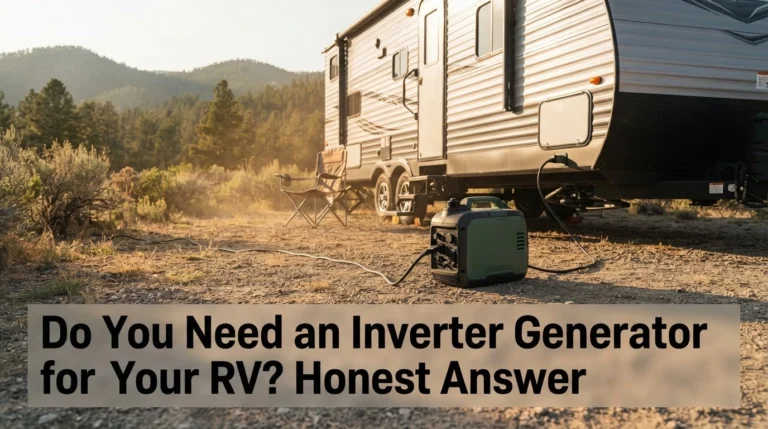
I’ve been asked this at campsites more than almost any other generator question. Someone owns a quiet 2,200-watt unit, a friend brings a different brand, and together they want to run an RV air conditioner.
It sounds simple. Two small generators, one bigger job. In practice, paralleling is about synchronization, not just plugs — and brand mixing is where the details really matter in 2026.
In This Guide
- Can You Parallel Inverter Generators From Different Brands?
- How Does Parallel Synchronization Actually Work?
- When Does Cross-Brand Paralleling Work?
- When Does It Fail or Cause Damage?
- Same Brand vs. Different Brand vs. Bigger Single Unit
- How Do You Connect Different Brands Safely?
- What Can Two Paralleled Generators Actually Run?
- What Are the Safer Alternatives?
- Frequently Asked Questions
Can You Parallel Inverter Generators From Different Brands?
Yes, in some cases — but no major brand guarantees it. The generators themselves don’t care about the logo. Their inverter boards care about voltage, frequency, and timing.
A parallel-capable inverter generator is a generator with special ports and electronics that let it lock its output waveform to another unit. Without that feature, there is no safe way to parallel it.
I’ve seen a Honda-style unit run happily beside a Champion-style unit for a full weekend. I’ve also seen a mismatched pair trip instantly, surge, and shut down the moment a load hit.
Both outcomes are real. The difference was compatibility, not luck.
Section Takeaway: Cross-brand paralleling is technically possible, but it is never manufacturer-guaranteed. Treat it as a compatibility test you must verify, not a feature you can assume.
How Does Parallel Synchronization Actually Work?
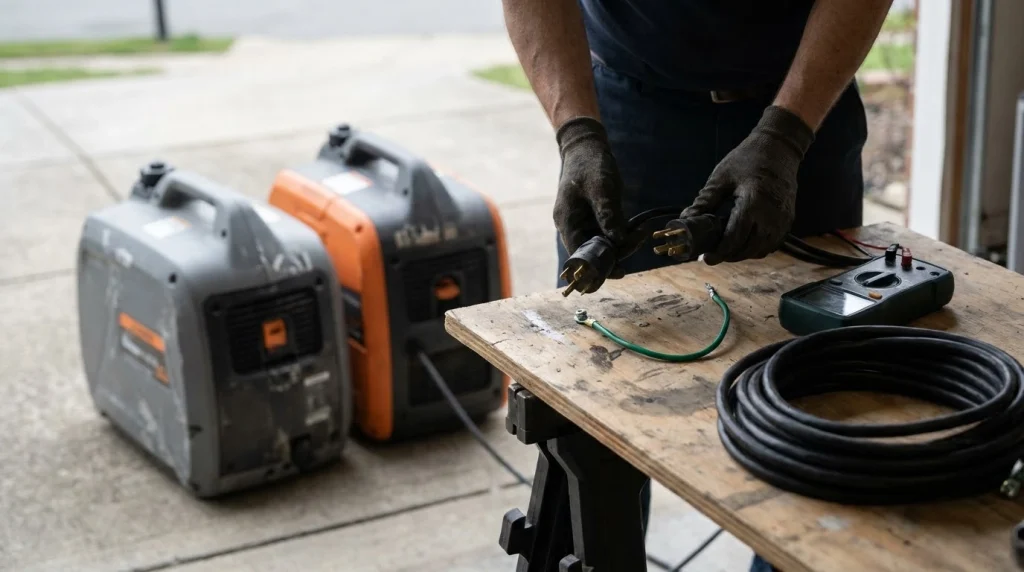
The two inverter boards must produce identical sine waves at the exact same moment. If one wave peaks while the other is falling, power flows back into the weaker unit.
That backfeed is the danger. It can overheat or fry an inverter module in seconds.
Why do inverter generators convert AC to DC back to AC?
That conversion is what makes sync possible. The board rebuilds clean AC electronically, so it can adjust timing — which is exactly why inverter generators convert AC to DC back to AC in the first place.
A conventional generator can’t do this. Its output is tied directly to engine speed.
- Voltage must match: Both units must be 120V models in North America — never mix 120V and 240V.
- Frequency must match: Both must output 60Hz under load, not just at idle.
- Waveform must match: Both should be pure sine wave with low total harmonic distortion.
- Grounding must be handled: The parallel kit manages neutral and ground bonding for the pair.
Safety note: Never use a male-to-male “suicide cord” to join generators. Always use a listed parallel kit with circuit protection, and run both units outdoors, at least 20 feet from occupied spaces, per manufacturer and CDC carbon monoxide guidance.
When Does Cross-Brand Paralleling Work?
It works best when the two units are close cousins in specs. Similar wattage, same fuel type, and identical parallel port style are good signs.
Many budget brands actually share similar inverter designs. That is why some cross-brand pairs sync with no drama at all.
- Both parallel-capable: Each unit has dedicated parallel ports, not just standard outlets.
- Similar size: A 2,000W and 2,200W pair balances load far better than 2,000W plus 4,500W.
- Same output type: Both 120V, 60Hz, pure sine wave.
- Compatible kit: The kit plugs fit both units and include a 30-amp RV or twist-lock outlet if you need one.
- Eco mode off at startup: Both units sync more reliably at full throttle first.
Start both units unloaded. Listen for hunting or surging.
Smooth, steady sound is what you want. Rough sync will announce itself fast.
When Does It Fail or Cause Damage?
It fails when one board cannot lock to the other. The pair will trip, buzz, surge, or shut down under load — and repeated tries make damage more likely, not less.
Stop at the first bad sign. Don’t keep resetting breakers hoping it settles.
- Instant tripping: The boards are fighting each other on phase.
- One unit racing: Load sharing has failed and one generator is doing all the work.
- Voltage swinging: Lights flicker or an RV converter buzzes loudly.
- Different port designs: Adapters that force a fit rarely produce a safe sync.
- One non-parallel model: If either manual says “not parallel capable,” the answer is no.
I once watched a mismatched pair run lights fine, then collapse the second a microwave started. Light loads can hide a bad sync.
Always test with a real, gradual load before you trust the setup with an air conditioner.
Section Takeaway: If the pair trips, surges, or shares load unevenly, disconnect and stop. Those are compatibility failures, not break-in behavior.
Same Brand vs. Different Brand vs. Bigger Single Unit
Same-brand pairing is the only option with factory support. Cross-brand pairing is a calculated risk, and a single larger unit is often simpler than either.
Here is how the three paths compare in real use as of 2026.
| Option | Reliability | Warranty | Best For |
|---|---|---|---|
| Same brand, same model | Highest — factory tested sync | Fully covered | RV AC, regular parallel use |
| Same brand, different models | Good — usually listed as compatible | Usually covered if listed | Adding a second unit later |
| Different brands | Varies — works or fails on sync | At risk if damage occurs | Occasional use of units you already own |
| One bigger generator | Highest — no sync at all | Fully covered | Daily use, 240V needs, simplicity |
Weight matters too. Two 50-pound units are easier to lift than one 110-pound unit.
That portability is the honest reason most people parallel at all.
How Do You Connect Different Brands Safely?
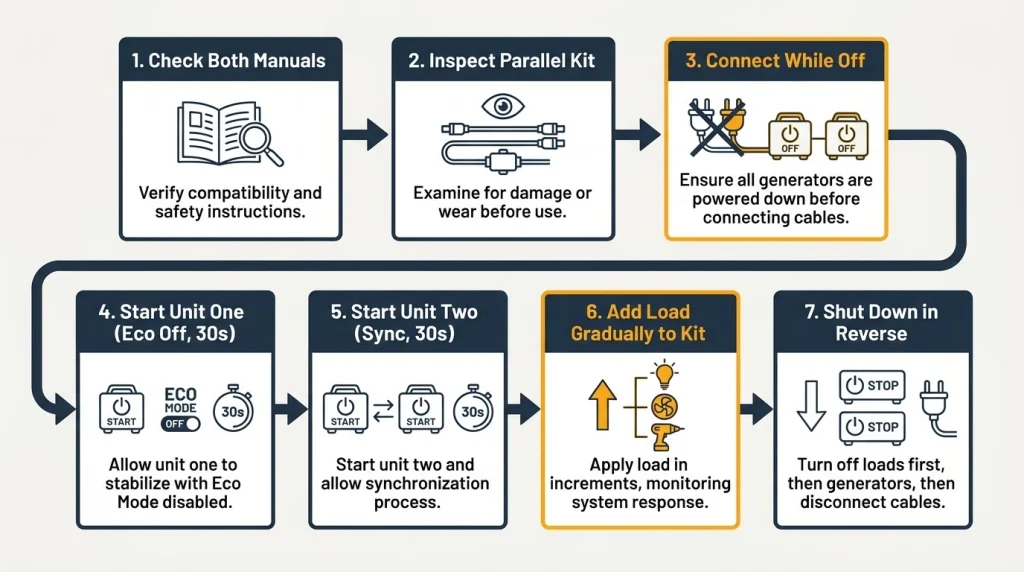
Connect with both units off, join them with the parallel kit first, then start them one at a time with no load attached. Add loads gradually, largest first.
That order protects both boards during sync.
- Check both manuals: Confirm parallel capability and any brand restrictions in writing.
- Inspect the kit: Plugs must seat fully in both units without adapters or force.
- Connect while off: Attach parallel cables and the ground wire with both generators switched off.
- Start unit one: Let it stabilize for 30 seconds with eco mode off.
- Start unit two: Let the pair sync for another 30 seconds, listening for surging.
- Add load gradually: Plug into the kit outlet, not into either generator directly.
- Shut down in reverse: Remove load, let units cool at idle, then switch off one at a time.
Safety note: Keep both units on dry, level ground outdoors with exhaust pointing away. Never refuel a hot or running unit, and let them cool before disconnecting the kit.
If you plan to feed several loads at once, review how load math works when you run multiple appliances at once — paralleled watts still have a hard ceiling.
What Can Two Paralleled Generators Actually Run?
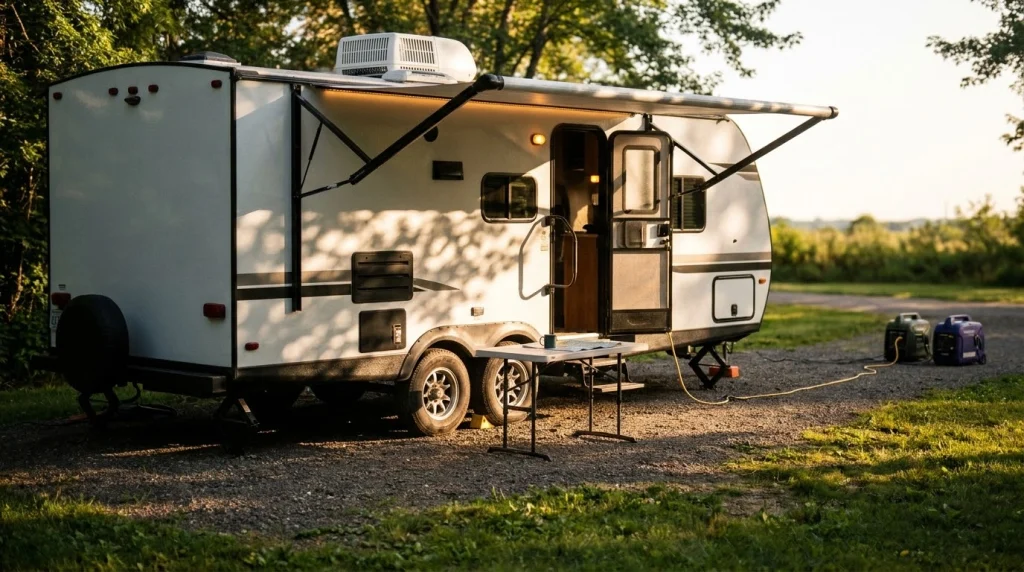
Two 2,200-watt units give you roughly 3,600 to 4,000 usable watts through a 30-amp kit outlet. That is enough for most single RV air conditioners plus lights and a fridge.
Starting watts are the real test. An AC compressor can surge well above its running draw for a few seconds.
Before you count on a pair at a campsite, confirm what size inverter generator can run an RV air conditioner for your specific BTU rating.
- 13,500 BTU RV AC: Usually yes with two 2,000W+ units, especially with a soft starter.
- 15,000 BTU RV AC: Borderline — soft starter strongly recommended.
- Fridge plus microwave: Yes, but run the microwave with the AC off if breakers trip.
- Home essentials: Fridge, lights, Wi-Fi, and phone charging are easy for any working pair.
Campers comparing setups should also look at the best portable generators for RV camping, where single larger RV-ready models often beat a risky cross-brand pair.
Section Takeaway: Budget about 90% of combined rated watts, respect the kit’s 30-amp outlet limit, and test your AC start at home — not on the first hot night of a trip.
What Are the Safer Alternatives?
The safest alternative is a matched same-brand second unit. The simplest is selling one unit and buying a single generator sized for the job.
Both remove the sync gamble entirely.
- Buy the matching twin: Often cheaper than replacing a damaged inverter board.
- Go single and larger: A 4,000 to 4,500W RV-ready model handles one AC with no kit at all.
- Add a soft starter: Lowers AC surge so a single mid-size unit may do the job alone.
- Split the loads: Run the RV from one generator and a separate fridge or tools from the other, un-paralleled.
If you are shopping anyway, the roundup of the best inverter generators flags which models have the strongest parallel support and kit availability.
For general safety guidance on portable generators, the National Highway Traffic Safety Administration covers vehicle and RV safety context, while manufacturer manuals and the AAA car care resources are useful companions for road-trip power planning.
Frequently Asked Questions
Can you parallel a Honda and a Champion inverter generator?
Sometimes, if both are parallel-capable 120V / 60Hz models and a kit fits both port sets cleanly. Many owners report successful sync, but neither brand guarantees or warranties the pairing. Test gradually at home, start with no load, and stop immediately if the pair trips or surges.
Do parallel generators have to be the exact same size?
No, but close is better. A small difference, like 2,000W and 2,200W, usually shares load well. A large gap means the smaller unit maxes out early and trips first. Total usable output is also limited by the parallel kit’s outlet rating, often 30 amps.
Will paralleling different brands void my warranty?
It can. Most warranties cover parallel use only with approved same-brand models and kits listed in the manual. If a board fails while connected to another brand, the manufacturer may decline the claim. Keep that risk in mind before pairing expensive new units.
Can you parallel an inverter generator with a conventional generator?
No. Conventional generators have no parallel ports or sync electronics, and their output waveform is tied to engine speed. There is no safe kit or method for this pairing. Only parallel inverter-to-inverter, and only when both models are specifically parallel-capable.
Do you need a special kit for cross-brand paralleling?
Yes. You need a listed parallel kit whose plugs match both units and whose outlet matches your load, such as a TT-30 RV outlet. Universal kits exist for common port styles, but a forced fit with adapters is not safe. Never join generators with a homemade cord.
Can paralleled different-brand generators make 240V?
Almost never. Standard parallel kits combine two 120V units into a larger 120V supply only. True 240V output requires a generator or a specific factory 240V parallel system designed for it. If you need 240V for a well pump or dryer, buy a single 240V-capable model.
The Bottom Line on Mixing Brands
Can you parallel inverter generators from different brands? You can try it when both units are parallel-capable and truly compatible — and many pairs will work.
But “can” is not “should for years.” For regular RV or backup use, a matched pair or one right-sized generator will serve you better, with a warranty behind it.
Already own two different brands? Test carefully at home, follow the start order above, and let the first trip or surge be your verdict — not hope.

Hi, I’m Michael Turner. I own a generator workshop in the United States and founded HomeGeneratorBlog to share practical, hands-on guidance about generator installation, maintenance, troubleshooting, safety, and backup power solutions. My goal is to help homeowners make smarter, more confident decisions through clear and reliable information