Can an Inverter Generator Run a Microwave? Wattage, Sizing, and Safe Setup
Quick Answer
Yes, an inverter generator can run a microwave if its running watts exceed the microwave’s input watts. A 2,000-watt inverter generator can usually run a 700- to 1,000-watt microwave on its own, while a larger microwave often needs a 3,000-watt or larger generator. If you want a model matched to your microwave, see our guide to the best generator for a microwave.
The short version
- Check input watts: Use the watts on the microwave label, not just the cooking watts on the door.
- Leave headroom: Choose a generator with at least 20% more running watts than the microwave draws.
- Run it alone: Turn off other large loads before you start the microwave.
- Turn eco mode off: Eco mode can lag when a microwave pulls a sudden, heavy load.
- Use a short cord: Use a short, heavy-duty outdoor extension cord rated for the load.
If it trips or surges
- Stop the microwave, unplug other loads, and restart the generator before you try again at a lower power setting.
- If it still trips, your generator is too small or the microwave draws more than its label suggests.
I’ve heated soup on a generator during a winter outage, and I’ve also watched a small generator trip the moment a microwave started. That gap between success and frustration usually comes down to one number.
Most people check cooking watts and stop there. The generator cares about input watts, and those are much higher.
This guide walks through the real wattage math, the right generator size, safe setup, RV use, and the fixes that work when a microwave won’t run. You’ll leave knowing exactly what to check before you plug in.
In This Guide
- Can a Microwave Run on an Inverter Generator?
- How Many Watts Does a Microwave Use?
- What Size Inverter Generator Do You Need for a Microwave?
- Inverter Generator vs Conventional Generator for a Microwave
- How to Run a Microwave on an Inverter Generator Step by Step
- Can You Run a Microwave and a Fridge Together?
- Can You Run a Microwave in an RV or While Camping?
- Why Won’t My Microwave Run on My Generator?
- Is It Safe to Run a Microwave on an Inverter Generator?
- Frequently Asked Questions
Can a Microwave Run on an Inverter Generator?
Yes, a microwave can run on an inverter generator when the generator has enough running watts. The microwave is a resistive-style heating load with a magnetron, so it pulls steady power once it starts.
That steady pull is the key difference from a fridge or air conditioner. A microwave does not need a huge starting surge, but it does need sustained watts for every minute it runs.
An inverter generator is a portable generator that makes clean sine wave power. It converts raw engine power to DC, then inverts it back to stable AC power.
That clean power matters for the microwave’s control board and timer. It also keeps voltage steadier when the load changes.
I learned this during a three-day outage when I ran a fridge, a few lights, and a small microwave in rotation. The microwave worked fine on its own, but it tripped the overload light when I tried to run it with the fridge compressor kicking on.
The lesson was simple and repeatable. Size for the microwave alone first, then add other loads only if you have real headroom left.
What makes a microwave a tough load?
A microwave looks small on the counter, yet it draws more power than a TV, laptop, and lights combined. Its cooking power is not its electrical draw.
A 1,000-watt microwave can draw 1,500 to 1,800 watts from the wall. That gap catches many first-time buyers by surprise.
The magnetron, fan, turntable motor, and control board all draw power at once. Lower power settings help, but they do not cut the peak draw as much as people expect.
Many microwaves cycle full power on and off at lower settings. That means a 50% setting can still pull near-full watts in short bursts.
Section Takeaway: A microwave can run on an inverter generator, but only when running watts exceed input watts, so check the label and run it alone first.
How Many Watts Does a Microwave Use?
A typical countertop microwave draws 1,000 to 1,800 watts while running. Compact models draw less, and large over-the-range models draw more.
Cooking watts tell you how much microwave energy reaches the food. Input watts tell you how much power the unit pulls from the generator.
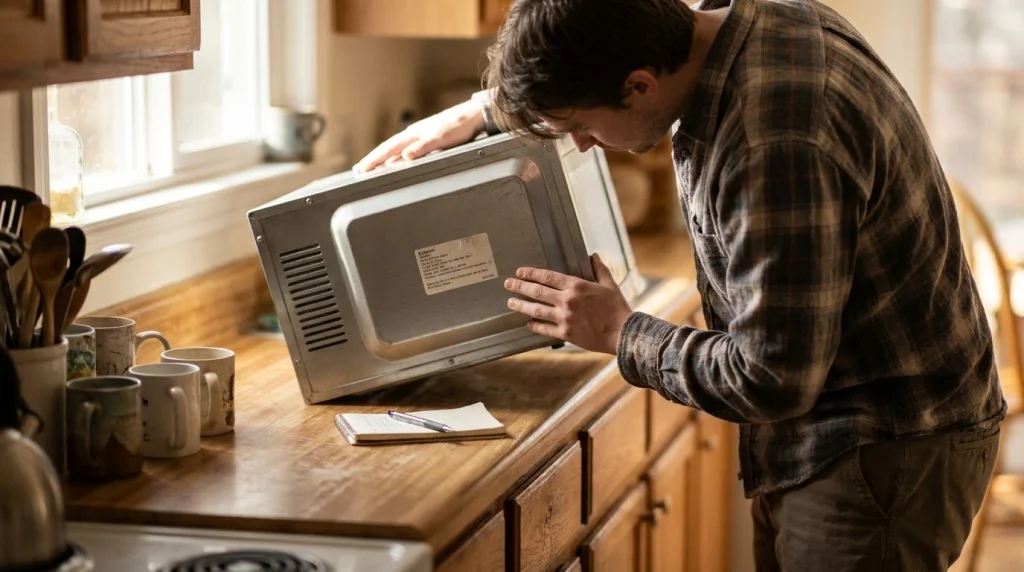
Always use input watts for sizing. You can find them on the back label, in the manual, or on the spec sheet.
If the label lists amps instead of watts, multiply volts by amps. A 120-volt microwave rated at 10 amps draws about 1,200 watts.
Check the label before you buy a generator for this job. A quick photo of the back plate saves a lot of guessing later.
| Microwave size | Cooking watts | Typical input watts | Minimum generator running watts |
|---|---|---|---|
| Compact, 0.7 cu. ft. | 700 watts | 1,000–1,200 watts | 1,600 watts |
| Standard countertop | 900 watts | 1,300–1,500 watts | 2,000 watts |
| Large countertop | 1,000 watts | 1,500–1,800 watts | 2,200 watts |
| Over-the-range | 1,100–1,200 watts | 1,700–2,000 watts | 2,800 watts |
| RV microwave | 700–900 watts | 1,000–1,400 watts | 2,000 watts |
Use these ranges as a starting point only. Check your spec sheet, because two 1,000-watt models can draw different input watts.
A microwave also draws a small amount of power in standby. That draw is tiny, but I still unplug it between uses during an outage to save fuel.
How long can you run a microwave on a generator?
You can run a microwave for short bursts as long as you have fuel and the generator stays within its running-watt limit. Most meals need only 2 to 10 minutes of microwave time.
Short runs are efficient because the generator does not need to carry the load for hours. That is why a microwave fits outage cooking so well.
Fuel use rises sharply while the microwave runs. A 2,000-watt generator at near-full load can use fuel much faster than it does at a light load.
Plan meals in batches when you can. Heat two portions back to back, then shut the microwave off and let the generator drop back to a light load.
Section Takeaway: Size by input watts, not cooking watts, and give the generator at least 20% headroom above that number.
What Size Inverter Generator Do You Need for a Microwave?
You need a generator with more running watts than your microwave’s input watts. For most homes, that means a 2,000- to 3,000-watt inverter generator.
A 2,000-watt peak generator often has about 1,600 to 1,800 running watts. That can run a compact or standard microwave alone, but it leaves little room for anything else.
A 2,200-watt generator is a safer pick for a 1,000-watt microwave. It gives you headroom for the fan, lights, and the small surge when the magnetron cycles.
A 3,000- to 3,500-watt generator handles a large microwave with room to spare. It also lets you run a fridge or a few lights at the same time, if you manage the loads.
Do not size by peak watts alone. Running watts are the number that matters for a microwave, because it runs for minutes at a time.
- 700-watt microwave: A 2,000-watt inverter generator is usually enough when run alone.
- 900-watt microwave: Choose at least 2,200 running watts for reliable use.
- 1,000-watt microwave: Choose 2,200 to 3,000 running watts, depending on other loads.
- 1,200-watt microwave: Choose 3,000 running watts or more.
- Microwave plus fridge: Add the fridge’s running watts, plus a margin for its compressor start.
If you already own a small generator, test it with the microwave before an outage. A two-minute test tells you more than any chart.
Parallel capability can help if you own two smaller inverter generators. Two parallel-capable units can share the load, but you need the right parallel kit and matched models.
Our guide to portable generators with parallel capability explains how that setup works. It is a useful option if you want to scale up later without buying one large unit.
Section Takeaway: A 2,000-watt generator suits a small microwave alone, while a 1,000-watt or larger microwave is safer on a 2,200- to 3,500-watt generator.
Inverter Generator vs Conventional Generator for a Microwave
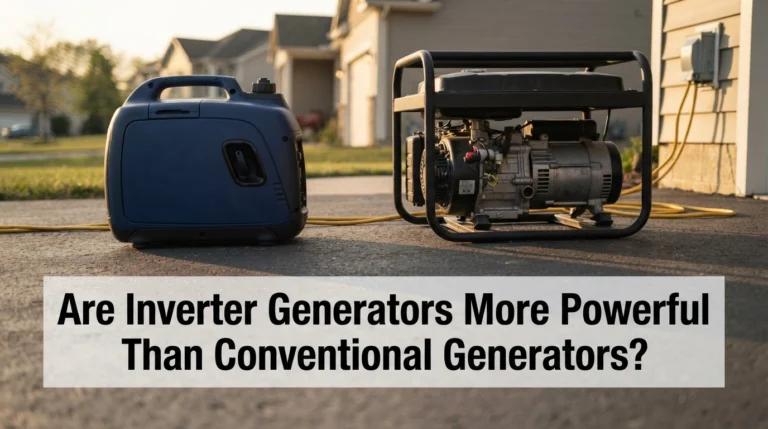
An inverter generator is the better choice for a microwave in most homes and RVs. It makes cleaner, more stable power and runs quieter at partial load.
A conventional generator, also called an open-frame generator, can also run a microwave. It is often cheaper per watt, but it is louder and its voltage can vary more under changing loads.
Clean sine wave power means the AC waveform is smooth and steady. Low total harmonic distortion, or THD, means less electrical noise that can stress sensitive electronics.
A microwave is not as sensitive as a laptop, but its control board still prefers stable power. That is why many owners choose an inverter model for kitchen loads.
| Feature | Inverter generator | Conventional generator |
|---|---|---|
| Power quality | Clean sine wave, low THD | Rougher waveform, higher THD |
| Noise | Quieter, especially at light load | Louder, runs at fixed speed |
| Fuel use | Throttles down at light load | Uses more fuel at light load |
| Weight | Lighter and easier to move | Heavier for the same watts |
| Cost per watt | Higher upfront cost | Lower upfront cost |
| Best for a microwave | Home, RV, and camping | Job sites and large loads |
If you already own a conventional generator with enough running watts, it can work. Test it first and listen for surging or voltage dips.
If you are buying new for home backup and RV use, start with our roundup of the best inverter generators. It helps you compare size, noise, and runtime in one place.
Low THD matters most when you also power phones, laptops, or a CPAP machine. A model with low THD gives you more flexibility for mixed loads.
See our guide to portable generators with low THD if clean power is a priority. It is worth the extra check before you buy.
Section Takeaway: Both types can run a microwave, but an inverter generator gives you cleaner power, less noise, and better fuel use for home and RV cooking.
How to Run a Microwave on an Inverter Generator Step by Step
Set up the generator first, then add the microwave. That order prevents overloads and keeps the process calm.
Place the generator outdoors, at least 20 feet from your home, with the exhaust pointing away from windows and doors. Never run it in a garage, even with the door open.
Safety note: Run generators outdoors and well away from windows, doors, and vents. Carbon monoxide is colorless and odorless, and it can build up fast in an enclosed space.
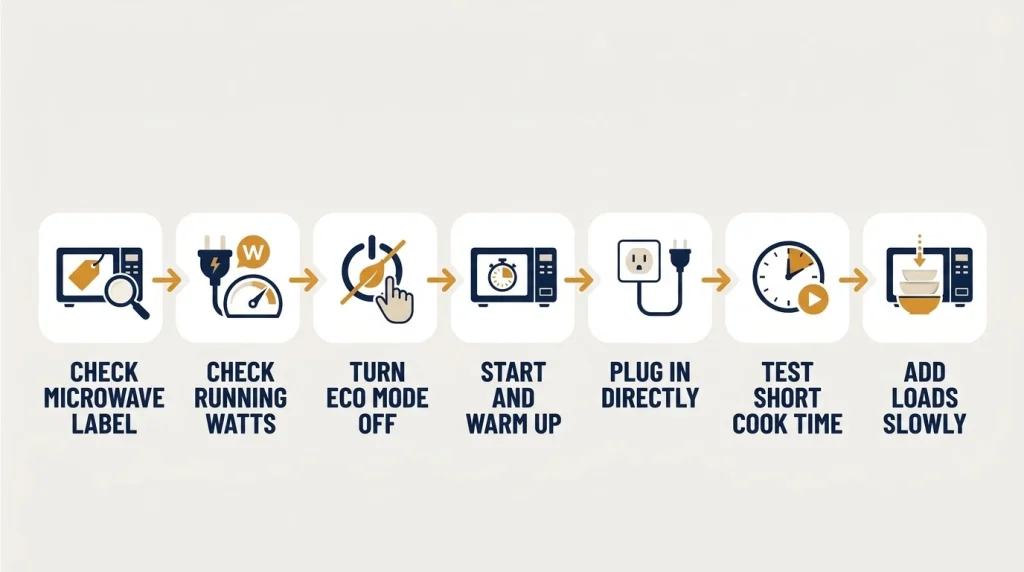
- Check the microwave label: Note input watts, volts, and amps before you plug anything in.
- Check the generator rating: Confirm running watts, not just peak watts, exceed the microwave draw.
- Turn eco mode off: Eco-throttle can react slowly to a sudden microwave load.
- Start the generator: Let it warm up for a minute and settle into a steady idle.
- Plug in directly: Use the generator outlet when possible, or a short, heavy-duty outdoor cord.
- Start the microwave: Use a short cook time first and watch for overload lights or surging.
- Add loads slowly: Add lights or a phone charger only after the microwave runs smoothly.
Use a 12-gauge outdoor extension cord for a microwave if you need one. A long, thin cord can drop voltage and make the microwave work harder.
Keep the cord dry and off the ground where people walk. Check it for heat after the first minute, and stop if the plug feels hot.
Do not use a power strip or a light-duty indoor cord. A microwave needs a direct, high-capacity connection to run safely.
Should eco mode be on or off for a microwave?
Turn eco mode off before you run a microwave. Eco mode saves fuel at light loads, but it slows the engine response to a sudden load.
A microwave pulls full power almost instantly. That sudden jump can cause a voltage dip or an overload trip on a small generator.
Turn eco mode back on after you finish cooking. The generator will then sip fuel while it powers lights or charges phones.
This small habit made a real difference in my own testing. The same generator that tripped in eco mode ran the same microwave cleanly with eco off.
Section Takeaway: Place the generator outdoors, turn eco off, plug in directly, and test with a short cook time before you add other loads.
Can You Run a Microwave and a Fridge Together?
Yes, you can run a microwave and a fridge together if the generator has enough running watts for both. You need to add their running watts and leave room for the fridge compressor start.
A typical fridge draws 100 to 200 watts while running, but its compressor can briefly draw 800 to 1,200 watts at startup. That short surge is what trips small generators.
If your microwave draws 1,500 watts and your fridge draws 150 watts, you need at least 1,650 running watts. Add a 20% margin, and you are near 2,000 running watts before the fridge starts.
A 3,000-watt generator handles this pair more comfortably. A 2,000-watt generator can do it, but only if you time the loads carefully.
The safest method is to run the fridge alone most of the time. Unplug the fridge for the few minutes you need the microwave, then plug it back in.
Food stays cold for a short unplug if the door stays shut. That tradeoff is far better than tripping the generator and losing both loads.
Our guide to the best portable generator for a refrigerator can help you size the fridge side of this pair. It covers running watts, startup watts, and runtime in more detail.
A freezer follows the same logic, but it cycles less often than a fridge. See our guide to the best generator for a freezer if you need to protect frozen food during a long outage.
Section Takeaway: Add both running watts plus a compressor-start margin, or unplug the fridge for the few minutes the microwave runs.
Can You Run a Microwave in an RV or While Camping?
Yes, you can run a microwave in an RV with an inverter generator, but RV power adds a few extra checks. Your RV microwave, air conditioner, and converter can all compete for the same watts.
Most RV microwaves are 700 to 900 cooking watts. That means they draw about 1,000 to 1,400 input watts.
A 2,200-watt inverter generator can run most RV microwaves alone. A 3,000-watt generator is better if you also want lights, a TV, or a small air conditioner.
Check your RV’s power panel before you plug in. Some RVs have a 30-amp service, while larger rigs use 50-amp service.
Use the generator’s RV outlet when you have one. A proper 30-amp connection is safer than a long adapter chain.
Turn off the RV air conditioner before you start the microwave. The air conditioner compressor is the most common cause of overloads in an RV.
Turn off the electric water heater element too if it is on. That hidden load can push a small generator over its limit without any warning.
Campsite noise rules matter as well. An inverter generator is quieter than an open-frame model, but it still makes noise at full load.
Run the microwave during daytime hours when you can. Keep cook times short, and let the generator return to a quiet idle between meals.
Safety note: Never run a generator inside an RV, under an awning, or near open windows. Keep exhaust away from the rig and from neighboring campsites.
Section Takeaway: A 2,200-watt generator can run most RV microwaves alone, but turn off the air conditioner and water heater first.
Why Won’t My Microwave Run on My Generator?
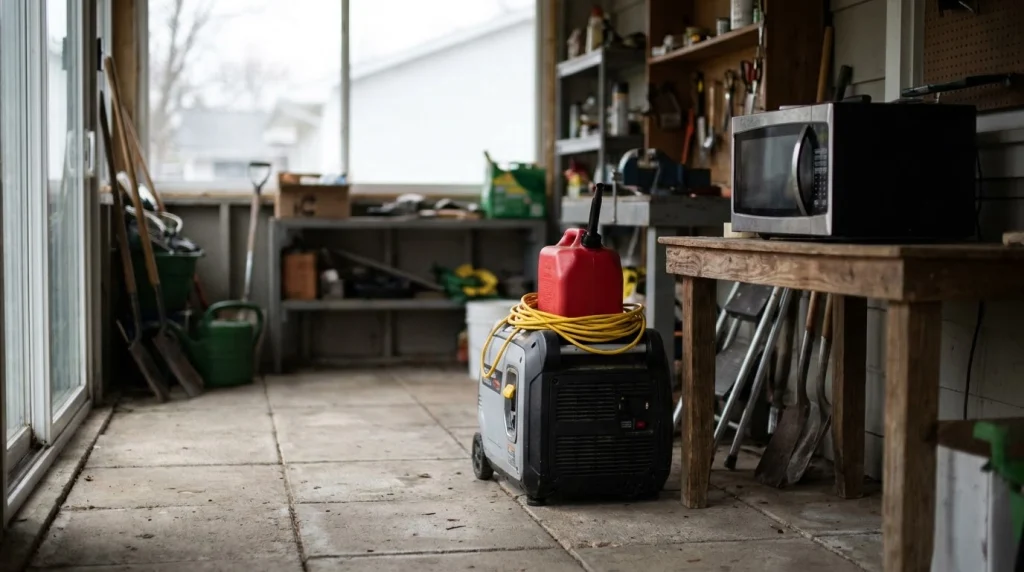
A microwave that won’t run on a generator usually points to low watts, low voltage, or a tripped overload. Start with the simplest cause first.
Check the generator’s running-watt rating against the microwave’s input watts. If the numbers are close, the generator may trip under the real load.
Check eco mode next. Turn it off, restart the generator, and try the microwave again at a short cook time.
Check the cord and outlet next. A long or thin extension cord can drop voltage enough to make the microwave hum, run slowly, or shut off.
- Generator trips instantly: The microwave draws more than the generator can supply, so use a larger generator or a smaller microwave.
- Microwave runs slowly: Voltage is low, so shorten the cord, use a heavier gauge, or reduce other loads.
- Generator surges: Eco mode is on, fuel is stale, or the air filter is dirty, so turn eco off and check maintenance.
- Microwave display resets: Power is unstable, so plug directly into the generator and remove other loads.
- Breaker trips: The outlet is overloaded, so move the microwave to a different outlet and check the cord rating.
Stale fuel is a common hidden cause. Gasoline can go stale in a month or two, and it can clog the carburetor and cause surging under load.
Use fresh fuel and follow your manual for storage. Run the generator monthly for 10 to 15 minutes under a light load to keep it ready.
Check oil level before each use. Low oil can trigger an automatic shutdown, and it can look like an overload problem at first.
If the microwave works on house power but not on the generator, the issue is power delivery, not the microwave. Test with a direct connection and no other loads to confirm it.
Section Takeaway: Most microwave failures come from low running watts, eco mode, a thin cord, or stale fuel, so test direct, with eco off, and no other loads.
Is It Safe to Run a Microwave on an Inverter Generator?
Yes, it is safe to run a microwave on an inverter generator when you follow basic placement, cord, and load rules. The main risks are carbon monoxide, overloads, and bad cords, not the microwave itself.
Carbon monoxide is the most serious risk with any generator. The CDC warns that generators must run outdoors and away from homes, because CO can kill in minutes.
The U.S. Consumer Product Safety Commission also warns against running a generator in a garage, basement, or near windows. Keep at least 20 feet of distance and point exhaust away from the house.
Install battery-powered CO alarms in your home if you use a generator for backup power. Test them monthly and replace batteries as needed.
Electrical safety matters too. Do not backfeed your home through a dryer outlet, and do not plug a generator directly into a wall outlet.
Use a transfer switch or interlock kit installed by a licensed electrician for home circuits. A microwave can run from a generator outlet with an extension cord, but whole-home wiring needs proper equipment.
The U.S. Department of Energy offers guidance on safe generator use and home backup planning. It is a useful starting point before you wire anything into your house.
Keep fuel away from heat and store it in approved containers. Let the generator cool before you refuel, and wipe up any spills right away.
The EPA and Consumer Reports both publish safety and buying guidance for portable generators. Check their homepages for current advice before a storm season.
Safety note: Check your owner’s manual before use, and have a licensed electrician install any transfer switch or interlock kit. Never modify a generator outlet or bypass a safety device.
Section Takeaway: A microwave is safe on an inverter generator when you run it outdoors, use a proper cord, respect running watts, and never backfeed your home.
Frequently Asked Questions
Can a 2000-watt inverter generator run a microwave?
Yes, a 2,000-watt inverter generator can run many microwaves, especially compact and standard models. It works best when the microwave draws under 1,600 running watts and runs alone with eco mode off.
Can a 1000-watt inverter generator run a microwave?
No, a 1,000-watt inverter generator is usually too small for a standard microwave. Most microwaves draw 1,000 to 1,800 input watts, so a 1,000-watt unit will trip or run the microwave very slowly.
What size generator do I need for a 1000-watt microwave?
You need at least 2,200 running watts for a 1,000-watt microwave in most cases. That size leaves headroom for the fan, control board, and cycling load without tripping the overload.
Will a microwave damage an inverter generator?
No, a microwave will not damage a properly sized inverter generator. It can trip the overload if the generator is too small, but that protection is designed to shut the unit down safely.
Can I run a microwave on eco mode?
You can try, but eco mode often causes tripping or surging with a microwave. Turn eco mode off for cooking, then turn it back on for light loads after you finish.
Can I run a microwave and an air conditioner on one generator?
It depends on size, but most small generators cannot run both at once. A large RV air conditioner can draw 1,500 watts or more, so you need a 3,500-watt or larger generator for both loads.
How long can I run a microwave on generator power?
You can run it for normal cook times of 2 to 10 minutes as long as you have fuel. Short, planned cooking sessions are the most fuel-efficient way to use a microwave during an outage.
Yes, an inverter generator can run a microwave, and the math is simpler than it first looks. Check input watts, choose a generator with headroom, run it alone, and turn eco mode off.
Test your setup before the next outage, not during it. A two-minute test now saves a cold meal and a tripped generator later.

Hi, I’m Michael Turner. I own a generator workshop in the United States and founded HomeGeneratorBlog to share practical, hands-on guidance about generator installation, maintenance, troubleshooting, safety, and backup power solutions. My goal is to help homeowners make smarter, more confident decisions through clear and reliable information