10 Best Portable Generator for a 1800 Square Foot Home 2026: Whole-Home Backup That Fits
The best portable generator for a 1800 square foot home is the Westinghouse WGen12000DF, with 9,500 running watts and a 50-amp outlet. We compared 10 portable generators, scoring each on Home Power Fit, Runtime and Fuel Flexibility, and Quiet Operation and Ease of Use. Most portable generators look strong on paper but fall short on starting watts, runtime, or 240-volt outlets. Whether you need essentials-only backup, near whole-home power, or quiet inverter power, this guide gives you one clear answer.
Quick Comparison: All 10 Products Ranked
| # | Product | Best For | Rating | Badge | |
|---|---|---|---|---|---|
| 1 | Westinghouse WGen12000DF | Whole-home backup | 4.9/5 | Best Overall | Buy → |
| 2 | DuroMax XP13000EH | Most loads at once | 4.8/5 | Best for Maximum Power | Buy → |
| 3 | Champion 100416 Tri-Fuel | Three fuel options | 4.7/5 | Best Tri-Fuel | Buy → |
| 4 | Generac GP15000E | Large loads | 4.6/5 | Best for Heavy Loads | Buy → |
| 5 | Westinghouse iGen11000DFc | Quiet inverter power | 4.5/5 | Best Quiet Inverter | Buy → |
| 6 | Predator 9500 | Quiet inverter value | 4.4/5 | Best Inverter Value | Buy → |
| 7 | Honda EU7000iS | Premium quiet essentials | 4.3/5 | Best Premium Inverter | Buy → |
| 8 | DuroMax XP12000EH | Budget whole-home power | 4.2/5 | Best Budget Whole-Home | Buy → |
| 9 | Firman T12071 Tri-Fuel | Very large tri-fuel backup | 4.1/5 | Best Large Tri-Fuel | Buy → |
| 10 | Pulsar G12KBN Dual Fuel | Dual-fuel value | 4.0/5 | Best Value Dual-Fuel | Buy → |
How We Chose These Portable Generators
This is a specification comparison based on manufacturer specifications for 10 portable generators. No hands-on testing, testing duration, laboratory work, or expert consultation is claimed. Scores are editorial judgements from published specifications, using the same 3 criteria for every product.
What we compared
Running and peak watts, fuel type, outlets, start type, and inverter versus open-frame design for 10 models.
Our 3 scoring criteria
Home Power Fit, Runtime and Fuel Flexibility, and Quiet Operation and Ease of Use, each scored out of 5.
Limits of this comparison
No unit was run in a home, no outage was simulated, and no load was measured. Check the manual before connecting a house.
What we cut — and why
Small inverters under about 3,500 running watts were cut, because they cannot cover the main loads in a 1800 sq ft home.
What to Look for When Buying a Portable Generator for a 1800 Square Foot Home
A 1800 sq ft home does not need the largest generator made, but it does need enough running watts, the right outlets, and a safe connection method. Start with the loads you must run, then choose the fuel and size around them.
1. Running watts and starting watts
Add the running watts of everything you will run at the same time, then add the largest starting watts for a motor load such as a refrigerator, well pump, or air conditioner. A fridge, lights, internet, a fan, and a sump pump can fit in 3,000 to 5,000 running watts, while adding a window air conditioner or electric water heater pushes the total much higher. For a closer fit, read a portable generator for home use guide and list loads before you shop.
2. 240-volt outlet and transfer-switch readiness
If you want to power hardwired circuits, you need a 240-volt outlet, usually a 50-amp or 30-amp receptacle, and a transfer switch or interlock installed by a qualified electrician. A generator with only 120-volt outlets can run extension cords to individual appliances, but it cannot feed a house panel. Before you buy, check what size generator runs a house and confirm the outlet type on the specification sheet.
3. Fuel type and runtime
Gasoline is easy to find but needs fresh fuel and safe storage. Propane stores longer and burns cleaner, but output is usually slightly lower. Tri-fuel models add natural gas, which avoids refuelling during a long outage when a gas connection is available. Runtime at half load is the useful comparison point, because full-load runtime is much shorter.
4. Noise, weight, and clean power
Open-frame generators are louder and heavier, while inverter generators are quieter and produce cleaner power for phones, laptops, and modern appliances. A large open-frame unit may need wheels and a second person to move, and it should run outdoors, at least 20 feet from the house, with the exhaust pointed away. If you run sensitive electronics, choose an inverter model or a model with a stated low total harmonic distortion figure.

Westinghouse WGen12000DF Dual Fuel Portable Generator — Whole-home power, dual fuel
Best for: Whole-home backup for a 1800 sq ft house
For a 1800 sq ft home, the WGen12000DF is the most complete portable option in this list. Its 9,500 running watts cover a refrigerator, freezer, lights, internet, fans, and a sump pump at the same time, with headroom left for a window air conditioner or microwave in turn. Dual-fuel operation lets you switch between gasoline and propane, and remote start avoids a walk outside in bad weather. The 50-amp outlet supports a transfer-switch connection, which is the practical route to powering house circuits. The trade-off is size and noise: this is a heavy open-frame unit, not a quiet inverter, so plan for outdoor placement and help moving it.
- 9,500 running watts on gasoline
- Dual-fuel gasoline and propane operation
- 50-amp outlet for transfer switch
- Remote start included
- Heavy open-frame unit to move
- Louder than inverter models
- Propane output slightly lower
4.9/5
4.9/5
4.9/5

DuroMax XP13000EH Dual Fuel Portable Generator — Highest output here
Best for: Running the most loads at once
If your 1800 sq ft home has a well pump, a large refrigerator, and a window air conditioner that may start together, the XP13000EH gives you the most headroom in this list. Its 10,500 running watts on gasoline handle heavy motor starts better than smaller models, and dual-fuel operation adds propane as a second option during a long outage. Electric start keeps starting simple, and the 50-amp outlet suits a transfer-switch setup. The cost is weight, fuel use, and noise: this is a large open-frame generator, so it needs a firm outdoor spot, a wheel kit, and a realistic fuel plan before an outage arrives.
- 10,500 running watts on gasoline
- Strong surge for motor loads
- Dual-fuel gasoline and propane
- 50-amp outlet included
- Very heavy to move alone
- High fuel use at load
- Loud open-frame design
4.8/5
4.8/5
4.7/5
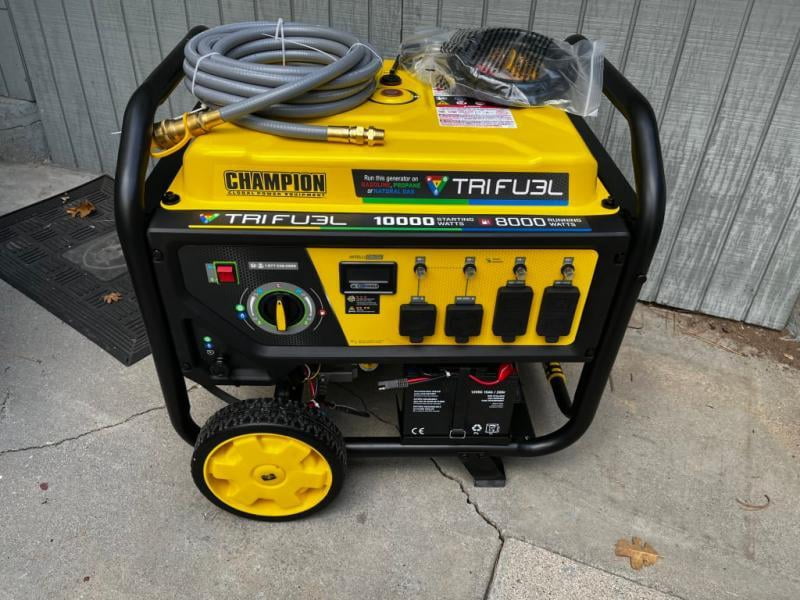
Champion 100416 10,000-Watt Tri-Fuel Portable Generator — Gas, propane, natural gas
Best for: Homes with gasoline, propane, and natural gas
The Champion 100416 is the most flexible fuel choice in this list, because it runs on gasoline, propane, or natural gas. That matters during a long outage, when gasoline stations may be closed and propane tanks run low, while a home natural gas connection keeps feeding the generator. Its 8,000 running watts on gasoline cover a refrigerator, freezer, lights, internet, fans, and a sump pump, with room for one larger load at a time. It is still an open-frame generator, so it is louder than an inverter and needs outdoor placement. Natural gas output is lower than gasoline output, so size loads for the fuel you will actually use.
- Three fuel options in one
- 8,000 running watts on gasoline
- Electric start with remote
- CO shutoff sensor included
- Lower output on natural gas
- Louder than inverter models
- Heavy to move alone
4.7/5
4.8/5
4.6/5

Generac GP15000E Portable Generator — Very large gasoline power
Best for: Large loads and long outages
The Generac GP15000E is the gasoline-only heavyweight in this list, with 12,000 running watts for homes that need to run a well pump, a large air conditioner, and several appliances together. Electric start and a large fuel tank suit long outages, and the 50-amp outlet supports a transfer-switch connection for house circuits. The trade-offs are clear: it runs on gasoline only, so you need a large fresh fuel supply, and it is heavy, loud, and thirsty at high load. Choose it when maximum gasoline output matters more than fuel flexibility, quiet operation, or easy moving.
- 12,000 running watts on gasoline
- Large fuel tank for long runs
- 50-amp outlet for transfer switch
- Electric start included
- Gasoline only, no dual fuel
- Very heavy and loud
- High fuel use at load
4.6/5
4.7/5
4.5/5

Westinghouse iGen11000DFc Dual Fuel Inverter Generator — Quiet, large, dual fuel
Best for: Quiet power for sensitive electronics
The iGen11000DFc is the quiet large option in this list, pairing inverter power with 9,000 running watts on gasoline. That combination suits a 1800 sq ft home where phones, laptops, a modern refrigerator, and a television need cleaner power, while the 50-amp outlet still supports a transfer-switch connection. Dual-fuel operation adds propane as a backup, and remote start makes starting easy from indoors. It costs more than a similar open-frame generator, and it is still a large unit to move. Choose it when quiet operation and clean power matter as much as raw output.
- 9,000 running watts, inverter power
- Cleaner power for electronics
- Dual-fuel gasoline and propane
- Remote start included
- Higher cost than open-frame
- Still large and heavy
- Propane output slightly lower
4.5/5
4.6/5
4.4/5

Predator 9500 Super Quiet Inverter Generator — Quiet power, lower cost
Best for: Quiet inverter power at a lower cost
The Predator 9500 gives a 1800 sq ft home quiet inverter power without the premium cost of the best-known inverter brands. Its 7,600 running watts cover a refrigerator, freezer, lights, internet, fans, and a sump pump, with room for one larger load at a time, and its enclosed design keeps noise down at night. Electric start, a large fuel tank, and a 240-volt outlet make it practical for home backup through extension cords or a transfer switch. It runs on gasoline only, so fuel storage matters, and service support is thinner than the major brands. It is still heavy, so plan for wheels and a firm outdoor spot.
- 7,600 running watts, inverter power
- Quiet enclosed design
- Electric start included
- 240-volt outlet included
- Gasoline only, no dual fuel
- Thinner service support
- Still heavy to move
4.4/5
4.5/5
4.3/5

Honda EU7000iS Inverter Generator — Premium quiet essentials power
Best for: Premium quiet power for essentials and electronics
The Honda EU7000iS is the premium choice for a 1800 sq ft home when quiet operation and clean power matter more than maximum output. Its 5,500 running watts cover a refrigerator, freezer, lights, internet, fans, and a sump pump, with clean inverter power for laptops, phones, and a modern television. Fuel injection improves starting and fuel use, and the enclosed design is one of the quietest in this list. The limit is output: it cannot run a large central air conditioner and several heavy loads together. It also costs more per watt than open-frame models, so buy it for essentials, not whole-home power.
- Very quiet enclosed inverter design
- Clean power for sensitive electronics
- Fuel-injected engine, easy starting
- Strong dealer and parts support
- Only 5,500 running watts
- Premium cost per watt
- Gasoline only, no dual fuel
4.3/5
4.4/5
4.2/5

DuroMax XP12000EH Dual Fuel Portable Generator — Large power, lower cost
Best for: Whole-home power on a tighter budget
The DuroMax XP12000EH is the lower-cost route to 9,500 running watts in this list, matching the top pick on output while keeping dual-fuel operation. It covers a refrigerator, freezer, lights, internet, fans, and a sump pump together, with room for one larger load at a time, and its 50-amp outlet suits a transfer-switch connection. Electric start keeps it easy to use, and propane adds a second fuel when gasoline is scarce. The trade-off is refinement: it is louder and heavier than inverter models, and propane output is lower. It is a practical budget choice when output per dollar matters most.
- 9,500 running watts on gasoline
- Dual-fuel gasoline and propane
- 50-amp outlet included
- Electric start included
- Loud open-frame design
- Heavy to move alone
- Propane output slightly lower
4.2/5
4.3/5
4.1/5
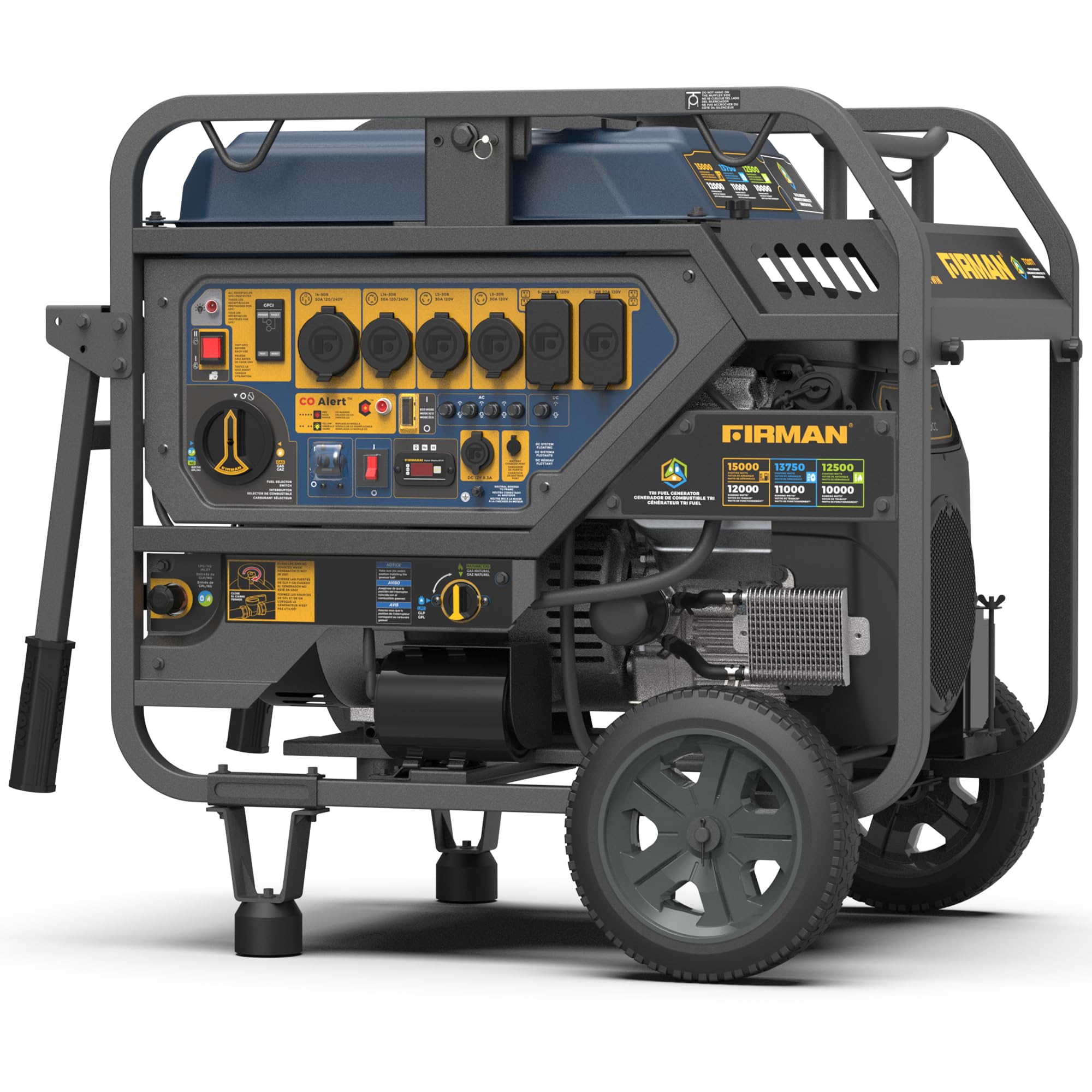
Firman T12071 Tri-Fuel Portable Generator — Very large tri-fuel backup
Best for: Very large tri-fuel backup
The Firman T12071 is the largest tri-fuel option in this list, with 12,000 running watts on gasoline and three fuel choices for long outages. That output covers a well pump, a large air conditioner, and several appliances together, while natural gas removes refuelling when a home gas connection is available. Remote start, a 50-amp outlet, and a wheel kit make a very large generator easier to use. The trade-offs are size, weight, noise, and fuel use: it needs a firm outdoor spot, a large fuel supply, and help to move. It also costs more than smaller tri-fuel models, so choose it only when you need this much power.
- 12,000 running watts on gasoline
- Three fuel options in one
- 50-amp outlet for transfer switch
- Remote start and wheel kit
- Very large and heavy
- High fuel use at load
- Lower output on natural gas
4.1/5
4.2/5
4.0/5

Pulsar G12KBN Dual Fuel Portable Generator — Large dual-fuel value
Best for: Dual-fuel value for essential loads
The Pulsar G12KBN closes this list as the value dual-fuel pick, with 9,500 running watts on gasoline for a 1800 sq ft home that needs essential loads covered. It runs a refrigerator, freezer, lights, internet, fans, and a sump pump together, with room for one larger load at a time, and propane gives a second fuel when gasoline is scarce. Its 50-amp outlet suits a transfer-switch connection, and electric start keeps it simple to use. The trade-off is refinement and support: it is louder than inverter models, heavier to move, and less proven than the top brands. It is a fair value choice, not a premium one.
- 9,500 running watts on gasoline
- Dual-fuel gasoline and propane
- 50-amp outlet included
- Electric start included
- Loud open-frame design
- Less proven than top brands
- Propane output slightly lower
4.0/5
4.1/5
3.9/5
Top 3 Head-to-Head: Westinghouse WGen12000DF vs DuroMax XP13000EH vs Champion 100416
These three are the common final choices for a 1800 sq ft home: the best overall balance, the highest output, and the most flexible fuel choice. The differences are fuel, noise, and how much you want to run at once.
| Feature | #1 WGen12000DF | #2 XP13000EH | #3 Champion 100416 |
|---|---|---|---|
| Home Power Fit | 4.9/5 — Best | 4.8/5 | 4.7/5 |
| Runtime and Fuel Flexibility | 4.9/5 — Best | 4.8/5 | 4.8/5 |
| Quiet Operation and Ease of Use | 4.9/5 — Best | 4.7/5 | 4.6/5 |
| Choose if… | You want the best balance of power, fuel, and outlets | You run heavy motor loads together | You want natural gas as a third fuel |
Who These Portable Generators Are NOT For
A large portable generator is not the right answer for every home, and buying one will not fix a load list that is too large for it.
These generators are also not for indoor use, for homes with no safe outdoor placement, or for anyone who cannot store fuel safely. If you only need to charge phones and run a small refrigerator, a small inverter generator is cheaper, quieter, and easier to move.
Common Mistakes to Avoid
Most generator problems come from sizing, connection, or fuel mistakes made before the outage, not from the generator itself.
Frequently Asked Questions About Portable Generators for a 1800 Square Foot Home
What size generator do I need for a 1800 square foot home?
Most 1800 sq ft homes need 7,500 to 12,000 running watts for near whole-home backup, depending on heating, cooling, and water systems. Essentials-only backup, such as a refrigerator, freezer, lights, and internet, can fit in 3,500 to 5,500 running watts. Add running watts for everything you will run together, then add the largest starting watts. Learn running watts versus starting watts before you choose a size.
Can a portable generator power a whole 1800 sq ft house?
A large portable generator can power most circuits in a 1800 sq ft home through a transfer switch, but it usually cannot run everything at once. Central air conditioning, electric water heating, and an electric range together can exceed even a 12,000 running-watt unit. The practical approach is to choose essential circuits, stagger large loads, and accept that some appliances will wait their turn during an outage.
How many watts does a 1800 sq ft house use?
A 1800 sq ft home typically uses 3,000 to 5,000 running watts for essential loads, and 7,000 to 12,000 running watts when heating, cooling, or a well pump is added. A refrigerator uses about 150 to 200 running watts, a freezer about 100 to 150, and a window air conditioner about 1,000 to 1,500. Motor loads need extra starting watts, so check the label on each appliance rather than guessing from house size alone.
Can a portable generator run a central air conditioner?
Some large portable generators can run a central air conditioner, but it depends on the unit size and its starting watts. A 2-ton central air conditioner can need 3,500 to 5,000 starting watts, plus running watts for the rest of the house. A soft-start kit can lower the starting surge. A window air conditioner is a safer load for most portable generators, because it needs far fewer starting watts.
How long can a portable generator run a house?
A portable generator can run as long as it has fuel and oil, with breaks for refuelling and checks. Most large models run 8 to 12 hours on a tank at half load, and dual-fuel or tri-fuel models last longer when propane or natural gas is available. Plan fuel for at least a full day, check oil regularly, and let the generator cool before refuelling. Never run it indoors or in a garage.
Do I need a transfer switch for a portable generator?
You need a transfer switch or an interlock if you want to power hardwired house circuits. It connects the generator safely to the panel and prevents backfeeding, which can injure line workers. Extension cords are fine for individual appliances, but they cannot feed a panel. Have a qualified electrician install the switch, and never use a double-ended cord to connect a generator to a house outlet.
Is a dual-fuel generator better for home backup?
A dual-fuel generator is usually better for home backup, because propane stores longer than gasoline and gives you a second fuel when stations are closed. Propane output is slightly lower, and propane tanks still need refilling, so it is not unlimited. Tri-fuel models add natural gas for even longer outages. If you have a natural gas connection, a tri-fuel model is the most flexible choice in this list.
Our Final Verdict
For a 1800 sq ft home, the balance is power, fuel flexibility, and a safe connection. The Westinghouse WGen12000DF leads this specification comparison on all three, with dual fuel and a 50-amp outlet, while larger or quieter models win only when one need matters more.

Hi, I’m Michael Turner. I own a generator workshop in the United States and founded HomeGeneratorBlog to share practical, hands-on guidance about generator installation, maintenance, troubleshooting, safety, and backup power solutions. My goal is to help homeowners make smarter, more confident decisions through clear and reliable information