How Big of a House Will a 15,000-Watt Generator Run?
Quick Answer
A 15,000-watt generator can provide substantial backup power for a roughly 2,000- to 3,000-square-foot home, and sometimes a larger house, if major electrical loads are managed. However, many generators advertised as “15,000 watts” provide only about 12,000 continuous running watts, so calculate your actual generator power capacity from the running rating rather than the peak number.
What 15,000 watts can usually handle
- Large home backup: Enough capacity for refrigerators, lighting, pumps, electronics, heating equipment, and several larger appliances.
- Central air: Often possible with one properly sized central AC system if its startup demand stays within the generator’s surge rating.
- Gas-equipped homes: Houses with gas heat, cooking, and water heating are much easier to cover than all-electric homes.
- All-electric homes: Electric dryers, water heaters, ranges, and resistance heat can quickly exceed available capacity.
- Peak vs. running: A generator rated at 15,000 starting watts may supply only around 12,000 watts continuously.
Best sizing rule
- Add the running watts of the loads you will use together, then account for your largest motor-starting surge.
If you’re considering a generator this large, you’re probably trying to avoid choosing which essential appliance gets power during an outage. I understand that goal, but the number printed in large type on the generator doesn’t tell the whole story.
As of 2026, I still size home backup systems from actual electrical loads first. Square footage is useful for comparison, but your air conditioner, pumps, water heater, and heating system determine the final answer.
What Size House Can a 15,000-Watt Generator Run?
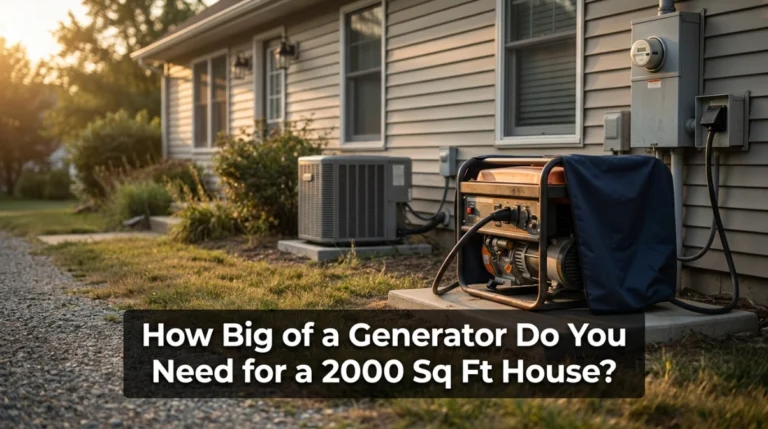
A 15,000-watt generator can often provide practical backup for a 2,000- to 3,000-square-foot home, provided you manage high-demand appliances. A gas-equipped home may stretch that capacity much further than an all-electric house of the same size.
Definition: A 15,000-watt generator is a generator capable of producing up to 15,000 watts at either its continuous or short-term peak rating, depending on the model. Always check which rating the manufacturer means.
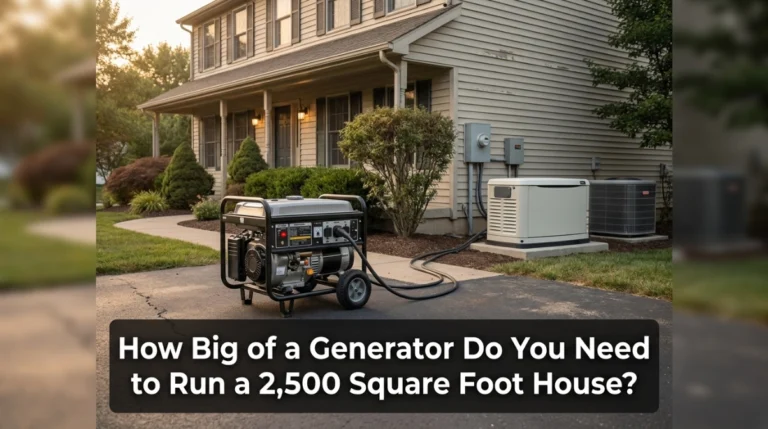
I treat house size as a starting filter only. Two 2,500-square-foot homes can have completely different generator requirements.
| Home / Backup Goal | 15,000-Watt-Class Generator | Likely Limitation |
|---|---|---|
| 1,500–2,000 sq. ft. | Strong capacity for most outage loads | Large electric heat or multiple HVAC loads |
| 2,000–2,500 sq. ft. | Often enough for broad managed backup | Central AC startup plus electric appliances |
| 2,500–3,000 sq. ft. | Useful for essentials and selected major loads | May require active load management |
| 3,000+ sq. ft. | Can still provide substantial emergency backup | True whole-home operation may need a larger standby unit |
For comparison, my guide to a 2,500-square-foot house generator explains why central air can push the target toward this power class.
A 3,000-square-foot house can also work with around 12–15 kW of managed backup, but broad whole-home coverage often requires more.
Does a 15,000-Watt Generator Mean Running or Starting Watts?
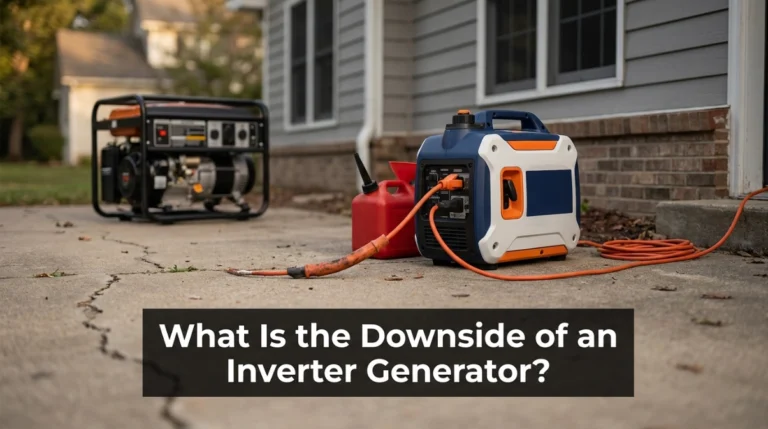
Not necessarily. Some models advertise 15,000 starting watts while providing about 12,000 running watts, while other large generators can supply close to 15,000 watts continuously.
This is the first specification I check. The difference between running watts and starting watts can change your usable capacity by several thousand watts.
| Generator | Gasoline Running Watts | Peak / Starting Watts |
|---|---|---|
| DuroMax XP15000HXT | 12,000 W | 15,000 W |
| Champion 201160 | 12,000 W | 15,000 W |
| Westinghouse WGen14500TFc | 14,500 W | 18,000 W |
That difference matters during an outage. A 12,000-running-watt machine should be treated as a 12,000-watt continuous power source, even when “15,000 watts” appears prominently in its name or marketing.
What Appliances Can a 15,000-Watt Generator Run at the Same Time?
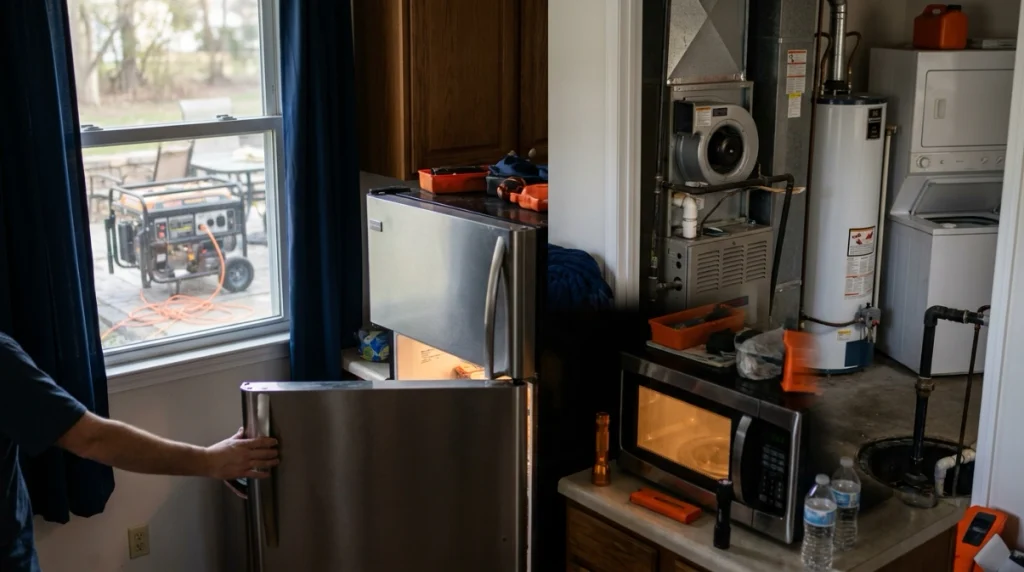
A 15,000-watt-class generator can run many normal household loads together. The difficult loads are usually central air compressors, well pumps, electric water heaters, dryers, ranges, and resistance heating.
Use the figures below only for initial planning. Your appliance nameplates and manufacturer specifications should determine the real calculation.
| Household Load | Typical Planning Range | What to Watch |
|---|---|---|
| Refrigerator / freezer | 150–700 running watts | Compressor startup |
| Furnace blower | 300–800 running watts | Motor startup |
| Sump pump | 800–1,050 running watts | High starting surge |
| Well pump | 1,000–1,500+ running watts | Pump horsepower and startup |
| Microwave | 600–1,500 watts | Short high-demand use |
| Electric water heater | About 4,000–5,500 watts | Consumes a large share of capacity |
| Electric clothes dryer | About 4,000–6,000 watts | Heating element plus motor |
A gas furnace, gas range, and gas water heater dramatically reduce the electrical load. That’s why a 15,000-watt generator can feel close to whole-house power in one home and undersized in another.
Will a 15,000-Watt Generator Run Central Air?
Yes, a 15,000-watt-class generator can often operate one central air conditioner, but the compressor’s starting demand decides whether it will start reliably. You must compare both running and startup requirements with the generator’s ratings.
Central AC is one of the biggest reasons I avoid sizing from square footage alone. My generator sizing guide for air conditioners covers the compressor surge issue in more detail.
- Check the AC nameplate: Find its rated current and electrical requirements.
- Check startup demand: Compressor starting power can be much higher than normal operation.
- Reduce competing loads: Avoid starting the AC while an electric dryer or water heater is drawing several kilowatts.
- Ask about soft starting: A professionally selected soft-start device may reduce compressor startup demand on compatible systems.
I prefer having extra margin rather than sizing a generator so tightly that every compressor cycle becomes a test of the breaker.
Can 15,000 Watts Run an All-Electric House?
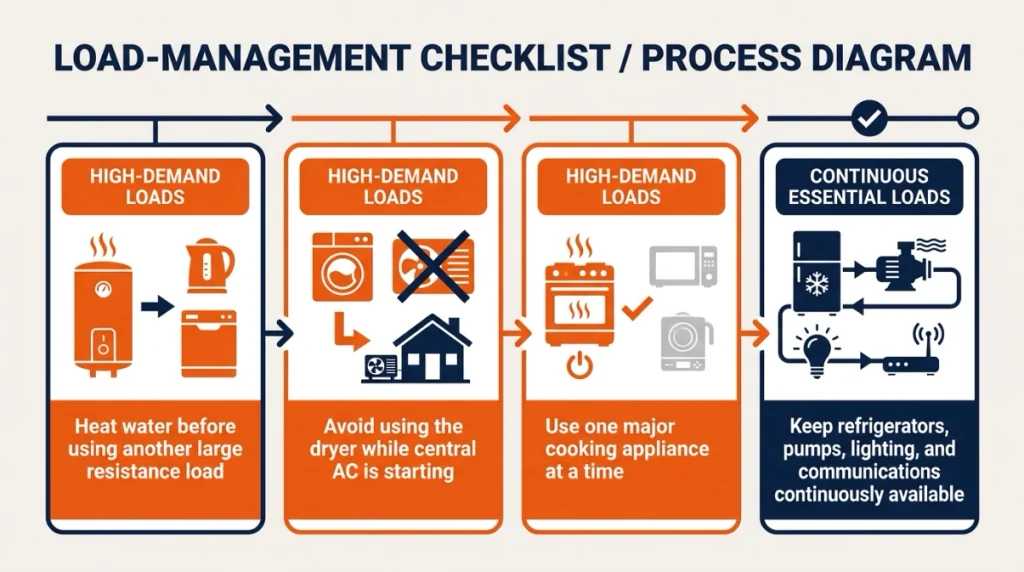
It can provide useful backup, but 15,000 watts usually does not mean unrestricted operation of every load in an all-electric home. Electric heating, water heating, cooking, clothes drying, and central air can overlap and consume the available capacity quickly.
Load management solves much of this problem. Instead of operating every high-demand appliance together, you deliberately stagger them.
- Heat water before using another large resistance load.
- Avoid using the dryer while central AC is starting.
- Use one major cooking appliance at a time.
- Keep refrigerators, pumps, lighting, and communications continuously available.
If you want an all-electric house to operate normally with little thought about load management, a larger permanently installed standby generator may be the better solution.
Can a 50-Amp Generator Inlet Use All 15,000 Watts?
Not through a single 50-amp, 240-volt connection. A 50-amp connection at 240 volts represents 12,000 watts, so the connection itself can become the bottleneck even when the generator has a larger total output rating.
This detail is easy to miss when comparing generator advertisements. A machine may have additional output available across other receptacles while its 50-amp household connection remains limited by its circuit design.
Practical point: Don’t assume a 15,000-watt generator automatically sends 15,000 watts through your existing 50-amp inlet. Have the inlet, breaker, transfer equipment, wiring, generator receptacle, and installation checked as one system.
How Do You Calculate Whether 15,000 Watts Is Enough?
Add the running watts of everything you expect to operate together, then account for your largest additional starting surge. Leave reasonable operating headroom instead of planning to sit at maximum output continuously.
- List essential loads. Include refrigeration, pumps, HVAC, lighting, communications, and medical or safety equipment.
- Write down running watts. Use the appliance label or manufacturer documentation whenever possible.
- Add simultaneous loads. Exclude equipment you plan to leave switched off.
- Find the largest startup surge. Pay close attention to compressors, pumps, and blower motors.
- Add the extra startup amount. Don’t automatically add every appliance’s full starting rating at once.
- Leave headroom. A generator should not need to live at its limit whenever normal outage loads are operating.
For example, imagine your planned continuous loads total 8,500 watts. If the largest motor temporarily needs another 3,000 watts above its normal running load, your short-term requirement becomes about 11,500 watts.
A generator with 12,000 running watts and 15,000 starting watts could be a reasonable fit for that example. A different home with two large HVAC systems and electric resistance heat could exceed it easily.
How Should a 15,000-Watt Portable Generator Be Connected Safely?
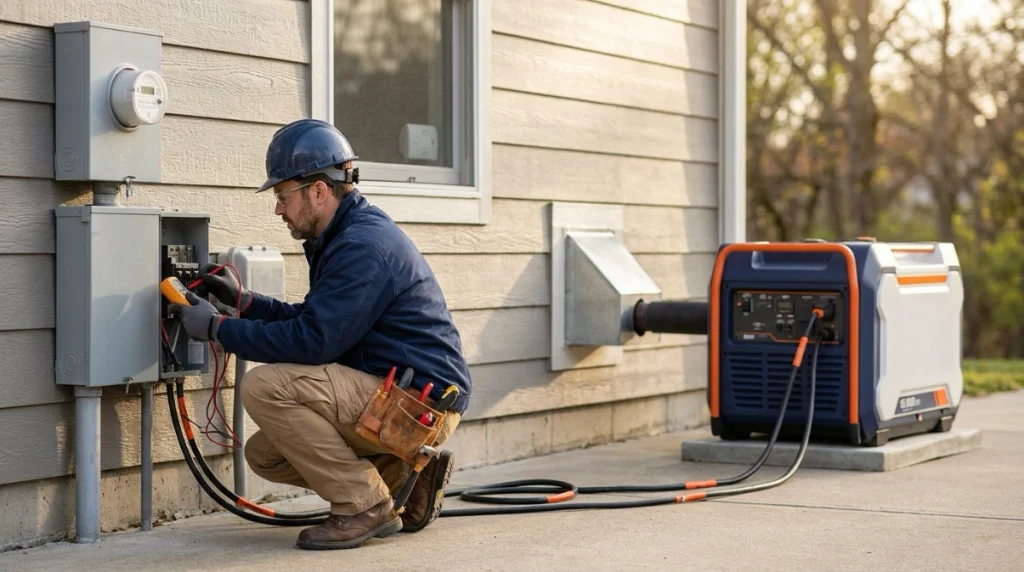
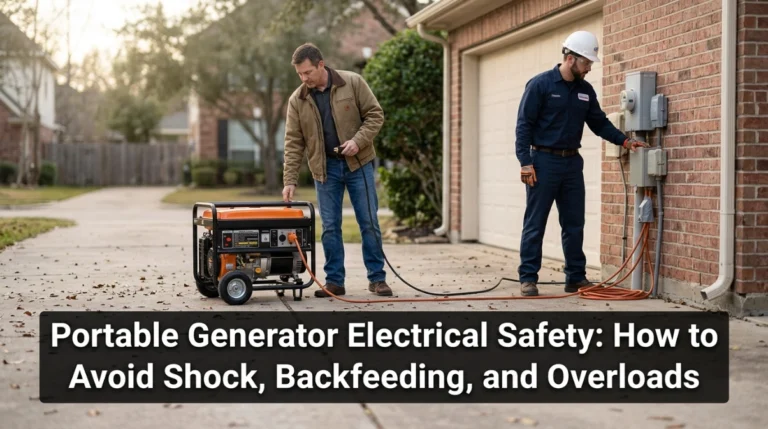
A generator this large deserves a proper electrical connection. Never improvise a connection that can energize utility lines or bypass the protection built into your home’s electrical system.
The OSHA portable-generator safety guidance warns about shock, electrocution, backfeeding, carbon monoxide, and fire hazards.
- Use proper transfer equipment: Have a qualified electrician install equipment suitable for your generator and electrical panel.
- Never backfeed: Don’t connect a generator to household wiring through an improvised outlet connection.
- Keep it outdoors: Portable generators produce deadly carbon monoxide.
- Protect against weather: Follow the generator manufacturer’s instructions without moving the machine into an enclosed space.
The U.S. Consumer Product Safety Commission generator guidance says portable generators should always operate outdoors and well away from openings.
The CDC carbon monoxide guidance recommends keeping generators more than 20 feet from windows, doors, and vents, with working carbon monoxide detectors inside the home.
Which 15,000-Watt-Class Generators Are Worth Considering?
If you’re ready to pick one, these are three large portable-generator configurations I would compare first. Pay close attention to continuous output, fuel type, connection options, and how much power you can deliver through your transfer setup.
🏆 Best Tri-Fuel Pick
DuroMax XP15000HXT
★★★★☆ 4.7/5 editorial fit
It provides 15,000 peak and 12,000 running watts on gasoline, with propane and natural-gas capability. I like this configuration when fuel flexibility matters more than squeezing out the highest possible continuous wattage.
⚡ Best For Higher Running Output
Westinghouse WGen14500TFc
★★★★☆ 4.8/5 editorial fit
Gasoline output reaches 14,500 running and 18,000 peak watts, while the unit also supports propane and natural gas. This is the one I’d compare closely when your priority is getting nearer to 15 kW of continuous portable power.
🔧 Best Gasoline-Only Option
Champion 201160
★★★★☆ 4.5/5 editorial fit
Champion rates this model at 15,000 starting and 12,000 running watts on gasoline. I see it as a straightforward choice when you don’t need tri-fuel plumbing and want a conventional large portable backup generator.
Frequently Asked Questions
Will a 15,000-watt generator run a whole house?
A 15,000-watt generator can run most or many circuits in a typical home, especially when heating, cooking, and water heating use gas. An all-electric home may require load management because HVAC, water heating, dryers, and ranges can exceed the generator’s available continuous power when operated together.
How many square feet can a 15,000-watt generator power?
Roughly 2,000 to 3,000 square feet is a useful planning range for broad backup, but square footage doesn’t determine generator demand. A smaller all-electric house can need more generator capacity than a larger house using natural gas for heat, cooking, and hot water.
Will a 15,000-watt generator run a 5-ton AC unit?
Possibly, but you cannot determine that from tonnage alone. Check the air conditioner’s actual running current and compressor starting requirement, then compare those numbers with the generator’s continuous and surge ratings while accounting for every other load operating at the same time.
Can I run an electric water heater and dryer on a 15,000-watt generator?
Potentially, but those two appliances can consume a large percentage of the generator’s available output. Running them alongside central air, an electric range, pumps, and other major loads may overload a 12,000- to 15,000-running-watt system, so stagger high-demand appliances.
Is a 15,000-watt portable generator better than a standby generator?
It depends on your goal. A large portable generator can provide substantial emergency power for less upfront equipment, while a permanently installed standby system offers automatic startup, dedicated transfer equipment, and easier whole-home operation during extended outages.
Final Takeaway
A 15,000-watt generator is powerful enough to provide serious home backup, but I wouldn’t buy one because a square-footage chart says it matches your house. Start with your actual running loads, check the largest motor startup demand, and confirm whether “15,000 watts” means continuous or peak output.
For many 2,000- to 3,000-square-foot homes, this class offers an excellent balance between portable backup and near-whole-home capability. If your house is all-electric or you expect every major appliance to run normally during an outage, calculate the load first and move to a larger standby system if the numbers require it.