What Will a 7500 Watt Generator Run in a House?
Quick Answer
A 7,500-watt generator can usually run the essential equipment in a house, including a refrigerator, freezer, lights, Wi-Fi equipment, furnace blower, sump pump, television, and selected kitchen appliances. If 7,500 watts is the generator’s continuous rating, you have considerably more usable capacity than a model where 7,500 watts represents only its temporary starting output; my generator power capacity guide explains the sizing math in more detail.
What a 7,500-watt generator can typically handle
- Refrigeration: A refrigerator and separate freezer normally leave plenty of capacity for other essential loads.
- Heating equipment: A gas or oil furnace blower is usually practical if you account for its motor starting surge.
- Water pumps: Many sump and well pumps can operate, but their startup demand must fit within the generator’s surge rating.
- Small electronics: LED lights, televisions, routers, laptops, and phone chargers consume a small share of the available output.
- Limited cooling: A window air conditioner is often practical, while central air requires much closer sizing.
- Kitchen loads: A microwave or coffee maker is usually fine when other large electrical appliances are managed.
Before switching anything on
- Check whether the generator’s 7,500-watt number refers to running watts or starting watts, then verify the actual wattage labels on your appliances.
A 7,500-watt generator sits in a useful middle ground for home backup. It can keep a surprising amount of a house functioning without moving into the cost and size of a large standby system.
The catch is that you can’t simply add appliance wattages until the total reaches 7,500. I’ll show you how I approach the load so pumps, refrigerators, and air conditioners don’t trip the generator when their motors start.
What Does a 7500-Watt Generator Actually Mean?
A 7,500-watt generator may be rated for 7,500 running watts, or the advertised number may refer to its higher temporary starting output. Always check the specification plate instead of relying on the largest number printed on the box.
Generator wattage is the amount of electrical power the generator can supply. Running watts describe continuous output, while starting or surge watts describe the short burst available when a motor starts.
For example, current 7,500-running-watt gasoline generators commonly have roughly 9,375 to 9,500 starting watts. That extra capacity helps start compressors, pumps, and blower motors.
If this distinction is new to you, see my guide to running watts vs. starting watts. It’s one of the most important things to understand before planning an outage load.
How Many Watts Do Common Household Appliances Use?
Appliance wattage varies by model, efficiency, age, and motor size. The numbers below are planning estimates, so use the label or owner’s manual on your equipment for the final calculation.
| Household Load | Typical Running Watts | Possible Starting Watts | 7500W Generator? |
|---|---|---|---|
| Refrigerator or freezer | About 700 W | About 2,200 W | Yes |
| Sump pump, 1/3 hp | About 800 W | About 1,300 W | Yes |
| Well pump | About 1,000 W | About 2,000-3,000 W | Usually |
| Furnace blower, 1/2 hp | About 800 W | About 2,350 W | Yes |
| Window AC, around 10,000 BTU | About 1,200 W | Up to about 3,600 W | Usually |
| Microwave | About 1,000 W | About 1,000 W | Yes |
| Portable space heater | About 1,500 W | About 1,500 W | Yes, but power-hungry |
| Electric water heater | About 4,000 W | About 4,000 W | Possible with load management |
| LED lights, several rooms | About 100 W | About 100 W | Yes |
| Wi-Fi router and modem | About 20 W | About 20 W | Yes |
A wattage chart is useful for planning, but I treat it as a starting point rather than a guarantee. A larger pump or older refrigerator can draw considerably more than a typical example.
What Can a 7500-Watt Generator Run at the Same Time?
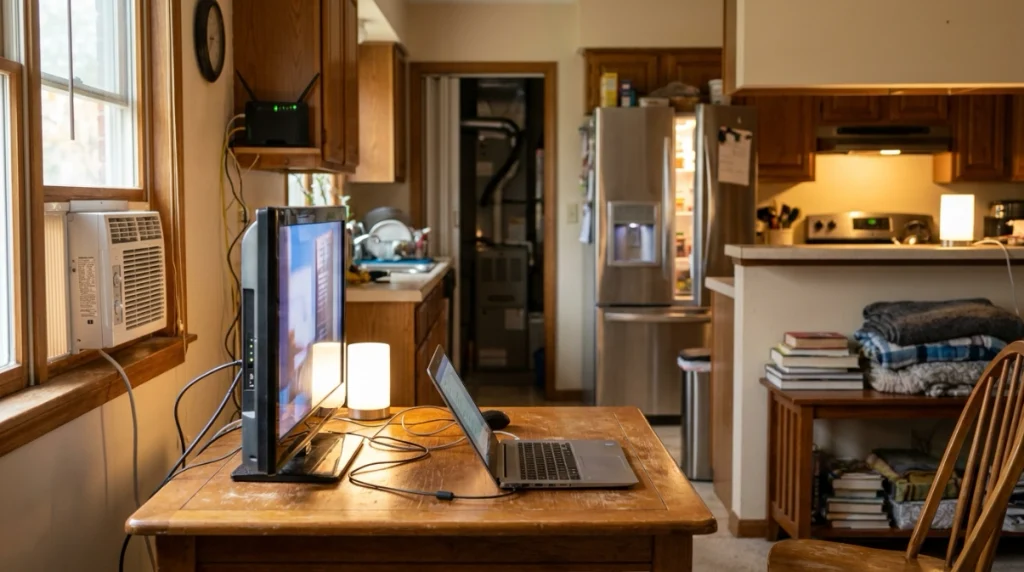
A 7,500-running-watt generator can usually operate several essential household systems together. The most reliable approach is to create an outage load instead of trying to reproduce normal whole-house electricity use.
Example 1: Basic winter outage
This combination keeps heat, food, communication, and basic lighting available. Its continuous demand is modest for a 7,500-watt generator.
- Refrigerator: 700 running watts
- Furnace blower: 800 running watts
- Sump pump: 800 running watts
- LED lighting: 100 running watts
- Wi-Fi: 20 running watts
- Television: 120 running watts
- Laptop: 90 running watts
The running total is about 2,630 watts. Replacing the furnace blower’s 800 running watts with a roughly 2,350-watt startup demand produces a temporary requirement near 4,180 watts.
That leaves substantial room on a generator capable of a true 7,500 running watts. It also gives the generator breathing space when equipment cycles unexpectedly.
Example 2: Summer essentials with a window AC
Add a roughly 1,200-watt window air conditioner to the previous basic load and continuous demand reaches about 3,830 watts. Its compressor may briefly require around 3,600 watts at startup.
With the rest of the load already operating, the temporary requirement can approach 6,230 watts. That’s still workable on many 7,500-running-watt generators with adequate surge capacity.
Central air is a different calculation. My generator sizing guide for air conditioners covers compressor loads and larger cooling systems separately.
Example 3: Refrigerator, well pump, and kitchen load
A refrigerator, 1,000-watt well pump, 1,000-watt microwave, basic lighting, and internet equipment total roughly 2,820 running watts. The largest motor surge could push the temporary requirement beyond 4,000 watts.
This is comfortably below 7,500 watts in many homes. I would still avoid switching several motor-driven loads on at the same moment.
Can a 7500-Watt Generator Run a Whole House?
A 7,500-watt generator can run the essential parts of many houses, but it shouldn’t be treated as unrestricted whole-house power. Large electric heating and cooling loads can consume most of its capacity by themselves.
My rule of thumb is simple: treat this size as a strong essentials generator, not permission to switch every breaker back on. That mindset prevents most overload problems.
Loads that can become difficult when used together include:
- Central air conditioning
- Electric water heaters
- Electric clothes dryers
- Electric ranges and ovens
- Multiple portable space heaters
- Large well pumps
- EV charging equipment
You may be able to operate one of these loads by itself or alongside smaller equipment. Trying to operate several simultaneously is where 7,500 watts becomes restrictive.
If your goal is broader backup rather than essential circuits, compare the load with my guide on what size generator you need to run a house.
Will a 7500-Watt Generator Run Central Air?
Sometimes, but central air is one of the loads I would never judge from generator wattage alone. Compressor startup demand can temporarily be far higher than the unit’s normal running power.
A smaller or efficient central system may fit a generator in this range, especially when other loads are minimized. A larger system can exceed the generator’s starting capacity before the compressor gets moving.
Check the air conditioner’s electrical nameplate and manufacturer data. For a permanent backup arrangement, an electrician or HVAC professional can also determine whether a properly selected soft-start device is appropriate.
Does Running the Generator on Propane Reduce Available Power?
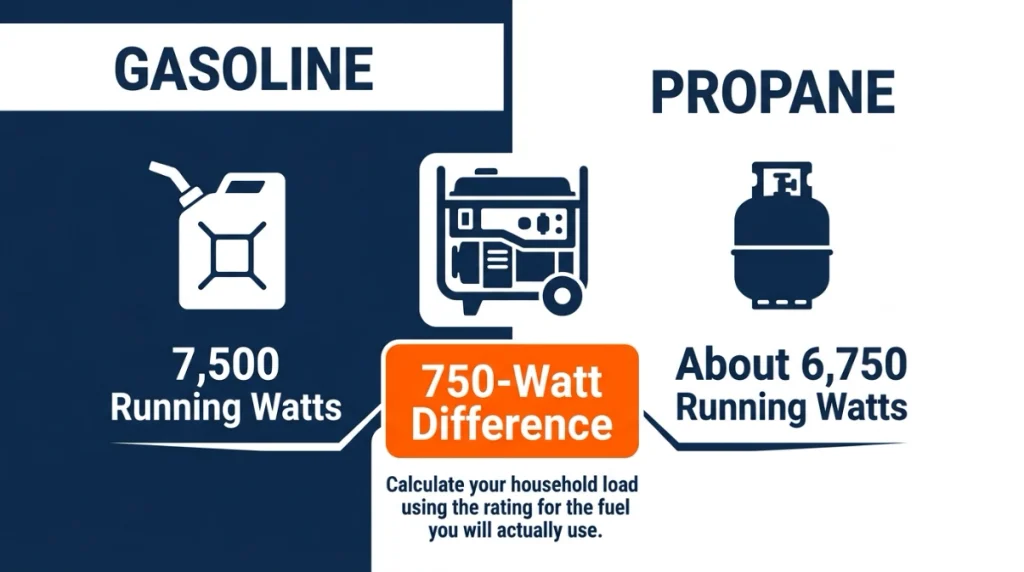
It often does. Many dual-fuel generators produce less power from propane than they do from gasoline, so calculate your household load using the rating for the fuel you will actually use.
For example, current Champion and Westinghouse dual-fuel models in this class are rated for 7,500 running watts on gasoline but about 6,750 running watts on propane. That’s a 750-watt difference you shouldn’t ignore.
This matters most when your planned load already sits near the generator’s limit. A setup that works comfortably on gasoline can have much less headroom on propane.
How Do I Calculate What My 7500-Watt Generator Can Run?
Start with the equipment you truly need during an outage. Don’t calculate every appliance in the house unless you genuinely expect to operate all of them.
- Write down each essential load. Include refrigerators, pumps, heating equipment, lights, communications, and any required medical or work equipment.
- Find each running wattage. Use the appliance label or manufacturer’s documentation whenever possible.
- Add the running watts. This is your normal simultaneous load.
- Identify the largest motor startup requirement. Refrigerators, pumps, furnace blowers, and air conditioners deserve special attention.
- Check the generator’s surge rating. Make sure it can carry the normal load while the largest motor starts.
- Leave headroom. I prefer not to plan an outage around operating a generator at its absolute limit.
If an appliance lists amps instead of watts, a basic estimate is volts × amps = watts. Motor loads and power factor can complicate that calculation, so manufacturer specifications are better when available.
Also remember that motors can occasionally start close together. Deliberately staggering large loads gives your generator a much easier job.
How Should a 7500-Watt Generator Be Connected to a House?
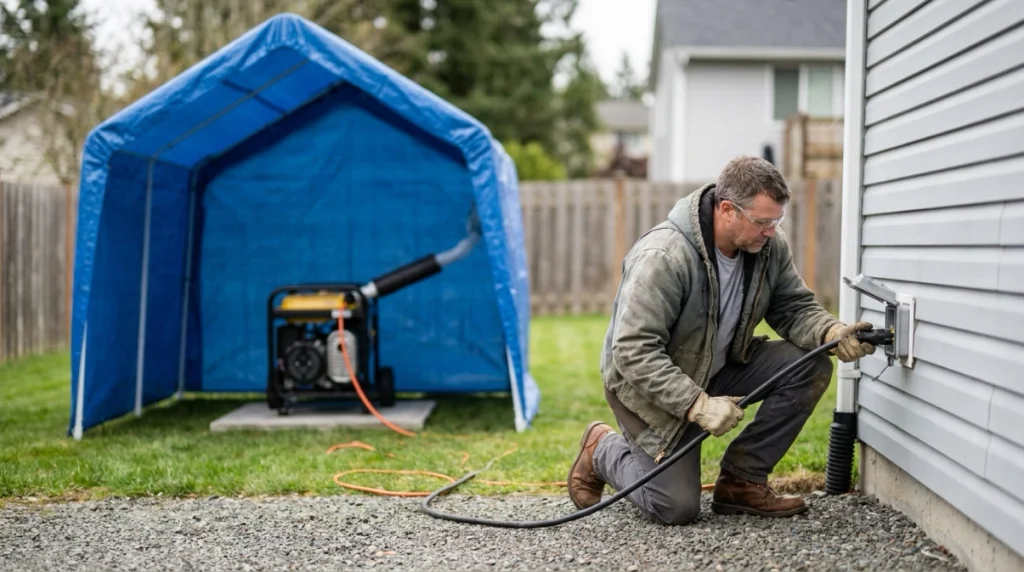
A properly installed transfer switch or approved interlock arrangement can supply selected household circuits while preventing dangerous utility backfeed. My guide to the portable generator transfer switch explains the basic setup.
Never improvise a house connection using a male-to-male cord or by feeding generator power through a household receptacle. That can energize wiring in unintended directions and create shock, electrocution, and fire hazards.
For generator safety, the U.S. Consumer Product Safety Commission generator guidance warns that portable generators must never be operated inside a home, garage, basement, crawlspace, or shed.
The EPA’s portable-generator placement guidance recommends keeping fuel-powered generators at least 20 feet from homes. Keep exhaust pointed away from occupied buildings, doors, windows, and vents.
- Use working carbon monoxide alarms inside the home.
- Keep the generator dry and protect it from wet conditions without enclosing it.
- Use correctly sized outdoor-rated cords when powering equipment directly.
- Follow grounding instructions in the generator manual and local electrical requirements.
- Turn the generator off before refueling and allow hot components to cool.
The OSHA generator safety resources also cover electrical shock, grounding, carbon monoxide, fire, and wet-condition hazards.
7500-Watt Generators I’d Consider for Home Backup
If your load calculation puts you in this class, these are three current models that match different priorities. I would still choose by output, outlet configuration, fuel type, and connection method rather than by brand name alone.
🏆 Best Dual-Fuel Pick
Champion 201281 7500W Dual Fuel Generator
★★★★☆ 4.7/5 editorial fit
It delivers 7,500 running and 9,375 starting watts on gasoline, or 6,750 running and 8,400 starting watts on propane. I like this configuration when fuel flexibility matters more than squeezing every possible watt from one fuel source.
📡 Best for Remote Starting
Westinghouse WGen7500DFc
★★★★☆ 4.8/5 editorial fit
This dual-fuel model provides 7,500 running and 9,500 peak watts on gasoline, plus remote and electric starting. Its 120/240-volt L14-30R connection and transfer-switch-ready design make it particularly relevant for planned home backup.
⛽ Best Gasoline-Only Option
Champion 201547 7500W Generator
★★★★☆ 4.6/5 editorial fit
This gasoline model produces 7,500 running and 9,375 starting watts and includes electric start and CO Shield technology. I would consider it when you prefer a straightforward gasoline setup and don’t need dual-fuel capability.
Frequently Asked Questions
Will a 7500-watt generator run a refrigerator and air conditioner?
Yes, a true 7,500-running-watt generator can usually run a refrigerator and many window air conditioners together. Calculate the AC compressor’s starting surge, however, because that brief demand can be several times its normal running wattage.
Can a 7500-watt generator run an electric water heater?
A typical electric water heater drawing around 4,000 watts may fit within a 7,500-watt generator’s capacity. It consumes such a large share of the available output that you should reduce other major loads while the heating elements operate.
Will a 7500-watt generator run central air conditioning?
It may run some smaller central air systems, but the compressor startup surge is often the limiting factor. Check the AC’s actual electrical specifications rather than assuming every central system will work with a generator this size.
Is a 7500-watt generator enough for a 2,000-square-foot house?
It can be enough for essential circuits in many 2,000-square-foot homes, but square footage doesn’t determine electrical demand. Heating type, air conditioning, pumps, water heating, cooking equipment, and the loads you operate simultaneously matter much more.
Should I run my 7500-watt generator at full capacity?
I wouldn’t design an outage plan around holding the generator at its absolute maximum continuously. Leaving capacity available for unexpected motor starts and temporary loads makes the setup easier to manage and reduces nuisance overload trips.
Final Takeaway
A 7,500-running-watt generator is a capable home-backup size when your goal is refrigeration, heating controls, pumps, lights, communications, and carefully selected comfort appliances. It isn’t automatically a whole-house replacement for utility power.
Add the running watts of what you’ll use together, account for the largest startup surge, and leave some headroom. Do that before the outage, and you’ll know exactly which appliances can stay on when the grid goes down.

Hi, I’m Michael Turner. I own a generator workshop in the United States and founded HomeGeneratorBlog to share practical, hands-on guidance about generator installation, maintenance, troubleshooting, safety, and backup power solutions. My goal is to help homeowners make smarter, more confident decisions through clear and reliable information