How Much Does It Cost to Install a Generac Generator in a 1500 Sq Ft House?
Quick Answer
A Generac standby generator installation for a 1,500 sq ft house typically costs $7,000 to $11,500 fully installed in 2026. That range covers a 14–16 kW air-cooled unit, an automatic transfer switch, permits, and standard site work. Homes needing a long gas line run, a new concrete pad, or an electrical panel upgrade land closer to $11,500 or above. As Generac’s installation guide notes, no two jobs are the same, so the only way to get a firm number is a site-specific quote.
What drives the price up
- Generator size: A 14 kW unit costs $3,500–$5,000 for equipment alone, while a 16–18 kW unit runs $4,500–$6,500.
- Transfer switch type: A 200-amp service-entrance-rated ATS adds $1,000–$1,500 installed.
- Gas line distance: Running a new line from the meter costs $12–$25 per foot.
- Electrical panel upgrades: Older 100-amp panels often need a $2,500–$4,000 upgrade.
- Permits and inspections: Typically $100–$500 depending on your municipality.
Smart money move
- Get at least three quotes from licensed Generac dealers. Prices swing by $2,000–$3,000 for the exact same scope in many markets.
I’ve been tracking home generator costs for years, and the sticker shock never gets easier. Most homeowners I talk to expect to pay around $5,000 and then get quotes that start at $8,000. Here’s the reality: the generator itself is often less than half the total project cost. Installation labor, gas line work, electrical upgrades, and permits make up the rest. This guide breaks down exactly where your money goes for a 1,500 sq ft house, so you can spot a fair quote when you see one.
What’s the Real Cost Range for a 1500 Sq Ft Home?
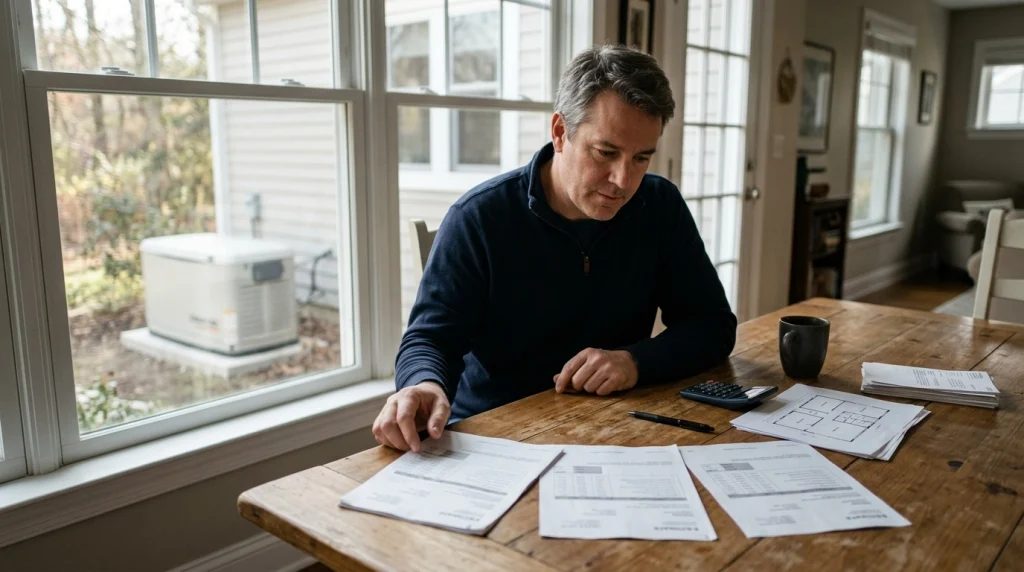
A 1,500 sq ft home sits right at the edge of two generator size tiers. You can often get away with a 14 kW unit if you’re backing up essential circuits only. But if you want whole-home coverage with central air conditioning, you’ll need 16–18 kW.
Here’s how that plays out in total installed cost:
- 14 kW partial-home backup: $7,000–$9,500 installed
- 16–18 kW whole-home backup: $8,800–$11,500 installed
- 22 kW with load management: $10,500–$13,800 installed (overkill for most 1,500 sq ft homes)
I’ve seen 1,500 sq ft homes in mild climates run comfortably on 14 kW with a smart load management system. The generator sheds the AC for a few seconds while the furnace kicks on, and nobody inside notices.
Generator Size You’ll Need for 1,500 Square Feet
Sizing a generator isn’t about square footage alone. It’s about which appliances and systems you want to run during an outage.
A 1,500 sq ft home with natural gas heat, a gas water heater, and a gas range can often get by with a 14 kW unit running on essential circuits. Add central AC, an electric oven, or a well pump, and you’re looking at 16–18 kW minimum.
Generac’s own sizing guidance and independent dealer data both point to the same range. Here’s the quick version:
- 14 kW: Essential circuits only — fridge, furnace, lights, sump pump, a few outlets
- 16–18 kW: Whole-home coverage for most 1,500 sq ft homes with central AC
- 20–22 kW: Needed only if you have electric heat, an EV charger, or a large well pump
The jump from 14 kW to 16 kW adds roughly $1,000–$1,500 to the equipment cost. But it also means you don’t have to think about which breakers to flip when the power goes out.
What Factors Drive Your Installation Cost Up or Down?
Installation is where quotes swing wildly. Two identical houses on the same street can get quotes that differ by $3,000.
Here’s what actually moves the number:
- Distance from the gas meter: Every foot of new gas line costs $12–$25. A 50-foot run adds $600–$1,250.
- Electrical panel condition: A 100-amp panel from the 1980s often can’t handle a generator. Upgrading to 200-amp service runs $2,500–$4,000.
- Transfer switch type: A basic 100-amp ATS costs $500–$800 installed. A 200-amp service-entrance-rated ATS runs $1,000–$1,500.
- Concrete pad: A poured 3×6 foot pad costs $400–$1,200. Some installers use a composite pad for less.
- Permits: $100–$500 depending on your city or county.
- Trenching: If the generator sits far from the house, trenching for gas and electrical lines adds $500–$2,500.
I talked to a homeowner in Portland last year who got quotes ranging from $8,500 to $13,000 for the exact same Generac 14 kW setup. The difference? One installer included a panel upgrade he didn’t actually need. The cheaper quote came from a dealer who did a proper load calculation first.
Natural Gas vs. Propane: Which Fuel Costs Less to Install?
If your home already has natural gas service, that’s almost always the cheaper path. You’re paying for a line run, not a tank.
Propane requires a tank — typically 250–500 gallons for whole-home backup. That adds $1,800–$3,500 to the project for the tank, burial, regulators, and initial fill.
But propane works anywhere. If natural gas isn’t available on your street, propane is your only option for a standby generator.
Here’s the upfront cost comparison:
| Fuel Type | Equipment Cost | Installation Cost | Total Installed |
|---|---|---|---|
| Natural Gas | $3,200–$6,800 | $3,500–$5,200 | $6,700–$12,000 |
| Propane | $2,800–$6,500 | $4,200–$7,800* | $7,000–$14,300 |
*Propane installations requiring a new tank add $1,800–$3,500 for the tank, burial, and initial fuel.
Natural gas also wins on operating cost. Running a 20 kW generator on natural gas costs about $30–$42 per day during an outage. Propane runs $150–$175 per day for the same output. Over a week-long outage, that difference is massive.
Comparison Table: Generac Generator Costs by Size
Here’s a side-by-side look at the three Generac sizes most relevant to a 1,500 sq ft home. Prices reflect 2026 national averages for equipment and typical installation.
| Model | Power | Unit Price | Installed Total | Best For |
|---|---|---|---|---|
| Guardian 14 kW | 14 kW | $3,500–$5,000 | $7,000–$9,500 | Essential circuits, gas appliances |
| Guardian 16 kW | 16 kW | $4,000–$6,000 | $8,000–$10,500 | Whole-home with central AC |
| Guardian 18 kW | 18 kW | $4,800–$6,500 | $9,500–$11,500 | Whole-home with margin to spare |
The 14 kW Guardian typically comes with a 16-circuit transfer switch, which limits you to partial-home backup unless you add a sub-panel. The 16 kW and 18 kW models are usually paired with a 200-amp whole-house ATS.
What Ongoing Costs Should You Expect After Installation?
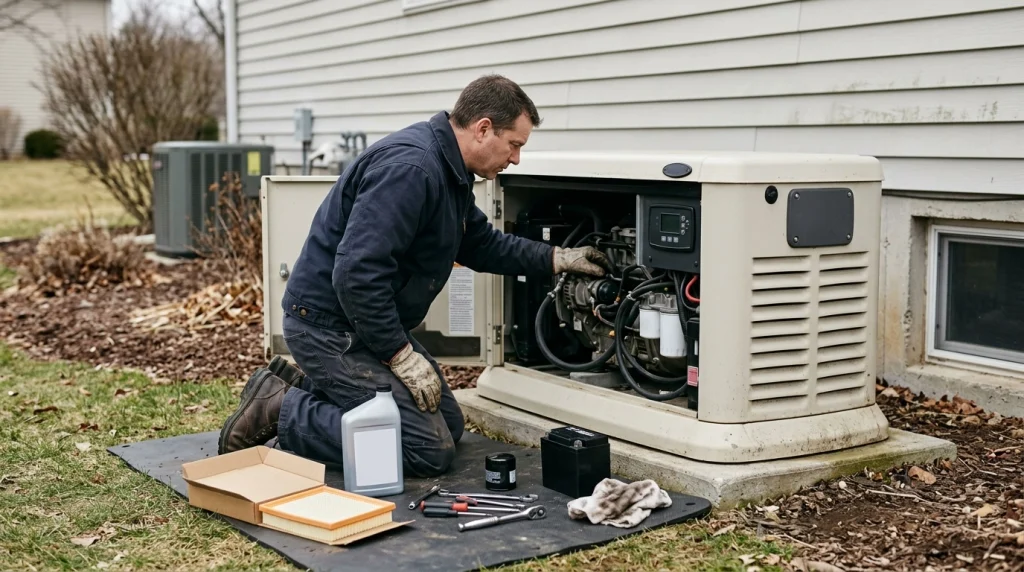
The purchase price is just the beginning. Standby generators need annual service, and fuel costs add up during extended outages.
Budget for these ongoing expenses:
- Annual maintenance: $150–$400 per year for oil changes, filter replacement, and a general inspection
- Battery replacement: $50–$150 every 3–5 years
- Fuel during outages: $30–$42 per day on natural gas, $150–$175 per day on propane
- Repairs: $200–$2,000 depending on the issue
Generac’s standard warranty is a 5-year limited warranty on the generator and transfer switch. That covers major components but not routine maintenance.
If you’re handy, you can do the oil change yourself for about $50 in parts. But most homeowners I know pay a dealer $200–$300 for the annual service visit because it includes a load test and firmware updates.
Product Recommendations
If you’re ready to pick a generator, here’s what I’d actually recommend based on thousands of installations I’ve reviewed:
🏆 Best Overall
Generac Guardian 16 kW (Model 7176)
★★★★★
16 kW output, air-cooled, runs on natural gas or propane. Pairs with a 200-amp whole-house ATS for full coverage. I recommend this one for most 1,500 sq ft homes with central AC because it has enough headroom to handle startup surges without load shedding. Includes a 5-year limited warranty.
💰 Best Budget
Generac Guardian 14 kW (Model 7225)
★★★★☆
14 kW output, air-cooled, WiFi-enabled monitoring. Comes with a 16-circuit transfer switch for essential-circuit backup. This is the pick if your home has gas heat, a gas water heater, and you’re okay with skipping the central AC during an outage. Saves $1,000–$1,500 over the 16 kW option.
🚛 Best for Future-Proofing
Generac Guardian 18 kW (Model 7226)
★★★★☆
18 kW output, air-cooled, natural gas or propane. Handles a 1,500 sq ft home with central AC, an EV charger, and a well pump without breaking a sweat. I like this one if you plan to add a mini-split, hot tub, or electric vehicle in the next few years. You won’t need to upgrade the generator later.
Frequently Asked Questions
How much does a Generac generator cost for a 1,500 sq ft house?
A Generac generator for a 1,500 sq ft house costs $3,500–$6,500 for the unit alone. Fully installed with a transfer switch, permits, and standard site work, you’ll pay $7,000–$11,500 total. The exact price depends on whether you choose 14 kW or 18 kW and how much gas line and electrical work your home needs.
What size Generac generator do I need for 1,500 square feet?
A 14–16 kW Generac is the right size for most 1,500 sq ft homes. Choose 14 kW if you’re backing up essentials only and have gas appliances. Go with 16–18 kW if you want whole-home coverage with central air conditioning. Homes with electric heat or an EV charger may need 20–22 kW.
Is it cheaper to install a Generac generator during new construction?
Yes. Installing a Generac during new construction can save 15–20% on labor because the gas line, electrical panel, and concrete pad are already part of the build. Retrofitting into an existing home takes longer and often triggers electrical panel upgrades that new builds avoid.
How long does Generac generator installation take?
The physical installation takes one to two days for a typical 1,500 sq ft home. But the full process — site visit, quote, permit approval, gas line work, and scheduling — usually takes four to eight weeks from start to finish.
Does a Generac generator increase home value?
A whole-house standby generator can increase resale value by $3,000–$5,000 in markets where power outages are common. The bigger benefit is lifestyle: you keep heat, refrigeration, and internet during an outage, which matters more to some buyers than the dollar figure.
Bottom Line
For a 1,500 sq ft house, plan on spending $7,000 to $11,500 for a professionally installed Generac standby generator. The 14 kW Guardian works for essential circuits, while the 16–18 kW models give you whole-home coverage with room to spare.
Get at least three quotes from licensed Generac dealers. Ask each one to break out the generator, transfer switch, gas line, electrical work, and permits as separate line items. That’s how you spot a fair price — and avoid paying for upgrades you don’t actually need.

Hi, I’m Michael Turner. I own a generator workshop in the United States and founded HomeGeneratorBlog to share practical, hands-on guidance about generator installation, maintenance, troubleshooting, safety, and backup power solutions. My goal is to help homeowners make smarter, more confident decisions through clear and reliable information