Should I Turn Off My Whole House Generator at Night?
Quick Answer
No, you usually do not need to turn off a properly installed whole house standby generator just because it is nighttime. If the utility outage continues, the generator can normally keep powering your home overnight, but you must follow your model’s continuous-run maintenance schedule; for example, Generac’s standby generator guidance requires maintenance checks during extended operation on applicable models.
When I would leave it running
- Outage continues: Leave the standby system operating when your home still needs backup electricity.
- Installation is correct: The unit should be permanently installed outdoors according to its manufacturer and local requirements.
- Fuel is available: Confirm your propane supply or natural-gas service can support extended operation.
- No warning appears: Do not ignore low-oil, overload, overcrank, overheating, or other controller warnings.
- Maintenance is current: Long outages can quickly push the generator into an inspection or service interval.
Turn it off when
- Your owner’s manual calls for an oil check, maintenance shutdown, or other continuous-use service.
- You notice unusual noise, smoke, leaking fluids, burning smells, abnormal heat, or repeated fault codes.
- A qualified technician or the generator manufacturer instructs you to stop operation.
I understand why this question comes up during a long outage. A generator running outside your bedroom at 2 a.m. can make you wonder whether eight or ten hours is simply too long.
With a whole-house standby system, nighttime itself isn’t the problem. What matters is runtime, maintenance, fuel supply, load, ventilation, and the instructions written for your exact generator.
Can a Whole House Generator Run All Night?
Yes, many permanently installed standby generators are designed for extended operation and can run overnight while utility power remains unavailable. You shouldn’t use sunrise or bedtime as your shutdown schedule.
I pay more attention to the generator’s accumulated operating hours. A long outage can turn a normal evening into 24, 48, or even 72 hours of engine operation surprisingly quickly.
- Automatic standby generator: Normally starts when the transfer system detects loss of utility power.
- Transfer switch: Safely transfers selected household electrical loads between utility power and generator power.
- Continuous operation: Extended generator runtime that may trigger additional inspections or maintenance requirements.
- Exercise cycle: A short scheduled run used to help verify generator readiness when no outage exists.
A whole-house standby generator is a permanently installed backup power system that automatically supplies electricity during a utility outage. Most residential units use natural gas or propane instead of a portable gasoline tank.
That distinction matters. Advice written for a gasoline-powered portable generator doesn’t automatically apply to a permanently installed standby unit.
Should You Shut Down a Standby Generator Every 24 Hours?
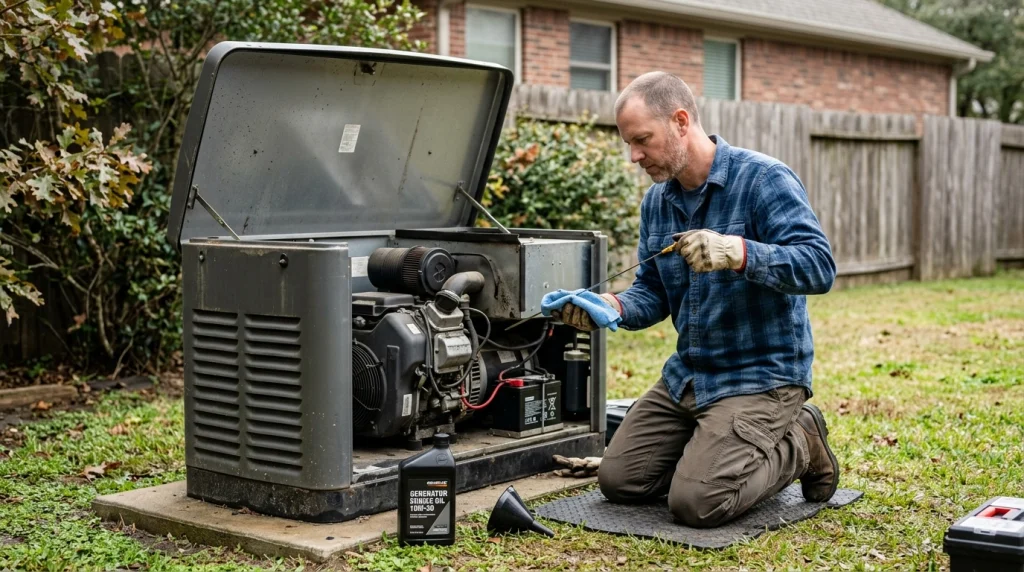
Some standby generators require a maintenance shutdown after extended continuous operation, so check your exact manufacturer’s instructions. You should never assume that “designed for backup power” means maintenance-free unlimited runtime.
As of 2026, Generac states that specified 10–28 kW air-cooled standby generators approaching or exceeding 24 hours of continuous use need a shutdown period for continuous-use maintenance.
That guidance includes checking the oil level, inspecting fuel and oil connections for leaks, and making sure enclosure louvers remain free of debris.
| Situation | Keep Running? | What I Would Do |
|---|---|---|
| 8-hour overnight outage | Usually yes | Let an approved standby system operate normally and monitor its status. |
| Approaching 24 hours continuously | Check manual | Perform the manufacturer’s required continuous-use checks. |
| Low-oil or fault warning | No | Follow the shutdown and diagnostic procedure for that warning. |
| Smoke, leaking fuel, or burning odor | No | Stop operation safely and arrange professional inspection. |
| Utility power has returned | Automatic system decides | Allow the automatic transfer and cool-down sequence to work normally. |
Generac’s current guidance for applicable air-cooled units specifies a minimum 30-minute shutdown after each 24 hours of continuous runtime so continuous-use maintenance can be performed.
Your generator may have a different requirement. Kohler, Briggs & Stratton, Cummins, and other manufacturers can specify different schedules by model and engine.
Why does oil matter during a long outage?
Standby engines can consume some oil while operating, making the oil level especially important during prolonged outages. A small engine running day and night accumulates service hours much faster than it does during normal weekly exercise cycles.
I would keep the correct oil and basic maintenance supplies available before storm season. Waiting until a widespread outage begins is the worst time to discover you don’t have what your particular generator requires.
For applicable Generac Guardian models, the manufacturer specifically says to verify oil daily during extended outage operation. Always use the procedure in your own manual before opening or servicing a running generator.
Is It Safe to Sleep While a Whole House Generator Is Running?
Sleeping while a correctly installed standby generator operates is generally different from sleeping near a portable generator, but carbon monoxide protection still matters. Any fuel-burning engine produces exhaust that must remain outside your living space.
The U.S. Consumer Product Safety Commission describes carbon monoxide as a colorless and odorless poisonous gas. Working CO alarms provide an important layer of protection inside the home.
- Keep CO alarms working: Use alarms on appropriate levels and near sleeping areas according to alarm instructions and local requirements.
- Never modify exhaust: Don’t improvise extensions, covers, walls, or barriers around the standby generator.
- Keep openings clear: Don’t defeat installation clearances around windows, doors, vents, or air intakes.
- Watch for obstruction: Snow, leaves, vegetation, stored objects, and storm debris can interfere with airflow.
- Respond to alarms: Treat a CO alarm as an emergency rather than assuming the generator cannot be responsible.
The U.S. Fire Administration also recommends maintaining carbon monoxide alarms inside the home. CO is impossible to reliably detect by smell.
I never use quiet operation as evidence that everything is safe. A generator can sound perfectly normal while an installation, exhaust, or ventilation problem creates a separate hazard.
What if I smell exhaust inside the house?
Do not treat exhaust odor inside your home as normal generator operation. Move occupants to fresh air and follow emergency guidance if a CO alarm sounds or anyone develops possible exposure symptoms.
Then have the installation inspected before normal generator use continues. A standby system should not be sending engine exhaust into occupied areas.
Does Turning a Whole House Generator Off at Night Save Fuel?
Yes, shutting a generator down stops fuel consumption, but fuel savings alone don’t make nighttime shutdown the right choice during an outage. You also lose backup power for every load the generator was supporting.
That can matter more than homeowners expect.
- Refrigerators and freezers stop cooling.
- Sump pumps may stop removing water.
- Well pumps may become unavailable.
- Furnace blowers and heating controls may stop.
- Medical or accessibility equipment may lose power.
- Security systems, internet equipment, and chargers may shut down.
If fuel supply is limited, I prefer thoughtful load management before an arbitrary nightly shutdown. Reducing unnecessary electrical loads can lower demand without eliminating backup protection entirely.
A propane standby generator deserves extra planning because the tank contains a finite fuel supply. Natural-gas installations depend on available gas service and correct fuel-system sizing.
Should you reduce the electrical load overnight?
Reducing unnecessary loads can be sensible during an extended outage. You don’t need every high-demand appliance running just because the generator can theoretically start it.
- Delay electric clothes drying.
- Avoid unnecessary electric oven use.
- Stagger large motor loads where appropriate.
- Turn off unused lighting.
- Use only the HVAC settings you need.
- Follow any installed load-management system rather than bypassing it.
The goal isn’t to make the house uncomfortable. It’s to avoid placing needless demand on an engine that may already be facing many hours of emergency service.
When Should I Turn My Whole House Generator Off?
Turn the generator off when maintenance is due, a fault requires inspection, the manufacturer instructs you to stop it, or something about its operation appears unsafe. Don’t shut it down randomly in the middle of an outage without understanding the proper sequence.
A standby generator is connected through electrical switching equipment. Correct shutdown is more involved than simply reaching inside the enclosure and pressing a button.
Stop and investigate these warning signs
- Oil warning: Low oil or abnormal oil consumption needs attention.
- Fluid leak: Investigate visible oil or fuel leakage.
- Unusual noise: New knocking, grinding, squealing, or severe vibration is not normal.
- Repeated shutdown: A controller that repeatedly stops the engine is telling you something needs diagnosis.
- Burning smell: Electrical, oil, or insulation odors justify immediate investigation.
- Smoke: Visible smoke from an unexpected source should never be ignored.
- Overheating: Blocked louvers, debris, or excessive load can contribute to heat problems.
If the system has been carrying the house, unload and shut it down exactly as your manufacturer specifies. Incorrect switching can create equipment damage or electrical hazards.
For Generac owners, the manufacturer’s support center provides model-specific operating and maintenance instructions. I would use the generator’s full model and serial information when checking procedures.
What Should You Check Before Going to Bed During an Outage?
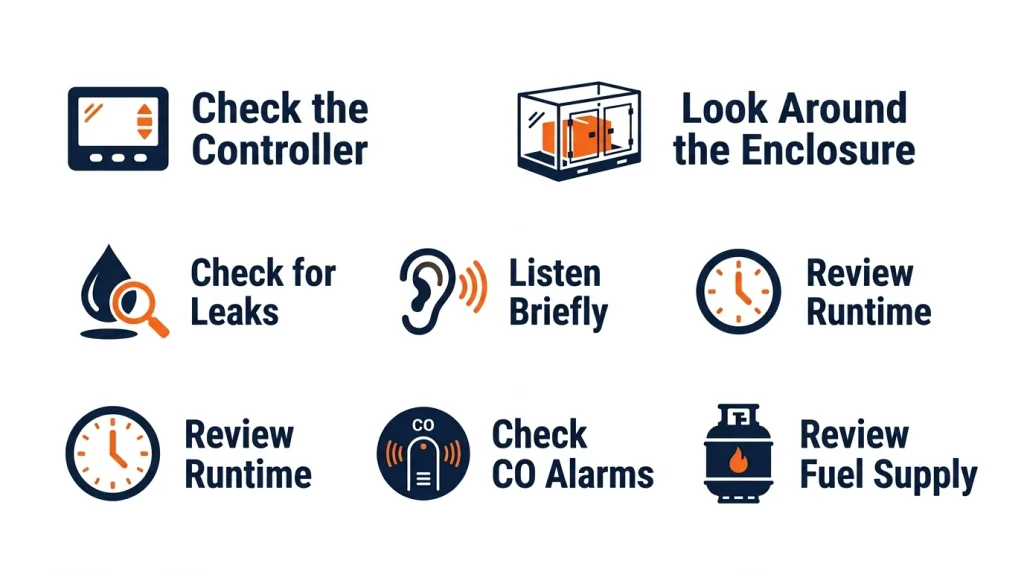
I use a short visual check before leaving a standby generator unattended overnight. It catches simple problems while they’re still easy to see.
- Check the controller. Confirm the generator shows normal operation and no warning or service message.
- Look around the enclosure. Make sure leaves, snow, branches, stored items, and storm debris aren’t blocking airflow.
- Check for leaks. Look for obvious oil or fuel leakage without touching hot components.
- Listen briefly. Pay attention to new mechanical noises, surging, or severe vibration.
- Review runtime. Determine whether you are approaching a continuous-operation maintenance interval.
- Check your CO alarms. Make sure alarms are operational and haven’t been disabled during the outage.
- Review fuel supply. Propane users should monitor available tank capacity during long outages.
My main rule is simple: I don’t open a hot generator enclosure and start working around a running engine before consulting the shutdown procedure. Hot components, moving parts, electricity, and fuel all deserve respect.
The Federal Emergency Management Agency also advises homeowners to follow generator manufacturer instructions. Model-specific directions should take priority over generic internet advice.
Whole House Generator vs Portable Generator at Night
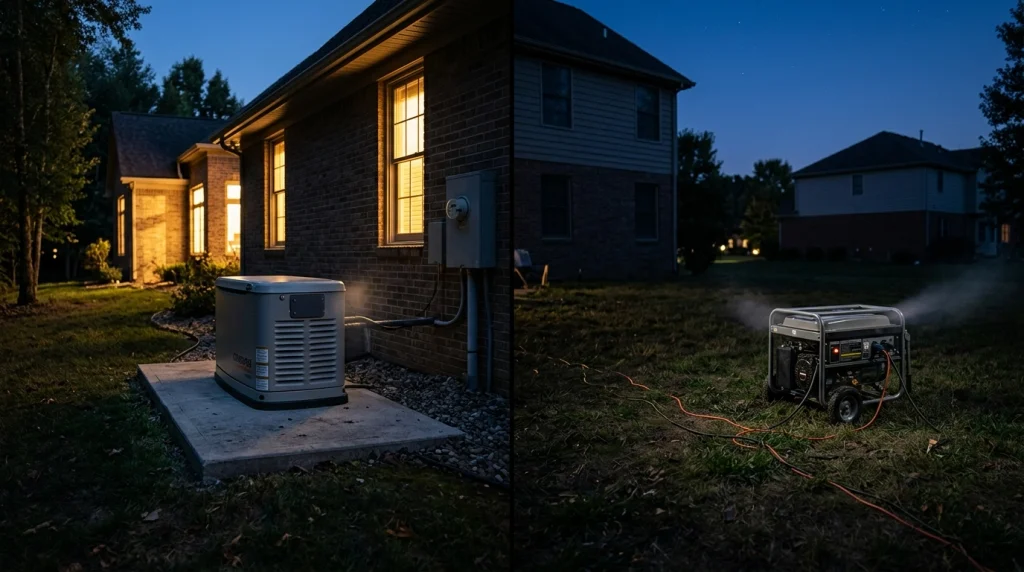
Don’t apply whole-house standby advice to a portable generator. The machines may both create electricity, but their installation, fuel systems, connection methods, and operating procedures can be quite different.
| Feature | Whole-House Standby | Portable Generator |
|---|---|---|
| Installation | Permanent outdoor installation | Temporary placement |
| Typical fuel | Natural gas or propane | Often gasoline, propane, or dual fuel |
| Starting | Usually automatic | Usually manual |
| Home connection | Installed transfer equipment | Extension cords or approved transfer equipment |
| Overnight concern | Runtime and scheduled maintenance | Placement, CO, refueling, oil, runtime, and weather protection |
CPSC guidance for portable generators is especially strict because improper placement can create deadly carbon monoxide exposure. It says portable units should operate outdoors, at least 20 feet from a home, with exhaust directed away from buildings.
Never move a portable generator into a garage, basement, shed, porch, or enclosed area merely because you want it protected overnight.
Useful Safety and Maintenance Items I Keep Around
If you’re preparing for extended outages, these are the kinds of items I consider worth having before the utility power disappears.
🏠 Safety Pick
First Alert CO606 Plug-In Carbon Monoxide Alarm
★★★★☆
This plug-in CO alarm includes battery backup, allowing monitoring to continue during a power interruption. I like battery backup around emergency-power systems because losing utility power shouldn’t also remove CO protection.
🔋 Battery Option
Kidde COB Battery-Powered Carbon Monoxide Alarm
★★★★☆
A battery-powered alarm doesn’t depend on a household receptacle for primary power. I consider that useful for outage preparedness, especially when placing multiple alarms according to manufacturer and local-code guidance.
🔧 Maintenance Pick
Generac Air-Cooled Standby Generator Maintenance Kit
★★★★☆
Generac sells model-specific air-cooled maintenance kits containing routine service components such as filters and spark plugs. I would verify the generator model before buying because these kits are not universally interchangeable.
Frequently Asked Questions
How long can a whole house generator run continuously?
The safe continuous runtime depends on the generator model, fuel source, load, and maintenance schedule. Some standby systems can operate through long outages, but extended operation still requires inspections and service at specified hour intervals.
Should I give my whole house generator a break at night?
Not simply because it is nighttime. Give the generator a shutdown or maintenance break when its manufacturer requires one, when service is due, or when a warning or abnormal operating condition needs attention.
Can a Generac generator run overnight?
Many Generac home standby generators can operate overnight during an outage. For applicable air-cooled models, Generac’s 2026 continuous-use guidance calls for a minimum 30-minute shutdown after every 24 hours of continuous runtime so required checks can be completed.
Will my standby generator shut itself off when utility power returns?
An automatic standby system normally senses restored utility power, transfers the home back to the utility supply, and completes its programmed cool-down sequence. Exact behavior and timing depend on the transfer switch and generator model.
Is it safe to leave a whole house generator unattended?
A properly installed automatic standby generator is designed to operate without someone standing beside it continuously. However, extended outages still require periodic monitoring, maintenance checks, working CO alarms, adequate fuel, clear ventilation, and attention to controller warnings.
Final Takeaway
I would not turn off a properly installed whole house generator every night solely because I’m going to bed. If the outage continues, overnight operation is normally part of what an automatic standby system is designed to provide.
I would instead track operating hours, check the controller, keep the enclosure clear, monitor fuel, maintain working CO alarms, and follow the exact continuous-run maintenance schedule in the owner’s manual.
If your generator reaches a required service interval or develops a warning, leak, unusual noise, smoke, or other abnormal condition, shut it down using the approved procedure. During a long outage, scheduled maintenance matters more than whether the clock says midnight.

Hi, I’m Michael Turner. I own a generator workshop in the United States and founded HomeGeneratorBlog to share practical, hands-on guidance about generator installation, maintenance, troubleshooting, safety, and backup power solutions. My goal is to help homeowners make smarter, more confident decisions through clear and reliable information