How Much Is a Generator for a 1500 Sq Ft House? 2026 Cost Guide
Quick Answer
A generator for a 1,500-square-foot house typically costs $500–$2,500 for a portable unit or approximately $8,000–$15,000 for a professionally installed whole-house standby system. Most homes this size can use a 5,000–8,500-watt portable generator for essential appliances, while 14–20 kW is a reasonable starting range for automatic whole-home backup. Actual costs depend on electrical demand, fuel supply, and installation requirements, as explained in this generator cost guide.
Typical Generator Prices
- Basic backup: $500–$1,200 for a smaller portable generator powering selected essentials.
- Stronger portable backup: $1,000–$2,500 for higher-output models, before professional electrical connection.
- Automatic standby: Approximately $8,000–$15,000 installed for many residential projects.
- Higher-demand homes: $15,000 or more when substantial electrical or gas upgrades are necessary.
- Installation difference: Portable setups generally cost less to connect than permanent standby systems.
Before Buying
- Check your appliances: Calculate running watts and motor-starting requirements.
- Choose your coverage: Decide between essential circuits and automatic whole-house backup.
- Compare installed quotes: Include transfer equipment, wiring, fuel connections, permits, and maintenance.
When homeowners ask me about generator prices, I first separate two very different purchases. Keeping the refrigerator running is much cheaper than maintaining nearly normal household operation during an outage.
For a 1,500-square-foot house, the smartest choice depends more on appliances than floor space. I’ll break down realistic 2026 prices, generator sizes, installation expenses, and practical buying options.
How Much Does a Generator Cost for a 1,500 Sq Ft House?
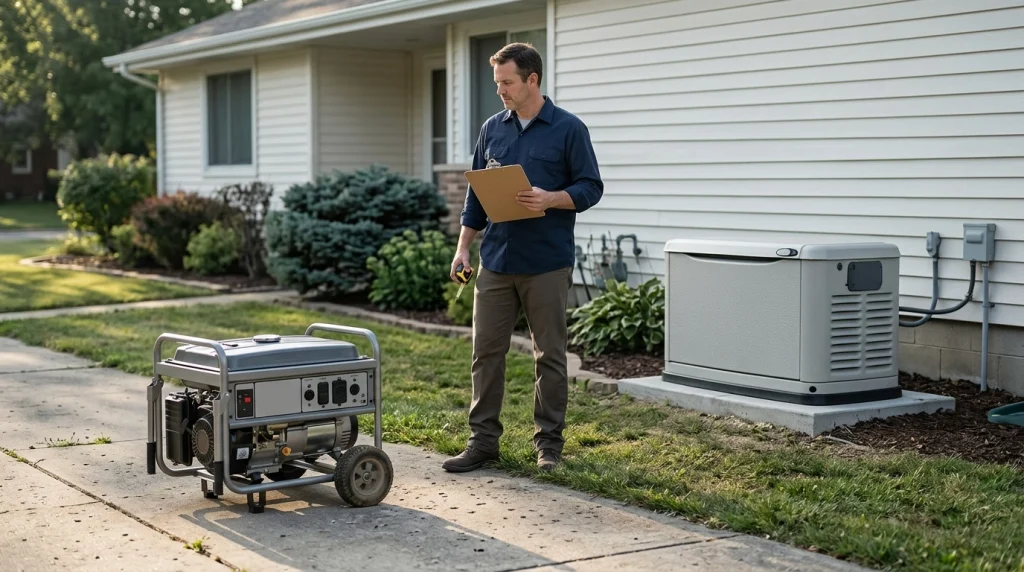
In 2026, a portable generator generally costs $500–$2,500 before electrical installation. A professionally installed automatic standby generator commonly requires a budget of roughly $8,000–$15,000, although straightforward projects can cost less.
The biggest price difference comes from what you expect the generator to power. Refrigeration and lighting require substantially less electricity than central air conditioning and electric heating.
Generator Cost Comparison by Type
The following estimates show practical U.S. budgeting ranges. They are not fixed quotes or guarantees that a particular unit will power every appliance.
| Generator Type | Typical Size | Equipment Cost | Budget Including Setup |
|---|---|---|---|
| Small portable | 3–5 kW | $350–$1,400 | Varies by connection method |
| Larger portable | 5–10 kW | $650–$2,500 | $1,050–$4,000 |
| Smaller standby | 10–14 kW | $3,700–$6,000 | $7,000–$12,000 |
| Larger standby | 18–22 kW | $5,400–$7,500+ | $9,000–$16,000+ |
Price note: These are approximate planning ranges, not guaranteed market prices. Equipment packages vary, and some already include a transfer switch.
I would compare total installed prices rather than advertised generator prices alone. A cheaper machine can become the more expensive option when installation is complicated.
What Size Generator Do You Need for a 1,500 Sq Ft House?
A 1,500-square-foot home may need 5,000–8,500 watts for selected essential loads or around 14–20 kW for broader standby coverage. Electric heating, multiple large appliances, and air-conditioning startup can increase those requirements.
Generator capacity is measured in watts or kilowatts. One kilowatt equals 1,000 watts of electrical output.
For a more detailed calculation, use this home generator sizing guide before choosing a specific model.
Generator Size Based on Your Backup Needs
- 3,000–5,000 watts: Refrigeration, basic lighting, internet equipment, and selected small appliances.
- 5,000–7,500 watts: Common essential circuits, potentially including a furnace blower or sump pump.
- 7,500–10,000 watts: More flexibility for pumps, kitchen appliances, and selected air conditioning.
- 14–18 kW: A starting range for substantial automatic home backup, depending on HVAC requirements.
- 20 kW or more: Worth considering when several major electrical loads require simultaneous operation.
These ranges describe possible applications, not guaranteed coverage. Actual equipment ratings and electrical load calculations determine what works.
Example: Calculating Essential Appliance Wattage
Consider a 1,500-square-foot house with a refrigerator, freezer, sump pump, furnace blower, and basic lighting. A simplified load estimate could look like this.
| Appliance | Example Running Watts |
|---|---|
| Refrigerator | 700 W |
| Freezer | 500 W |
| Furnace blower | 600 W |
| Sump pump | 800 W |
| Lights and electronics | 200 W |
| Total running load | 2,800 W |
If the refrigerator needs 2,200 watts while starting, its additional startup demand is 1,500 watts. That creates an estimated 4,300-watt temporary load when the other appliances are already operating.
Adding approximately 20% planning headroom brings the illustrative target above 5,100 watts. A generator rated for 5,500–6,500 running watts may be suitable after checking its surge rating.
This calculation assumes the appliances do not all start simultaneously. Actual motor characteristics, operating conditions, and manufacturer ratings can change the result.
Is a Portable Generator or Whole-House Generator Better?
A portable generator is usually the more affordable choice for occasional outages. A standby generator offers automatic operation and greater convenience but requires a much larger investment.
Portable Generators: Lower Initial Cost
Portable generators typically run on gasoline, propane, or both. Larger models can power selected household circuits through professionally installed transfer equipment.
They work best when you can manage which appliances operate simultaneously.
- Purchase cost: Usually lower than comparable standby systems.
- Operation: Generally requires manual setup, starting, and refueling.
- Power coverage: Suitable for selected essential appliances and circuits.
- Fuel storage: Requires a safe, practical supply during outages.
- Maintenance: Includes oil changes, inspections, and periodic testing.
I consider a portable unit a sensible starting point when outages are infrequent. It can provide meaningful protection without the expense of permanently installed equipment.
Standby Generators: Automatic Backup
A standby generator connects permanently to the home’s electrical system through approved transfer equipment. Many use natural gas or propane and start automatically after utility power fails.
That convenience is particularly valuable when nobody is home during an outage.
- Automatic starting: No routine manual starting during an outage.
- Higher capacity: Can supply more circuits and larger appliances.
- Fuel connection: Usually requires adequate natural-gas service or propane storage.
- Professional installation: Electrical, gas, and permitting work increases costs.
- Long-term expenses: Periodic servicing and fuel consumption remain necessary.
Current Generac standby generator listings illustrate how prices change with generator size and transfer-switch packages.
How Much Does Generator Installation Cost?
A permanent standby generator installation often adds approximately $3,000–$5,000 or more beyond the generator itself. Complex fuel connections, long wiring runs, and electrical upgrades can increase that amount considerably.
Portable generator connections generally cost less, but any connection to home wiring still needs approved isolation from utility power.
What Installation Expenses Should You Expect?
- Transfer equipment: A manual or automatic switching arrangement that prevents unsafe utility backfeeding.
- Electrical labor: Wiring, breakers, protection, testing, and panel modifications.
- Gas connections: Properly sized piping, regulators, or propane supply arrangements.
- Generator foundation: A suitable concrete or manufacturer-approved mounting base.
- Permits and inspections: Local approval requirements for electrical and fuel installations.
- Site preparation: Groundwork, drainage, access, and compliant equipment placement.
For portable home connections, this transfer switch guide explains the equipment involved. Always use a qualified electrician for a connection to permanent household wiring.
Example: An $11,500 Standby Installation
Suppose a homeowner receives a hypothetical quote totaling $11,500 for an automatic backup system. The breakdown might look like this.
| Expense | Illustrative Cost |
|---|---|
| Generator and switch package | $6,200 |
| Electrical installation | $2,000 |
| Fuel connection | $1,500 |
| Pad and site preparation | $900 |
| Permits, inspection, and miscellaneous | $900 |
| Total estimated project | $11,500 |
This is a budgeting illustration, not an actual contractor quote. The scope must specify exactly which components and services are included.
I would request at least three itemized estimates before committing. Comparing identical installation scopes makes it easier to identify unnecessary charges or missing services.
Can a Generator Run Central Air Conditioning in a 1,500 Sq Ft House?
Yes, a correctly sized generator can run central air conditioning. However, compressor startup demand may require more generator capacity than the air conditioner’s normal running load suggests.
A smaller portable generator may support a window air conditioner but struggle with a central system. Proper sizing must consider startup current and other loads already operating.
Why Air Conditioning Changes Generator Cost
Central air conditioners use electrically driven compressors that can demand substantial power when starting. Larger units often need more generator surge capacity.
A professionally selected soft-start device may reduce compressor startup demand on compatible equipment. It does not eliminate the need for a load calculation.
Before paying for a larger generator, compare the options in this air conditioner sizing guide.
- Window air conditioning: May be compatible with a moderately sized portable generator.
- Central air conditioning: Requires careful compressor-starting and total-load calculations.
- Electric resistance heating: Can sharply increase continuous power demand.
- Heat pumps: May have additional electrical loads when auxiliary heating operates.
A 14–18 kW standby generator can be a reasonable starting point for many gas-heated homes. All-electric homes may need larger systems or automatic load management.
What Affects the Price of a Home Generator?
Generator capacity, fuel type, equipment quality, and installation conditions account for much of the price difference. Two 1,500-square-foot homes can receive substantially different quotes.
1. Generator Capacity
Larger generators generally cost more because they require bigger engines, alternators, and supporting equipment. Buying unnecessary capacity also increases your upfront investment.
2. Fuel Type and Availability
Gasoline and propane are common portable-generator fuels. Permanent standby models typically use propane or natural gas.
Fuel prices vary by location and purchasing method. This generator fuel comparison explains how to evaluate operating costs.
3. Existing Electrical Infrastructure
An older electrical panel may require additional work to accommodate the generator connection. Panel location and cable distance can also increase labor expenses.
4. Installation Location
Standby generators need a manufacturer-approved installation site that meets applicable local requirements. Obstacles, drainage problems, and long gas connections can complicate the project.
5. Backup Coverage
Powering selected essential circuits generally costs less than supplying an entire panel. Automatic load management can sometimes reduce the generator capacity required.
How Much Does It Cost to Run a Generator?
Operating expenses depend on generator load, fuel consumption, runtime, and local energy prices. A larger generator running several heavy appliances can cost substantially more per hour than a lightly loaded portable unit.
The simplest method is to calculate fuel consumption at your expected load, then multiply by local fuel prices.
Example Fuel-Cost Calculation
Suppose a portable generator burns 0.5 gallon of gasoline per hour while powering selected appliances. At a hypothetical gasoline price of $3.50 per gallon, operating cost would be $1.75 per hour.
- 4 hours: Approximately $7 in gasoline.
- 8 hours: Approximately $14 in gasoline.
- 24 hours: Approximately $42 in gasoline.
These figures are examples, not universal consumption rates. Real fuel usage changes with load, generator efficiency, and operating conditions.
For another worked calculation, see the seven-hour operating cost comparison.
How Can You Save Money on a Generator?
The best way to control generator costs is to identify the appliances you actually need during an outage. Avoid buying the largest model before calculating your electrical demand.
Practical Ways to Reduce Costs
- Prioritize essential circuits: Keep refrigeration, heating controls, pumps, and necessary outlets at the top of your list.
- Compare portable and standby options: Match automation and convenience to how often outages occur.
- Consider load management: Avoid running large electric appliances simultaneously when the system supports this approach.
- Check fuel availability: Choose a supply you can maintain during prolonged power outages.
- Request itemized estimates: Compare generator packages, labor, permits, and fuel connections.
- Plan maintenance: Follow the manufacturer’s service schedule to reduce preventable problems.
My preferred approach is to spend money on reliable backup for necessary loads before purchasing extra capacity. A correctly sized system is more useful than an oversized generator with an unsuitable connection.
What Safety Requirements Should You Know?
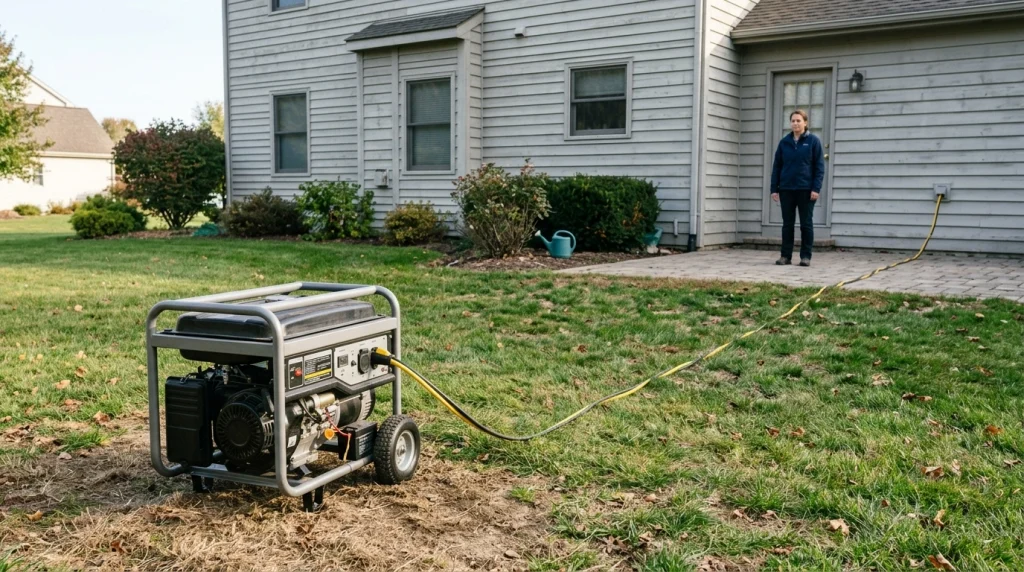
Portable generators produce carbon monoxide and must operate outdoors, away from occupied buildings. A generator must also be electrically isolated from utility power when connected to household wiring.
The Consumer Product Safety Commission warns that generator exhaust can become deadly within minutes.
Essential Generator Safety Rules
- Outdoor placement: Keep portable generators at least 20 feet from the house, with exhaust directed away from doors, windows, and vents.
- Never operate indoors: Garages, basements, sheds, and enclosed porches are unsafe, even with open doors.
- Install CO alarms: Use working carbon monoxide alarms with battery backup according to manufacturer instructions.
- Prevent backfeeding: Never connect a generator through a regular household wall receptacle.
- Protect against moisture: Follow manufacturer requirements for safe operation during wet weather.
- Refuel safely: Turn off the generator and allow it to cool before adding fuel.
The Occupational Safety and Health Administration also provides guidance on generator electrical hazards and safe connections. Have qualified professionals install and inspect permanently connected systems.
Which Generators Are Worth Considering for a 1,500 Sq Ft House?
I would shortlist generators according to backup goals rather than choose a single model for every homeowner. The following options represent different priorities, from portable value to automatic standby convenience.
The ratings below reflect an editorial assessment of feature suitability, not laboratory testing or customer review averages. Always verify current specifications, availability, and installation compatibility.
🏆 Best for High-Output Portable Backup
Westinghouse WGen9500DFc Dual Fuel
★★★★½ Editorial fit: 4.5/5
Offers 9,500 running watts on gasoline and 8,500 on propane, plus electric starting and a CO sensor. I favor its combination of high output and fuel flexibility for homeowners prioritizing essential circuits.
Manufacturer MSRP: approximately $1,399; retailer prices may vary.
🔇 Best for Quieter Portable Operation
Champion 201177 Dual Fuel Inverter
★★★★☆ Editorial fit: 4/5
Produces 7,000 running watts on gasoline and 6,300 on propane, with an enclosed inverter design and CO Shield protection. I would consider it when lower noise and cleaner inverter output matter more than maximum wattage.
Manufacturer-rated noise: 61 dBA at 23 feet under specified test conditions.
🏠 Best for Automatic Home Backup
Generac Guardian 18kW Model 7228
★★★★½ Editorial fit: 4.5/5
Provides up to 18 kW on propane or 17 kW on natural gas and includes a whole-house transfer-switch package. I would shortlist it for homeowners who want automatic operation and broader coverage after professional sizing.
Manufacturer starting MSRP: approximately $6,229 before installation.
Affiliate disclosure: As an Amazon Associate, this website may earn from qualifying purchases. Product availability, specifications, and prices can change.
Frequently Asked Questions
How much does a whole-house generator cost for a 1,500-square-foot home?
A whole-house standby generator for a 1,500-square-foot home commonly costs around $8,000–$15,000 installed. A straightforward installation may cost less, while electrical panel upgrades, long gas connections, and larger generator capacity can push the total above $15,000.
Will a 7,500-watt generator run a 1,500 sq ft house?
A 7,500-watt generator can often power selected essential appliances in a 1,500-square-foot house. Refrigeration, lighting, furnace blowers, and certain pumps may be possible, depending on simultaneous demand and starting watts. It generally cannot support every major electric appliance at once.
Is a 14kW generator enough for a 1,500 sq ft house?
A 14 kW generator may provide substantial backup for a 1,500-square-foot house, especially when heating and water heating use gas. However, central air-conditioning startup, electric resistance heating, and other heavy loads must be evaluated before confirming that 14 kW is sufficient.
Can I install a home generator myself to save money?
You can perform certain non-electrical preparation tasks where local rules allow them. However, transfer equipment, permanent wiring, and fuel connections require appropriate expertise and often permits. A qualified installer should handle these systems to prevent electrical hazards, fuel leaks, and code violations.
Is buying a whole-house generator worth the money?
A standby generator can justify its higher cost when outages are frequent, prolonged, or disruptive to essential household systems. Homeowners experiencing rare, short outages may find a portable generator more economical. Compare expected outage needs with purchase, installation, fuel, and maintenance expenses.
Final Takeaway: What Should You Budget?
For a 1,500-square-foot house, I would start with a $1,000–$2,500 portable-generator equipment budget when essential backup is the goal. A professionally connected setup adds electrical costs.
For automatic standby coverage, a budget around $8,000–$15,000 is a more practical starting point. Larger electrical demands or complicated installations may require significantly more.
Before purchasing, calculate your appliances’ running and starting watts, choose the coverage you need, and obtain itemized installation quotes. That approach gives you a reliable basis for selecting the right generator without overspending.

Hi, I’m Michael Turner. I own a generator workshop in the United States and founded HomeGeneratorBlog to share practical, hands-on guidance about generator installation, maintenance, troubleshooting, safety, and backup power solutions. My goal is to help homeowners make smarter, more confident decisions through clear and reliable information