What Is the Cheapest Fuel to Run a Generator?
Quick Answer
For most homes already connected to a utility gas line, natural gas is usually the cheapest fuel to run a generator. For portable generators, propane and gasoline are much closer, and the winner depends on local prices, generator efficiency, and load. You can compare fuels fairly by converting their prices to a common energy unit using the U.S. Energy Information Administration’s energy conversion data.
Cheapest generator fuel by situation
- Natural gas: Usually the lowest fuel cost when your home already has a properly sized utility gas connection.
- Propane: Can compete with gasoline on fuel cost while offering much easier long-term storage.
- Gasoline: Easy to buy and provides strong generator output, but current prices can make it expensive for long outages.
- Diesel: Efficient under steady heavy loads, although the fuel and generator usually cost more upfront.
- Best flexibility: A tri-fuel generator lets you choose whichever usable fuel is cheapest or easiest to obtain.
Before choosing
- Compare your local price and the generator’s fuel consumption at the load you actually expect to run.
Generator fuel costs look simple until you start comparing gallons, cubic feet, runtime, and actual electrical output. I prefer to reduce everything to the cost of usable energy before deciding which fuel is cheapest.
That approach matters even more in 2026 because fuel prices don’t always follow the old rule that gasoline automatically costs less than propane. Here’s how the numbers compare and when each fuel makes sense.
Which Generator Fuel Is Cheapest in 2026?
Natural gas generally wins when you already have a utility connection. Propane and gasoline come next in a much tighter race, while diesel’s efficiency can partially offset its higher retail price.
The table below uses recent U.S. national price data as a comparison snapshot. Your local cost may differ significantly.
| Fuel | Price used | Approx. energy content | Approx. fuel cost per MMBtu | Cost position |
|---|---|---|---|---|
| Natural gas | $24.09 per 1,000 cu. ft. | About 1.033 MMBtu per 1,000 cu. ft. | About $23.32 | Lowest in this snapshot |
| Propane | $2.674 per gallon | About 91,452 Btu per gallon | About $29.24 | Second |
| Gasoline | $4.071 per gallon | About 120,000 Btu per gallon | About $33.90 | Third |
| Diesel | $5.599 per gallon | About 137,381 Btu per gallon | About $40.75 | Highest raw fuel cost |
Important: this isn’t the same as generator cost per kilowatt-hour. Engine efficiency and load determine how much of that fuel energy becomes useful electricity.
The price dates aren’t identical either. EIA’s latest gasoline and diesel figures used here are from August 31, 2026, while its seasonal residential propane series last reported March 30, 2026.
Why Is Natural Gas Often the Cheapest Fuel for a Generator?

Natural gas combines a relatively low cost per unit of energy with continuous delivery through a utility line. That eliminates gas cans, propane-cylinder exchanges, and repeated fuel runs during a long outage.
The economics work best when the house already has natural gas. Installing a new service line only for a generator can erase years of fuel savings.
Definition: Generator fuel cost is the money spent on fuel to produce electricity. A fair comparison accounts for fuel price, energy content, generator efficiency, and the electrical load being supplied.
Natural gas does have an output penalty on many portable generators. A tri-fuel machine usually produces fewer running watts on natural gas than it does on gasoline.
For example, the Champion 201445 is rated for 4,000 running watts on gasoline, 3,600 on propane, and 3,240 on natural gas. That lower output needs to be included when sizing the generator.
- Main advantage: Low-cost continuous fuel when utility service remains available.
- Main disadvantage: Lower generator output than gasoline on many tri-fuel engines.
- Best fit: Long outages at homes that already have natural gas.
- Installation issue: The gas meter, regulator, piping, and connection must provide enough flow.
If natural gas interests you, my tri-fuel portable generator guide explains how gasoline, propane, and natural gas operation differ on the same machine.
Is Propane Cheaper Than Gasoline for a Generator?
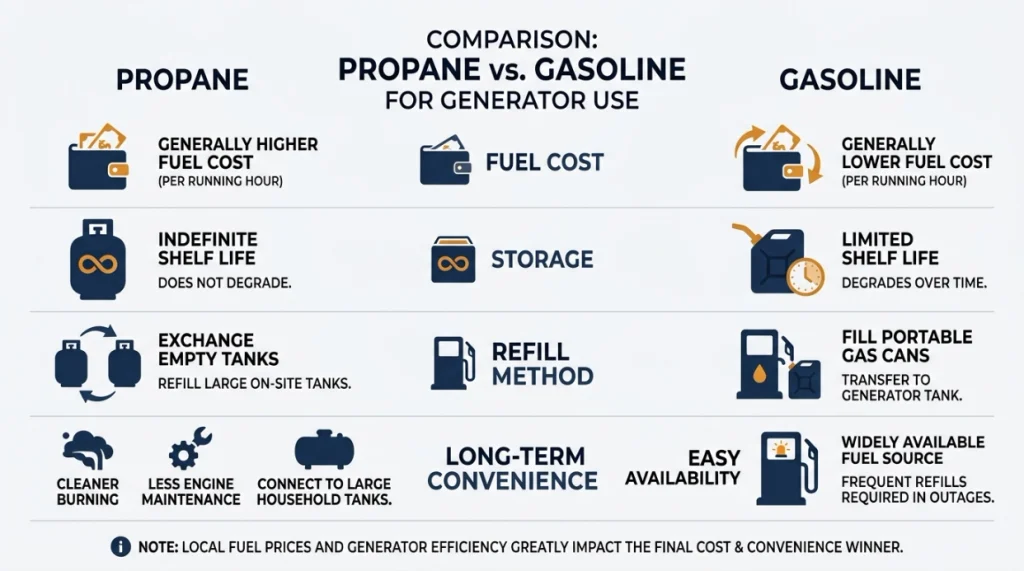
Propane can be cheaper than gasoline, but it isn’t guaranteed. The answer depends heavily on whether you’re buying bulk-delivered propane, filling cylinders, or paying the higher price of tank exchange.
The 2026 national price snapshot above gives propane a lower raw-energy cost than regular gasoline. Generator efficiency and your actual refill price can reverse that result.
A Real Generator Shows Why Local Price Matters
The Champion 201445 provides a useful comparison because the same engine operates on both fuels. Champion rates it for 14 hours at 50% load from its 5-gallon gasoline tank and 10.5 hours at 50% load from a 20-pound propane cylinder.
| Specification | Gasoline | Propane | Natural gas |
|---|---|---|---|
| Running watts | 4,000 W | 3,600 W | 3,240 W |
| Published runtime | 14 hours at 50% load | 10.5 hours at 50% load | Continuous supply possible |
| Fuel source | 5-gallon onboard tank | 20-pound cylinder | Properly sized gas line |
Here’s the calculation I use at home before an outage: divide the cost of a full tank or cylinder by its expected runtime. Then compare that hourly number at roughly the same electrical load.
- Gasoline example: A $20 fill lasting 10 hours costs about $2 per operating hour.
- Propane example: A $24 cylinder refill lasting 10 hours costs about $2.40 per hour.
- Better comparison: Also check the watts available on each fuel because propane usually reduces maximum output.
Propane has another advantage that doesn’t appear on a fuel receipt. It avoids the stale-gas and carburetor problems associated with storing gasoline for long periods.
My propane portable generator guide covers tank sizing, runtime, and the output tradeoffs in more detail.
Is Diesel the Most Fuel-Efficient Generator Fuel?
Diesel engines are often efficient under sustained loads, but efficiency doesn’t automatically make diesel the cheapest choice. Fuel price, generator purchase price, maintenance, and your operating pattern all matter.
Diesel also contains more energy per gallon than gasoline or propane. The EIA’s fuel conversion data lists about 137,381 Btu per gallon for diesel.
- Best strength: Long, steady operation at meaningful load.
- Fuel advantage: High energy content per gallon.
- Cost disadvantage: Diesel generators usually cost more to purchase.
- 2026 price issue: National on-highway diesel prices are currently well above regular gasoline.
- Best users: Farms, jobsites, commercial operations, and heavy backup applications.
I wouldn’t buy a diesel generator solely because someone calls diesel the cheapest fuel. I would choose it when its durability, runtime, and heavy-load efficiency fit the job.
For a deeper comparison, see my diesel portable generator guide.
How Do You Calculate Generator Fuel Cost Per Hour?

The fastest method is to divide fuel cost by runtime at the load you plan to use. Manufacturer runtime specifications make this calculation fairly easy for gasoline and propane generators.
Use the following steps rather than comparing only the price printed at the gas station.
- Find the generator’s runtime: Look for runtime at 25% or 50% load in the manufacturer specifications.
- Calculate fuel cost: Work out what a complete tank or cylinder costs you locally.
- Divide cost by hours: A $30 fuel supply lasting 12 hours costs $2.50 per operating hour.
- Check electrical output: Compare fuels at similar actual loads rather than maximum nameplate wattage.
- Add practical costs: Include tank exchange fees, delivery charges, storage, and extra fuel trips when they matter.
Load is one of the biggest variables. A lightly loaded generator normally consumes less fuel per hour than the same machine near maximum output.
Oversizing can therefore waste money. If your emergency load is 2,000 watts, running a huge conventional generator just to power those loads may not be the economical choice.
My Simple Fuel-Cost Formula
Cost per operating hour = cost of usable fuel ÷ runtime on that fuel. For a more accurate comparison, divide again by the average kilowatts supplied to estimate fuel cost per kilowatt-hour.
I also compare fuel flexibility before chasing a few cents per hour. The cheapest fuel on a normal Tuesday may be unavailable after a hurricane, ice storm, or regional blackout.
Which Fuel Is Best for a Long Power Outage?
Natural gas is usually the easiest long-duration fuel when utility service stays intact. Propane comes next because large tanks can store fuel without the degradation problems associated with gasoline.
Gasoline remains useful because filling stations are widespread. The problem is that stations may lose power, run out of fuel, or develop long lines during the same emergency affecting your home.
| Situation | Fuel I’d favor | Why |
|---|---|---|
| Home already has utility gas | Natural gas | Low fuel cost and no manual refilling |
| Fuel stored for emergencies | Propane | Excellent storage characteristics |
| Short outage or jobsite use | Gasoline | Easy availability and strong output |
| Heavy sustained commercial load | Diesel | Efficiency and durability under steady load |
| Uncertain fuel availability | Tri-fuel | Lets you choose among three fuel sources |
Does the Cheapest Fuel Always Save the Most Money?
No. Fuel price is only one part of generator ownership.
A fuel that’s slightly cheaper per hour can become the expensive option if it requires a major plumbing installation, oversized storage tank, or a much more expensive generator.
- Generator purchase price: Gasoline-only units are often cheaper upfront.
- Fuel storage: Gasoline requires careful storage and rotation.
- Maintenance: Old gasoline can create fuel-system problems after storage.
- Available wattage: Propane and natural gas may reduce rated output.
- Refueling effort: Utility natural gas eliminates manual refilling.
- Outage availability: A cheap fuel has little value if you can’t obtain it.
A portable generator fuel system also behaves differently depending on whether it handles gasoline, propane, or natural gas. Understanding that system helps explain the storage and maintenance costs that don’t appear in a simple price-per-gallon comparison.
What Generator Would I Choose for Lower Fuel Costs?
If you’re buying a new generator rather than trying to optimize an existing one, I favor fuel flexibility. Being able to switch fuels is often worth more during an outage than optimizing for one theoretical lowest price.
🏆 Best Fuel Flexibility
Champion 201445 4000-Watt Tri-Fuel Generator
★★★★½ My fit rating
It provides 4,000 running watts on gasoline, 3,600 on propane, and 3,240 on natural gas. I like this format for homeowners who want to buy whichever fuel makes the most sense during an outage.
🏠 Best for Larger Home Loads
Westinghouse WGen11500TFc
★★★★½ My fit rating
This larger tri-fuel model provides up to 11,500 running watts on gasoline, 10,500 on propane, and 9,500 on natural gas. I’d consider it when major household loads matter more than portability.
💡 Best for Small Essential Loads
Champion 2500-Watt Dual-Fuel Inverter
★★★★½ My fit rating
This compact inverter runs on gasoline or propane and targets lighter loads. I prefer a smaller inverter when the goal is keeping a refrigerator, electronics, lights, and chargers running efficiently.
Don’t Let Fuel Savings Create a Safety Problem
Every combustion generator produces dangerous exhaust, whether it burns gasoline, propane, diesel, or natural gas. Fuel choice doesn’t make indoor generator operation safe.
The CDC recommends operating portable generators outdoors more than 20 feet from windows, doors, and vents. It also recommends battery-powered or battery-backup carbon monoxide detectors inside the home.
- Operate outside: Never run a portable generator in a house, garage, basement, shed, or other enclosed space.
- Control exhaust: Keep the exhaust directed away from occupied buildings.
- Refuel safely: Shut down gasoline generators and allow hot components to cool before refueling.
- Check connections: Inspect propane hoses, regulators, and natural-gas connections before use.
- Use CO alarms: Keep working carbon monoxide alarms inside your home.
I’ve put the storage and refueling side into a separate portable generator fuel safety guide because saving money isn’t worth taking shortcuts around fuel or exhaust.
Frequently Asked Questions
What is the cheapest fuel to run a generator?
Natural gas is usually the cheapest generator fuel when your home already has utility gas service and the generator is designed for it. Propane and gasoline costs are closer and depend heavily on local prices, generator efficiency, and operating load.
Is it cheaper to run a generator on propane or gasoline?
Either fuel can be cheaper. Recent national fuel-price data makes propane competitive with gasoline, but cylinder-exchange propane can cost far more than bulk propane, so compare your actual refill cost with local gasoline prices and the generator’s published runtime.
Is natural gas cheaper than propane for a generator?
Natural gas is commonly cheaper when purchased through an existing residential utility connection. It also eliminates tank refilling, although many generators produce less maximum wattage on natural gas than they do on propane or gasoline.
Is diesel cheaper to run than a gasoline generator?
Diesel generators can consume fuel efficiently under sustained loads, but diesel isn’t automatically cheaper per operating hour. The answer depends on fuel prices, load, engine efficiency, and generator size, while diesel equipment usually costs more upfront.
What is the most economical generator for home backup?
For many homes, a properly sized dual-fuel or tri-fuel generator offers the best balance. You can run the cheapest available fuel while avoiding the cost of operating a generator that’s much larger than your essential electrical load.
Final Takeaway: Which Fuel Saves the Most Money?
If your home already has natural gas, that’s the first fuel I’d price for long-duration backup power. Its combination of fuel cost and continuous supply makes it difficult for gasoline or bottled propane to beat.
For portable generators without a gas connection, don’t assume gasoline automatically wins. Compare your local propane refill price, gasoline price, generator runtime, and available wattage before deciding.
Diesel makes the most sense where long runtimes and heavy sustained loads justify the higher equipment cost. For most homeowners, fuel flexibility is more useful than chasing one permanent winner.
My practical choice is simple: size the generator correctly, calculate cost per hour using local prices, and keep at least two usable fuel options when possible. That gives you cheaper power when prices cooperate and backup flexibility when they don’t.

Hi, I’m Michael Turner. I own a generator workshop in the United States and founded HomeGeneratorBlog to share practical, hands-on guidance about generator installation, maintenance, troubleshooting, safety, and backup power solutions. My goal is to help homeowners make smarter, more confident decisions through clear and reliable information