What Is the Quietest Whole House Generator? Top Quiet Models Compared
Quick Answer
Among mainstream residential standby generators with published operating-noise figures I could verify for 2026, the Champion 14 kW aXis is one of the quietest choices at about 62 dB(A) measured from 23 feet. That makes it quieter on paper than many Generac, Cummins, Briggs & Stratton, and Kohler models in comparable home-backup categories. Noise matters, but capacity matters more, so choose the right generator size for your house before buying solely on decibels.
What I would compare first
- Quietest operating pick: Champion 14 kW aXis publishes an approximate 62 dB(A) operational rating at 23 feet.
- More capacity: Larger 18–26 kW generators may suit heavier homes better, even when they produce a few more decibels.
- Exercise noise: Exercise-mode ratings can be much lower than the sound produced during a real outage.
- Installation location: Walls, corners, fences, and hard surfaces can change the noise you hear.
- Fuel and load: Engine load and operating conditions can affect real-world sound.
My buying rule
- Compare normal operating sound at the same distance whenever possible, not just the lowest exercise-mode figure.
If a standby generator will sit near a bedroom, patio, or neighboring property, noise can become almost as important as wattage. A few decibels on the specification sheet can make a noticeable difference during a long overnight outage.
I also wouldn’t crown a generator based on its quiet-test mode alone. What matters most is how it sounds while producing the power your home needs.
Definition: A whole-house standby generator is a permanently installed backup generator that automatically supplies electricity after utility power fails. Most residential models run on natural gas or liquid propane and connect through an automatic transfer switch.
What Is the Quietest Whole House Generator in 2026?
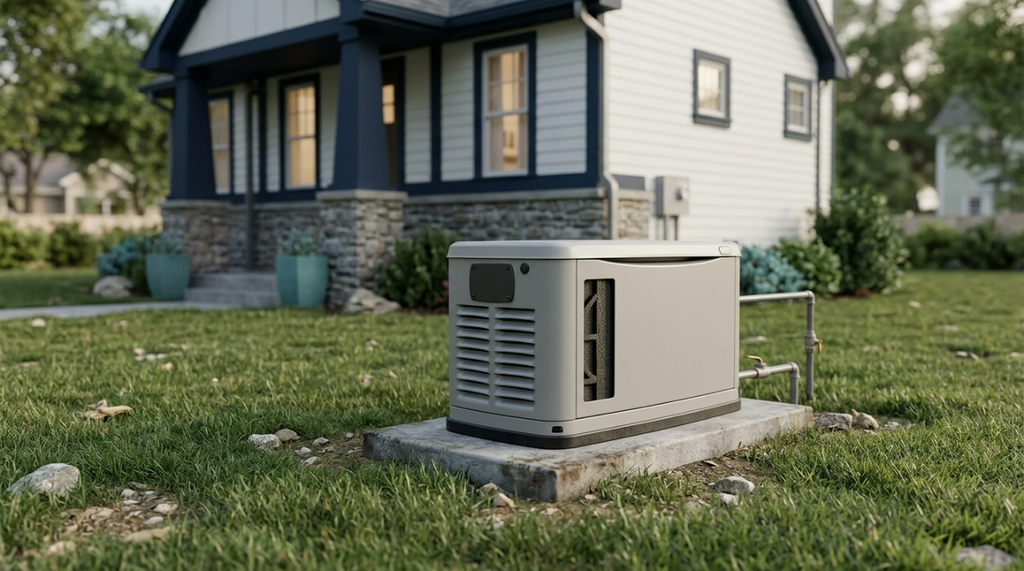
The Champion 14 kW aXis Home Standby Generator is one of the quietest full-size residential standby systems I found with a clearly published operating rating. Champion lists its operational volume at approximately 62 dB(A) measured at 23 feet.
Champion says the system uses sound dampening and a low-tone muffler to reduce noise. You can review the manufacturer’s Champion 14 kW standby generator specifications before choosing a model.
- Operational sound: Approximately 62 dB(A) at 23 feet.
- Propane output: 14,000 watts.
- Natural-gas output: 12,500 watts.
- Cooling: Air-cooled.
- Transfer-switch options: Whole-house configurations are available.
The capacity is the important limitation. A 14 kW generator can provide excellent whole-home backup in some houses, but a large all-electric home may need considerably more power.
How Loud Is a Whole House Generator in Decibels?
A modern residential standby generator commonly lands somewhere in the low-to-upper 60 dB(A) range, depending on the model and how the manufacturer measures it. That’s why the difference between a 62 dB model and a 67 dB model deserves attention.
The decibel scale is logarithmic rather than linear. A five-decibel difference is more meaningful than the small numbers make it appear.
- About 55–56 dB(A): Possible during low-speed exercise cycles on some models.
- About 62 dB(A): An unusually quiet published operating figure for a residential standby unit.
- About 65 dB(A): Common among several quiet standby designs.
- About 67 dB(A): Still normal territory for larger residential standby systems.
- Distance matters: A rating measured at 23 feet cannot be compared fairly with one measured much closer.
My rule is simple: compare generators using normal operating noise at the same distance. Otherwise, you’re comparing different tests instead of different generators.
Which Quiet Whole House Generators Compare Best?
Champion isn’t your only quiet option. Generac, Cummins, Briggs & Stratton, and Kohler all make sound-attenuated residential standby systems.
The table below compares published manufacturer figures that are useful for narrowing your shortlist. Final specifications can vary by exact model and configuration.
| Generator | Capacity | Published Sound | Best Fit |
|---|---|---|---|
| Champion aXis | 14 kW LP / 12.5 kW NG | Approx. 62 dB(A) operational | Noise-sensitive homes with moderate loads |
| Generac Guardian | 14–18 kW examples | About 65 dB(A) on current 14/18 kW specifications | Broad dealer support and flexible home backup |
| Cummins QuietConnect | Residential range includes 13–25 kW models | 65 dB or lower for the series | Quiet operation with multiple capacity choices |
| Briggs & Stratton PowerProtect | 26 kW LP / 24 kW NG | 65 dB(A) normal operation | Larger homes needing more output |
| Kohler 26RCA | 26 kW class | 67 dB(A) full-speed / 56 dB(A) exercise | High-capacity backup with quiet exercise cycles |
Generac says its home standby generators average roughly 65–67 decibels depending on model. Its standby generator FAQ is useful when comparing normal residential sound levels.
Cummins markets its QuietConnect home standby series at 65 dB or lower. That puts it close to the quiet end of the residential standby market.
- Need maximum quiet: Start with Champion’s 14 kW aXis if its capacity covers your calculated load.
- Need around 18–20 kW: Generac and Cummins give you more capacity while remaining relatively quiet.
- Need around 24–26 kW: Briggs & Stratton or Kohler may make more sense despite slightly higher sound.
Why Do Generator Noise Ratings Differ?
Generator noise depends on much more than the muffler. Engine speed, cooling airflow, enclosure design, electrical load, and measurement distance all affect the published number.
This is also why comparing exercise mode against full operation can mislead you. A generator running a low-speed self-test isn’t doing the same work as a generator powering air conditioning during an outage.
- Engine load: Heavier electrical demand can change engine sound.
- Enclosure design: Sound-insulated cabinets help contain mechanical and exhaust noise.
- Cooling airflow: Air-cooled generators need substantial ventilation, which limits how tightly manufacturers can seal them.
- Measurement distance: Sound drops as you move farther from the generator.
- Nearby surfaces: Masonry walls and narrow side yards may reflect sound back toward the house.
The Briggs & Stratton 26 kW PowerProtect, for example, lists a normal operating sound rating around 65 dB(A). That’s impressive considering its much higher output.
Kohler takes a different approach with its 26RCA. Its manufacturer specifications list 67 dB(A) at full-speed operation but only 56 dB(A) during weekly exercise; see the Kohler 26RCA specifications for that distinction.
How Much Generator Capacity Do You Need?
The quietest generator is the wrong generator if it can’t start your air conditioner, well pump, or other major loads. I would settle the capacity question before comparing two or three decibels of sound.
A 14 kW standby generator may cover many gas-equipped homes, while electric-heavy properties can require 20 kW or more. Square footage helps only as a rough starting point.
- Gas-heavy homes: Gas furnaces, water heaters, and ranges leave more generator capacity for electrical loads.
- Central air: Compressor startup can create a substantial short-duration load.
- Electric water heating: Heating elements can consume several kilowatts continuously.
- Well pumps: Motor startup demand needs to be included.
- EV charging: Consider whether charging will be disabled or managed during an outage.
If your house is around 2,500 square feet, my 2,500-square-foot generator sizing guide shows why homes of the same size can require very different generator capacities.
If you’re considering the next size class, see what a 20 kW generator can realistically run before paying for capacity you don’t need.
How should you calculate generator load?
Add the running loads you expect to use together, then account for the largest motor-starting requirement. HVAC equipment and other large appliances deserve special attention.
For a deeper calculation, use this generator power-capacity guide before discussing the final size with your installer.
- Step 1: List the circuits and appliances you want available during an outage.
- Step 2: Record their continuous electrical loads.
- Step 3: Identify motor and compressor starting requirements.
- Step 4: Decide whether large loads can be automatically managed.
- Step 5: Have the final installation and load calculation checked professionally.
How Can You Make a Whole House Generator Quieter?
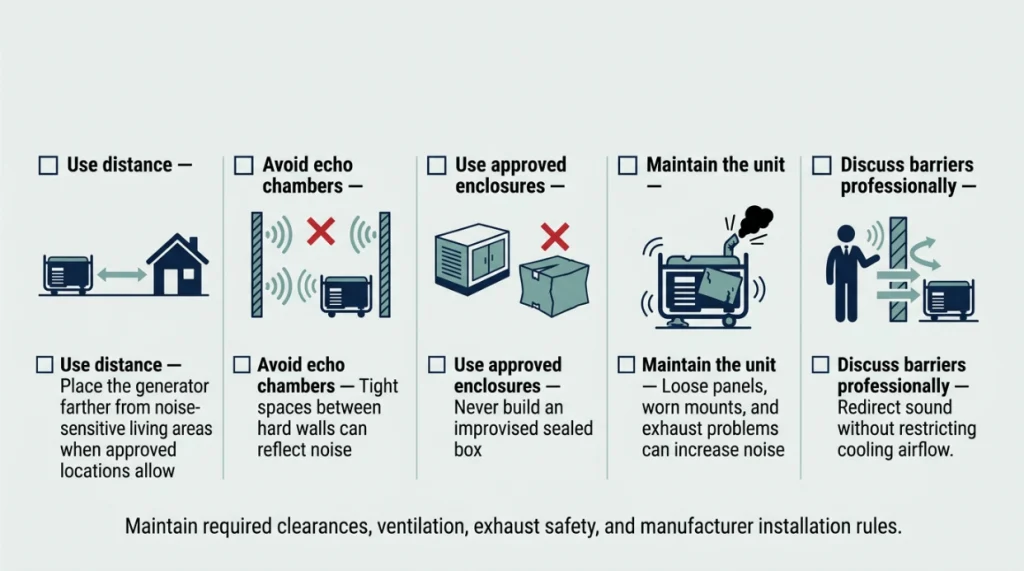
Choosing a quiet generator helps, but installation has a major effect on what reaches your bedroom or property line. Good placement can be more useful than chasing a tiny difference between two similar specifications.
Never compromise required clearances, ventilation, exhaust safety, or manufacturer installation rules just to reduce noise. Safety and code compliance come first.
- Use distance: Place the generator farther from noise-sensitive living areas when approved installation locations allow it.
- Avoid echo chambers: Tight spaces between hard walls can reflect noise.
- Use approved enclosures: Never build an improvised sealed box around a standby generator.
- Maintain the unit: Loose panels, worn mounts, and exhaust problems can make a generator sound worse.
- Discuss barriers professionally: A properly planned acoustic barrier may redirect sound without restricting cooling airflow.
I pay particular attention to bedroom windows and neighboring patios when thinking through placement. A generator that’s acceptable during an afternoon test can feel much louder at 2 a.m.
Is the Quietest Generator Always the Best Choice?
No. The best whole-house generator balances noise, capacity, reliability, service support, fuel availability, installation requirements, and cost.
I would gladly accept 65 dB(A) instead of 62 dB(A) if the quieter generator were badly undersized. Capacity and dependable starting come first.
| Priority | What to Look For |
|---|---|
| Quietest operation | Low published operating dB(A) at a stated measurement distance |
| Whole-home comfort | Enough capacity for HVAC and major appliances |
| Easy ownership | Strong local dealer and service availability |
| Long outages | Correct fuel supply and consumption planning |
Quiet Whole House Generators I Would Shortlist
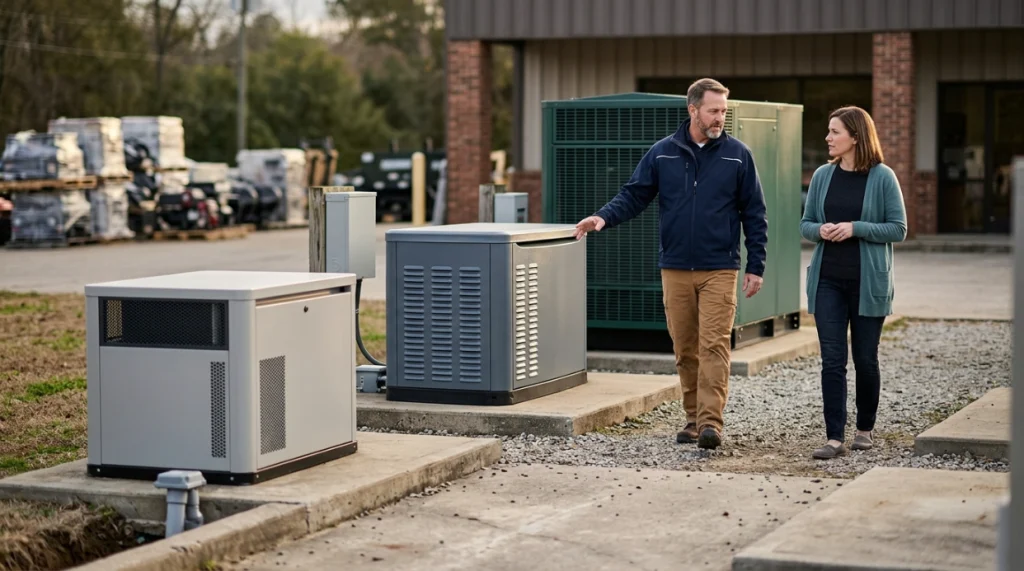
If you’re ready to narrow the field, these are the three models or product families I would compare first. Your final choice should still be sized around your home’s electrical load.
🏆 Best for Quiet Operation
Champion 14 kW aXis Home Standby Generator
★★★★★ 4.8/5
Champion publishes an approximate 62 dB(A) operational rating at 23 feet, with 14 kW output on propane and 12.5 kW on natural gas. This is my first model to compare when neighborhood noise is a major concern and 14 kW is enough capacity.
🏠 Best All-Rounder
Generac Guardian 18 kW Standby Generator
★★★★★ 4.7/5
The current 18 kW Guardian class provides up to 18 kW on propane and 17 kW on natural gas, while Generac’s current residential range stays around the mid-60 dB(A) territory. I like this category when a homeowner needs more headroom than a 14 kW system.
🔇 Best Quiet Higher-Capacity Option
Cummins QuietConnect RS20A
★★★★☆ 4.6/5
The RS20A belongs to Cummins’ sound-attenuated QuietConnect residential family, which Cummins describes as operating at 65 dB or lower. I would put it on the shortlist when you want around 20 kW of standby capacity without moving into an especially loud setup.
Frequently Asked Questions
What is the quietest whole house generator?
Among mainstream residential standby generators with current published operating-noise figures I compared, the Champion 14 kW aXis stands out at approximately 62 dB(A) from 23 feet. However, it is only the best choice if its 14 kW propane or 12.5 kW natural-gas capacity fits your home’s electrical load.
How many decibels is a quiet standby generator?
A residential standby generator around 62–65 dB(A) is quiet relative to many full-size backup generators. Always check the measurement distance and whether the rating represents normal operation, full-speed operation, or a reduced-speed exercise cycle.
Is Generac quieter than Kohler?
It depends on the exact models and operating modes. Generac says its residential standby models average around 65–67 dB, while the Kohler 26RCA lists 67 dB(A) during full-speed operation and 56 dB(A) during its reduced-noise exercise cycle.
Can I put a soundproof box around my standby generator?
Don’t place a standby generator inside an improvised sealed enclosure. Generators require manufacturer-specified ventilation, cooling airflow, exhaust clearance, and installation distances, so any noise-control structure should be designed without interfering with those requirements.
Is 62 dB loud for a whole-house generator?
For a full-size engine-driven standby generator, about 62 dB(A) at 23 feet is relatively quiet. Real perceived noise still depends on distance, load, surrounding walls, landscaping, property layout, and where the generator sits in relation to bedrooms and neighbors.
Final Takeaway
If quiet operation is your top priority, the Champion 14 kW aXis is my first model to investigate because of its published approximate 62 dB(A) operational rating. It gives noise-sensitive homeowners a strong starting point without dropping into portable-generator territory.
Don’t let one decibel specification decide the purchase, though. Size the generator for your actual loads, compare normal operating noise at equal distances, and have the installation planned around both safety and your home’s quietest living areas.

Hi, I’m Michael Turner. I own a generator workshop in the United States and founded HomeGeneratorBlog to share practical, hands-on guidance about generator installation, maintenance, troubleshooting, safety, and backup power solutions. My goal is to help homeowners make smarter, more confident decisions through clear and reliable information