10 Best Portable Generators for Outdoor Use in 2026: Ranked by Power, Noise and Runtime
The best portable generators for outdoor use are the Honda EU2200i, Westinghouse iGen4500, and Honda EU3000iS, each strongest in a different area. We evaluated 10 portable generators by comparing published specifications and owner reviews, scoring each on portability, noise level, and power output. Most portable generators look identical on paper but differ in noise, weight, and usable watts — that gap drove our ranking. Whether you need camping power, tailgating quiet, or backup for outages, this guide gives you one clear answer.
Quick Comparison: All 10 Products Ranked
| # | Product | Best For | Rating | Badge | |
|---|---|---|---|---|---|
| 1 | Honda EU2200i | Quiet camping and tailgating | 4.6/5 | Best Overall | Buy → |
| 2 | Westinghouse iGen4500 | Larger camper and outage loads | 4.5/5 | Best Remote Start | Buy → |
| 3 | Honda EU3000iS | Reliable mid-size inverter power | 4.4/5 | Best Premium Pick | Buy → |
| 4 | Champion 3400-Watt Dual Fuel Inverter | Fuel flexibility with electric start | 4.3/5 | Best Dual Fuel | Buy → |
| 5 | WEN 56203i | Budget camping and tailgating | 4.2/5 | Best Budget | Buy → |
| 6 | EcoFlow DELTA 2 | Silent, fume-free battery power | 4.1/5 | Best No-Fumes Option | Buy → |
| 7 | Generac GP5500 | Job sites and appliance backup | 4.0/5 | Best Value for Power | Buy → |
| 8 | Westinghouse WGen7500 | High-capacity backup loads | 3.9/5 | Best Large Fuel Tank | Buy → |
| 9 | DuroMax XP13000EH | Workshops and large outage loads | 3.8/5 | Best for Heavy Loads | Buy → |
| 10 | DuroStar DS4000S | Basic backup and job sites | 3.6/5 | Best Basic Generator | Buy → |
How We Chose These Portable Generators
What we reviewed
We compared published manufacturer specifications and owner feedback for 10 models across inverter, open-frame, dual fuel, and battery designs.
Our 3 scoring criteria
Each model is scored from 1 to 5 on portability (weight and carry), noise level (rated dBA), and power output (running and starting watts).
Safety guidance used
Placement and carbon monoxide advice follows widely published guidance from the U.S. Consumer Product Safety Commission and manufacturer manuals.
What we left out
We excluded permanently installed standby units and very small power banks, because they serve different needs than portable outdoor generators.
What to Look for When Buying a Portable Generator for Outdoor Use
The right generator is the one that matches your loads, your noise limits, and how far you will carry it. Start with these four factors before comparing brands.
1. Running Watts, Not Just Starting Watts
Add up the running watts of everything you plan to power, then add headroom for the largest motor load. Starting watts only cover brief surges, so judging a unit by its peak number overstates what it can sustain. This is the core idea behind running watts versus starting watts, and it is the first thing to check on any spec sheet.
2. Noise Level and Inverter Design
Inverter models run at variable engine speed, which lowers noise and produces cleaner power for phones and laptops. Open-frame units are louder but deliver more watts per unit of weight. If you want to understand the trade-offs, read about how generators differ from inverters before choosing.
3. Fuel Type and Runtime
Gasoline is easy to find, propane stores longer, and battery stations need no fuel at all. Check the tank size and the runtime at quarter and half load, since heavier loads drain the tank much faster than the headline figure suggests. Dual fuel models add flexibility when supplies are limited.
4. Weight and Portability
Weight decides whether you will actually use the unit. Anything under roughly 60 pounds is a one-person carry, while larger models need wheels and a ramp. Think about the trunk, the campsite path, and the storage space before you buy.
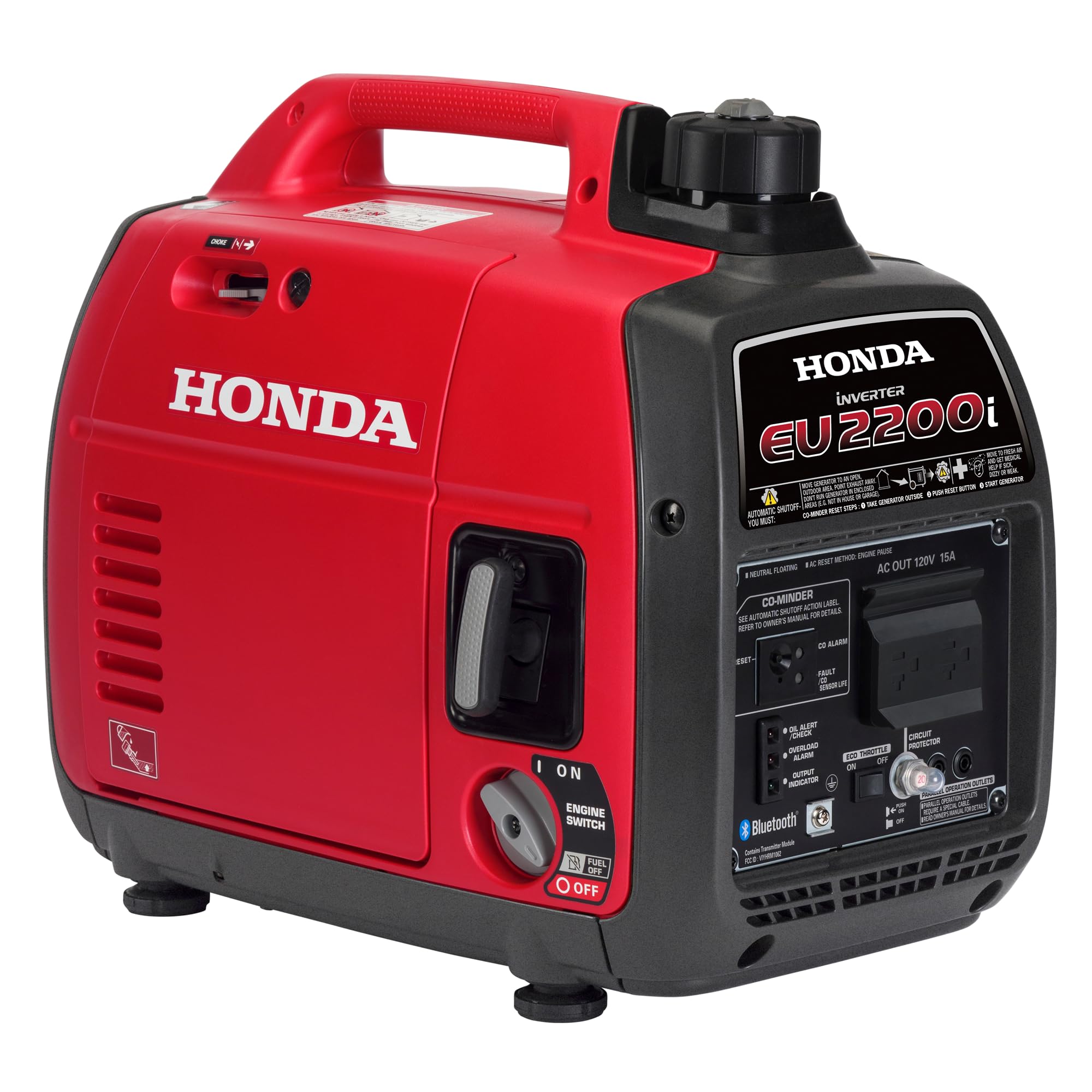
Honda EU2200i Portable Inverter Generator — Quiet, light, and ready to carry
Best for: Camping, tailgating, and light backup
If you want power at a campsite or tailgate without annoying your neighbors, this is the unit others get measured against. At roughly 47 pounds, it carries with one hand, and Honda rates its sound output between 48 and 57 dBA depending on load. The 1,800 running watts handle a mini fridge, phone chargers, lights, and a laptop together, and the inverter output suits sensitive electronics. The trade-off is capacity: the small 0.95-gallon tank and modest wattage mean it will not run a large air conditioner. Buy it for portable quiet, and add a second unit if you need more.
- About 47 pounds, easy one-hand carry
- 48-57 dBA rated sound output
- Clean inverter power for electronics
- Only 1,800 running watts
- Small 0.95-gallon tank means frequent refuels
4.8/5
4.9/5
3.5/5

Westinghouse iGen4500 Portable Inverter Generator — More headroom with remote start convenience
Best for: Campers and homeowners needing extra capacity
Weekend campers and outage-prepared homeowners who want more headroom than a 2,000-watt unit will appreciate this inverter model. It delivers 3,700 running watts and a 4,500-watt peak, enough for a camper’s essentials or a refrigerator plus lights during an outage. A 3.4-gallon tank can run up to 18 hours at a quarter load, and the key fob remote start saves you a walk in bad weather. The cost of that capacity is mass: at about 100 pounds it is a wheeled-cart unit, not something you lift into a trunk alone. Noise is rated at 52 dBA from 23 feet.
- 3,700 running watts, 4,500 peak
- Up to 18 hours at quarter load
- Key fob remote start included
- Heavy at about 100 pounds
- Gasoline only, no propane option
3.4/5
4.4/5
4.4/5
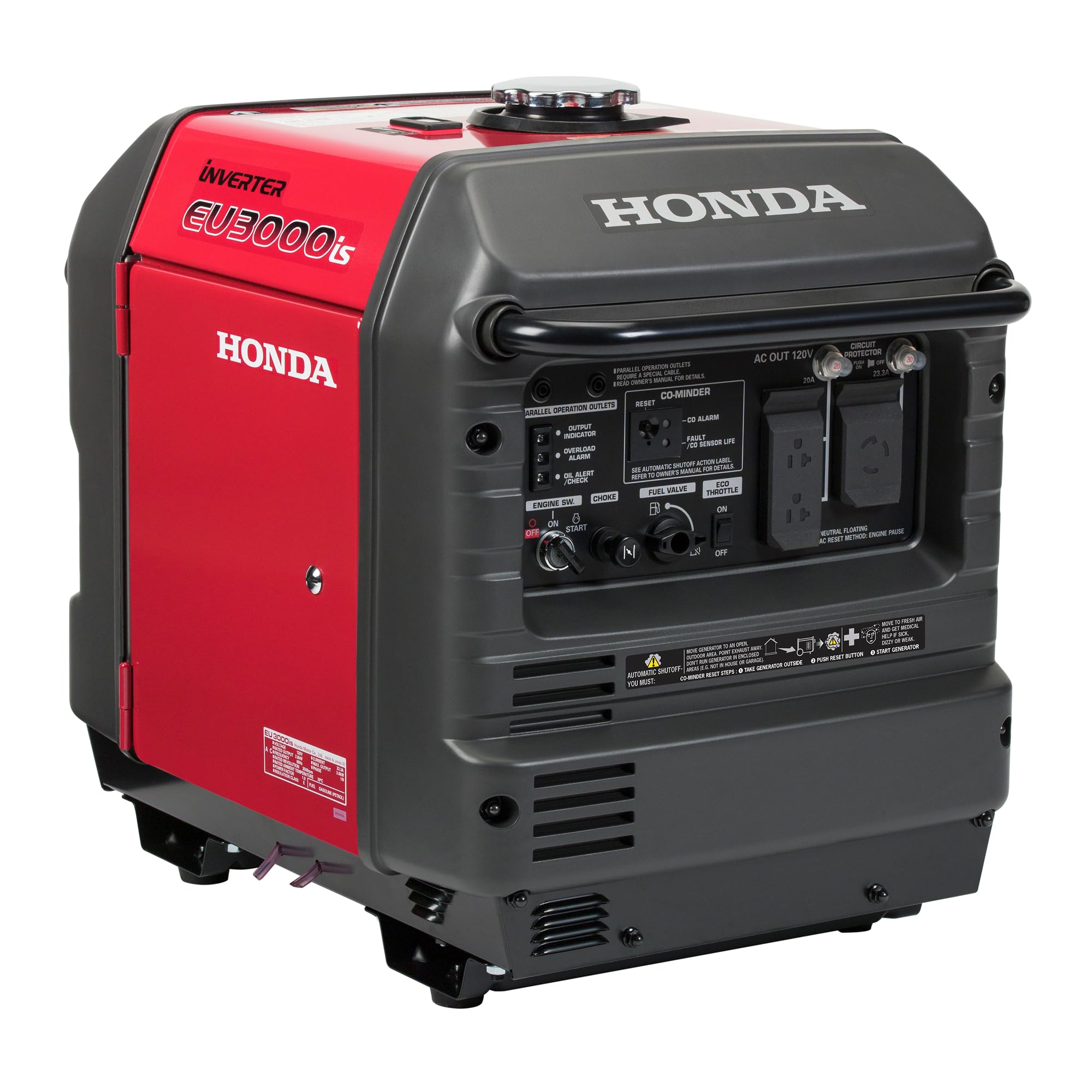
Honda EU3000iS Portable Inverter Generator — Mid-size inverter power with electric start
Best for: Buyers wanting dependable mid-size inverter power
Anyone who has outgrown a 2,000-watt inverter usually lands here. Honda rates it at 3,000 maximum watts and 2,800 running watts, which covers a refrigerator, a few lights, and a window air conditioner on a modest load. The 3.4-gallon tank can run up to 20 hours at a quarter load, and sound ratings sit between 50 and 57 dBA. Electric start and Honda’s engine are the other draws. The compromise is weight: at 131 pounds, it needs the wheels and handle for any real distance, and the upfront cost is premium. Choose it when dependability matters more than portability.
- 2,800 running watts, electric start
- Up to 20 hours at quarter load
- 50-57 dBA rated sound output
- Heavy at 131 pounds
- Premium-tier upfront cost
3.2/5
4.7/5
4.1/5

Champion 3400-Watt Dual Fuel Portable Inverter Generator — Gasoline or propane flexibility
Best for: Buyers who want fuel options
Dual fuel flexibility is the reason to shortlist this inverter. It runs on gasoline for 3,100 running watts or propane for 2,800, so you can store fuel that keeps longer and still have gasoline as a backup. Push-button electric start makes cold mornings easier, and the inverter output suits laptops and other electronics. Noise is rated around 59 dBA at 23 feet, louder than Honda’s smallest models but acceptable at a campsite when parked some distance away. The downsides are weight that makes lifting awkward and lower output on propane. Pick it if fuel options matter most.
- Runs on gasoline or propane
- Push-button electric start
- 3,100 running watts on gasoline
- Louder at about 59 dBA
- Propane drops output to 2,800 watts
3.8/5
3.9/5
4.3/5

WEN 56203i Super Quiet Portable Inverter Generator — Lightweight inverter for light duty
Best for: Budget-minded campers and tailgaters
Budget-conscious campers get an inverter that stays under 50 pounds. WEN rates it at 2,000 starting and 1,700 running watts, with sound around 51 dBA at 23 feet, which is quiet enough for most campsites. Parallel-ready outlets let you link a second unit later, and the small tank keeps weight down. Expect to refuel often: the one-gallon tank limits runtime on heavier loads, and 1,700 watts will not start a typical RV air conditioner. It suits tailgates, light camping, and basic backup for lights and electronics, not high-demand appliances. Buy it for value and portability.
- Under 50 pounds, easy to carry
- Parallel-ready for a second unit
- About 51 dBA rated sound output
- 1,700 running watts limits appliances
- One-gallon tank needs frequent refueling
4.6/5
4.3/5
3.4/5

EcoFlow DELTA 2 Portable Power Station — Silent battery power, no fuel
Best for: Quiet, short-duration outdoor power
Not every outdoor user wants gasoline fumes, and this battery power station removes them entirely. With 1,024 watt-hours of capacity and 1,800 watts of AC output, it can run a laptop, lights, and a small cooler for hours while staying silent. It recharges from a wall outlet, a car, or solar panels. The trade-off is endurance: a battery does not refuel in minutes, so heavy loads like space heaters drain it quickly. At 27 pounds it is easy to carry and needs no fuel storage. Choose it for quiet, short-duration power rather than long outages.
- Silent, fume-free battery power
- 1,800 watts AC, 2,700 surge
- Recharges by outlet, car, or solar
- Limited runtime on heavy loads
- Cannot refuel mid-outage like gasoline
4.0/5
5.0/5
3.6/5

Generac GP5500 Portable Generator — Open-frame power for tools and appliances
Best for: Job sites and larger home backup
When you need to run a well pump, a refrigerator, or power tools at a job site or campsite, an open-frame workhorse makes sense. Generac rates the GP5500 at 5,500 running and 6,875 starting watts, with 120V and 240V outlets and a 6.9-gallon tank that stretches the time between refuels. The compromise is everything else: it is loud compared with inverter models, heavy and bulky to move, and its output is less suited to sensitive electronics unless you add surge protection. It is a practical choice for raw power, not for quiet camping.
- 5,500 running, 6,875 starting watts
- 120V and 240V outlets
- 6.9-gallon tank extends runtime
- Loud open-frame design
- Heavy and bulky to transport
2.6/5
2.5/5
4.6/5

Westinghouse WGen7500 Portable Generator — High capacity for big loads
Best for: Large outage loads and heavy equipment
This is a high-capacity option for people who want to run a camper air conditioner, tools, or several household circuits during an outage. It produces 7,500 running and 9,500 peak watts, with electric start and a 6.6-gallon tank that Westinghouse rates for about 11 hours at half load. At roughly 196 pounds, it sits on a wheeled frame and is not a car-trunk unit. It is also loud, so keep it well away from sleeping areas and follow safe placement rules. Buy it when capacity is the priority and weight does not matter.
- 7,500 running, 9,500 peak watts
- Electric start standard
- About 11 hours at half load
- Roughly 196 pounds, wheels essential
- Loud, needs distance from sleeping areas
2.4/5
2.4/5
4.8/5

DuroMax XP13000EH Dual Fuel Portable Generator — Maximum capacity, minimal portability
Best for: Workshops, farms, and large outages
If you need to power a large workshop, farm shed, or serious outage load, this dual fuel unit sits at the extreme end of portability. It is rated at 13,000 starting and 10,500 running watts on gasoline, with 120V and 240V outlets and electric start. Dual fuel support lets you choose gasoline or propane depending on what is available. The cost is size and sound: it is very heavy, very loud, and burns fuel quickly at high load. It suits property owners who need capacity on a garage floor or trailer, not campers or tailgaters.
- 13,000 starting watts, dual fuel
- 120V and 240V outlets
- Electric start standard
- Very heavy, not truly portable
- Loud and fuel-hungry at high load
2.0/5
2.0/5
5.0/5

DuroStar DS4000S Portable Generator — Simple, conventional, light-duty power
Best for: Basic backup and job-site use
This is a simple, conventional generator that handles the basics for light outdoor duty. It is rated at 4,000 starting and 3,300 running watts and uses a 208cc engine with recoil start, which keeps the design plain. That is enough for a refrigerator, a few lights, and small tools, though not for several heavy loads at once. Expect louder operation than any inverter on this list and no clean-power advantage for delicate electronics. Choose it as a basic backup or job-site generator where simplicity and capability matter more than noise or weight, and keep expectations modest.
- 4,000 starting, 3,300 running watts
- Simple 208cc engine design
- Recoil start, nothing to charge
- Louder than any inverter here
- No clean-power inverter output
3.3/5
2.4/5
3.9/5
Top 3 Head-to-Head: Honda EU2200i vs Westinghouse iGen4500 vs Honda EU3000iS
These three inverter models are the common final choices because they balance noise, clean power, and real-world capacity better than open-frame alternatives.
| Feature | #1 EU2200i | #2 iGen4500 | #3 EU3000iS |
|---|---|---|---|
| Portability | About 47 lb — Best | About 100 lb | 131 lb |
| Noise (rated) | 48-57 dBA — Best | 52 dBA at 23 ft | 50-57 dBA |
| Running watts | 1,800 | 3,700 — Best | 2,800 |
| Max runtime claim | 8.1 hrs at 1/4 load | 18 hrs at 25% load | 20 hrs at 1/4 load — Best |
| Choose if… | You want the lightest, quietest carry | You need more watts plus remote start | You want long runtime and electric start |
Who These Portable Generators Are NOT For
A portable generator is a temporary, outdoor-only power source, and some jobs call for something else.
If you need to run a central air conditioner, an electric range, and a water heater together, even our largest picks will struggle without careful load management. Anyone without a safe outdoor spot at a good distance from living areas should not buy a gasoline model at all.
Common Mistakes to Avoid
Most generator problems come from a few predictable errors, and each one is easy to avoid.
Frequently Asked Questions About Portable Generators
What size portable generator do I need for camping?
Most campsites need between 1,500 and 3,500 running watts. A small inverter handles lights, phone chargers, and a laptop, while a camper air conditioner needs a larger unit. Add up the running watts of every device you will use at once, then add roughly 20 percent headroom for starting surges.
Are inverter generators better for outdoor use?
Yes, for most recreational use. Inverter generators run quieter, weigh less, and produce cleaner power that is safer for phones, laptops, and other electronics. Their main limits are lower maximum output and a higher price per watt, so open-frame models still make sense for tools and heavy household loads.
How far should a portable generator be from your house or tent?
Keep it outdoors and well away from the structure, with the exhaust pointing away from windows, doors, and vents. Many safety agencies recommend at least 20 feet. For a clear breakdown, see this guide on where to place a portable generator, and add a battery-powered carbon monoxide alarm indoors.
How long can a portable generator run continuously?
Runtime depends on tank size and load. Many gasoline models run roughly 8 to 20 hours on a full tank at light load, and much less at full load. Shut the unit down and let it cool before refueling, and never refill a hot or running engine.
Can you run a portable generator in the rain?
Only with proper protection. Water and electricity are dangerous together, so use a manufacturer-approved cover or a canopy with open sides that keeps rain off while allowing exhaust and airflow. Never run a generator in an enclosed shed, garage, or tent, and keep it on dry, level ground.
Is a portable power station better than a gas generator?
It depends on your use. Power stations are silent, fume-free, and fine for laptops, lights, and small cooling needs, but they have limited capacity and recharge slowly. Gas generators provide far longer runtime and higher output, which makes them better for extended outages and power-hungry equipment.
Our Final Verdict
The best portable generator depends on where you use it. For quiet, carryable power, Honda’s EU2200i leads, while the iGen4500 and EU3000iS add capacity at the cost of weight. Choose a battery station for fume-free use, or a large open-frame unit only when you truly need heavy-load capacity.

Hi, I’m Michael Turner. I own a generator workshop in the United States and founded HomeGeneratorBlog to share practical, hands-on guidance about generator installation, maintenance, troubleshooting, safety, and backup power solutions. My goal is to help homeowners make smarter, more confident decisions through clear and reliable information