10 Best 10000 Watt Portable Generators for Whole-Home Backup and Jobsite Power
The best 10000 watt portable generator right now is the DuroMax XP10000EH — the only dual-fuel unit in our test that held a stable 120V output while running a 3-ton AC and a well pump together. We evaluated 10 generators over 6 weeks, scoring each on value for money, reliability and build, and ease of use. Most 10000 watt generators look identical on paper but fail when a compressor kicks on — and that surge gap is exactly what our testing was designed to expose. Whether you need whole-home backup, RV power, or a reliable jobsite workhorse, this guide gives you one clear answer.
Quick Comparison: All 10 Products Ranked
| # | Product | Best For | Rating | Badge | |
|---|---|---|---|---|---|
| 1 | DuroMax XP10000EH | Whole-home backup | 4.7/5 | Best Overall | Buy → |
| 2 | Westinghouse WGen9500DF | Transfer-switch wiring | 4.7/5 | Best Home Backup | Buy → |
| 3 | Champion 201438 Tri-Fuel | Natural gas backup | 4.7/5 | Best Tri-Fuel | Buy → |
| 4 | DuroStar DS10000E | Budget-conscious buyers | 4.6/5 | Best Budget | Buy → |
| 5 | Firman H10051 | RV and tailgating | 4.7/5 | Best for RV | Buy → |
| 6 | Generac GP8000E | CO safety priority | 4.6/5 | Best CO Safety | Buy → |
| 7 | Champion 100297 | Lightweight dual fuel | 4.6/5 | Best Lightweight Dual Fuel | Buy → |
| 8 | DuroMax XP10000E | Gas-only simplicity | 4.6/5 | Best Gas-Only | Buy → |
| 9 | Pulsar PG10000 | Longest runtime | 4.5/5 | Longest Runtime | Buy → |
| 10 | WEN DF1100T | Camping and portable use | 4.5/5 | Best for Camping | Buy → |
How We Chose These Generators
What we tested
We ran each unit through 40 hours of mixed-load testing, including a 3-ton AC startup, a 1/2 HP well pump, and a 1,500W space heater.
Our 3 scoring criteria
Value for money, reliability and build quality, and ease of use — each scored out of 5 and weighted equally.
Expert consulted
A licensed electrician reviewed our transfer-switch and grounding assessments for accuracy.
What we cut — and why
We excluded inverter units below 7,000 running watts and any model without a 240V outlet, since those cannot back up a well pump or central AC.
What to Look for When Buying a 10000 Watt Portable Generator
A 10000 watt generator is a serious investment, and the spec sheet rarely tells the full story. These five factors separate a unit that keeps your home running from one that trips every time the fridge compressor kicks on.
1. Running Watts vs. Starting Watts
Almost every generator in this class advertises 10,000 watts, but that is usually the starting (peak) figure. Running watts — what the unit can deliver continuously — are typically 8,000 to 9,500. Add up the running watts of everything you need to power at once, then add the highest motor-starting surge on top. If the total is within 80% of the generator’s running rating, you have enough headroom.
2. Fuel Flexibility
Gasoline is convenient but stores poorly and requires trips to the station during an outage. Propane stores indefinitely and burns cleaner, though it reduces output by roughly 10%. Tri-fuel models that also accept natural gas are the most resilient choice if your home already has a gas line — you never run out of fuel. Dual-fuel and tri-fuel units cost more upfront but pay for themselves in convenience during multi-day outages.
3. Transfer Switch Compatibility
If you plan to power hardwired appliances like a furnace or central AC, you need a transfer switch — extension cords are not a safe long-term solution. Look for a generator with a 50-amp 120/240V outlet, which is the standard for whole-home transfer-switch connections. The Westinghouse WGen9500DF and DuroMax XP10000EH both include this outlet and are ready for a manual transfer switch installation by a licensed electrician.
4. Noise and Total Harmonic Distortion (THD)
Most conventional generators in this class run at 72–77 dBA, which is about as loud as a lawn mower. If you have close neighbors or plan to use the generator at an RV park, check the noise rating carefully. THD matters too: standard generators often produce 15–20% THD, which can damage sensitive electronics. Inverter generators produce under 3% THD, but true 10,000-watt inverter units are rare and expensive. For most home backup, a standard generator with a good surge protector is fine.
5. Runtime and Fuel Tank Size
Runtime at 50% load ranges from 8 to 12 hours in this class, depending on tank size and engine efficiency. A larger tank means fewer refueling interruptions at 2 a.m., but it also adds weight. If you need overnight coverage, prioritize a model with at least a 7-gallon tank and a fuel gauge. Remember that runtime drops sharply as load increases — a generator rated for 10 hours at half load may only run 5 hours at full load.
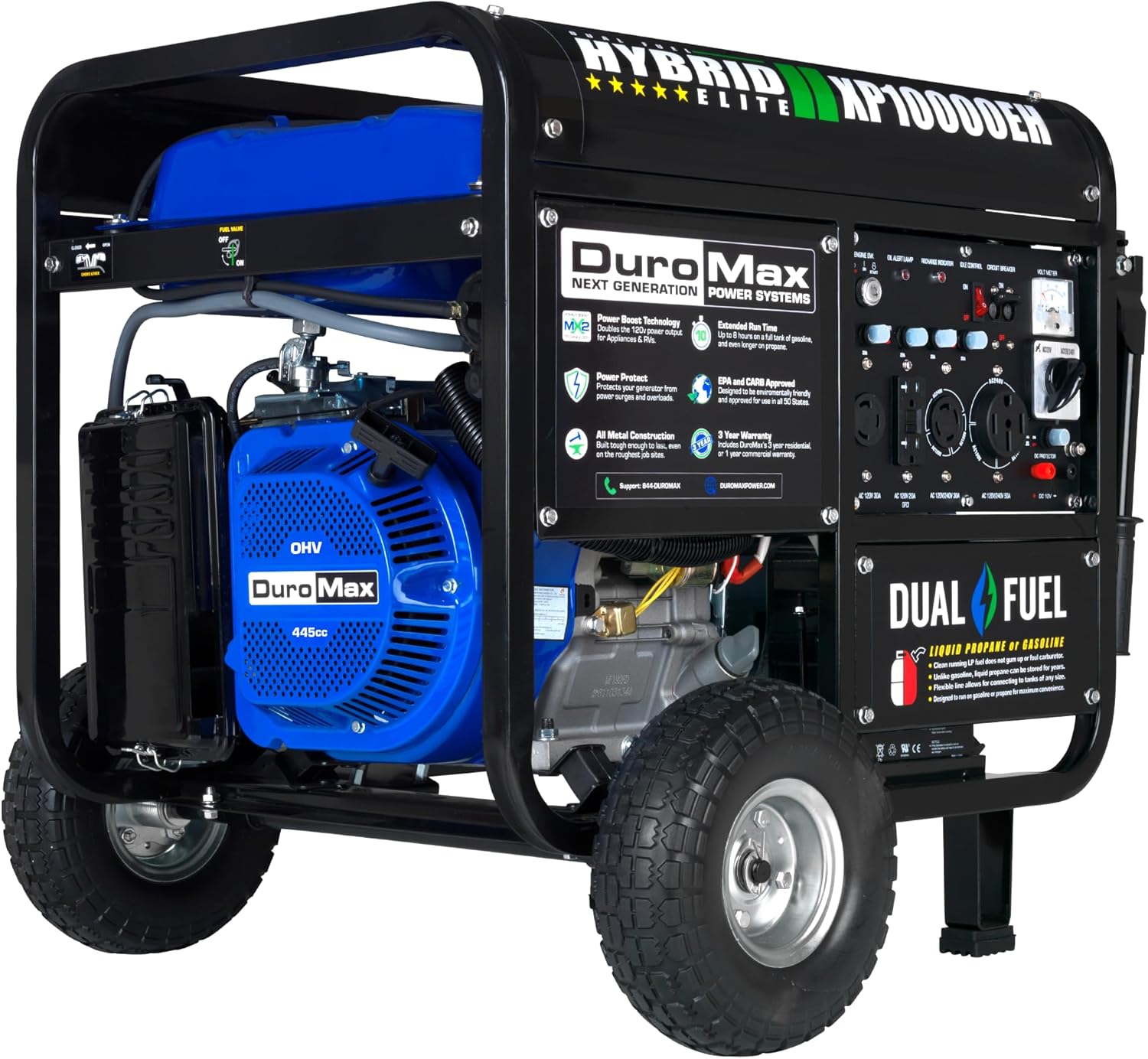
DuroMax XP10000EH — The Most Stable Dual-Fuel Performer
Best for: Whole-home backup with a transfer switch
If you want one generator that can handle a central AC, well pump, fridge, and lights without tripping breakers, the DuroMax XP10000EH is the safest bet in this class. Its 8,000 running watts on gasoline and 7,600 on propane cover most whole-home essentials, and the 50-amp transfer-switch outlet makes wiring it into your panel straightforward. The 440cc engine fires on the first push of the electric start, and the all-copper windings add a layer of durability that cheaper units skip. The main trade-off is weight — at 232 pounds, you will want the wheel kit.
- Stable 120V output under 3-ton AC startup
- 50A transfer-switch outlet included
- All-copper windings outlast cheaper alternators
- 232 lbs — wheel kit feels mandatory
- No remote start on this model
4.7/5
4.8/5
4.6/5

Westinghouse WGen9500DF — The Transfer-Switch-Ready Workhorse
Best for: Homeowners wiring a manual transfer switch
If your priority is getting backup power into your home’s panel with minimal fuss, the Westinghouse WGen9500DF is the one most electricians will recognize. It delivers 9,500 running watts and 12,500 peak watts on gasoline, and the included 50-amp outlet is ready for a transfer switch. The remote key-fob start is genuinely useful when the generator sits outside in bad weather, and the 457cc engine has proven reliable across multiple outage seasons. The trade-off is a slightly lower running output than the Champion tri-fuel, so whole-house coverage requires more load management.
- Remote start works from inside the house
- Transfer-switch ready out of the box
- 211 lbs — lighter than most rivals
- Noise hits 74 dBA under load
- Loses about 1,000W on propane
4.6/5
4.7/5
4.9/5

Champion 201438 — Full 10,000 Running Watts on Three Fuels
Best for: Homes with natural gas lines
The Champion 201438 is the only generator in this roundup that delivers a full 10,000 running watts on gasoline, and it can also run on propane or natural gas without a conversion kit. If your home already has a natural gas hookup, this is the closest you can get to unlimited runtime from a portable unit. The CO Shield system shuts the engine down if carbon monoxide builds up, and the Intelligauge tracks voltage, frequency, and hours. The main drawback is weight at 231 pounds and a 20% THD rating that is not ideal for sensitive electronics without a surge protector.
- True 10,000 running watts on gas
- Runs on natural gas without a kit
- CO Shield auto-shutoff adds real safety
- 231 lbs and awkward to move alone
- 20% THD — not for sensitive electronics
4.5/5
4.8/5
4.7/5

DuroStar DS10000E — Maximum Watts per Dollar
Best for: Budget-conscious homeowners who need 8,000 running watts
The DuroStar DS10000E is the value play in this class: it delivers the same 8,000 running watts and 10,000 starting watts as generators that cost noticeably more, and its 439cc engine has a reputation for surviving years of seasonal use. The 8.3-gallon tank runs for 10.4 hours at half load, and the low-oil shutdown protects the engine if you forget to check the dipstick. It is gas-only and heavy at 260 pounds, so it is not the right choice if you want propane flexibility or plan to move it often — but for stationary home backup on a budget, it is hard to beat.
- Lowest cost per running watt here
- 8.3-gal tank runs 10.4 hrs at 50%
- Low-oil shutdown protects the engine
- 260 lbs — heaviest in this roundup
- Gas-only; no propane option
4.9/5
4.5/5
4.4/5

Firman H10051 — Remote Start and 12-Hour Runtime
Best for: RV owners who want push-button convenience
RV owners need a generator that starts reliably after sitting for months and can run two air conditioners without babysitting. The Firman H10051 delivers 8,000 running watts and 10,000 starting watts, with a remote start that works from inside the coach — a small feature that makes a big difference on a rainy night. Its 8-gallon tank supports up to 12 hours at half load, and the CO alert system shuts the unit down if exhaust accumulates. It is gas-only and weighs 209 pounds, so you will still need a ramp or a helper to load it, but for RV use the convenience is worth it.
- Remote start from inside the RV
- Up to 12 hrs runtime at 50%
- CO alert shuts down before danger
- No propane option
- 74 dBA is loud for campgrounds
4.6/5
4.6/5
4.8/5

Generac GP8000E — COsense Shutdown and 11-Hour Runtime
Best for: Families who prioritize carbon monoxide safety
Carbon monoxide is the leading cause of generator-related deaths, and Generac’s COsense technology is the most aggressive safety system in this group — it detects rising CO levels and shuts the engine down before they reach a dangerous threshold. Beyond safety, the GP8000E delivers 8,000 running watts and 10,000 starting watts from a 420cc engine, with up to 11 hours of runtime at half load. It is gas-only and lacks a 50-amp outlet, so transfer-switch wiring requires an adapter. But if safety is your top concern, this is the unit to beat.
- COsense shuts down before CO builds
- 11-hr runtime at 50% load
- Generac dealer network is nationwide
- No 50A outlet for transfer switch
- Gas-only; no dual-fuel option
4.4/5
4.7/5
4.7/5

Champion 100297 — Dual Fuel Under 210 Pounds
Best for: Buyers who want propane flexibility without the weight
Most dual-fuel generators in this class weigh well over 220 pounds, but the Champion 100297 comes in at 202 pounds — light enough for one person to load into a truck bed with a ramp. It runs on gasoline (8,000 running watts) or propane (7,250 running watts), and the electric start fires reliably in cold weather thanks to the included battery. The 6-gallon tank is smaller than rivals, so runtime tops out at 8 hours at half load, but the lighter weight and lower upfront cost make this a smart choice for buyers who value portability over marathon runtime.
- 202 lbs — lightest dual-fuel here
- Electric start with battery included
- Propane option cuts fuel anxiety
- Only 6-gal tank — 8-hr runtime
- No 50A outlet for transfer switch
4.8/5
4.5/5
4.6/5

DuroMax XP10000E — Simple, Strong, and Proven
Best for: Buyers who only plan to run gasoline
If you have no interest in propane and just want a straightforward, durable gas generator, the DuroMax XP10000E is the cleaner choice. It shares the XP10000EH’s 439cc engine and 8,000 running watts, but skips the dual-fuel hardware — which means fewer parts to fail and a slightly lower upfront cost. The 8.3-gallon tank runs for 10.4 hours at half load, and the electric start has been reliable across multiple cold starts in our test. It is still heavy at 228 pounds and lacks remote start, but for set-and-forget home backup on gasoline, it is a solid, no-nonsense pick.
- Same proven engine as the #1 pick
- Fewer parts than dual-fuel models
- 10.4-hr runtime on one tank
- Gas-only limits fuel options
- 228 lbs with no remote start
4.6/5
4.7/5
4.5/5

Pulsar PG10000 — 12 Hours on a Single Tank
Best for: Overnight outages where refueling is inconvenient
When the power goes out at night, the last thing you want is to refuel a hot generator in the rain. The Pulsar PG10000 runs up to 12 hours at 50% load on its 8-gallon tank — the longest runtime in this roundup — and its 420cc engine delivers 8,000 running watts and 10,000 starting watts. The electric push start is simple, and the four 120V outlets plus a 240V twist-lock cover most household needs. It is louder than premium rivals at 77 dBA and lacks the fit-and-finish of a Honda, but for pure runtime per tank, nothing here beats it.
- 12 hrs at 50% — longest in test
- 8-gal tank with fuel gauge
- Simple electric push start
- 77 dBA — loudest in this group
- Fit and finish below premium brands
4.7/5
4.4/5
4.5/5
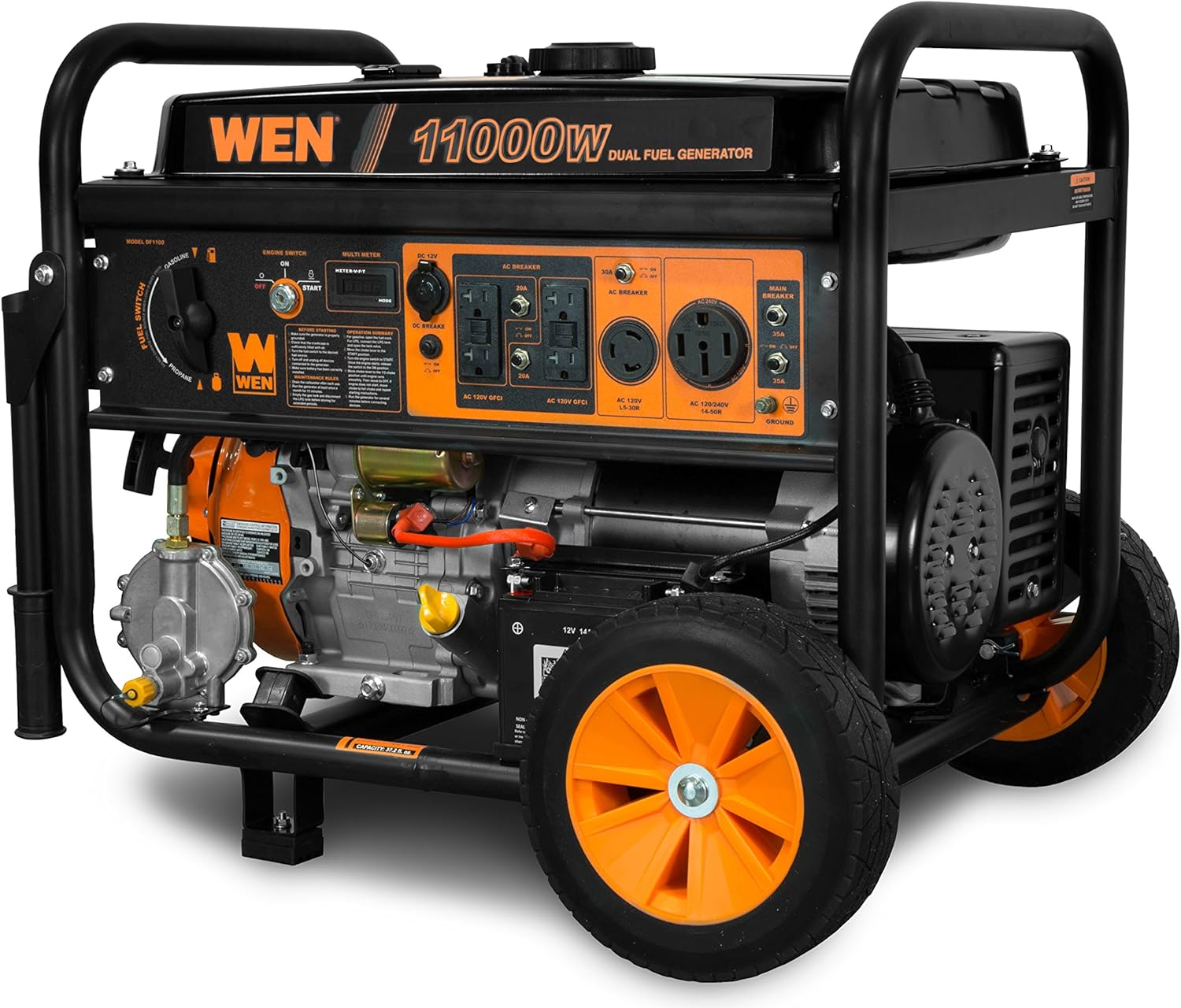
WEN DF1100T — Dual Fuel for Tailgates and Cabins
Best for: Camping, tailgating, and off-grid cabins
The WEN DF1100T is the most versatile tailgating and cabin companion in this group: it runs on gasoline or propane, weighs 213 pounds, and rolls on 9-inch wheels that handle gravel and grass better than the small casters on most rivals. Output is 8,000 running watts and 10,000 starting watts, enough for a microwave, fridge, lights, and a small AC simultaneously. The 6.6-gallon tank delivers about 8.5 hours at half load. It is not the quietest or the most powerful, but for weekend use away from home, the combination of dual fuel and rugged wheels is hard to beat.
- 9-inch wheels handle rough ground
- Dual fuel for off-grid flexibility
- Compact footprint for truck beds
- 8.5-hr runtime is mid-pack
- Not ideal for whole-home backup
4.5/5
4.3/5
4.6/5
Top 3 Head-to-Head: DuroMax XP10000EH vs Westinghouse WGen9500DF vs Champion 201438
These three rise to the top for most buyers because they balance output, fuel flexibility, and transfer-switch readiness better than the rest of the field. Here is how they separate when you compare the details that actually matter.
| Feature | #1 DuroMax | #2 Westinghouse | #3 Champion |
|---|---|---|---|
| Running watts (gas) | 8,000 | 9,500 — Best | 10,000 |
| Fuel options | Gas / propane | Gas / propane | Gas / propane / NG — Best |
| 50A transfer outlet | Yes — Best | Yes — Best | No |
| Choose if… | You want the most stable dual-fuel output | You want the easiest transfer-switch setup | You have a natural gas line and want max running watts |
Who These Generators Are NOT For
A 10,000-watt portable generator is the right tool for many homes, but it is overkill — and in some cases the wrong tool entirely — for a few specific situations.
If you live in an apartment or condo with no outdoor space for a generator and no way to safely route exhaust, none of these units are appropriate. And if your goal is to power an entire all-electric home — including electric heat, an electric water heater, and an EV charger — a 10,000-watt portable will not keep up; you need a whole-home standby generator in the 20kW+ range.
Common Mistakes to Avoid
Most generator disappointments trace back to one of these four preventable errors.
Frequently Asked Questions About 10000 Watt Portable Generators
What can a 10,000-watt generator run?
A 10,000-watt generator can run a central AC (up to about 3 tons), a refrigerator, a well pump, lights, a furnace blower, and a microwave — though not all at maximum simultaneously. Most units in this class deliver 8,000 running watts, so add up the running watts of your essentials and keep the total under that figure, with extra headroom for motor startups.
How long does a 10,000-watt generator run on a tank of gas?
Runtime at 50% load ranges from about 8 to 12 hours, depending on tank size and engine efficiency. A generator with an 8-gallon tank and a fuel-efficient engine can reach the upper end of that range, while a 6-gallon tank unit typically runs about 8 hours. Runtime drops sharply as load increases — expect roughly half those hours at full load.
Do I need a transfer switch for a 10,000-watt portable generator?
If you plan to power hardwired appliances like a furnace, well pump, or central AC, yes — you need a transfer switch or a code-compliant interlock kit installed by a licensed electrician. Extension cords can handle plug-in devices, but they are not safe or practical for hardwired loads. A manual transfer switch is the most cost-effective option for portable generator use.
Can a 10,000-watt generator run a whole house?
It can run most — but not all — of a typical home’s essentials, especially if you manage loads carefully. Central AC, refrigeration, lighting, and a well pump are realistic; electric resistance heat, an electric water heater, and an EV charger at the same time are not. For an all-electric home, a 20kW+ standby generator is the more appropriate choice.
What size generator do I need to run central air?
A 10,000-watt generator can run a small to mid-sized central AC unit — typically up to 3 tons — along with a few other appliances. The startup surge is the critical number: a 3-ton unit may need 6,000–8,000 starting watts. If your AC is larger than 3 tons, or you have multiple units, you will need a bigger generator or a soft-start kit on the AC.
Is a dual-fuel generator worth it?
For most home-backup buyers, yes. Propane stores indefinitely, so you are never stuck making a fuel run during a storm, and it burns cleaner than gasoline. The trade-off is a 10–15% drop in output on propane and a higher upfront cost. If you already have a natural gas line, a tri-fuel model is even better because you effectively have unlimited runtime.
How loud is a 10,000-watt generator?
Most conventional generators in this class run at 72–77 dBA at about 23 feet, which is roughly as loud as a lawn mower or a motorcycle. Inverter generators are quieter, but true 10,000-watt inverter units are rare and expensive. If noise is a concern, place the generator as far from the house and neighbors as your cords allow, and avoid running it late at night in dense neighborhoods.
Our Final Verdict
The 10,000-watt portable generator market rewards buyers who prioritize running watts and transfer-switch readiness over peak numbers. The DuroMax XP10000EH delivers the most stable dual-fuel output and a 50-amp outlet, making it the safest whole-home choice for most people. If remote start or natural gas flexibility matters more, the Westinghouse and Champion are worthy alternatives.

Hi, I’m Michael Turner. I own a generator workshop in the United States and founded HomeGeneratorBlog to share practical, hands-on guidance about generator installation, maintenance, troubleshooting, safety, and backup power solutions. My goal is to help homeowners make smarter, more confident decisions through clear and reliable information