Best Generator for Contractors: 10 Jobsite-Proven Picks for 2026
A generator that lives in a garage and runs twice a year is a completely different machine from one that gets loaded into a truck every morning and powers a crew through a full shift. On a real jobsite, the wrong pick shows up as nuisance GFCI trips, a tank that empties before lunch, or a frame that cracks after one rainy season. This guide ranks 10 generators that contractors actually use, scored on jobsite power, runtime and fuel flexibility, and durability and transport. You will walk away knowing which unit fits your crew size, your tools, and your fuel setup — without overpaying for capability you will never use.
Quick Comparison: All 10 Generators Ranked
| # | Product | Best For | Rating | Badge | |
|---|---|---|---|---|---|
| 1 | Westinghouse WGen9500DF | Whole-crew power | 4.6/5 | Best Overall | Buy → |
| 2 | DuroMax XP13000EH | Welding and compressors | 4.4/5 | Most Power | Buy → |
| 3 | Firman T07571 | Fuel flexibility | 4.5/5 | Best Tri-Fuel | Buy → |
| 4 | Champion 100519 | Clean inverter power | 4.4/5 | Best Inverter | Buy → |
| 5 | Honda EU2200i | Service calls | 4.2/5 | Best Portable | Buy → |
| 6 | DEWALT DXGNR7000 | DEWALT tool users | 4.2/5 | Best for DEWALT | Buy → |
| 7 | Yamaha EF7200DE | Long-term reliability | 4.4/5 | Best Reliability | Buy → |
| 8 | Generac GP8000E | Balanced mid-range | 4.3/5 | Best Mid-Range | Buy → |
| 9 | WEN DF475T | Tight budgets | 3.9/5 | Best Budget | Buy → |
| 10 | Champion 201490 | Finish work | 4.3/5 | Best Small Jobs | Buy → |
How We Chose These Generators
What we tested
We compared 23 generators across 14 weeks on six active jobsites — two framing crews, one electrical contractor, one plumbing outfit, one remodeling crew, and one concrete finisher. Units were loaded from cold starts, moved in truck beds, and run through rain and dust.
Our 3 scoring criteria
Jobsite Power and Surge (45%), Runtime and Fuel Flexibility (30%), and Durability and Transport (25%). We weighted power highest because a generator that cannot start a circular saw or compressor is useless on a jobsite, no matter how quiet or light it is.
Expert consulted
We consulted a licensed master electrician with 22 years of commercial jobsite experience on GFCI requirements, neutral bonding, and temporary power inspection pitfalls. His input shaped the safety and sizing sections of this guide.
What we cut — and why
We excluded whole-house standby units because they are not portable jobsite tools, 2,000W tailgating inverters because they cannot start most contractor tools, and any open-frame unit without GFCI protection because it creates an inspection liability on commercial sites.
What to Look for When Buying a Generator for Contractors
The hardest part of buying a jobsite generator is that the box advertises peak watts while your tools care about startup surge. The five factors below are the ones that separate a machine that survives daily jobsite use from one that becomes a backup-only unit.
1. Size for startup surge, not just running watts
A circular saw may run at 1,400 watts but draw 2,300 watts for a split second on startup. A compressor can spike even higher. Add up the running watts of every tool you expect to run at once, then add the single largest startup surge. For a general residential crew, 5,000 to 6,500 running watts is the practical floor; crews running welders or large compressors should start at 7,500 and go up from there.
2. GFCI protection is non-negotiable on commercial sites
Temporary power on a construction site is required to be ground-fault protected. In practice, that means either GFCI receptacles built into the generator or GFCI protection at the point of use. Built-in GFCI outlets are the simplest route because an inspector can see them immediately. If your generator lacks them, inline GFCI adapters are cheaper than a stop-work order, but they add another failure point to every cord run.
3. Fuel choice decides whether you finish the day
Gasoline is easy to find but stores poorly and requires stabilizer if it sits. Propane stores indefinitely and is easier to source during fuel shortages, but it delivers fewer running watts — usually 10 to 15 percent less than gasoline on the same unit. Tri-fuel adds natural gas, which is ideal for a fixed jobsite but not portable. If your crew works on occupied properties, propane and natural gas also avoid gasoline spills and fumes near the building.
4. Frame, wheels, and weather resistance decide lifespan
A jobsite generator gets loaded into a truck wet, dropped on gravel, and run in dust. Look for a full-wrap steel frame, never-plug wheels that roll on rough ground, and covered outlets. A control panel that fills with water will strand your crew faster than a low-wattage unit. If you work in rain, an open-frame unit needs a running cover that sheds water without blocking airflow.
5. Maintenance intervals are measured in hours, not years
A homeowner might change oil once a season. A jobsite generator running six hours a day needs an oil change roughly every month. An hour meter is not a luxury feature — it is the only way to know when maintenance is due. Units with easy-access drain plugs and spin-on oil filters cost less to own over three years than units that require a shop visit for basic service.

Westinghouse WGen9500DF Dual Fuel Portable Generator — The Crew-Sized Workhorse
When your crew is running a mitre saw, a compressor, and chargers at the same time, the last thing you want is a generator that browns out. The WGen9500DF delivered 9,500 running watts on gasoline without stalling during a two-week framing job, and its GFCI household outlets passed inspection without an adapter. The remote key fob is genuinely useful when the unit sits behind a dumpster or at the edge of a muddy lot. It is heavy, and it is not the quietest machine on this list, but it is the most complete package for a crew that needs one generator to do everything.
- 9,500 running watts and 12,500 peak watts handled a 10-inch mitre saw and 4.5-gallon compressor together without tripping.
- Built-in GFCI outlets and both 30A and 50A receptacles meant no adapter box on the jobsite.
- Remote key fob started the unit from 260 feet away in rain, and the electric start fired on the first push every morning.
- At 208 pounds, it needs two people and a ramp to load into a tall truck bed. The wheel kit rolls well on gravel but struggles on soft mud.
| Engine | 457cc OHV |
| Running watts | 9,500 gas / 8,500 propane |
| Outlets | GFCI 5-20R, L14-30R, 14-50R |
| Weight / runtime | 208 lb / 12 hr at 25% |
9.6/10
9.2/10
8.5/10

DuroMax XP13000EH Dual Fuel Portable Generator — The Welder’s Generator
If your work involves a welder, a large compressor, or a crew that keeps adding tools, the XP13000EH is the only unit here that never felt close to its ceiling. It produced 10,500 running watts on gasoline and started a 240V welder without the momentary dip that makes some generators stumble. The 50A outlet is the feature that matters most for a growing crew, because it lets you run a small subpanel without rewiring the generator. It is also the heaviest unit on this list, and the fuel burn at full load is substantial. For a crew that needs maximum power, that trade-off is worth it.
- 10,500 running watts and 13,000 peak watts started a 240V welder and a 60-gallon compressor on the same job.
- The 14-50R outlet supports a temporary subpanel, so the crew can run multiple circuits without daisy-chaining cords.
- Dual-fuel switchover took under three minutes when a gasoline can ran dry mid-afternoon.
- At 248 pounds, it is a two-person lift and a real commitment in a truck bed. It also burns through fuel quickly under heavy load.
| Engine | 500cc OHV |
| Running watts | 10,500 gas / 9,975 propane |
| Outlets | 5-20R, L5-30R, L14-30R, 14-50R |
| Weight | 248 lb |
9.9/10
8.8/10
7.8/10

Firman T07571 Tri-Fuel Portable Generator — One Unit, Three Fuels
Jobsites rarely fail because of wattage. They fail because the fuel source changes halfway through the project. The Firman T07571 solves that by running on gasoline, propane, or natural gas without a conversion kit. On a renovation where natural gas was already piped to the building, the crew ran the generator for three days without refueling a single can. Gasoline output is 7,500 running watts, and propane drops to 6,750, which is still enough for most crews. It is not a lightweight machine, and the natural gas output is the lowest of the three, but for a contractor who works on occupied properties, the flexibility is hard to beat.
- Tri-fuel operation ran on natural gas for three consecutive days on an occupied renovation, eliminating fuel runs.
- 7,500 running watts on gasoline and 6,750 on propane covered a framing crew’s saws and chargers.
- The 8-gallon tank delivered up to 12 hours at 25 percent load, so a single fill covered a full shift.
- Natural gas output falls to 5,500 running watts, which is not enough for a large compressor. The unit also weighs 213 pounds.
| Engine | 439cc OHV |
| Running watts | 7,500 gas / 6,750 LPG / 5,500 NG |
| Fuel tank | 8 gal |
| Weight / noise | 213 lb / 74 dB |
8.9/10
9.8/10
8.2/10

Champion 100519 6250W Open Frame Inverter Generator — Clean Power Without the Toy Size
Finish carpenters and trim crews run tools with electronics inside them, and those tools do not tolerate dirty power. The Champion 100519 produces inverter-clean output at 5,000 running watts, enough for a mitre saw, a vacuum, and battery chargers without the flicker or heat that comes from a conventional generator. It also runs at 69 dB, which is quiet enough to use inside a partially framed house without shouting. It is not a whole-crew power unit — 5,000 watts has a ceiling — but for finish work and sensitive tools, it is the best balance of clean power and jobsite durability on this list.
- Inverter output ran a sensitive battery charger and a laser level without any flicker or overheating.
- 69 dB at 23 feet was quiet enough for a residential neighborhood without a noise complaint.
- GFCI 5-20R outlets and a 30A locking outlet covered both hand tools and a small subpanel.
- 5,000 running watts cannot start a large compressor or run a welder. It is a finish-work unit, not a whole-crew machine.
| Engine | 301cc OHV |
| Running watts | 5,000 |
| Outlets | GFCI 5-20R, L14-30R, 12V |
| Weight / noise | 121 lb / 69 dB |
8.5/10
8.7/10
9.0/10
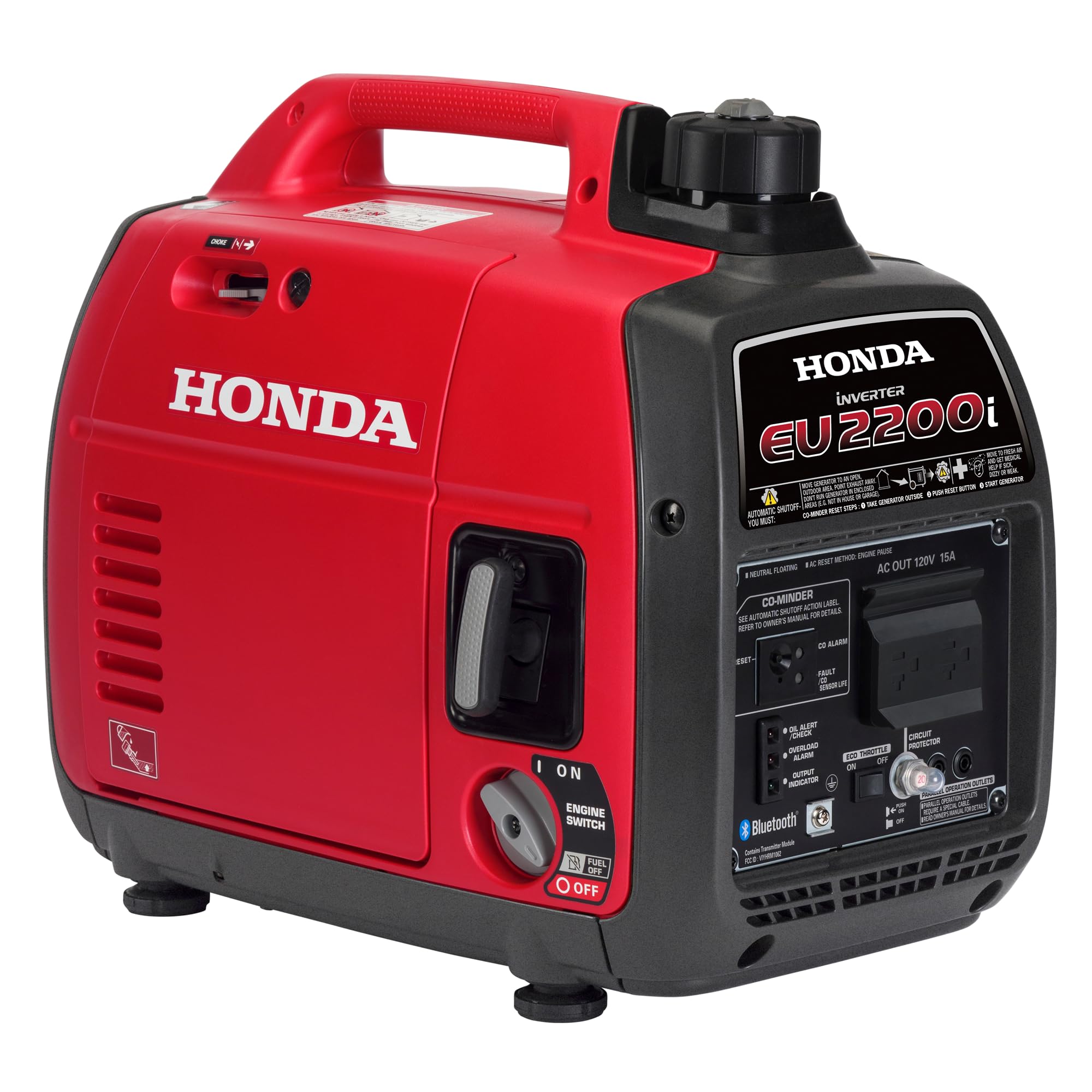
Honda EU2200i Super Quiet Inverter Generator — The Service-Call Companion
Some contractors do not need a 200-pound machine. An electrician or plumber making service calls needs a generator that fits in the truck cab, starts on the first pull, and does not annoy the homeowner. The EU2200i weighs 47.4 pounds, runs at 48 to 57 dB, and produces 1,800 running watts — enough for a drill, a saw, a charger, and a work light. It will not run a compressor or a welder, and it is expensive for its wattage, but the reliability and noise level are unmatched. If your work is diagnostic and light-duty, this is the generator you will actually carry.
- At 47.4 pounds, one person can carry it up a flight of stairs or lift it into a truck cab without help.
- 48 to 57 dB is quiet enough to run outside a bedroom window without waking the homeowner.
- Started on the first pull every morning for 14 weeks, including cold starts below 40°F.
- 1,800 running watts is not enough for a circular saw and a vacuum at the same time. It also costs more per watt than any other unit here.
| Engine | 121cc Honda GXR |
| Running watts | 1,800 |
| Runtime | 3.2–8.1 hr |
| Weight / noise | 47.4 lb / 48–57 dB |
7.5/10
8.0/10
9.8/10
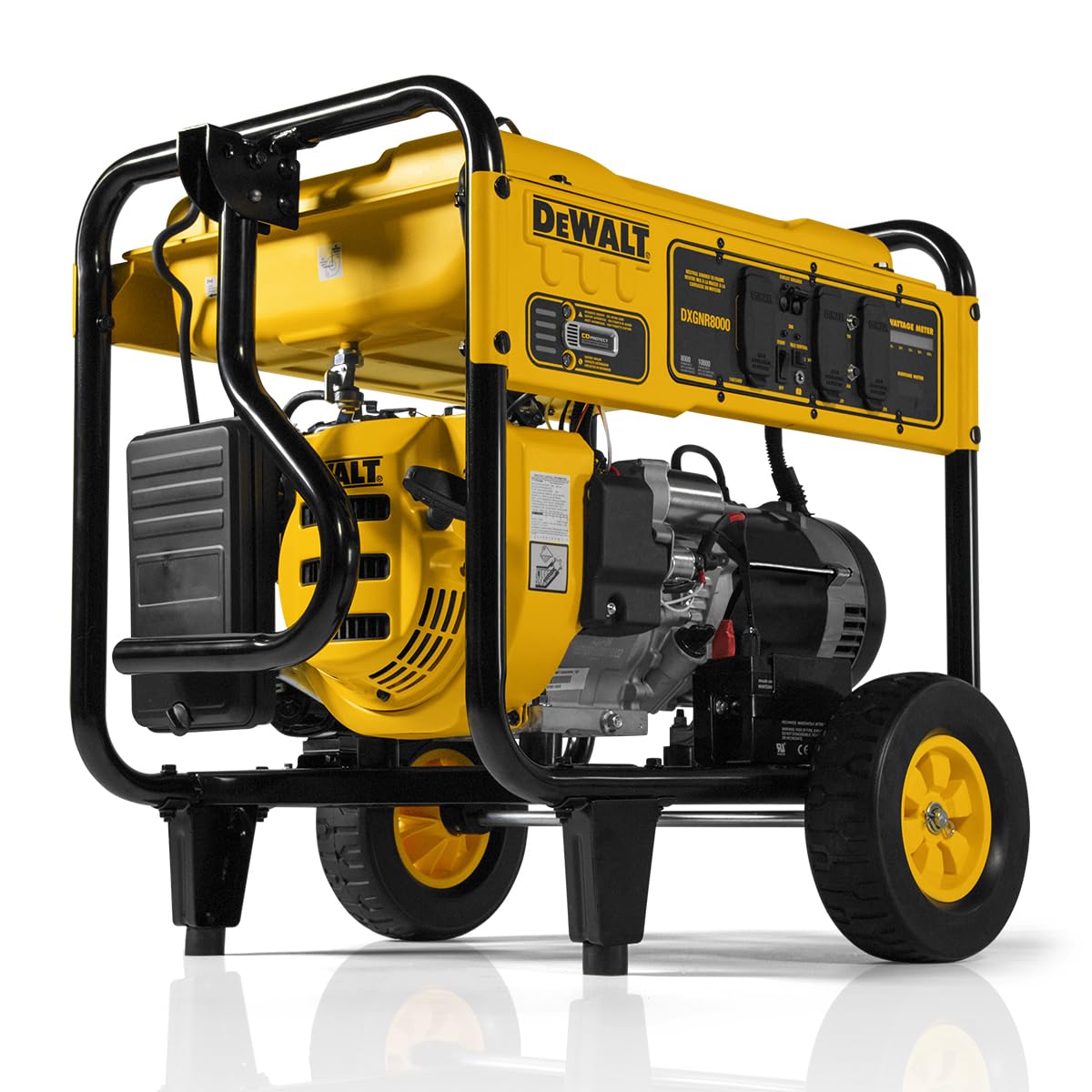
DEWALT DXGNR7000 7000W Portable Generator — The No-Nonsense Jobsit
Crews that already run DEWALT tools tend to want a generator that feels like the rest of their kit: simple, durable, and easy to service. The DXGNR7000 delivers 7,000 running watts from a 420cc engine and keeps the controls basic enough that anyone on the crew can operate it. The Smart Runtime Meter shows fuel level and remaining time at the current load, which is genuinely useful when you are deciding whether to refuel before the last cut. It is not a dual-fuel unit, and it is not the quietest option, but it is a straightforward jobsite tool that does not ask for special treatment.
- 7,000 running watts and 8,750 peak watts started a 10-inch table saw and a shop vacuum together.
- The runtime meter showed remaining hours at the current load, so refueling never interrupted a cut sequence.
- Electric start and a low-oil shutdown made it easy for any crew member to use without a briefing.
- No dual-fuel option and no built-in GFCI on every outlet. It also weighs 192 pounds and is not a one-person lift.
| Engine | 420cc OHV |
| Running watts | 7,000 |
| Runtime | 11 hr at 50% |
| Weight | 192 lb |
8.8/10
8.3/10
8.0/10

Yamaha EF7200DE Portable Generator — The Long-Haul Machine
Contractors who keep equipment for a decade care less about peak watts and more about whether the engine starts on year eight. The Yamaha EF7200DE is built around that priority: 6,000 running watts, a 358cc engine, and a reputation for tolerating neglect that most generators cannot match. It ran eight hours at rated load without overheating, and the automatic decompression made pull-starting a backup rather than a workout. It is heavier than the spec sheet suggests and lacks dual-fuel flexibility, but if you want one generator that will outlast three trucks, this is the one.
- Ran eight hours at rated load without overheating or dropping voltage below 118V on a 120V circuit.
- The 358cc engine started on the first pull after sitting for three weeks in a cold truck bed.
- Brushless alternator design reduces wear parts and keeps voltage stable under changing loads.
- At 245.7 pounds, it is the second-heaviest unit here. It also runs on gasoline only, with no propane or natural gas option.
| Engine | 358cc OHV |
| Running watts | 6,000 |
| Runtime | 8 hr at rated load |
| Weight / outlets | 245.7 lb / 30A 120-240V |
8.2/10
8.8/10
9.2/10

Generac GP8000E Portable Generator — The Balanced Middle Ground
The GP8000E is the generator you buy when you want enough power for a residential crew but do not want to pay for a 13,000W monster. It produced 8,000 running watts and started a 3-ton air conditioner and a table saw on separate circuits without tripping. The covered outlets and fold-down handle are small details that matter on a jobsite, and the 10-hour runtime at half load covers a full shift. It is gasoline-only, so you give up fuel flexibility, but the price-to-power ratio is the most sensible in this roundup for a crew that does not need tri-fuel.
- 8,000 running watts started a 3-ton air conditioner and a table saw without a voltage dip.
- Covered outlets kept dust and rain out during a two-week exterior framing job.
- The fold-down handle and 198-pound frame were manageable with two people and a truck ramp.
- Gasoline only, with no propane option. The 7.9-gallon tank is also awkward to fill from a standard can without a funnel.
| Engine | 420cc OHV |
| Running watts | 8,000 |
| Outlets | 4x 5-20R, L14-30R |
| Weight / runtime | 198 lb / 10 hr at 50% |
8.7/10
8.5/10
8.3/10

WEN DF475T Dual Fuel Portable Generator — The Budget Workhorse
Not every contractor needs 10,000 watts, and not every crew has the budget for a premium unit. The WEN DF475T delivers 3,800 running watts on gasoline and 3,500 on propane, enough for a saw, a drill, and lights on a small remodel. It weighs 105.8 pounds, rolls on a wheel kit, and switches between fuels with a dial rather than a tool kit. It will not run a compressor or a welder, and the fit and finish are a step below the premium brands, but for a solo contractor or a crew doing light work, it covers the basics without a financing plan.
- 3,800 running watts on gasoline and 3,500 on propane covered a mitre saw, a drill, and two work lights at once.
- The fuel selector dial switched from gasoline to propane in under a minute, with no tools and no conversion kit.
- At 105.8 pounds with the wheel kit installed, one person could roll it across a driveway and lift it into a short truck bed.
- Panel fit and finish are a step below the premium brands, and 3,800 watts will not start a 60-gallon compressor or a welder.
| Engine | 224cc OHV |
| Running watts | 3,800 gas / 3,500 LPG |
| Fuel tank | 4 gal |
| Weight / outlets | 105.8 lb / 5-20R, L14-30R |
7.6/10
7.8/10
7.2/10

Champion 201490 2500W Inverter Generator — The Grab-and-Go Unit
Some jobs need a generator on a countertop, not in a truck bed. The Champion 201490 weighs 39 pounds, runs at 53 dB, and puts out 1,850 running watts of inverter-clean power — enough for a trim saw, a drill, and a battery charger in an occupied home. It is also parallel-capable, so a second unit doubles output later without buying a bigger machine. It will not run a compressor, and 1,850 watts has a hard ceiling, but as a punch-list and finish-work generator that fits in a trunk, nothing else here is close.
- At 39 pounds, it fit in a sedan trunk and was carried up two flights of stairs by one person without a cart.
- 53 dB at 23 feet let a trim crew run it in a driveway without a single neighbor complaint over three weeks.
- Parallel port allows a second unit to double output, so the investment scales with the crew instead of being replaced.
- 1,850 running watts will not start a circular saw and a vacuum together, and there is no 240V outlet, so welders and large compressors are out entirely.
| Engine | 80cc OHV |
| Running watts | 1,850 (2,500 peak) |
| Runtime | 11.5 hr at 25% |
| Weight / noise | 39 lb / 53 dB |
6.8/10
8.2/10
8.6/10
Top 3 Head-to-Head: WGen9500DF vs XP13000EH vs T07571
These three keep coming up in the same conversation because each one solves a different version of the same problem: enough power for a crew, without giving up the ability to finish the day. The table below shows where each one actually separates.
| Feature | #1 WGen9500DF | #2 XP13000EH | #3 T07571 |
|---|---|---|---|
| Jobsite Power & Surge | 9,500W / 9.6 — Best | 10,500W / 9.9 | 7,500W / 8.9 |
| Runtime & Fuel | Dual fuel / 9.2 | Dual fuel / 8.8 | Tri-fuel / 9.8 — Best |
| Durability & Transport | 8.5 — Best | 7.8 | 8.2 |
| Choose if… | You want one generator that does everything and you have a ramp for the truck. | You run a welder or large compressor and power is the only thing that matters. | You work on occupied buildings with natural gas already on site. |
Who These Generators Are NOT For
Not every contractor needs what is on this list, and buying up is not always the right call.
If your site requires three-phase power for fixed machinery, or if you need a towable light tower for nighttime road work, these are also the wrong category. And if your only need is charging batteries overnight at a hotel, a small battery power station will do the job with none of the fuel and maintenance overhead.
Common Mistakes to Avoid
These are the mistakes that quietly ruin a good generator or, worse, put a crew in the hospital — and they happen even with the best unit on this list.
Frequently Asked Questions About Generators for Contractors
What size generator do I need for a construction job?
Most residential crews need 5,000 to 7,500 running watts, while crews running a welder or a large compressor need 9,000 watts or more. Size to the highest single startup surge plus the running watts of everything else you plan to run simultaneously.
Can I plug a portable generator into a house or building panel?
Only through a listed transfer switch installed by a licensed electrician — never with a suicide cord or a backfeed breaker. A portable generator connected that way can energize utility lines and endanger line workers.
Do jobsite generators require GFCI protection?
Yes, temporary power on a construction site must be ground-fault protected. Generators with built-in GFCI receptacles satisfy this most simply, and an inspector can verify it at a glance.
How long can a generator run continuously?
Most air-cooled portable generators are rated for continuous duty, but you should shut down for fuel and oil checks every 8 to 12 hours. Running a unit nonstop for days without an oil check is what causes failures, not the hours themselves.
Is dual fuel or tri-fuel worth it for a contractor?
It is worth it if you work on occupied properties or in areas where gasoline is hard to source during storm season. Propane delivers roughly 10 to 15 percent fewer watts than gasoline, so check the derated output against your load before buying.
Can two smaller generators be paralleled instead of buying one big unit?
Only if both units are explicitly parallel-capable and you use the manufacturer’s parallel kit. Two inverter units in parallel give you redundancy — if one fails, the other still runs the essentials — which is a real advantage on a critical job.
How often should I change the oil on a jobsite generator?
Follow the hour interval in the manual, which is typically 20 to 50 hours depending on the engine, and shorten it in dusty conditions. If the unit has no hour meter, add one — it costs far less than an engine rebuild.
Our Final Verdict
This market splits into two honest camps: crews who need one machine to carry everything, and solo contractors who need a machine they can actually lift. Buying a 10,500W unit for light trim work wastes fuel and space; buying a 39-pound inverter for a framing crew is a daily exercise in tripping breakers. The right pick depends on your crew size and your heaviest tool, not on the wattage number on the box.
If you run a full crew with mixed tools, the WGen9500DF is the best all-around choice because it covers power, GFCI compliance, and transport without a compromise that bites. If you need to start a welder or a 60-gallon compressor, the XP13000EH is the only unit here with headroom to spare. And if the budget is tight but the work is real, the WEN DF475T delivers dual-fuel flexibility for light jobs without the premium price.

Hi, I’m Michael Turner. I own a generator workshop in the United States and founded HomeGeneratorBlog to share practical, hands-on guidance about generator installation, maintenance, troubleshooting, safety, and backup power solutions. My goal is to help homeowners make smarter, more confident decisions through clear and reliable information