10 Best WEN Portable Generators for 2025: Which Model Fits Your Power Needs
Choosing a portable generator sounds simple until you notice that a 1,000-watt unit and a 4,000-watt unit can both be sold as portable. Your outage list, camp setup, or RV loads decide which one you need, and the spec sheet rarely makes that obvious. This guide ranks ten WEN models on power delivery, portability, and fuel and runtime, and explains which one fits each situation. By the end, you will know which model to buy and which ones to skip.
Quick Comparison: All 10 WEN Generators Ranked
| # | Product | Best For | Rating | Badge | |
|---|---|---|---|---|---|
| 1 | WEN 56235i 2350-Watt Portable Inverter Generator | Best overall balance | 4.2/5 | Best Overall | Buy → |
| 2 | WEN 56380i 3800-Watt Portable Inverter Generator | Home backup headroom | 4.0/5 | Best for Home Backup | Buy → |
| 3 | WEN 56200i 2000-Watt Portable Inverter Generator | Camping and light loads | 3.8/5 | Best Budget | Buy → |
| 4 | WEN DF200T 2000-Watt Dual Fuel Portable Inverter Generator | Gas or propane backup | 3.7/5 | Best Dual Fuel | Buy → |
| 5 | WEN DF475T 4750-Watt Dual Fuel Portable Generator | Highest output, fixed spot | 3.7/5 | Highest Output | Buy → |
| 6 | WEN 56180i 1800-Watt Portable Inverter Generator | Lightweight inverter jobs | 3.5/5 | Lightweight Pick | Buy → |
| 7 | WEN 56400i 4000-Watt Portable Inverter Generator | RV and job-site runs | 3.5/5 | Best for RVs | Buy → |
| 8 | WEN DF1100T 1100-Watt Dual Fuel Portable Inverter Generator | Camping and charging | 3.3/5 | Best for Camping | Buy → |
| 9 | WEN 56125i 1200-Watt Portable Inverter Generator | Phones and small devices | 3.2/5 | Smallest Pick | Buy → |
| 10 | WEN 56475 4750-Watt Portable Generator | Heavy-duty fixed use | 3.0/5 | Heavy Duty | Buy → |
How We Chose These 10 Generators
What we checked
This is a specification-based comparison, not a lab test. We compared published running watts, peak watts, fuel options, and weight class for ten WEN models against typical household loads, such as a refrigerator that needs modest running power but a surge several times higher to start.
Our 3 scoring criteria
Power Delivery (running and peak watts), Portability (weight class and handling), and Fuel and Runtime (tank options and fuel flexibility). Each criterion is scored from 1 to 10, averaged, and converted to a 5-point rating.
Safety features reviewed
We checked each listing for carbon monoxide protection, outlet configuration, and overload protection, and noted where a listing did not state a feature clearly.
What we cut and why
Discontinued WEN models and units whose specifications could not be confirmed from the manufacturer listing. We also left out units above 5,000 watts, which are impractical to move without a dedicated frame.
What to Look for When Buying a WEN Portable Generator
Model names rarely tell you how much power a unit delivers or how it will feel to carry. The four factors below cover the choices that matter most before you compare any two models.
1. Running Watts vs. Peak Watts
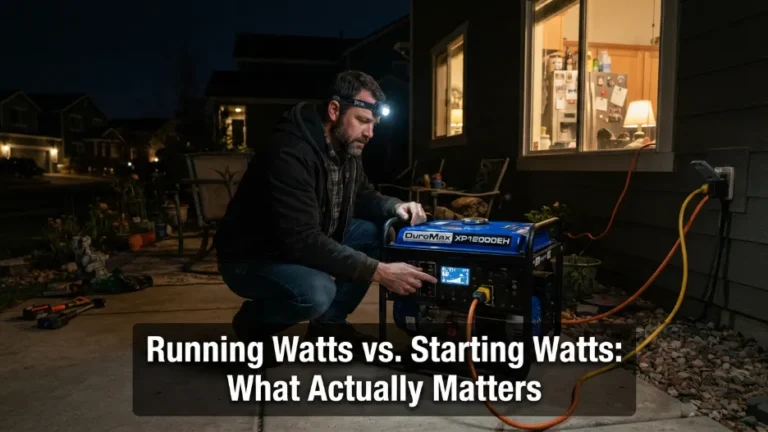
Running watts is the steady output a generator can sustain, and it is the number that matters for most appliances. Peak watts is the short burst available for starting motors, such as a refrigerator compressor or a well pump. Add the running watts of everything you plan to run at the same time, then check that the largest motor’s starting surge fits within the peak rating. A unit with a generous peak but a low running rating will shut down as soon as the load settles.
2. Fuel Type and Runtime
Gasoline is the most available fuel, but it degrades in storage within weeks unless it is treated. Dual-fuel models add propane, which stores almost indefinitely and can run from a standard cylinder. Propane output is usually rated lower than gasoline, so check the propane rating before you plan a critical load around it. Runtime depends on both tank size and load, and a unit running at half its rated output lasts far longer than one pushed to its limit.
3. Inverter vs. Conventional Output
Inverter generators produce a clean sine wave that is safe for laptops, phones, and modern electronics, and they adjust engine speed to the load, which keeps noise down at light use. Conventional generators run at a fixed speed, tend to be louder, and suit heavy fixed-location use where noise matters less. If you power sensitive equipment, check the listing for total harmonic distortion and a clear inverter label.
4. Safety Features and Outlet Layout
Carbon monoxide is the hazard that matters most, so look for built-in CO protection that shuts the engine down when levels rise. Confirm the outlet layout too, with enough 120-volt outlets for your devices and a 12-volt DC output where you need one for vehicle or RV gear. Overload protection and a low-oil shutdown guard both your appliances and the engine. None of these features replaces placing the unit outdoors, away from doors and windows.

WEN 56235i 2350-Watt Portable Inverter Generator — Best Overall Balance
Best for: everyday backup and camping
Most buyers ask a generator to do three jobs: keep the fridge running during an outage, power a few lights, and survive a weekend trip. The 56235i handles all three with 1,850 rated running watts and 2,350 peak watts, enough to start a refrigerator without tripping. It ranks first because it balances output against weight, which the 3,800-watt models cannot match. Skip it if your must-run list includes a well pump or several large appliances at once.
- 2,350 peak watts gives a starting margin for refrigerator compressors, the surge that smaller units often cannot handle.
- Inverter output is clean enough for laptops, phones, and modern appliances.
- Movable for short hauls with a helper, unlike the heavier frames higher in this list.
- Not enough running capacity to run a well pump alongside a refrigerator.
- Runtime drops quickly at high load, so plan refueling for long outages.
| Running watts | 1,850 |
| Peak watts | 2,350 |
| Fuel | Gasoline |
| Weight class | Mid |
7/10
9/10
9/10

WEN 56380i 3800-Watt Portable Inverter Generator — Best for Home Backup
Best for: heavier home outage loads
A multi-day outage tests the limits of a light generator, because the fridge, freezer, and sump pump all compete for power. The 56380i offers 3,100 rated running watts and 3,800 peak watts, which gives those loads room to start and run together. It ranks second because the extra output costs you weight and turns the unit into a two-person lift. Skip it if you mostly camp, since the 56235i gives most of the usefulness with much less bulk.
- 3,800 peak watts gives a generous starting margin when several motors start at once.
- Enough running capacity for a refrigerator and a sump pump together, based on typical household motor loads.
- Gasoline-only, which keeps the fuel plan simple.
- Heavy enough that a wheel kit is strongly recommended for any move.
- Noticeably louder at full load than the lighter units in this list.
| Running watts | 3,100 |
| Peak watts | 3,800 |
| Fuel | Gasoline |
| Weight class | Heavy |
9/10
6/10
9/10

WEN 56200i 2000-Watt Portable Inverter Generator — Best Budget Pick
Best for: camping and tailgating
A 2,000-watt inverter covers most camping, tailgating, and emergency charging needs, and many buyers overpay for capacity they never use. The 56200i delivers 1,600 rated running watts and 2,000 peak watts in a frame light enough to carry to a campsite. It ranks third because its output ceiling is firm, so you have to choose your loads carefully. Skip it if you need a refrigerator and a second large appliance running at the same time.
- Light enough for most adults to carry short distances, a real advantage at campsites.
- Inverter output keeps sensitive electronics such as laptops and phones safe to run.
- Single-fuel setup means one fuel to plan for.
- Limited headroom: a refrigerator with lights works, but a second large appliance will overload it.
- Gasoline only. For propane flexibility, look at the dual-fuel DF200T below.
| Running watts | 1,600 |
| Peak watts | 2,000 |
| Fuel | Gasoline |
| Weight class | Light |
5/10
10/10
8/10

WEN DF200T 2000-Watt Dual Fuel Portable Inverter Generator — Best Dual Fuel
Best for: gas or propane flexibility
Dual-fuel models earn their place when gasoline goes stale in storage or fuel is hard to find after a storm. The DF200T runs on gasoline or propane and is rated in the same 2,000-watt class as the 56200i, with 1,600 rated running watts on gasoline. It ranks fourth because propane output is usually rated lower, so the propane figure matters more than the headline number. Skip it if you only ever run on fresh gasoline, since you would be buying a feature you do not use.
- Propane is a backup fuel that stores far longer than gasoline and is easy to source from a standard cylinder.
- Same 2,000-watt class output as the single-fuel 56200i for camping and light backup.
- Inverter-class output suits laptops, phones, and other electronics.
- Propane output is lower, so check the propane rating before planning around it.
- Two fuel systems mean one more thing to check before a storm.
| Running watts | 1,600 (gas) |
| Peak watts | 2,000 |
| Fuel | Gasoline or propane |
| Weight class | Light to mid |
5/10
8/10
9/10

WEN DF475T 4750-Watt Dual Fuel Portable Generator — Highest Output in the Roundup
Best for: heavy loads at a fixed spot
When a backup plan includes a well pump, a refrigerator, and a freezer, the peak rating decides whether the unit can start them at all. The DF475T lists 3,800 rated running watts and 4,750 peak watts, the highest running output in this roundup, with dual-fuel flexibility on top. It ranks fifth because its frame is heavy, so it works as a stay-put backup rather than a camping unit. Skip it if you plan to move it between sites.
- 4,750 peak watts gives the surge margin needed to start demanding motors.
- Dual fuel adds propane as a storage-friendly backup fuel.
- Highest running output here for multi-appliance outages.
- Heavy enough that a wheel kit or a second person is needed for most moves.
- Propane output is lower than gasoline, so verify the propane rating first.
| Running watts | 3,800 |
| Peak watts | 4,750 |
| Fuel | Gasoline or propane |
| Weight class | Heavy |
10/10
4/10
8/10

WEN 56180i 1800-Watt Portable Inverter Generator — Lightweight Inverter Pick
Best for: tailgating and light camp loads
Some jobs are smaller than a full outage: a camp fridge, a few lights, and a set of charging stations. The 56180i is built for that, with 1,400 rated running watts and 1,800 peak watts in a light, easy-to-stow frame. It ranks sixth because the output ceiling is firm, though its portability is excellent for the class. Skip it if you expect to run a refrigerator and a second appliance together.
- Among the lightest inverter units in this roundup, which matters on tailgate days and campsite arrivals.
- Clean inverter output for phones, laptops, and camera gear.
- Compact enough to stow in an SUV or pickup bed with room to spare.
- 1,400 running watts is tight for a refrigerator plus lights, so total your loads first.
- Gasoline only, so there is no fuel switch during a long outage.
| Running watts | 1,400 |
| Peak watts | 1,800 |
| Fuel | Gasoline |
| Weight class | Light |
4/10
9/10
8/10

WEN 56400i 4000-Watt Portable Inverter Generator — Heavier Option for RVs and Job Sites
Best for: RV and job-site loads
RV owners and contractors often need more headroom than a 2,000-watt unit but do not want a full-size frame. The 56400i brings 3,200 rated running watts and 4,000 peak watts into a mid-to-heavy frame, enough headroom to run most RV and tool loads one at a time. It ranks seventh because its output sits close to the 56380i while the frame is heavier, which costs portability. Skip it if your needs stay under 2,000 watts, since the extra weight will not pay off.
- 4,000 peak watts handles the starting surge of compressor-based tools and appliances.
- 120-volt outlets suit a mixed set of loads at a campsite or job site.
- Inverter-class output suits RV electronics.
- Only a modest output gain over the 56380i for a heavier frame.
- Noticeable engine noise at full load on a crowded campsite.
| Running watts | 3,200 |
| Peak watts | 4,000 |
| Fuel | Gasoline |
| Weight class | Mid to heavy |
9/10
4/10
8/10

WEN DF1100T 1100-Watt Dual Fuel Portable Inverter Generator — Best for Camping
Best for: weekend camping and device charging
For a weekend at the lake or a few hours on a job site, a dual-fuel unit at this size covers the basics without much bulk. The DF1100T provides 900 rated running watts and 1,100 peak watts, enough for phones, lights, and a small fan. It ranks eighth because its output is the lowest of the dual-fuel models, which rules it out for compressor-driven appliances. Skip it if you need a refrigerator or any motor-driven appliance running.
- Easy to carry and store, a strong fit for car camping.
- Dual-fuel flexibility, including propane for easy long-term storage.
- Clean inverter output for phones, cameras, and small electronics.
- Too little output for refrigerators or other compressor-driven appliances.
- Lowest running output of the dual-fuel models in this list.
| Running watts | 900 |
| Peak watts | 1,100 |
| Fuel | Gasoline or propane |
| Weight class | Light |
2/10
9/10
9/10

WEN 56125i 1200-Watt Portable Inverter Generator — Smallest Pick for Small Devices
Best for: phones, tablets, and small tools
If your needs are phones, tablets, a camp light, and a travel fan, a larger generator is overkill and takes up storage space you do not have. The 56125i delivers 1,000 rated running watts and 1,200 peak watts, and it is the smallest unit in this roundup. It ranks ninth because it offers the least headroom, though it wins on carry-ability and fuel burned at light loads. Skip it if you need to run a refrigerator, since it is unlikely to start one reliably.
- Smallest unit in the roundup, easy to store in a trunk.
- Clean inverter output for phones, tablets, and small electronics.
- Light loads on a small engine mean less fuel burned per hour.
- Cannot reliably start a refrigerator or any compressor motor.
- Little room to grow, so expanding needs will outgrow it quickly.
| Running watts | 1,000 |
| Peak watts | 1,200 |
| Fuel | Gasoline |
| Weight class | Ultralight |
2/10
10/10
7/10

WEN 56475 4750-Watt Portable Generator — Heavy-Duty Gasoline Option
Best for: fixed-spot gasoline backup
Some buyers want the maximum output a single gasoline unit can give and do not need to move it often. The 56475 delivers 3,500 rated running watts and 4,750 peak watts on gasoline only, a straightforward choice for a fixed backup plan. It ranks last because it offers the least portability and no propane option. Skip it if you plan to carry the unit to campsites or need quiet operation.
- A single gasoline fuel keeps the plan simple.
- 4,750 peak watts handles large starting surges.
- Suits a permanent spot where weight matters less.
- Very heavy, so moving it alone is not realistic.
- Expect more engine noise than the inverter models in this list.
| Running watts | 3,500 |
| Peak watts | 4,750 |
| Fuel | Gasoline |
| Weight class | Heavy |
9/10
2/10
7/10
Top 3 Head-to-Head: 56235i vs. 56380i vs. 56200i
These three cover the most common choices: a balanced mid-size unit, a high-output model for heavier loads, and a light budget option for camping.
| Feature | #1 56235i | #2 56380i | #3 56200i |
|---|---|---|---|
| Running watts | 1,850 | 3,100 — Best | 1,600 |
| Peak watts | 2,350 | 3,800 — Best | 2,000 |
| Weight class | Mid | Heavy | Light — Best |
| Choose if… | You want one unit for backup, camping, and jobs | You need the most headroom for home backup | You want the lightest option for light loads |
Who These WEN Generators Are NOT For
Not every buyer needs a portable generator, and some power needs call for an entirely different setup.
If your loads add up to more than about 3,800 running watts, none of the models here will carry them, so prioritize which circuits you run or look at the next size class up.
Common Mistakes to Avoid
These are the mistakes that quietly undermine a good generator, whether they show up at setup, during an outage, or months later in the garage.
Frequently Asked Questions About WEN Portable Generators
How many watts do I need for a portable generator?
Start with your largest motor, since its starting surge sets the minimum peak rating, then leave about 20 percent of running capacity unused.
Can I run a CPAP machine on a WEN inverter generator?
Generally yes, because inverter output is clean and a CPAP draws modest power. Confirm the wattage on the machine’s label and check with your sleep provider about backup power planning.
How long will a WEN portable generator run on one tank?
It depends on the load, and the runtime on the box usually assumes a fraction of rated output. Expect a much shorter run at full load, and check the manufacturer’s runtime chart for your tank size before planning a long outage.
Can a WEN generator be used in the rain?
Only under a ventilated, open-sided shelter that keeps water off the unit while letting exhaust escape. Never run it inside a tent, an enclosed porch, or any structure, even when it is raining hard.
Do I need a transfer switch to power my house?
Yes, if you want to power house circuits. Plugging a generator into a wall outlet, called backfeeding, can electrocute utility workers and damage your equipment, so use a listed transfer switch or inlet kit installed by a licensed electrician.
How often should I run a generator that sits in storage?
Start it about once a month and let it run for 15 to 20 minutes under a real load, not just at idle. That keeps the engine warm and the moving parts working, which reduces the chance of a no-start on the day you need it.
Our Final Verdict
The WEN lineup is wide enough that the wrong model is easy to buy, usually because people size for their best day instead of their worst. The real tension is between headroom and portability: every extra watt tends to add weight, and every pound you save costs some output.
If you want one generator for backup and weekend trips, the 56235i fits most households. If your outage list includes a well pump or a larger appliance, choose the 56380i and accept the extra weight. If your loads are phones, lights, and a small fan, and you will move the unit alone, choose the 56200i.

Hi, I’m Michael Turner. I own a generator workshop in the United States and founded HomeGeneratorBlog to share practical, hands-on guidance about generator installation, maintenance, troubleshooting, safety, and backup power solutions. My goal is to help homeowners make smarter, more confident decisions through clear and reliable information