10 Best Pulsar Portable Generators for 2026: Home Backup Without the Guesswork
The 10 best Pulsar portable generator list starts with the Pulsar G12KBN — 9,500 running watts on gasoline, plus propane flexibility. We compared 10 Pulsar portable generators from published specifications, scoring each on Power Output, Runtime and Fuel Efficiency, and Portability and Ease of Use. Most generators look similar on paper but fail when starting loads, fuel, or noise matter most. Whether you need home backup, RV power, or quiet camping power, this guide gives you one clear answer.
Quick Comparison: All 10 Products Ranked
| # | Product | Best For | Rating | Badge | |
|---|---|---|---|---|---|
| 1 | Pulsar G12KBN 12,000W Dual Fuel Portable Generator | Home backup with two fuel options | 4.9/5 | Best Overall | Buy → |
| 2 | Pulsar PGD105TiSCO 10,500W Tri-Fuel Portable Inverter Generator with CO Sentry | Homes with natural gas access | 4.8/5 | Best Tri-Fuel | Buy → |
| 3 | Pulsar PG13000BRCO 13,000W Dual Fuel Portable Generator with CO Alert | Large homes and job sites | 4.7/5 | Best Maximum Power | Buy → |
| 4 | Pulsar GD10KBN 10,500W Dual Fuel Portable Inverter Generator | RV and home backup | 4.6/5 | Best Large Inverter | Buy → |
| 5 | Pulsar PG10000B16 10,000W Dual Fuel Portable Generator | Essential home backup | 4.5/5 | Best Mid-Size Backup | Buy → |
| 6 | Pulsar PG4500BiSRCO 4,500W Dual Fuel Inverter Generator with CO Shutdown Sensor | RV and camping | 4.4/5 | Best RV Inverter | Buy → |
| 7 | Pulsar PG5250B 5,250W Dual Fuel Portable Generator | Job sites and essentials | 4.3/5 | Best Value Dual Fuel | Buy → |
| 8 | Pulsar PG2300iS 2,300W Portable Super Quiet Inverter Generator | Camping and light electronics | 4.2/5 | Best Quiet Camping | Buy → |
| 9 | Pulsar PG2200BiS 2,200W Portable Dual Fuel Inverter Generator | Camping with propane backup | 4.1/5 | Best Budget Dual Fuel | Buy → |
| 10 | Pulsar PG4500iSR 4,500W Portable Inverter Generator with Remote Start | RV users wanting simplicity | 4.0/5 | Best Gas RV Pick | Buy → |
How We Chose These Pulsar Portable Generators
What we compared
We compared 10 Pulsar models using manufacturer and retailer specification listings, focusing on peak and running watts, fuel type, tank size, runtime at half load, noise, weight, and outlets.
Our 3 scoring criteria
Power Output, Runtime and Fuel Efficiency, and Portability and Ease of Use were applied to every model, so the ranking reflects the same three questions throughout.
Limits of this comparison
No hands-on testing was done for this guide, so scores reflect published specifications and practical fit, not measured output, noise, or runtime in our own tests.
What we cut — and why
We excluded non-Pulsar models and Pulsar models without clear portable-generator specifications, so every pick here is a Pulsar portable generator with a verifiable wattage class.
What to Look for When Buying a Pulsar Portable Generator
Start with the load, then the fuel, then where the generator will actually live. A model that looks strong on watts can still disappoint if it needs fuel you cannot store, is too loud for a campsite, or lacks the outlet your appliance needs.
1. Wattage: running watts matter more than peak watts
Peak watts help start a motor, but running watts decide what you can keep on together. Add up the running watts of your essentials, then add headroom for the largest starting load, because a refrigerator or well pump draws more for a moment when it starts.
If you plan to run a well pump or larger appliance, check generators with a 240V outlet before you buy.
2. Fuel type: gasoline, dual fuel, or tri-fuel
Gasoline is simple and widely available, but it goes stale and needs safe storage. Dual fuel adds propane, which stores longer and gives you a second option during a fuel shortage. Tri-fuel adds natural gas for homes with a suitable connection, though that connection should be handled professionally.
3. Inverter or conventional open-frame
Inverter generators generally produce cleaner power for sensitive electronics and run quieter, which helps at campsites and around an RV. Conventional open-frame models usually give more watts for the money, but they are louder and better suited to tools and larger home loads.
For sensitive electronics, start with Pulsar inverter generator options and check the wattage class first.
4. Portability and starting
Weight, wheels, handles, and start type change how usable a generator is in real life. A 200-pound unit with wheels is manageable on flat ground but still needs help on steps or into a truck. Electric and remote start help in cold, wet, or dark conditions, while recoil start keeps the design simpler.
If starting in bad weather matters, compare remote-start portable generator guides before choosing a recoil-only model.
5. Safety, noise, and placement
Run every portable generator outdoors, well away from doors, windows, and vents, and never in a garage, even with the door open. Check the noise rating against your setting: a quiet inverter suits camping, while an open-frame unit may disturb neighbours at night.
For extra protection, look at portable generators with CO shutoff and still run them outdoors.

Pulsar G12KBN 12,000W Dual Fuel Portable Generator — Balanced power for whole-home essentials
For many homes, the G12KBN hits the most useful balance in this lineup. It delivers 9,500 running watts on gasoline, so it can cover a refrigerator, lights, fans, and several smaller essentials at once, while propane gives you a second fuel when gasoline is scarce. Electric start removes the hardest part of an outage, and the 120/240-volt outlets support larger appliances. Its main trade-off is weight and the absence of a listed CO shutoff, so placement and a separate CO alarm still matter. Keep a working CO alarm close, and test your load plan before a real outage.
- 9,500 running watts on gasoline
- Propane backup with Switch & Go
- Electric start with recoil backup
- 120/240-volt outlets for essentials
- No CO shutoff listed here
- Heavy to move alone
5.0/5
4.9/5
4.8/5

Pulsar PGD105TiSCO 10,500W Tri-Fuel Portable Inverter Generator with CO Sentry — Three fuels, cleaner inverter power
If fuel flexibility is your priority, this tri-fuel inverter is the standout. It runs on gasoline, propane, or natural gas, so a home with a natural gas connection gains a backup option that does not depend on stored fuel alone. Inverter output suits sensitive electronics, CO Sentry adds a safety layer, and remote start helps in bad weather. The trade-off is clear: at 247 pounds, this is a two-person move, and natural gas connection is not a casual do-it-yourself job. Check natural gas hookup rules first, and keep a working CO alarm in the home.
- Gasoline, propane, natural gas
- CO Sentry safety shutoff included
- Remote, electric, recoil start
- 62 dB inverter operation
- 247 pounds, very heavy
- Natural gas needs professional hookup
4.9/5
4.7/5
4.8/5

Pulsar PG13000BRCO 13,000W Dual Fuel Portable Generator with CO Alert — Maximum output, remote-start convenience
When the load list is long, the PG13000BRCO gives you the most headroom in this guide. Its 10,200 running watts on gasoline can support more large appliances and tools than the mid-size models, and remote start is genuinely useful when the generator sits outside in rain or cold. Dual fuel adds flexibility during a long outage. The cost of that power is size and noise: it is heavy, louder than any inverter here, and still needs safe outdoor placement. Keep spare fuel, oil, and a working CO alarm ready before storm season.
- 13,000 peak watts on gasoline
- CO Alert safety feature
- Remote, electric, recoil start
- 9.5-gallon fuel tank
- 232 pounds, needs two people
- 80.5 dB, louder than inverters
5.0/5
4.5/5
4.6/5
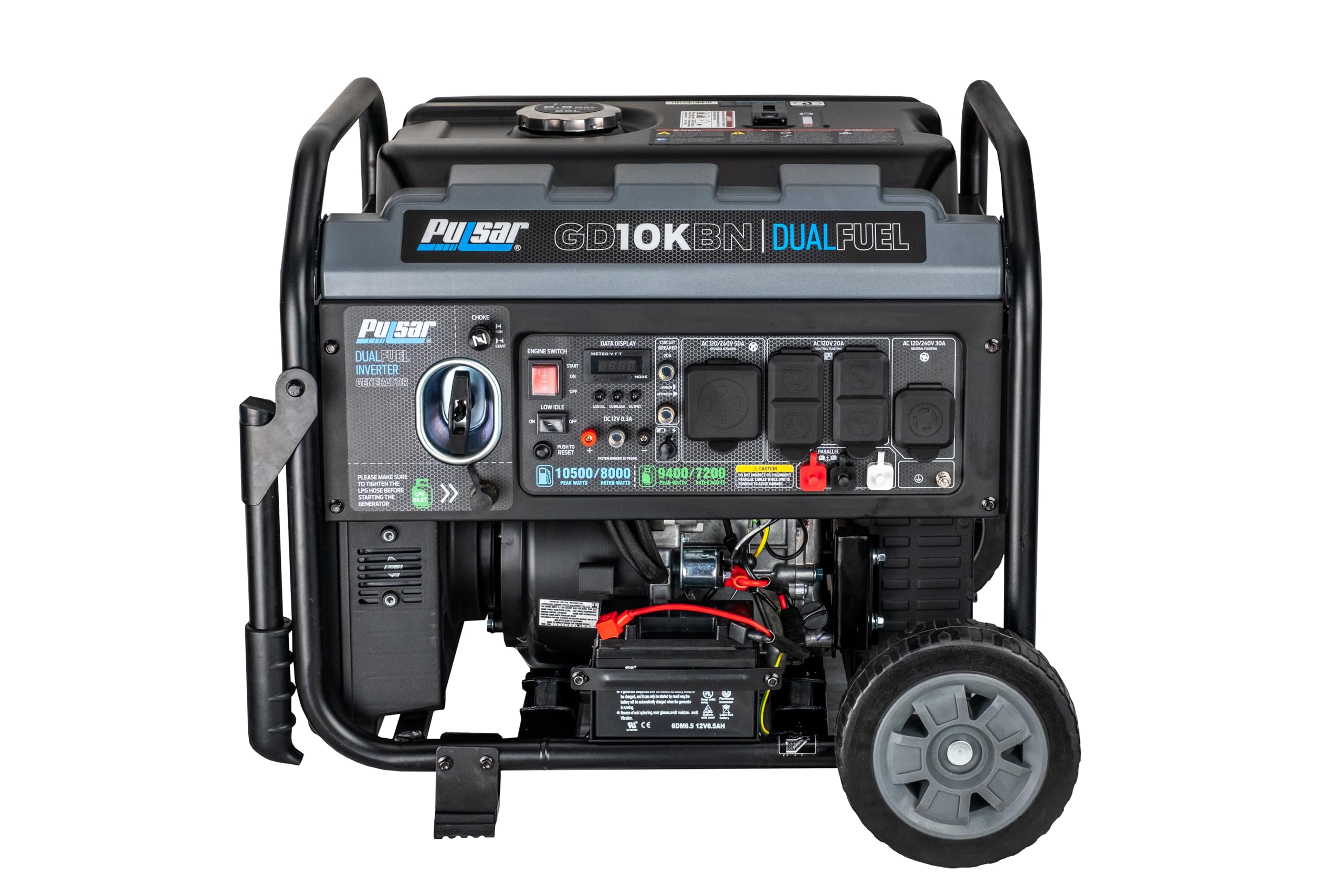
Pulsar GD10KBN 10,500W Dual Fuel Portable Inverter Generator — Large inverter power, RV ready
The GD10KBN bridges home backup and RV use better than most large Pulsar models. Inverter output protects sensitive electronics, dual fuel gives you a propane fallback, and the wheel kit helps move a large unit into position. With 8,000 running watts on gasoline, it covers major essentials rather than just phones and lights. It is still a large generator, so do not expect the easy carrying of a small camping inverter, and propane output is lower than gasoline output. Check the RV outlet type first, and keep a working CO alarm nearby.
- 10,500 peak watts, inverter output
- Dual fuel gasoline and propane
- Electric start, wheel kit
- RV-ready 120/240-volt outlets
- Heavier than small inverters
- Propane running watts lower
4.8/5
4.6/5
4.4/5

Pulsar PG10000B16 10,000W Dual Fuel Portable Generator — Strong mid-size home backup
The PG10000B16 is a practical middle step between small camping power and whole-home units. It offers 8,000 running watts on gasoline, enough for a refrigerator, freezer, lights, and several tools, with propane as a useful second fuel. Switch & Go lets you change fuels while running, and the 12-hour half-load runtime reduces refuelling trips. It is bulky and not quiet, so plan for outdoor placement, wheels, and a second person for loading. Plan fuel storage early, and keep a working CO alarm in the home during outages.
- 10,000 peak watts on gasoline
- Switch & Go fuel switching
- 12 hours at half load
- Electric start with recoil backup
- About 209 pounds, bulky
- 76 dB, not quiet
4.6/5
4.6/5
4.3/5

Pulsar PG4500BiSRCO 4,500W Dual Fuel Inverter Generator with CO Shutdown Sensor — Quiet RV power, two fuels
For RV owners, the PG4500BiSRCO is one of the most complete small Pulsar packages. It combines dual fuel, inverter output, a CO shutdown sensor, and remote start, so you can power an RV air conditioner and sensitive devices without walking outside in bad weather. Parallel capability leaves room to grow if one unit is not enough. At 103 pounds it is not a one-hand carry, and you will need a separate parallel kit to link two units. Keep the remote fob charged, and test the unit with your RV load first.
- Dual fuel with CO sensor
- Remote, electric, recoil start
- Parallel capable for more power
- 64 dB, quieter than open-frame
- 103 pounds, still heavy
- Parallel kit sold separately
4.3/5
4.6/5
4.3/5

Pulsar PG5250B 5,250W Dual Fuel Portable Generator — Affordable dual-fuel workhorse
The PG5250B is the sensible dual-fuel choice when budget and simplicity matter more than remote start. It delivers 4,250 running watts on gasoline, enough for a refrigerator, sump pump, tools, and lights, with propane as a backup fuel. Switch & Go avoids shutting down to change fuels, and the 12-hour half-load runtime is strong for its size. Recoil-only starting is the main compromise, so it suits buyers comfortable with a pull start. Store fuel safely, and always keep a working CO alarm close during any outage before you rely on it.
- 5,250 peak watts on gasoline
- Switch & Go fuel switching
- 12 hours at half load
- 120/240-volt output
- Recoil start only
- 72 dB, audible outdoors
4.3/5
4.5/5
4.1/5

Pulsar PG2300iS 2,300W Portable Super Quiet Inverter Generator — Light, quiet camping power
The PG2300iS is built for quiet, light use rather than home backup. At about 53 pounds and 59 dB, it is easy to carry to a campsite and far less intrusive than an open-frame generator. Inverter output and a USB outlet suit phones, laptops, lights, and small fans. Its limit is power: 1,800 running watts will not run a large refrigerator and air conditioner together, and gasoline is the only fuel, so plan refuelling carefully. Pack extra fuel, and keep the unit outdoors well away from tents and sleeping areas.
- Only about 53 pounds
- 59 dB super quiet operation
- USB outlet for small devices
- Parallel capable for growth
- 1,800 running watts only
- Gasoline only, no propane
3.9/5
4.2/5
4.5/5

Pulsar PG2200BiS 2,200W Portable Dual Fuel Inverter Generator — Small dual-fuel, USB ready
The PG2200BiS answers a simple camping problem: what happens when gasoline runs out? Adding propane to a small inverter gives you a second fuel without moving to a heavy open-frame unit. It still suits light loads only, such as phones, lights, fans, and small electronics, and it will not replace a home backup generator. For a portable, dual-fuel companion that stays easy to carry, that trade-off is the point. For camping, pack both fuels, check the load limit first, and keep the unit outdoors well away from tents and sleeping areas.
- Dual fuel in small size
- USB outlet included
- Parallel capable design
- Inverter output for electronics
- Lowest wattage in guide
- Shorter runtime than larger units
3.8/5
4.1/5
4.4/5

Pulsar PG4500iSR 4,500W Portable Inverter Generator with Remote Start — Simple gas-only RV power
The PG4500iSR is for RV users who want remote start and inverter power without managing a second fuel. It delivers 3,700 running watts, enough for many RV air conditioners and essentials, with parallel capability if you later need more output. The simplicity is also its limit: gasoline is the only fuel, so a long outage or a distant fuel stop matters more here than with the dual-fuel version. Choose it for convenience, not maximum fuel flexibility. Test the RV load first, and keep a working CO alarm nearby during use.
- 4,500 peak watts, inverter output
- Remote start convenience
- Parallel capable, RV ready
- Quieter than open-frame models
- Gasoline only, no propane
- Remote fob needs care
4.1/5
3.9/5
4.0/5
Top 3 Head-to-Head: Pulsar G12KBN vs Pulsar PGD105TiSCO vs Pulsar PG13000BRCO
These three are the common final choices because they cover the three main priorities in this guide: balanced home backup, maximum fuel flexibility, and maximum output. The right one depends on which of those you value most, not on watts alone.
| Feature | #1 G12KBN | #2 PGD105TiSCO | #3 PG13000BRCO |
|---|---|---|---|
| Power Output | 9,500 running watts | 8,500 running watts | 10,200 running watts — Best |
| Runtime and Fuel Efficiency | Up to 12 hours — Best | Up to 9 hours | Up to 9.5 hours |
| Portability and Ease of Use | Electric start, wheels — Best | Remote start, 247 pounds | Remote start, 232 pounds |
| Fuel Flexibility | Gasoline and propane | Gasoline, propane, natural gas — Best | Gasoline and propane |
| Choose if… | You want the best balance of power, runtime, and outlets | You want three fuels and inverter output | You want the largest single-unit output |
Who These Pulsar Portable Generators Are NOT For
A portable generator is not a silent, automatic whole-home system, and buying one with that expectation leads to disappointment.
They are also a poor fit for backpacking, for powering a home without any outdoor space, or for anyone who cannot safely store fuel and move a heavy unit. In those cases, a smaller power station, a professionally installed system, or a different backup plan may fit better.
Common Mistakes to Avoid
Most generator regret comes from a sizing, fuel, or placement mistake, not from the brand itself.
Frequently Asked Questions About Pulsar Portable Generators
What size Pulsar portable generator do I need for home backup?
Start with your essential running watts, then add headroom for the largest starting load. For many homes, 8,000 to 9,500 running watts covers a refrigerator, freezer, lights, fans, and smaller tools, while smaller loads suit a 3,700-watt RV inverter. List the appliances you truly need during an outage before choosing a wattage class, because buying on peak watts alone often leaves you short.
Are Pulsar dual fuel generators worth it?
Yes, for many buyers, because propane stores longer than gasoline and gives you a second fuel during a shortage. Dual-fuel models in this guide use Switch & Go technology, which lets you change fuels while the generator is running. The trade-off is lower output on propane, so size the generator on its propane running watts if propane will be your main backup fuel.
Can a Pulsar inverter generator power sensitive electronics?
Yes, inverter models are designed to produce cleaner, more stable power for laptops, phones, televisions, and other sensitive devices. Check the model’s wattage and outlet type before connecting a device, and avoid overloading the unit. For larger appliances and tools, a higher-wattage open-frame model may still be the better choice, even if it is louder.
How loud is a Pulsar portable generator?
It depends on the type. Small inverters in this guide are rated around 59 to 64 dB, which is much quieter than large open-frame models rated around 76 to 80 dB. Noise ratings are manufacturer figures at a stated load and distance, so treat them as a comparison guide, not a promise for your garden. For campsites and close neighbours, a quiet inverter is the safer choice.
Can I run a Pulsar generator in the rain or inside a garage?
No, never run a portable generator inside a garage, home, or enclosed space, even with a door open, because carbon monoxide can build up quickly. Outdoor use in rain needs a suitable generator cover or shelter that still allows airflow and keeps exhaust away from the home. Always place the unit outdoors, away from doors, windows, and vents, and use a working CO alarm indoors.
What is CO Sentry or a CO shutdown sensor on Pulsar generators?
CO Sentry and CO shutdown sensors are safety features that detect rising carbon monoxide levels and shut the generator down. They add a valuable layer of protection, especially during long outages, but they do not make indoor use safe. A CO sensor is a backup safety measure, not a substitute for correct outdoor placement, distance from the home, and a separate indoor CO alarm.
Our Final Verdict
Pulsar covers the full range from quiet camping inverters to 13,000-watt home backup, but the best choice is the one that matches your running watts, fuel plan, and outdoor space. For most homes, the G12KBN gives the strongest balance of power, runtime, and flexibility without moving to the heaviest class.

Hi, I’m Michael Turner. I own a generator workshop in the United States and founded HomeGeneratorBlog to share practical, hands-on guidance about generator installation, maintenance, troubleshooting, safety, and backup power solutions. My goal is to help homeowners make smarter, more confident decisions through clear and reliable information