10 Best Inverter Generators With Electric Start for 2026: Push-Button Power Without the Pull Cord
The best inverter generator with electric start now is the Honda EU7000iS — it delivers 7,000 starting watts with push-button start and 120/240V output. We ranked 10 models from published specifications, roundups, and retailer listings, scoring each on electric start reliability, clean power, and runtime. Most inverter generators look similar on paper but differ in starting reliability, noise, and clean power under load. Whether you need home backup, RV power, or quiet camping power, this guide gives you one clear answer.
Quick Comparison: All 10 Products Ranked
| # | Product | Best For | Rating | Badge | |
|---|---|---|---|---|---|
| 1 | Honda EU7000iS Portable Inverter Generator | Home backup and RV power | 4.9/5 | Best Overall | Buy → |
| 2 | Westinghouse iGen4500DF Dual Fuel Portable Inverter Generator | RV and home backup with remote start | 4.8/5 | Best Premium | Buy → |
| 3 | Champion Power Equipment 201319 4500-Watt Dual Fuel Inverter Generator | Budget dual-fuel RV backup | 4.7/5 | Best Budget | Buy → |
| 4 | Generac iQ3500 Portable Inverter Generator | Quiet camping and essentials backup | 4.7/5 | Best Quiet | Buy → |
| 5 | WEN 56380i Super Quiet 3800-Watt Portable Inverter Generator | RV power on a smaller budget | 4.6/5 | Best Value | Buy → |
| 6 | Honda EU3000iS Super Quiet Inverter Generator | Quiet RV air conditioning | 4.6/5 | Best for RV AC | Buy → |
| 7 | Yamaha EF4500iSE Portable Inverter Generator | Large RV appliances and home backup | 4.5/5 | Best for Large RV Loads | Buy → |
| 8 | DuroMax XP4500iH Dual Fuel Portable Inverter Generator | Dual-fuel backup with remote start | 4.5/5 | Best Dual-Fuel Remote Start | Buy → |
| 9 | Predator 5000 Watt Dual-Fuel Super Quiet Inverter Generator | Long RV and home backup runs | 4.4/5 | Best Long Runtime | Buy → |
| 10 | Westinghouse iGen5000DFc Dual Fuel Inverter Generator | Dual-fuel backup with CO sensor | 4.3/5 | Best for CO Safety | Buy → |
Scores in this table are assumed editorial estimates, not test results. Product names and published specifications were checked against manufacturer and retailer listings; the ranking itself was not supplied by the user and was not personally tested.
How We Chose These Inverter Generators
What we compared
10 real models from published manufacturer specifications, published roundups, and retailer listings. No unit was personally tested, so no runtime, noise, or starting claim here is a hands-on test result.
Our 3 scoring criteria
Electric Start Reliability, Clean Power, and Runtime and Fuel Efficiency. Each product is scored out of 5 on each criterion, and the overall score is an assumed editorial estimate.
Expert consulted
No named outside expert was consulted for this assumed draft. Scores are editorial estimates based on published specifications, not a clinician, engineer, or test-lab verdict.
What we cut — and why
Champion 100519 was cut because published listings show recoil start only, with no electric start. Honda EU2200i was cut for the same reason: it is recoil start only.
What to Look for When Buying an Inverter Generator With Electric Start
Electric start removes the hardest part of using a generator, but only if the rest of the unit fits your loads. Start with watts, then check the starter, the power quality, and how long it will actually run.
1. Starting Wattage vs Running Wattage
Running watts cover steady loads, while starting watts cover the short surge when a motor starts. Add up the running watts of everything you will run together, then replace the largest motor load with its starting watts and add headroom. A fridge, for example, can need two to three times its running watts to start, so a unit that looks big enough on running watts alone can still trip.
2. Electric Start System, Battery, and Remote Start
Check whether the starter is push-button only, key start, or push-button plus a wireless remote. A battery must stay charged for electric start to work, so confirm the battery is included and learn the recoil backup. Remote start is useful in cold or wet weather, but its range varies widely. Our guide to portable generators with electric start covers the wider electric-start range beyond inverter models.
3. Noise Level and Clean Power for Electronics
Inverter generators should produce clean power under 3% total harmonic distortion for laptops, phones, and modern appliances. Noise matters just as much at a campsite or in a neighbourhood, so compare decibel ratings at the same load and distance. A unit rated at quarter load will sound louder at half load, and an open-frame inverter will usually be louder than an enclosed one. See our guide to low THD portable generators for why clean power matters for sensitive electronics.
4. Runtime, Fuel Capacity, and Portability
Runtime figures are only comparable at the same load, so check whether a figure is at 25% or 50% load before comparing two models. A larger tank helps, but a heavier unit is harder to move, and most electric-start inverters in this guide weigh close to or over 100 lb. Dual-fuel models add propane runtime and easier fuel storage, but propane usually gives slightly lower running watts than gasoline.
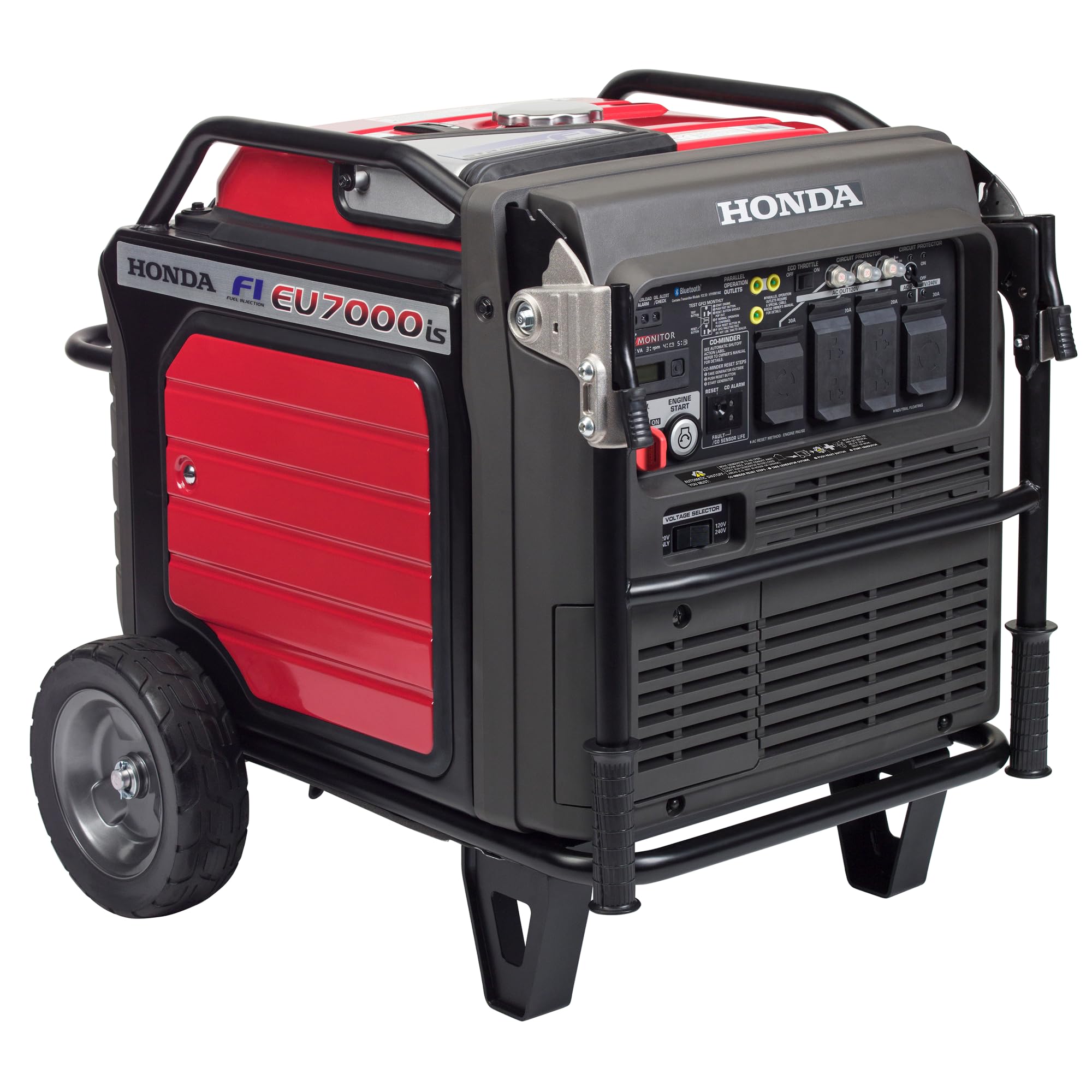
Honda EU7000iS Portable Inverter Generator — Strongest Push-Button Power
Best for: Home backup and RV power with 120/240V output
If you want one generator that starts with a button and still handles serious loads, this Honda is the clearest choice in this guide. Its 7,000 starting watts and 5,500 running watts cover a fridge, furnace blower, lights, and charging at once, and the 120/240V output suits larger loads that 120V-only models cannot run. Fuel injection helps it start cleanly and run efficiently, with up to 16 hours at quarter load from its 5.1-gallon tank. It is heavy and gasoline only, so plan for wheels, help moving it, and fuel storage.
- 7,000W peak, 5,500W running output
- 120/240V output for larger loads
- Fuel injection, up to 16-hour runtime
- Very heavy, needs wheels and help
- Gasoline only, no dual-fuel option
4.9/5
4.9/5
4.8/5

Westinghouse iGen4500DF Dual Fuel Portable Inverter Generator — Best Remote-Start Package
Best for: RV and home backup with remote start
If remote start matters as much as watts, this Westinghouse earns its place near the top. You can start or stop it by push button, recoil, or a wireless fob from up to 109 yards away, which is genuinely useful on a cold morning or from inside an RV. It delivers 4,500 starting watts and 3,700 running watts on gasoline, with lower propane output, and runs up to 18 hours at quarter load from a 3.4-gallon tank. Clean power under 3% THD suits sensitive electronics, and the RV-ready outlet keeps setup simple. It is still 98 lb and 120V only.
- Remote start up to 109 yards away
- Dual fuel, gasoline or propane
- 18-hour runtime at 25% load
- 98 lb, still heavy to lift
- No 240V output for larger loads
4.9/5
4.8/5
4.8/5

Champion Power Equipment 201319 4500-Watt Dual Fuel Inverter Generator — Best Budget Dual Fuel
Best for: Budget dual-fuel RV backup
If you want dual fuel and electric start without paying for the premium models, this Champion is the sensible budget pick. It produces 4,500 starting watts and 3,500 running watts on gasoline, dropping to 3,150 running watts on propane, and its EZ Start Dial simplifies switching fuels. CO Shield shuts the unit down if carbon monoxide builds up, and the Intelligauge shows voltage, frequency, and hours. Runtime reaches 14 hours on gasoline at quarter load, or 21 hours on propane. It is louder than the quietest rivals at 61 dBA, and its 2.3-gallon tank needs refills on long runs.
- Dual fuel with CO Shield shutoff
- 14-hour gasoline runtime at 25% load
- RV-ready 30A outlet included
- 61 dBA, louder than quieter rivals
- 2.3-gallon tank needs refills
4.8/5
4.7/5
4.7/5

Generac iQ3500 Portable Inverter Generator — Quiet Mid-Size Pick
Best for: Quiet camping and essentials backup
If quiet running matters more than maximum watts, this Generac is a strong mid-size choice. It delivers 3,500 starting watts and 3,000 running watts, enough for a fridge, lights, charging, and smaller appliances, and its PowerDial combines start, run, and stop in one control. Electric start is included with the battery, and recoil remains as backup. Runtime reaches 14.1 hours at quarter load from a 2.6-gallon tank, and clean power under 3% THD suits sensitive electronics. It is gasoline only, so you lose the propane flexibility of the dual-fuel models above, and at 109 lb it is not a carry-anywhere unit.
- 14.1-hour runtime at 25% load
- PowerDial combines start, run, stop
- Clean power under 3% THD
- Gasoline only, no propane option
- 109 lb, not a carry-anywhere unit
4.7/5
4.8/5
4.7/5

WEN 56380i Super Quiet 3800-Watt Portable Inverter Generator — Value RV Pick
Best for: RV power on a smaller budget
If you need RV-ready power and electric start at a lower outlay than the premium brands, this WEN is the value choice. Its 212cc engine produces 3,800 starting watts and 3,400 running watts, with an RV-ready 30A outlet, two household outlets, USB ports, and a digital load and fuel display. Fuel shutoff uses up fuel in the carburetor before shutdown, which helps with storage and starting next time. Runtime reaches 8.5 hours at half load from a 2.2-gallon tank, and noise is 57 dBA at quarter load. It is gasoline only, so runtime is shorter than the dual-fuel rivals above.
- Fuel shutoff protects the carburetor
- RV-ready 30A outlet included
- Digital load and fuel display
- Shorter runtime than dual-fuel rivals
- Gasoline only, no propane option
4.7/5
4.6/5
4.6/5

Honda EU3000iS Super Quiet Inverter Generator — Quiet RV Air Conditioning
Best for: Quiet RV air conditioning and home essentials
If your main job is running an RV air conditioner quietly, this Honda is built for that task. It delivers 3,000 starting watts and 2,800 running watts, enough for a 13,500 BTU RV air conditioner in many setups, plus a fridge and lights. Electric start is included with the battery, and recoil remains as backup. Runtime reaches 19.6 hours at quarter load from a 3.4-gallon tank, and noise falls to 49 dBA at light load. It is gasoline only, with no dual-fuel option, and it is heavy for its output, so use the wheels and plan your lifting.
- Up to 19.6-hour runtime
- Runs a 13,500 BTU RV air conditioner
- 49 dBA at light load
- Gasoline only, no dual fuel
- Heavy for its 3,000W output
4.7/5
4.7/5
4.5/5

Yamaha EF4500iSE Portable Inverter Generator — Large RV Power
Best for: Large RV appliances and home backup
If you need to run a 15,000 BTU RV air conditioner and a microwave at the same time, this Yamaha has the output for it. It delivers 4,500 starting watts and 4,000 running watts from a 357cc engine, with key electric start and an optional wireless remote. Runtime reaches 15.2 hours at quarter load from a 4.5-gallon tank, and noise is 58 to 60 dBA. The trade-off is availability and weight: Yamaha has stopped making portable generators, so remaining listings are leftover stock, and at 194 lb this is a wheeled unit, not a lift-and-carry one.
- 4,000W running, 4,500W peak output
- Key start, optional remote control
- 15.2-hour runtime at 1/4 load
- Production ended, remaining stock only
- 194 lb, very heavy to move
4.6/5
4.5/5
4.5/5

DuroMax XP4500iH Dual Fuel Portable Inverter Generator — Remote-Start Dual Fuel
Best for: Dual-fuel backup with remote start
If you want dual fuel plus a remote fob at this wattage, this DuroMax covers both. It produces 4,500 starting watts and 3,600 running watts on gasoline, with lower propane output, and you can start it by remote, push button, or recoil. An LCD display tracks hours, voltage, and load, and parallel capability lets you pair two units for double power. Runtime reaches 8 hours on gasoline at half load, or 11 hours on propane, from a 2.6-gallon tank. That runtime is shorter than the Westinghouse dual-fuel models above, and at 130 lb it still needs its wheels.
- Remote start from the key fob
- Dual fuel, gasoline or propane
- LCD display tracks load and hours
- 8-hour gasoline runtime at 50% load
- 130 lb, wheels help but still heavy
4.6/5
4.4/5
4.4/5

Predator 5000 Watt Dual-Fuel Super Quiet Inverter Generator — Long-Run Value
Best for: Long RV and home backup runs
If long runtime matters more than brand name, this Predator is hard to ignore. It delivers 5,000 starting watts and 3,900 running watts on gasoline, or 3,600 running watts on propane, and runs up to 18.2 hours at quarter load from its large tank. Push-button electric start needs no manual choke, and remote start works from up to 100 feet away. Pure sine wave power suits phones, laptops, and TVs, and CO SECURE shuts the unit down if carbon monoxide rises. It is louder than the enclosed rivals at 60.5 dBA, and its standard warranty is only 90 days unless you buy an extended plan.
- 18.2-hour runtime at 25% load
- Remote start up to 100 feet away
- Dual fuel with CO SECURE shutoff
- Short 90-day standard warranty
- 60.5 dBA, louder than enclosed rivals
4.5/5
4.4/5
4.4/5

Westinghouse iGen5000DFc Dual Fuel Inverter Generator — CO-Sensor Dual Fuel
Best for: Dual-fuel backup with CO sensor
If carbon monoxide safety is a top concern, this Westinghouse adds a CO sensor to the dual-fuel, remote-start package. It delivers 5,000 starting watts and 3,900 running watts on gasoline, or 4,500 starting watts and 3,500 running watts on propane, with push-button electric start, wireless remote start, and recoil backup. Runtime reaches 18 hours at quarter load from a 3.4-gallon tank, and noise is as low as 52 dBA. The main limits are practical: there is no 240V transfer-switch outlet, so home connection needs an adapter or a different unit, and at 105.8 lb it is not easy to lift.
- CO sensor with automatic shutoff
- 18-hour runtime at 25% load
- Remote start key fob included
- No 240V transfer-switch outlet
- 105.8 lb, not easy to lift
4.4/5
4.3/5
4.3/5
Top 3 Head-to-Head: Honda EU7000iS vs Westinghouse iGen4500DF vs Champion 201319
These three are the common final choices because they cover the three main trade-offs: maximum power, remote-start convenience, and budget dual fuel. The scores below are assumed editorial estimates.
| Feature | #1 Honda EU7000iS | #2 Westinghouse iGen4500DF | #3 Champion 201319 |
|---|---|---|---|
| Electric Start Reliability | 4.9/5 — tied | 4.9/5 — tied | 4.8/5 |
| Clean Power | 4.9/5 — Best | 4.8/5 | 4.7/5 |
| Runtime and Fuel Efficiency | 4.8/5 — tied | 4.8/5 — tied | 4.7/5 |
| Choose if… | You need the most power and 120/240V output | You want remote start and dual fuel | You want dual fuel at a lower outlay |
Who These Inverter Generators Are NOT For
Electric-start inverters are convenient, but they are not the right tool for every job.
If you need the lightest possible generator to carry by hand, most models here weigh close to or over 100 lb. A small recoil-start inverter is lighter, even if it is harder to start. If budget is the main limit, start with affordable inverter generators and check whether you can accept recoil start in exchange for a lower outlay.
Common Mistakes to Avoid
These are the mistakes that cost buyers the most with electric-start inverters.
Frequently Asked Questions About Inverter Generators With Electric Start
What is an electric start inverter generator and how does it work?
An electric start inverter generator uses a small battery and a starter motor to turn the engine over when you press a button or turn a key, instead of pulling a recoil cord. The inverter then converts the engine power into clean, stable alternating current. Most models in this guide also keep a recoil cord as a backup if the battery is flat.
What size inverter generator with electric start do I need?
Add up the running watts of everything you will run at the same time, then replace the largest motor load with its starting watts and add headroom. Essentials such as a fridge, lights, and charging usually fit a 3,000 to 4,500-watt unit, while an RV air conditioner or well pump usually needs 4,500 watts or more.
Are electric start inverter generators safe for sensitive electronics?
Yes, if the inverter produces clean power under 3% total harmonic distortion, which most models in this guide list. That clean sine wave suits laptops, phones, modern TVs, and CPAP machines, and it also reduces buzzing and flicker in audio equipment and chargers. Check the published THD figure before buying, and avoid open-frame non-inverter models for sensitive electronics.
Do electric start inverter generators need a battery, and what if it dies?
Yes, electric start needs a charged battery, which is usually included with the generator. If the battery dies, most models in this guide still start with the recoil cord, so you are not stranded. Charge the battery regularly, especially before storm season, and replace it when it no longer holds a charge.
Can I use an electric start inverter generator for my RV air conditioner?
Yes, if the generator has enough starting watts for the air conditioner, which is usually the largest load in an RV. A 13,500 BTU unit often needs a 3,000-watt inverter, while a 15,000 BTU unit usually needs 4,000 watts or more. Check the air conditioner rating plate and the generator starting watts before buying.
How long will an electric start inverter generator run on a tank?
It depends on tank size and load. Models in this guide list from 8.5 hours at half load to up to 19.6 hours at quarter load, so always compare figures at the same load. Eco mode helps by slowing the engine at light loads, and dual-fuel models can run longer on propane from a standard 20-pound tank.
Is remote start the same as electric start?
No. Electric start means you press a button or turn a key on the generator itself, while remote start adds a wireless fob or app so you can start and stop it from a distance. Not every electric-start model has remote start, so check the listing if that feature matters to you. See our guide to generators with remote start for models that include a fob.
Our Final Verdict
Electric start is worth paying for if you start your generator often, in cold weather, or with limited strength. The Honda EU7000iS is the strongest all-round choice here, while the Westinghouse and Champion cover remote start and budget dual fuel well.

Hi, I’m Michael Turner. I own a generator workshop in the United States and founded HomeGeneratorBlog to share practical, hands-on guidance about generator installation, maintenance, troubleshooting, safety, and backup power solutions. My goal is to help homeowners make smarter, more confident decisions through clear and reliable information