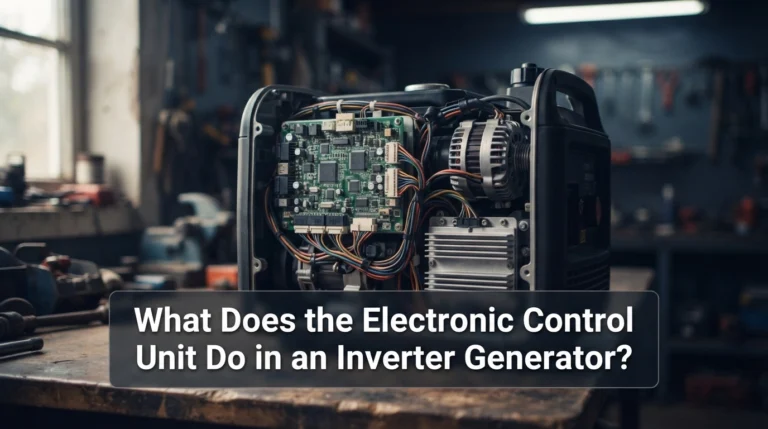
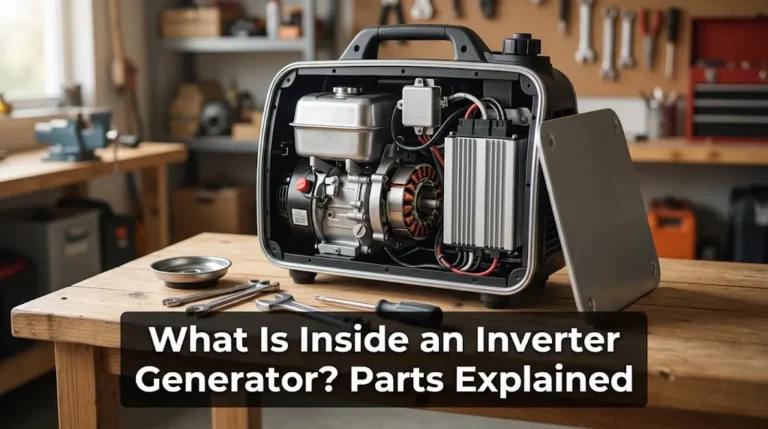
How Do You Identify an Inverter Generator?
Quick Answer
You can identify an inverter generator by its label, its enclosed case, and its spec sheet. Look for the word “inverter” on the nameplate, a THD rating under 3%, an eco or economy mode, and parallel ports. If you want the full background first, start with our inverter portable generator guide.
Check these five things first
- Word on the label: The nameplate, box, or model name says “inverter” or “inverter generator.”
- Clean power rating: The spec sheet lists total harmonic distortion, or THD, under 3%.
- Enclosed body: The engine sits inside a closed plastic case, not an open steel frame.
- Eco mode switch: A switch or dial marked eco, economy, or smart throttle slows the engine under light loads.
- Parallel ports: Two small covered ports let you link a second matching unit for more watts.
If the label is missing
- Search the exact model number on the maker’s site and check the spec sheet for THD and eco mode.
- Do not trust the word “quiet” alone, since some conventional models use it too.
I’ve stood in front of a used generator at a yard sale and wondered the same thing you’re wondering now. The seller called it an inverter, but the label was faded and the box was long gone.
That moment taught me a simple lesson. You don’t need to open the case or run a lab test to tell the difference.
This guide shows you how to identify an inverter generator in about a minute, using the label, the body, the outlets, and the spec sheet. You’ll also learn the traps that fool buyers, and the one test that settles it when the label is gone.
In This Guide
- What Is an Inverter Generator?
- How Do You Identify an Inverter Generator in 60 Seconds?
- What Does the Label and Nameplate Tell You?
- Inverter vs Conventional Generator: How to Tell Them Apart
- What Physical Clues Give It Away?
- How Can You Test It Before You Buy or Use It?
- What Size and Features Should You Match to Your Needs?
- What Mistakes Do Buyers Make When Identifying One?
- The Short Version
- Frequently Asked Questions
What Is an Inverter Generator?
An inverter generator is a portable generator that makes raw AC power, converts it to DC, then rebuilds it as clean, stable AC power. That middle step is the whole point.
A conventional generator ties its engine speed to the output frequency. It must spin at a fixed speed, usually 3,600 rpm, to hold 60 Hz in the United States.
An inverter generator breaks that link. Its engine can speed up or slow down with the load, while the inverter module holds the output steady.
That design gives you three practical benefits. Power stays clean enough for laptops, phones, and medical devices. Noise drops when the load is light. Fuel lasts longer at partial load.
The term THD matters here. THD stands for total harmonic distortion, and it measures how far the power waveform strays from a pure sine wave.
Inverter models typically hold THD under 3%. Conventional open-frame models typically run 10–25%, though some sources list 6–25% for conventional models, so the exact range varies by model and source.
That gap is why the label matters so much. If you plan to charge a laptop or run a CPAP machine, clean power is not a luxury feature.
Portable power covers a wide family. Inverter generators sit beside conventional generators, dual-fuel models, standby units, and solar generators or power stations.
An inverter unit is still a fuel-burning generator. It still needs fresh fuel, oil checks, and outdoor placement.
Section Takeaway: An inverter generator is defined by its AC-DC-AC conversion, not its size or color. That conversion is what delivers clean power under 3% THD.
How Do You Identify an Inverter Generator in 60 Seconds?
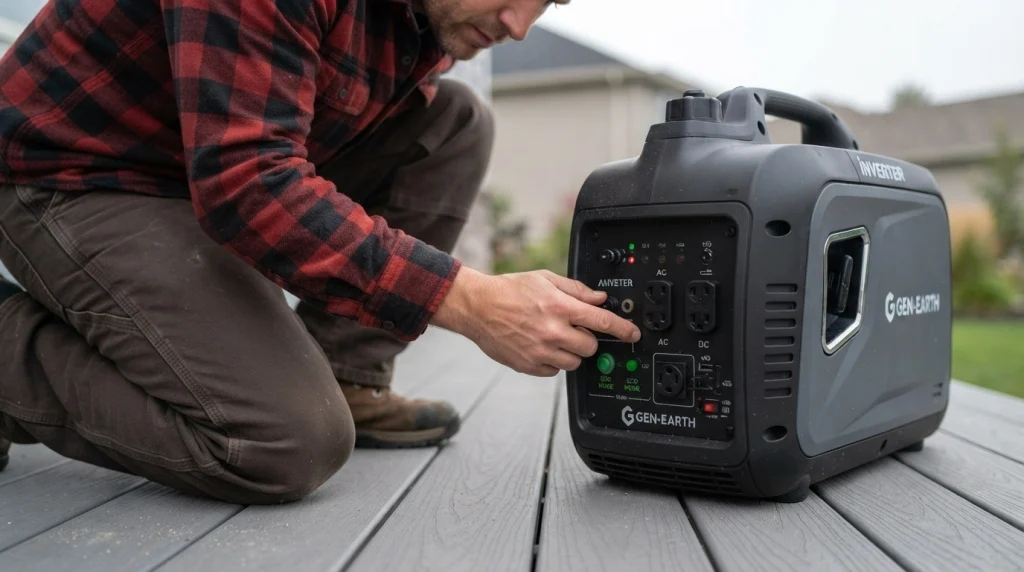
You can run this check on a store shelf, in a garage, or at a campsite. It takes about a minute and needs no tools.
Start with the name. Look at the front panel, the side decal, and the box for the word “inverter.”
Next, look for the eco switch. It may say eco, economy, or smart throttle, and it usually sits near the start switch.
Then check the case. Inverter models almost always use a closed, molded body with vents, handles, and a carry grip built in.
Now find the parallel ports. They are two small round sockets, often covered, and marked with a parallel symbol or the word “parallel.”
Finally, read the spec label. Look for THD under 3%, a decibel rating, and running watts versus starting watts.
Here is the quick sequence in order:
- Read the model name and front panel for the word “inverter.”
- Find the eco or economy switch near the controls.
- Check for a closed case instead of an open steel frame.
- Look for parallel ports on the control panel.
- Confirm THD under 3% on the spec label or spec sheet.
Three of these five signs usually settle it. Five out of five leaves no doubt at all.
I once checked a neighbor’s unit this way during a storm outage. The label said inverter, the eco switch was on, and the parallel ports were right there.
We plugged in his fridge and a phone charger, and the engine stayed quiet at low load. That is the moment the design makes sense.
Section Takeaway: Name, eco switch, closed case, parallel ports, and THD under 3% form a fast five-point check. Three matches are strong evidence, and five are conclusive.
What Does the Label and Nameplate Tell You?
The nameplate is the metal or plastic sticker on the side or rear of the unit. It carries the facts the marketing box may skip.
Read the model number first. Many makers build “inverter” into the model name or series name, and the box repeats it in large type.
Look for the output line next. It should list voltage, frequency, running watts, and starting watts or surge watts.
Running watts are what the unit can supply nonstop. Starting watts are the short burst it can supply when a motor starts.
A fridge may need 700 starting watts but only 150 running watts. That gap is why both numbers matter, and why our running watts vs starting watts guide is worth a read before you size a unit.
Check the THD line if it is printed. Some makers print it on the nameplate, and most print it in the manual or online spec sheet.
If THD is missing, do not assume the worst yet. Search the exact model number on the maker’s site and open the specifications tab.
Also note the fuel type and engine size. Most portable inverter models run on gasoline, while some dual-fuel inverter models also run on propane.
Watch for the certification marks too. A UL or CSA mark tells you the unit passed third-party safety testing.
One more label clue helps with older units. If the nameplate lists a fixed 3,600 rpm engine speed with no eco mode, treat it as a warning sign.
Section Takeaway: The nameplate gives you the model name, running and starting watts, and sometimes THD. When THD is missing there, the maker’s spec sheet for that exact model number is the next place to look.
Inverter vs Conventional Generator: How to Tell Them Apart
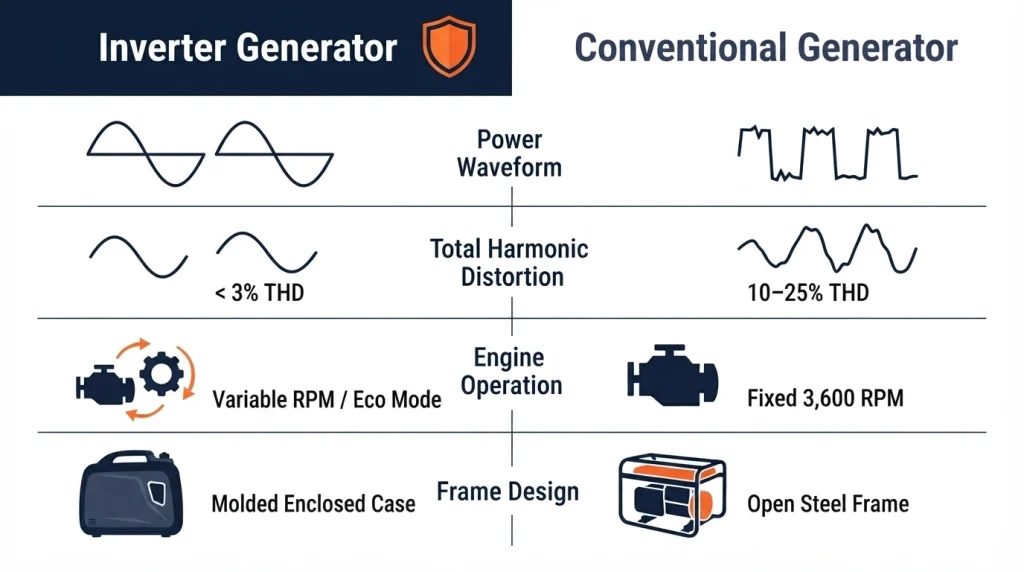
How do you tell an inverter generator from a conventional one at a glance? Start with the frame, then the sound, then the spec sheet.
A conventional generator usually has an open steel tube frame. You can see the engine, the fuel tank, and the alternator through the frame.
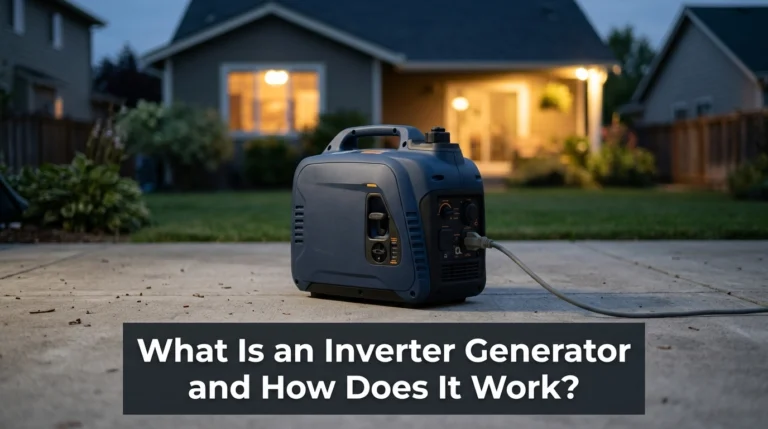
An inverter generator hides those parts inside a molded case. You see vents, a control panel, and a handle, not bare metal and hoses.
The sound gives a second clue. An inverter unit drops its engine speed at light load, so it hums quietly while charging a phone.
A conventional unit holds a steady roar even with a small load. It cannot slow down without losing frequency, so it stays loud.
Weight tells a third story. Inverter models in the 2,000-watt class are often light enough for one person to carry.
Conventional models of the same wattage are usually heavier and bulkier. They need a bigger frame and a larger fuel tank for the same job.
Use this table to compare the two side by side:
| Feature | Inverter Generator | Conventional Generator |
|---|---|---|
| Power output | Clean sine wave, rebuilt by an inverter module | Raw AC straight from the alternator |
| THD | Typically under 3% | Typically 10–25% |
| Noise | Quieter, and quieter still at light load | Louder, steady roar at fixed speed |
| Engine speed | Varies with load in eco mode | Fixed, usually 3,600 rpm |
| Size and weight | Compact, enclosed, often easy to carry | Larger, open frame, heavier to move |
| Fuel use | Thrifty at partial load | Steady burn even at light load |
| Best for | Electronics, camping, RV use, quiet backup | High-watt tools, whole-home backup, job sites |
Dual-fuel models can be either type. A dual-fuel inverter still has the inverter module, eco mode, and low THD.
A dual-fuel conventional model still has the open frame and fixed speed. Fuel choice alone does not make a unit an inverter.
Section Takeaway: The frame, the sound, and the THD rating separate the two types fast. An enclosed case with variable engine speed points to an inverter, while an open frame at fixed speed points to a conventional unit.
What Physical Clues Give It Away?
What should you look for on the body itself? Four physical details are hard to fake.
First, check the outlets. Inverter panels often include USB ports or a 12V DC outlet beside the standard AC outlets.
That DC outlet is a clue, not proof. It reflects the DC stage inside, but some conventional units offer one too.
Second, look at the control panel layout. Inverter panels pack the outlets, eco switch, parallel ports, and indicator lights into one neat panel.
Third, lift it if you can. A 2,000-watt inverter model often feels like a heavy suitcase, not a shop machine.
Fourth, look for a fuel gauge or a low-oil light on the panel. Many inverter models include them, and they sit beside the start switch.
Here are the physical clues in one list:
- Closed case: Molded plastic body with vents, not an open steel frame.
- Eco switch: A labeled switch or dial near the start control.
- Parallel ports: Two small covered sockets for linking a second unit.
- Compact panel: Outlets, lights, and switches grouped on one face.
- Carry handle: A built-in handle or telescoping handle for one-person transport.
One more clue hides in the exhaust. Inverter cases route exhaust through a small outlet on one side, often with a spark arrestor fitted.
Conventional frames leave the muffler exposed. You can see it, and you can burn yourself on it fast.
Safety note: Never touch a hot muffler or run a generator indoors, in a garage, or near an open window. Keep it outdoors, at least 20 feet from your home, with the exhaust pointed away.
Section Takeaway: A closed case, eco switch, parallel ports, and a compact panel are the physical signature of an inverter generator. No single clue proves it, but together they are hard to mistake.
How Can You Test It Before You Buy or Use It?
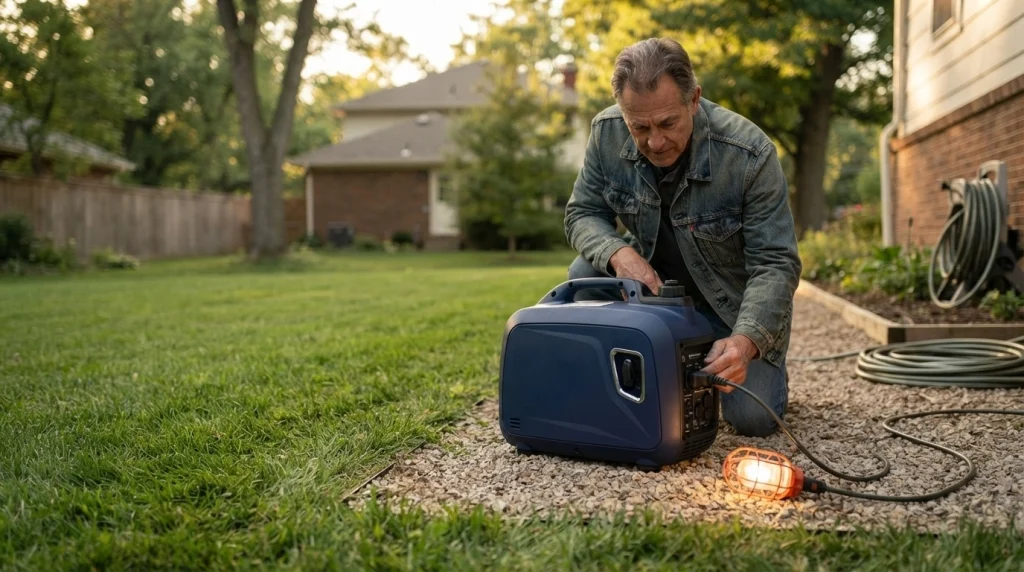
Can you prove it without a lab? Yes, with three simple checks that need no special tools.
First, run it with no load and listen. Turn eco mode on, then off, and listen for the engine speed to change.
An inverter unit should slow down in eco mode with no load. A conventional unit holds the same pitch with or without a load.
Second, add a small load. Plug in a phone charger or a lamp, and watch the engine respond.
The inverter engine should rise gently to meet the load, then settle back down. That smooth ramp is the variable-speed design at work.
Third, check the outlets with a simple plug-in meter if you own one. It can show voltage and frequency while the unit runs.
Look for steady voltage near 120V and frequency near 60 Hz as you add and remove a load. Big swings under a small load point to a conventional design.
Here is a worked example from a used-unit check I did in 2026. A seller listed a 2,200-watt unit as an inverter, but the decal was worn off.
I found the model number stamped on the side, searched it on my phone, and confirmed THD under 3% on the maker’s spec sheet. The case was enclosed, the eco switch worked, and the engine slowed at idle.
The test settled it in five minutes. I also checked the oil, the air filter, and the fuel for stale gas before I made an offer.
That last step matters for any used generator. Stale fuel clogs carburetors, and a clogged carburetor causes surging and hard starts.
If the seller will not let you start it, walk away. A no-start test tells you nothing about the inverter, and it tells you a lot about the seller.
For safety guidance on placement and carbon monoxide, see the CDC and the U.S. Consumer Product Safety Commission. Both stress outdoor use far from windows, doors, and vents.
Safety note: Run any test outdoors, at least 20 feet from your home, and never in a garage or enclosed space. Check your owner’s manual before you start a unit you do not own.
Section Takeaway: The eco-mode speed change is the best hands-on test. If the engine slows at light load and ramps smoothly when you add a load, you are almost certainly looking at an inverter.
What Size and Features Should You Match to Your Needs?
Identifying the type is only half the job. The other half is matching watts and features to what you will actually run.
Start by listing your loads. A phone charger needs very little, while a fridge or window AC needs a strong starting surge.
Add up running watts first. Then add the largest starting watts on top, not every starting watt at once.
That math keeps you from buying too small. It also keeps you from buying a huge unit for a small camping load.
Here are common size bands and what they fit:
- 1,000–2,200 watts: Phones, laptops, lights, a CPAP machine, and small fans.
- 2,200–3,500 watts: A fridge, a few lights, and charging gear during an outage.
- 3,500–5,000 watts: A fridge, a furnace blower, a sump pump, and a small window AC.
- Parallel pair: Two matched units linked for RV air conditioning or heavier backup loads.
Check the outlets next. RV owners need a 30A RV outlet, while home backup may need a twist-lock outlet for an inlet box.
Look for a CO shutoff feature too. Many newer inverter models shut down if carbon monoxide builds up near the unit.
That feature helps, but it does not replace safe placement. You still need distance, fresh air, and a working CO alarm indoors.
If quiet running matters, compare the decibel rating at the same load and distance. A rating at 25% load is not the same as a rating at full load, so check the spec sheet for the test conditions.
Our quietest portable generators guide and our sensitive electronics guide both use that same check, and they are useful next reads if noise or clean power is your top need.
Section Takeaway: Size by running watts plus your largest starting surge, then match outlets, CO shutoff, and parallel capability to your real loads. The right size beats the biggest size.
What Mistakes Do Buyers Make When Identifying One?
What trips buyers up most? Five common mistakes show up again and again.
First, buyers trust the word “quiet” on the box. Some conventional models claim quiet operation, but they still run at fixed speed.
Second, buyers trust size alone. A small conventional unit can look like an inverter until you check the frame and THD.
Third, buyers trust the seller’s word without checking the model number. A quick search on the maker’s site takes a minute and settles most disputes.
Fourth, buyers confuse inverter generators with solar generators. A solar generator is a battery power station, not a fuel-burning generator.
Fifth, buyers ignore the spec sheet. If THD, eco mode, and parallel ports are all missing, the unit is probably not an inverter.
Here is a short list of red flags:
- Open frame, no eco switch: Strong sign of a conventional unit.
- No THD listed anywhere: Ask the maker, or assume conventional until proven otherwise.
- “Inverter” only in the ad: Check the nameplate and the maker’s listing, not the sales copy.
- Fixed 3,600 rpm on the label: Classic conventional design.
One more mistake is subtle. Buyers sometimes buy an inverter for a job that needs a conventional unit, like running a large welder or a whole-home load.
Inverter models shine for electronics and quiet, light loads. They are not always the best pick for the heaviest tools.
If you need more watts later, check parallel capability before you buy. Not every inverter model links to a second unit, so confirm the kit and the matching model in the manual.
For broader energy and safety background, the U.S. Department of Energy and the EPA both publish plain-language guidance on backup power and generator use.
Section Takeaway: Do not trust a single word on the box. Cross-check the nameplate, the spec sheet, and the eco-mode test before you pay.
The Short Version
You now have a fast way to spot an inverter generator. Read the label, check the case, find the eco switch, and confirm THD under 3%.
If the label is gone, run the eco-mode test. A slowing engine at light load is the sound of an inverter doing its job.
Buy for the loads you will run, not the watts on the box. Clean power, quiet running, and the right outlets matter more than a big number.
As of 2026, the five-point check still holds across brands like Honda, Yamaha, Champion, Westinghouse, WEN, Generac, DuroMax, Predator, and Pulsar. The names change, but the inverter signs stay the same.
Worth a Look Before You Buy
Compare current inverter models by size and features, and check the spec sheet for THD, eco mode, and parallel capability before you choose.
Frequently Asked Questions
Can you tell an inverter generator by its sound alone?
Sound helps, but it does not prove it. An inverter unit slows down at light load, while a conventional unit holds a steady roar. Confirm with the label and THD rating too.
Do all inverter generators have parallel ports?
Most do, but not all. Parallel ports are a strong clue, yet some small inverter models skip them. Check the spec sheet for the exact model.
Is every quiet generator an inverter generator?
No. Some conventional models are marketed as quiet, and some use sound-dampening cases. Quiet alone is not proof, so check for eco mode and low THD.
What THD rating proves a generator is an inverter?
A THD rating under 3% is the standard sign of an inverter generator. Conventional models typically run 10–25%, so a low THD figure points firmly to inverter design.
Can a dual-fuel generator also be an inverter generator?
Yes. Dual fuel describes the fuel choice, not the power design. A dual-fuel inverter still has an inverter module, eco mode, and low THD.
Where is the model number if the front label is worn off?
Check the side, rear, and underside of the case for a stamped plate. The engine shroud and the manual often carry the same number, and the maker’s site can confirm the specs from it.
Should I buy an inverter generator for sensitive electronics?
Yes, in most cases. Laptops, phones, CPAP machines, and modern furnace controls all benefit from clean power under 3% THD. Check the running watts first, then the outlets you need.
Ready to narrow it down? Start with our best portable inverter generator picks, then compare them against the best low-THD portable generators and our best affordable inverter generator guide before you decide.

Hi, I’m Michael Turner. I own a generator workshop in the United States and founded HomeGeneratorBlog to share practical, hands-on guidance about generator installation, maintenance, troubleshooting, safety, and backup power solutions. My goal is to help homeowners make smarter, more confident decisions through clear and reliable information