When Were Inverter Generators Invented?
Quick Answer
Inverter generators were invented in stages, not on one day. Honda put the first inverter circuit in a portable generator in 1987, produced true sine-wave power in 1996, and launched the modern microprocessor-controlled inverter generator in 1998. That 1998 EU series is the direct ancestor of the quiet, fuel-efficient models sold today.
The three dates to remember
- 1987, first inverter circuit: Honda’s EX300 used an inverter circuit to hold a stable frequency.
- 1996, true sine wave: Honda’s EX500 used a custom chip to make sine-wave power close to mains power.
- 1998, modern inverter generator: Honda’s EU9i, EU24i, and EU28is used a microprocessor-controlled sine-wave inverter.
- Why 1998 counts most: It combined clean power, variable engine speed, light weight, and quiet running in one portable design.
- What came before: Conventional portable generators had existed since the 1960s, but they ran at a fixed speed and made rougher power.
If you only remember one thing
- Say 1998 for the modern inverter generator, and 1987 for the first inverter circuit in a portable generator.
I’ve tested a lot of generators in campgrounds, on job sites, and during home outages. The same question keeps coming up, and it sounds simple until you try to answer it.
When did someone actually invent the inverter generator? The short version is 1998. The full version is more useful, because it explains why your laptop, fridge, and CPAP can run safely from a small portable unit today.
This guide walks through each step in order. You’ll see what changed in 1987, 1996, and 1998, how the design spread to other brands, and what to look for as a buyer in 2026.
In This Guide
- What Is an Inverter Generator?
- What Is the Short Answer: 1987, 1996, or 1998?
- 1987: How Did the Honda EX300 Change Portable Power?
- 1996: What Did the Honda EX500 Fix?
- 1998: Why Was the Honda EU Series the Real Breakthrough?
- How Did Inverter Technology Spread After 1998?
- Inverter vs Conventional Generator: What Is Different?
- What Did the Invention Change for Buyers in 2026?
- Frequently Asked Questions
What Is an Inverter Generator?
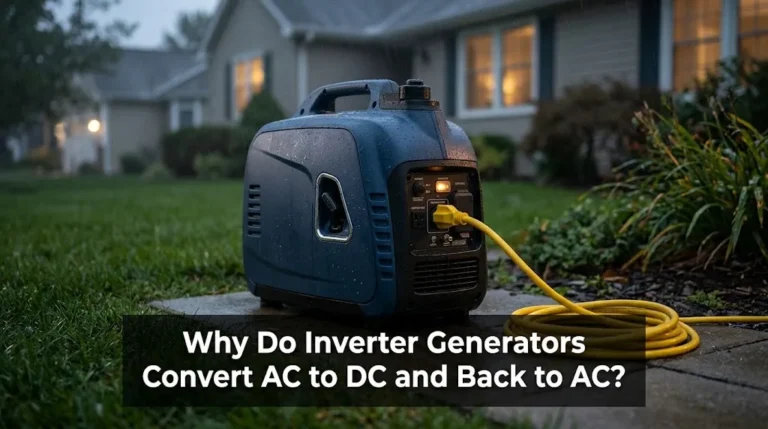
An inverter generator is a portable generator that makes clean, stable AC power through a three-step process. It first makes raw AC power, converts it to DC power, then inverts it back to smooth AC power.
That middle step is the whole idea. The inverter rebuilds the power wave, so voltage and frequency stay steady even when the load changes.
Total harmonic distortion, or THD, measures how clean that wave is. A lower THD means a smoother wave and safer power for sensitive electronics.
Modern inverter generators typically keep THD under 3%. Honda’s 1998 EU series was rated at a maximum sine-wave distortion rate of 2.5%, which set the clean-power standard other brands later had to match.
An inverter generator also changes engine speed to match the load. A light load means a slower, quieter engine and less fuel use.
A conventional generator works the other way. It must hold a fixed engine speed, often 3,600 rpm, to hold 60 Hz output in North America.
That fixed speed wastes fuel at light loads. It also makes more noise and rougher power.
I learned this the practical way at a campsite years ago. My old open-frame unit ran loud all night to power a few phone chargers and a light.
A small inverter unit on the next pitch barely whispered at the same load. It throttled down, sipped fuel, and nobody complained.
Section takeaway: An inverter generator is not just a quieter generator. It is a different power system that rebuilds AC power for clean, stable output and lets the engine slow down when demand drops.
What Is the Short Answer: 1987, 1996, or 1998?
The honest answer depends on what you mean by “invented.” Each date marks a different milestone, and mixing them up causes most of the confusion online.
Use 1987 if you mean the first inverter circuit in a portable generator. Use 1996 if you mean the first true sine-wave inverter generator. Use 1998 if you mean the first modern, microprocessor-controlled inverter generator.
Most buyers should use 1998. That is the year the design became practical, portable, quiet, and safe for laptops and other precision electronics.
Before any of those dates, portable power was already common. Honda released its first commercially available portable generator, the E300, in 1965.
The E300 made only 300 watts. It was light and easy to carry, and it proved people wanted power away from a wall outlet.
By the 1970s and 1980s, larger portable generators powered tools, lights, and job sites. They were useful, but they were heavy, loud, and hard on sensitive devices.
The problem was power quality, not power itself. A rough wave can make a laptop charger buzz, a TV flicker, or a modern fridge control board act up.
Engineers knew inverters could fix the wave. Inverter circuits already existed in other kinds of power electronics.
The hard part was making the system small, light, cheap, and tough enough for a portable generator. That took Honda more than a decade of work.
- 1965: Honda E300, the first commercial portable generator in its line, at 300 watts.
- 1987: Honda EX300, the first portable generator with an inverter circuit.
- 1996: Honda EX500, sine-wave generation through a purpose-built chip.
- 1998: Honda EU9i, EU24i, and EU28is, the first microprocessor-controlled sine-wave inverter generators.
- 2001: Honda EU16i, which doubled the output of the small EU9i class.
Section takeaway: There was no single invention day. The inverter generator arrived in three steps, and 1998 is the date that best describes the modern machine.
1987: How Did the Honda EX300 Change Portable Power?
Honda released the EX300 in 1987 as an ultra-compact portable generator. It was designed to be carried easily, almost like a small bag.
The key change was inside the case. The EX300 was the first generator to use an inverter circuit to produce electricity with a stable frequency.
That sounds small now. At the time, it overturned the idea that a generator had to be big and heavy to be useful.
The EX300 also showed that a small engine could serve a real need. Street vendors, market traders, and outdoor workers could carry power to the job instead of working near an outlet.
It was not yet a true sine-wave machine. Its output was cleaner and more stable than a basic conventional unit, but it did not yet match household mains power for precision electronics.
Think of it as a proof of concept that worked in the real world. Honda proved the inverter idea could survive in a small, portable, affordable product.
Other makers watched closely. Once the concept worked, the race was on to make the wave cleaner and the unit lighter.
The EX300 also pushed Honda toward a new design goal. The team wanted compact size, low weight, low noise, and high fuel efficiency in the same machine.
That goal shaped every inverter generator that followed. It still shapes the buying guides I write today.
Safety note: Early or not, the same safety rules applied. Run any generator outdoors, at least 20 feet from your home, and well away from windows, doors, and vents.
Section takeaway: The EX300 proved an inverter circuit belonged in a portable generator. It made power stable and portable, even before the wave was clean enough for every device.
1996: What Did the Honda EX500 Fix?
The EX500, released in 1996, fixed the main weakness of the EX300. It made sine-wave power equivalent to mains power.
Honda did it with purpose-built integrated circuits, or ICs. Those chips controlled the inverter with far more precision than the earlier circuit could manage.
Why did that matter in the mid-1990s? Personal computers were spreading fast. Printers, chargers, and other precision devices needed cleaner power than a rough wave could give.
A distorted wave can cause heat, noise, and errors in sensitive electronics. A clean sine wave looks like the smooth wave from a wall outlet.
The EX500 closed that gap. It showed that a portable generator could power a computer without the user worrying about the wave shape.
The model was still a step on the road, not the final design. It did not yet have the microprocessor control, the high-speed alternator, or the light resin body that made the 1998 EU series famous.
But it proved the core claim. A small generator could make mains-quality power, not just rough backup power.
That claim changed what buyers expected. After 1996, “clean power” stopped being a luxury feature and started becoming the standard for portable use.
Section takeaway: The EX500 turned inverter power from stable into clean. Its custom chip made sine-wave output practical, and it set up the 1998 breakthrough.
1998: Why Was the Honda EU Series the Real Breakthrough?
Honda launched the EU9i, EU24i, and EU28is on June 29, 1998, under the GENE21 concept. The goal was simple and bold: make electricity as clean as a household wall outlet.
These were the world’s first generators to use a microprocessor-controlled sine-wave inverter system. A small computer, not just a fixed circuit, managed the power output in real time.
The result was power quality close to commercial mains power. Honda rated the maximum sine-wave distortion rate at 2.5%.
That figure matters for buyers today. Modern inverter generators typically stay under 3% THD, and that 1998 rating is why the standard exists.
The EU series also used a new high-speed multi-polar alternator. That alternator made the power system about 70% lighter than a conventional system.
The whole generator was about half the size and weight of earlier designs with the same output. The small EU9i made about 1 kVA, yet weighed about half as much as the 1 kW-class EX900 from 1985.
It was also fully enclosed in a resin body. That case cut noise, protected the parts, and made the unit look like a tool, not a machine.
Eco-throttle, or economy mode, let the engine slow down at light loads. Fuel lasted longer, noise dropped, and the generator did not have to roar to charge a phone.
Parallel capability let two units link together for more power. A camper could start with one small unit and add a second later, instead of buying a big, heavy generator up front.
I still think of the EU9i as the template. Every modern inverter generator I test, from Honda and Yamaha to Champion, Westinghouse, and WEN, follows its basic recipe.
If you want clean power for sensitive loads, start with low-THD portable generators. Check the spec sheet for THD under 3% before you buy.
Safety note: Clean power does not make a generator safe indoors. Always run it outdoors, at least 20 feet from your home, and never in a garage, even with the door open.
Section takeaway: The 1998 EU series combined a microprocessor, a clean sine wave, a light alternator, and a quiet enclosed body. That combination is what we now call an inverter generator.
How Did Inverter Technology Spread After 1998?
After 1998, other brands moved fast. Yamaha, Champion, Westinghouse, WEN, Generac, DuroMax, and Predator all built inverter lines of their own.
The basic design stayed the same. An engine drives an alternator, the inverter cleans the power, and the engine speed follows the load.
What changed was choice and price. Buyers could pick a 1,000-watt unit for camping, a 2,200-watt unit for a fridge and lights, or a 4,500-watt unit for an RV air conditioner.
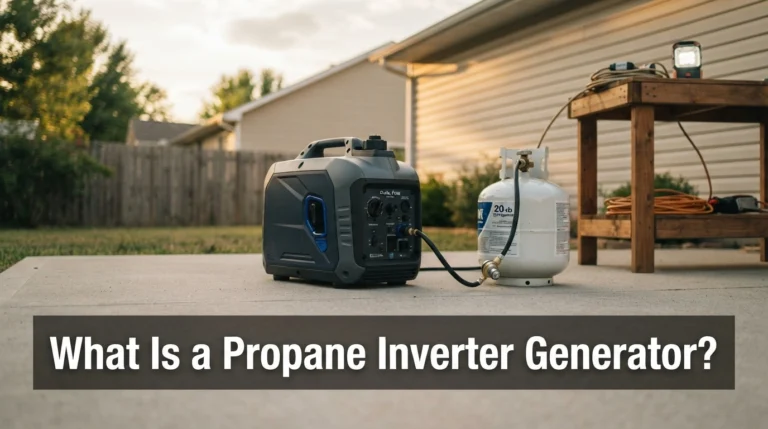
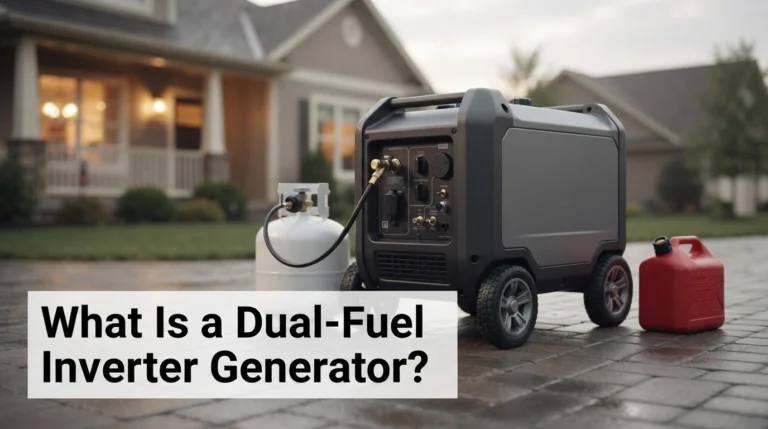
Dual-fuel models added propane as a second fuel. Propane stores longer than gasoline and burns cleaner, which helps during a long outage.
Fuel injection, electric start, and remote start arrived on larger models. Parallel kits became standard, so two mid-size units could run a bigger load together.
Noise also became a selling point. Many quiet inverter models now run in the 50s dB range at quarter load, measured at a short distance.
Check the spec sheet for the exact test distance and load. A dB number means little without those two details.
My own test last summer shows why the spread mattered. I ran a modern 2,200-watt inverter at a campsite with a laptop, phone chargers, LED lights, and a small chest freezer cycling on and off.
The running load stayed near 400 watts most of the time. Eco mode kept the engine slow and quiet, and the freezer stayed cold without a surge or a shutdown.
An old open-frame unit would have roared at full speed for the same job. It would have used more fuel and annoyed every neighbor in earshot.
That test was not about one brand. It was about the 1998 idea working at a price most buyers can now afford.
The spread also brought trade-offs. Some cheap inverter models cut corners on build quality, fuel systems, or support.
Read the manual for break-in, oil changes, and fuel storage. Stale fuel still clogs carburetors, even on a modern inverter unit.
For a step-by-step buying check, use an inverter generator buying guide before you compare models. It helps you match running watts and starting watts to your real loads.
There are also real downsides of inverter generators to weigh, including higher cost per watt and lower peak output than a large conventional unit.
Safety note: Store fuel in an approved container, away from living space, and let the generator cool before refuelling. Check your owner’s manual for the break-in and oil-change schedule.
Section takeaway: After 1998, inverter technology spread from one Honda series to the whole market. Buyers gained more sizes, fuels, and features, but they still need to check THD, wattage, and noise on the spec sheet.
Inverter vs Conventional Generator: What Is Different?
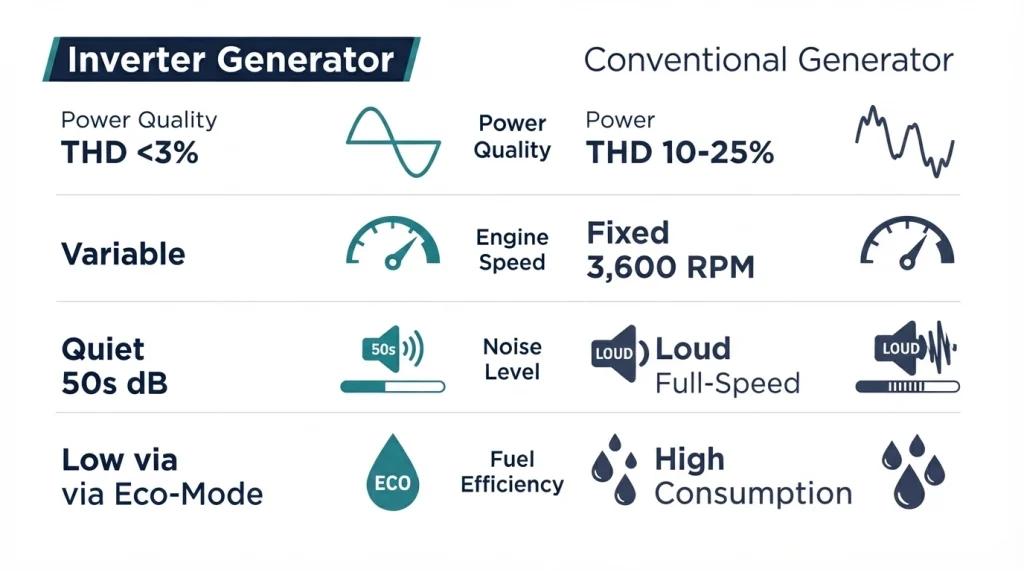
How does an inverter generator differ from a conventional generator? The short answer is power quality, engine speed, noise, and fuel use.
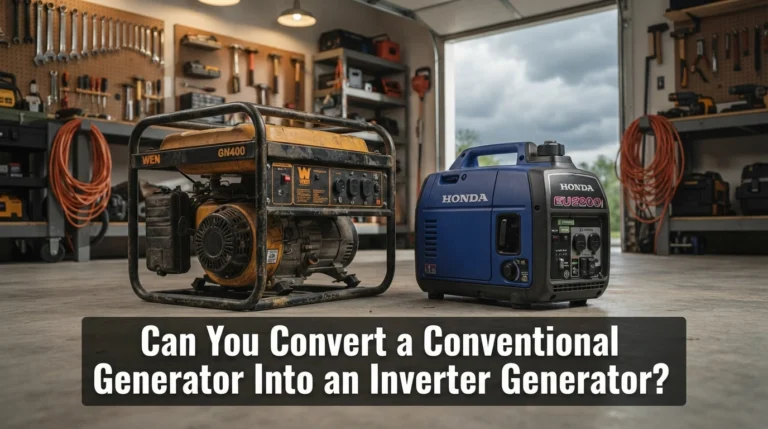
A conventional generator makes AC power directly from an alternator driven at a fixed speed. Its frequency depends on that speed, so the engine cannot slow down.
An inverter generator makes raw power, converts it to DC, then rebuilds it as clean AC. Its engine speed can rise and fall with the load.
That difference shows up in daily use. An inverter unit is quieter at light loads, uses less fuel, and is safer for laptops, phones, and modern appliances.
A conventional unit is often cheaper per watt and can make more peak power for the same price. It suits heavy tools and large loads where clean power matters less.
Use the table below to compare the two designs at a glance. Figures are general ranges for portable models, not specs for one model.
| Feature | Inverter Generator | Conventional Generator |
|---|---|---|
| Power quality (THD) | Typically under 3% | Often 10-25% in this cluster’s shared range; some sources cite 6-25% |
| Engine speed | Varies with load | Fixed, often 3,600 rpm |
| Noise at light load | Quieter, often in the 50s dB at quarter load | Louder, runs at full speed |
| Fuel use at light load | Lower, thanks to eco mode | Higher, engine cannot slow down |
| Best for | Laptops, phones, CPAP, fridge, camping, RV use | Power tools, large loads, low-cost backup power |
| Cost per watt | Higher | Lower |
For a direct head-to-head, read this inverter vs conventional generator comparison. It covers the same trade-offs in more depth.
Section takeaway: Choose an inverter generator for clean power and quiet running. Choose a conventional generator when you need the most watts for the lowest cost and clean power is less critical.
What Did the Invention Change for Buyers in 2026?
The invention changed who can use a portable generator. Before 1998, portable power was mainly for tools and lights.
After 1998, it became safe for home life. A small unit could run a fridge, charge phones, power a laptop, and keep a CPAP running through the night.
It also changed where people use power. Campers, RVers, tailgaters, and van-life travellers could carry clean power without carrying a huge, loud machine.
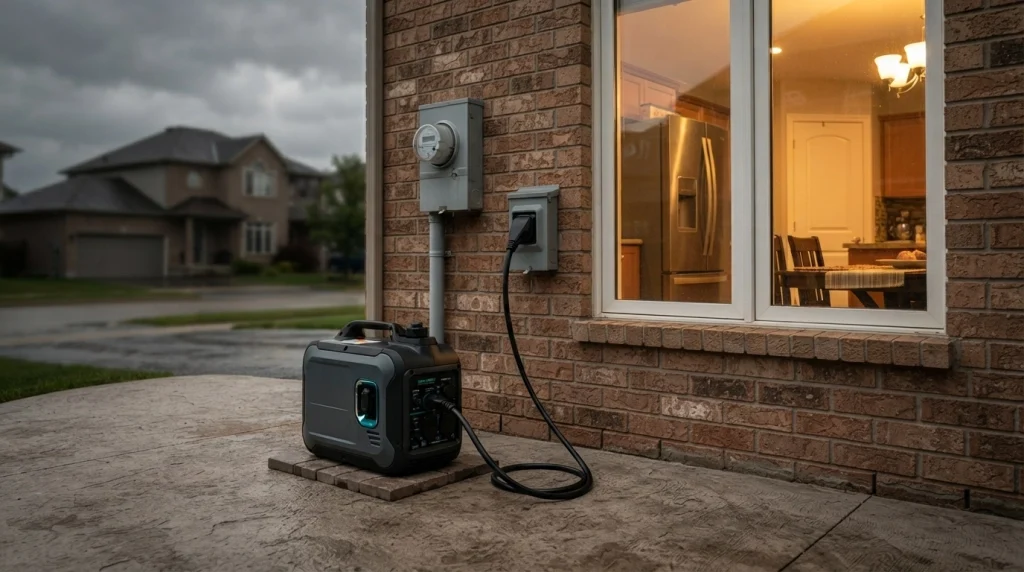
Home backup changed too. A 2,200-watt inverter unit can cover lights, a fridge, and device charging during a short outage.
A larger inverter unit, or two units in parallel, can cover more loads. A transfer switch or inlet, installed by a licensed electrician, makes the connection safer and simpler.
As of 2026, the market has split into clear sizes. Small units suit camping and charging. Mid-size units suit fridges and home essentials. Large inverter units suit RV air conditioners and longer outages.
The buying question has not changed since 1998. Add up your running watts, add the highest starting watts, and leave headroom for the load that starts next.
Check THD under 3% for sensitive electronics. Check runtime at 25% and 50% load, tank size, and noise at a stated distance.
Look at the best portable inverter generators only after you know your wattage needs. A top-rated unit is the wrong pick if it cannot start your fridge or run your RV air conditioner.
Safety note: For home hookups, use a transfer switch or interlock kit installed by a licensed electrician. Never backfeed power through a household outlet.
Section takeaway: The 1998 invention made portable power clean, quiet, and safe for modern electronics. In 2026, the best buy is still the unit that matches your real loads, not the biggest or cheapest one on the shelf.
Models That Follow the 1998 Template
These are the modern descendants of the EU series design. Check the spec sheet for THD, running watts, and starting watts before you choose.
- Honda EU2200i: Small, quiet inverter generator for camping and home essentials. Check the Honda EU2200i on Amazon
- Yamaha EF2200iS: Light inverter generator for RV and camping use. Check the Yamaha EF2200iS on Amazon
- Champion 4500-Watt Dual Fuel Inverter Generator: Larger dual-fuel inverter for RV and home backup. Check the Champion 4500-Watt Dual Fuel Inverter Generator on Amazon
Frequently Asked Questions
Who invented the inverter generator?
Honda led the work. It put the first inverter circuit in a portable generator with the EX300 in 1987, made true sine-wave power with the EX500 in 1996, and launched the first microprocessor-controlled sine-wave inverter generators, the EU9i, EU24i, and EU28is, in 1998.
When was the first inverter generator made?
The first portable generator with an inverter circuit was the Honda EX300 in 1987. The first modern inverter generator, with a microprocessor-controlled sine-wave inverter, was the Honda EU series in 1998.
What was the first inverter generator model?
The first model with an inverter circuit was the Honda EX300 in 1987. The first modern model was the Honda EU9i in 1998, launched with the EU24i and EU28is in Japan.
Why was 1998 important for inverter generators?
In 1998, Honda combined a microprocessor-controlled sine-wave inverter, a high-speed multi-polar alternator, and a quiet enclosed body. The EU series made power as clean as mains power, with a maximum distortion rate of 2.5%, and cut size and weight by about half.
Did inverter generators exist before 1998?
Yes, in early form. The EX300 used an inverter circuit in 1987, and the EX500 made sine-wave power in 1996. Those models proved the idea, but the 1998 EU series made it light, quiet, and practical for everyday use.
What is the difference between an inverter generator and a conventional generator?
An inverter generator rebuilds AC power through DC, so it makes clean power under 3% THD and lets the engine slow down at light loads. A conventional generator makes AC directly at a fixed engine speed, so it is louder, uses more fuel at light loads, and often has THD of 10-25%.
Are inverter generators still based on the 1998 design?
Yes, in basic form. Modern models still use an engine, an alternator, and an inverter to make clean AC power, with variable engine speed and eco mode. They add larger outputs, dual fuel, fuel injection, and parallel capability, but the core system dates to 1998.
Ready to use what history taught us? Pick your loads first, check THD under 3% on the spec sheet, and choose the smallest inverter generator that can start your largest load. That is how you get quiet, clean backup power without paying for watts you will never use.

Hi, I’m Michael Turner. I own a generator workshop in the United States and founded HomeGeneratorBlog to share practical, hands-on guidance about generator installation, maintenance, troubleshooting, safety, and backup power solutions. My goal is to help homeowners make smarter, more confident decisions through clear and reliable information