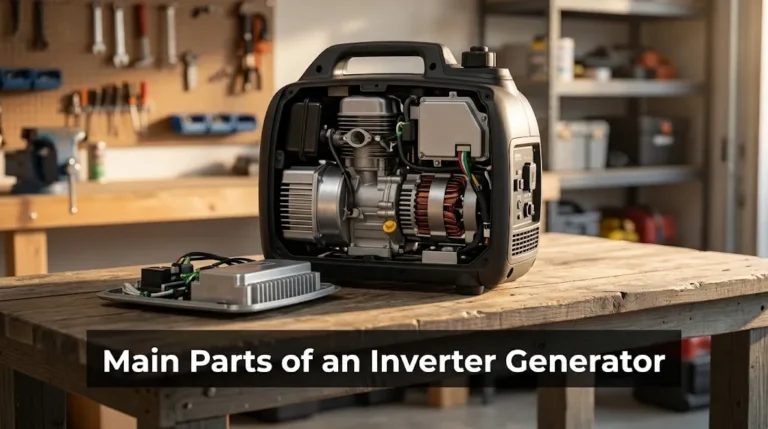
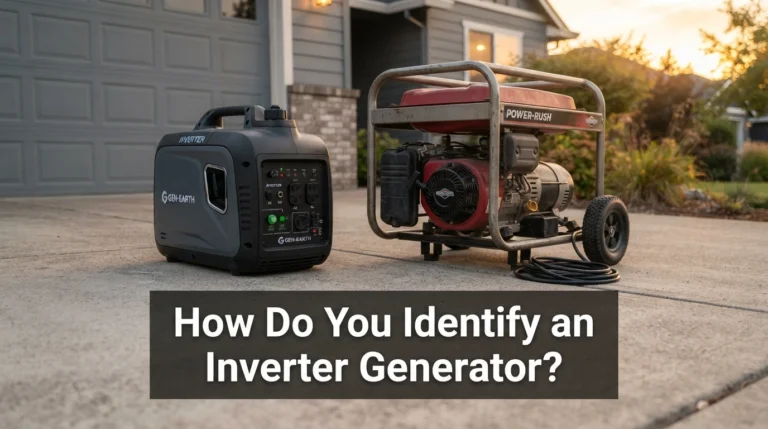
What Is a Dual-Fuel Inverter Generator?
Quick Answer
A dual-fuel inverter generator is an inverter generator that can run on gasoline or propane, so you can switch fuels when one runs out or costs less. It makes clean, stable power with low total harmonic distortion, usually under 3%, which suits laptops, phones, CPAP machines, and modern furnace controls. For the wider fuel choice, see the dual-fuel portable generator guide.
What makes it dual-fuel
- Two fuel inputs: One engine burns gasoline from a tank or propane from a cylinder through a fuel selector.
- Clean inverter power: It converts raw power to DC, then rebuilds it as a smooth sine wave.
- Lower propane output: Propane often gives about 10% less power than gasoline, so check the spec sheet for both ratings.
- Quieter at light load: The engine slows down when demand drops, which saves fuel and cuts noise.
- Flexible storage: Propane stores for years without going stale, while gasoline needs stabilizer and rotation.
If you buy one, start here
- Add up running watts for your must-run loads, then leave room for motor starting watts.
- Size it on the propane rating if propane will be your main fuel in an outage.
- Test a fuel switch before you need it, with the engine off and cool.
I’ve run inverter generators on gasoline for years, and I still remember the first night propane saved an outage for me. The gas can was empty, the storm had closed the nearest station, and a spare propane cylinder from the grill was sitting by the garage door.
That switch took two minutes, and the fridge kept running. This guide explains how that choice works, what it costs in power, and when it is worth paying for.
In This Guide
- What Is a Dual-Fuel Inverter Generator?
- How Does a Dual-Fuel Inverter Generator Work?
- Gasoline vs Propane: What Changes When You Switch Fuels?
- Dual-Fuel Inverter vs Dual-Fuel Conventional Generator: What’s the Difference?
- What Can a Dual-Fuel Inverter Generator Run?
- How Much Power Do You Need? Sizing a Dual-Fuel Inverter Generator
- How Do You Switch Fuels Safely?
- Is a Dual-Fuel Inverter Generator Worth It?
- Conclusion
- FAQ
What Is a Dual-Fuel Inverter Generator?
An inverter generator is a portable generator that makes clean, stable AC power by converting raw power to DC, then rebuilding it as a smooth sine wave. A dual-fuel inverter generator adds a second fuel choice to that design.
It runs on gasoline or propane. Most models use a fuel selector dial or switch, a gasoline tank, and a propane inlet with a hose and regulator. You choose the fuel, and the engine burns it the same way a single-fuel inverter engine does.
The inverter part matters more than the fuel part for your electronics. Inverter power stays close to a perfect sine wave, with steady voltage and steady frequency. That is why these units suit sensitive loads.
The usual measure is total harmonic distortion, or THD. THD describes how far the wave strays from a perfect sine shape. Lower is cleaner.
Many quality inverter generators hold THD under 3%. Conventional open-frame generators often run much higher, commonly in the 10 to 25 percent range, depending on load and design. Some sources list 6 to 25 percent for conventional models, so the range varies by model and source.
Dual-fuel does not mean tri-fuel. Tri-fuel adds natural gas as a third option, usually through a home gas line. Dual-fuel covers gasoline and propane only, which keeps the setup portable.
Most dual-fuel inverter models fall in the 2,000 to 4,500 running-watt range as of 2026. Larger dual-fuel units exist, but they are often open-frame models, not inverters. Check the spec sheet for running watts on each fuel, because the headline number is often the gasoline figure.
Section Takeaway: A dual-fuel inverter generator is an inverter generator with two fuel choices, gasoline and propane, and clean power under 3% THD for sensitive electronics.
How Does a Dual-Fuel Inverter Generator Work?
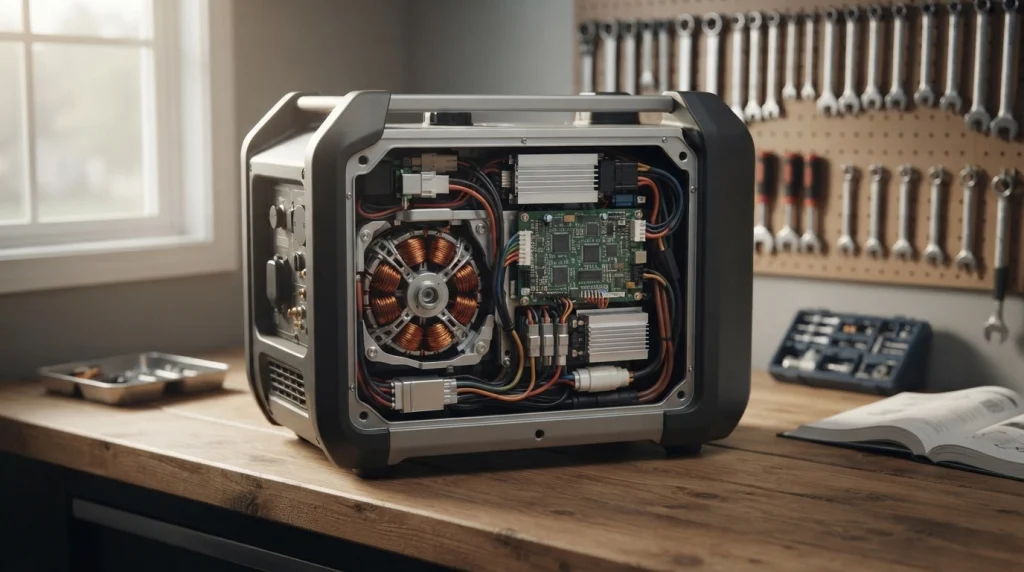
It works in three stages, and the fuel choice changes only the first one. The rest of the chain stays the same.
- Burn fuel to spin the engine: Gasoline comes from the tank, or propane comes from a cylinder through a regulator and hose.
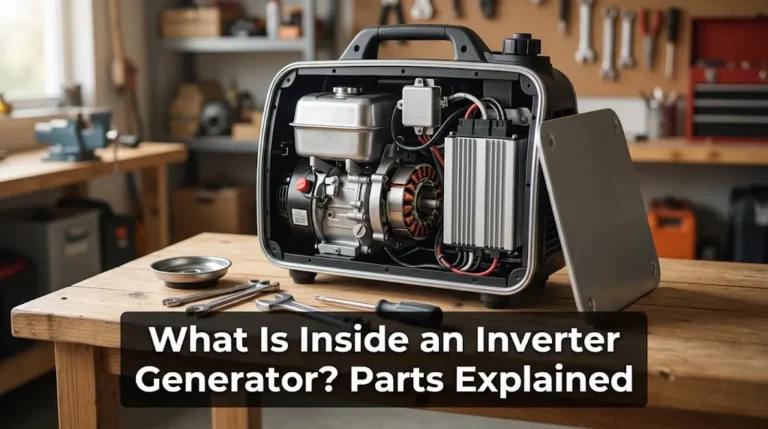
- Make raw AC, then DC: The engine spins an alternator, which makes rough, high-frequency AC, and a rectifier turns that AC into DC.
- Rebuild clean AC: The inverter module turns DC back into AC as a smooth sine wave, usually 120 volts at 60 hertz in the United States.
A microprocessor watches the load the whole time. Plug in a phone charger and it tells the engine to idle down. Start a fridge compressor and it tells the engine to ramp up.
The fuel selector controls which fuel reaches the carburetor or fuel system. On many models, you turn the selector to gasoline, propane, or off. The propane side needs a firm hose connection and a regulator that drops cylinder pressure to a safe working level.
Eco mode, sometimes called economy mode or smart throttle, lets the engine slow down at light load. That saves fuel and cuts noise. Turn it off when you start a large motor, because a fridge compressor or sump pump can stumble if the engine is idling too low to respond.
Parallel capability is common on inverter models. Two compatible units can link with a parallel kit to share a larger load. Check compatibility first, because not every model pairs with another model, even from the same brand.
For a plain inverter explainer, the inverter portable generator guide covers the AC-DC-AC path in more depth.
Safety note: Run any fuel generator outdoors only, at least 20 feet from the house, with exhaust pointed away from doors, windows, and vents. Never run it in a garage, even with the door open.
Section Takeaway: Fuel choice changes the first stage only; the inverter still rebuilds the power into a clean sine wave.
Gasoline vs Propane: What Changes When You Switch Fuels?
Gasoline gives you more power per unit on most models. Propane gives you cleaner storage and a longer shelf life. That trade-off drives most buying decisions.
What does gasoline do best?
Gasoline is easy to find, and it often gives the highest wattage rating on the spec sheet. Most owners already keep a gas can for a mower or car, so the fuel is familiar.
Gasoline also starts well in cold weather when the fuel is fresh. It can go stale in a few months, though, and stale fuel can clog a carburetor. Use stabilizer, rotate the can, and run the unit dry for storage if your manual allows it.
What does propane do best?
Propane does not go stale the way gasoline does. A sealed cylinder can sit for years and still burn cleanly. That makes it a strong choice for a generator you may not use for months.
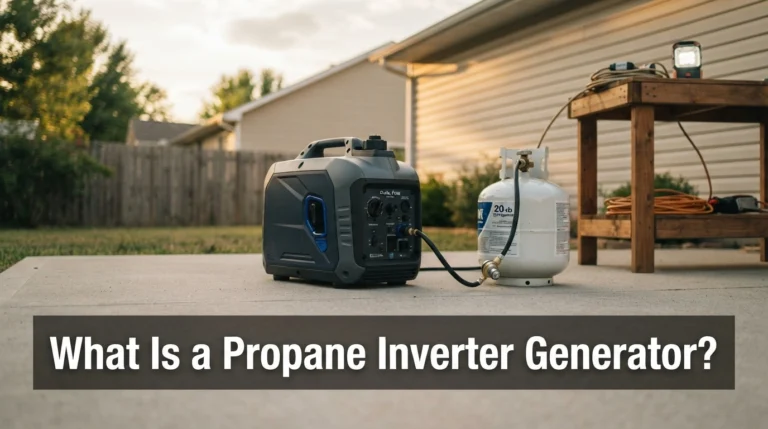
Propane also burns cleaner, with less carbon buildup in the engine. Many owners keep a 20-pound grill cylinder as backup fuel, which is easy to swap and easy to store outdoors. For more on that fuel, see the propane portable generator guide.
What do you lose on propane?
You often lose some power. Propane commonly gives about 10% less running and starting watts than gasoline on the same model. A unit rated at 3,000 running watts on gasoline may give about 2,700 running watts on propane.
Runtime also depends on tank size and load. A small load can run for many hours on a 20-pound cylinder, while a heavy load can drain it much faster. Check the spec sheet for runtime at 25% and 50% load on each fuel.
| Factor | Gasoline | Propane |
|---|---|---|
| Power output | Usually higher, the headline rating | Often about 10% lower |
| Storage life | Months, needs stabilizer | Years in a sealed cylinder |
| Engine deposits | More carbon buildup over time | Cleaner burn, less buildup |
| Refueling | Pour from a can, let unit cool first | Swap cylinder, check hose and regulator |
| Cold starts | Often easier with fresh fuel | Can be harder in very cold weather |
| Best for | Highest power, short outages | Long storage, backup fuel, RV use |
I learned the propane power drop the hard way at a campsite. I had sized an RV air conditioner on the gasoline rating, then switched to propane for the night. The compressor tripped the overload once, and I had to turn eco mode off and drop a second load before it started cleanly.
That is the lesson: size on propane if propane will be your main fuel. Gasoline gives you a margin, not a promise.
Safety note: Store propane cylinders outdoors, upright, away from living spaces, and never store gasoline indoors. Check hoses for cracks before each use.
Section Takeaway: Gasoline gives more power, propane stores longer and burns cleaner, so size the unit on the fuel you will use most.
Dual-Fuel Inverter vs Dual-Fuel Conventional Generator: What’s the Difference?
Both burn two fuels. Only one rebuilds the power into a clean sine wave. That is the core difference.
A dual-fuel conventional generator, often called an open-frame dual-fuel generator, ties engine speed to output. It must hold about 3,600 revolutions per minute to make 60-hertz power, even when only a lamp is plugged in.
A dual-fuel inverter generator breaks that tie. The inverter sets the frequency, so the engine can slow down at light load. That cuts noise and fuel use, and it keeps voltage steady.
Power quality follows the same split. Inverter models often hold THD under 3%, while conventional models often run in the 10 to 25 percent range. That gap matters for laptops, routers, furnace boards, and CPAP machines.
Size and noise follow the same pattern. Inverter models are usually quieter at light load, often in the 50 to 60 decibel range at a quarter load, which is close to conversation level. Conventional models stay loud at fixed speed, even with a small load.
Conventional dual-fuel models still win on raw wattage per dollar. If you need 10,000 watts or more for a large well pump, a welder, or several big motors at once, an open-frame unit may be the better tool. Inverter dual-fuel models suit home essentials, RV use, and camping, where clean power and low noise matter more than peak watts.
| Factor | Dual-fuel inverter | Dual-fuel conventional |
|---|---|---|
| Power quality | Clean sine wave, often under 3% THD | Rougher wave, often 10 to 25% THD |
| Engine speed | Varies with load | Fixed, near full speed |
| Noise at light load | Usually quieter | Usually louder |
| Fuel use at light load | Lower, engine idles down | Higher, engine stays fast |
| Typical size | 2,000 to 4,500 running watts | Often 5,000 watts and up |
| Best for | Electronics, RV, camping, home essentials | Heavy tools, large motors, high load |
If you want a ready-made dual-fuel shortlist, the best dual-fuel portable generator guide compares larger models, including open-frame options.
Section Takeaway: Choose the inverter version for clean, quiet power at light load, and the conventional version for high continuous watts.
What Can a Dual-Fuel Inverter Generator Run?
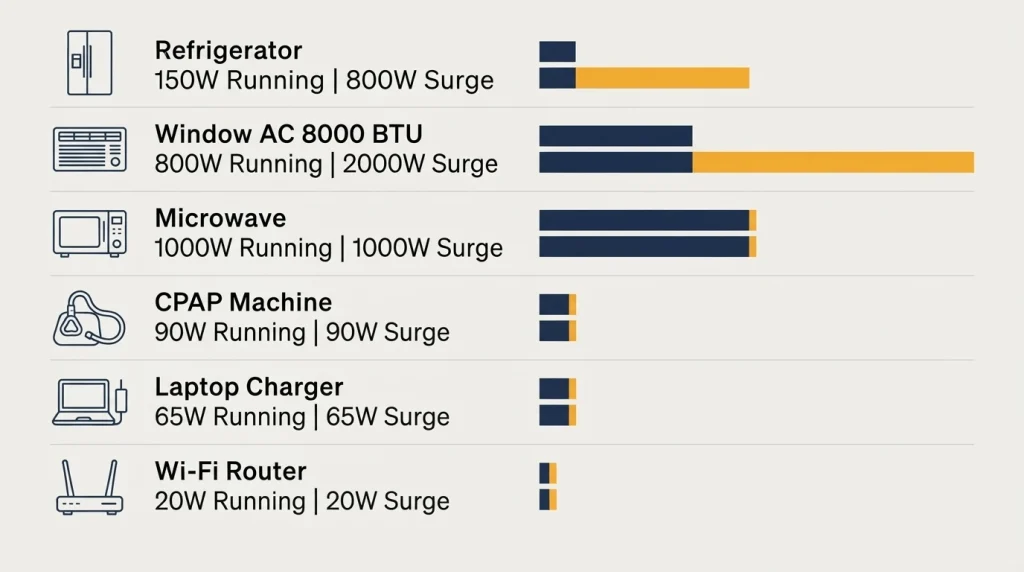
It can run the same loads as a single-fuel inverter of the same size, with one change: use the propane rating when you run on propane. A fridge, lights, router, laptop, and CPAP machine fit well on a small dual-fuel inverter.
A window air conditioner, a microwave, or an RV air conditioner needs more care. Those loads draw high starting watts, and they can trip the unit if you add them at the wrong time. Start the largest motor first, then add smaller loads one by one.
| Appliance | Typical running watts | Typical starting watts |
|---|---|---|
| Fridge | 100 to 200 | 600 to 800 |
| LED lights | 40 | 40 |
| Router and modem | 20 | 20 |
| Laptop charger | 65 | 65 |
| CPAP, no heated humidifier | 90 | 90 |
| Microwave, small | 1,000 | 1,000 |
| Window AC, 8,000 BTU | 700 to 900 | 1,800 to 2,200 |
These are typical estimates, not labels for your appliances. Read the wattage plate on each device, and add a safety margin of about 20% to your total.
Here is a worked example from a home outage, different from a campsite run. On propane, a 3,000-running-watt inverter powered a fridge at 150 watts, LED lights at 40 watts, a router at 20 watts, a laptop at 65 watts, and a furnace blower at 400 watts.
The running total was 675 watts. The fridge start surge pushed the load briefly higher, but the unit held, because eco mode was off for that start. A microwave would have pushed it over the comfort zone, so we ran it in turns, not at the same time as the furnace blower.
It will not run a whole house at once. Central air conditioning, an electric range, an electric water heater, and a large well pump usually need far more power, and often 240 volts and a proper house connection.
Section Takeaway: A dual-fuel inverter runs home essentials well, if you size on the propane rating and start large motors first.
How Much Power Do You Need? Sizing a Dual-Fuel Inverter Generator
Size by running watts, not by the headline number on the box. Running watts are what the generator can sustain. Starting watts are the brief extra push a motor needs to start.
Follow these steps, and do the math on paper before you buy.
- List must-run loads: Write down the fridge, lights, router, CPAP machine, and furnace blower, with running watts from each label.
- Add running watts: Add those figures together for your base load.
- Add the largest starting watts: Add the starting watts for the largest motor only, not for every motor at once.
- Add a margin: Add about 20% to the total, so the unit does not run at its limit all night.
- Check both fuel ratings: Compare that total with the propane running watts first, then with gasoline.
A 2,000 to 2,500 running-watt unit often covers a light outage list. A 3,000 to 4,500 running-watt unit covers a fridge, a furnace blower, and one more large load, such as a window AC or microwave in turns.
For the watt terms in full, see running watts vs starting watts. The U.S. Department of Energy also publishes general guidance on home energy use at energy.gov.
Section Takeaway: Add running watts, add the largest motor start, add a 20% margin, then check the propane rating first.
How Do You Switch Fuels Safely?
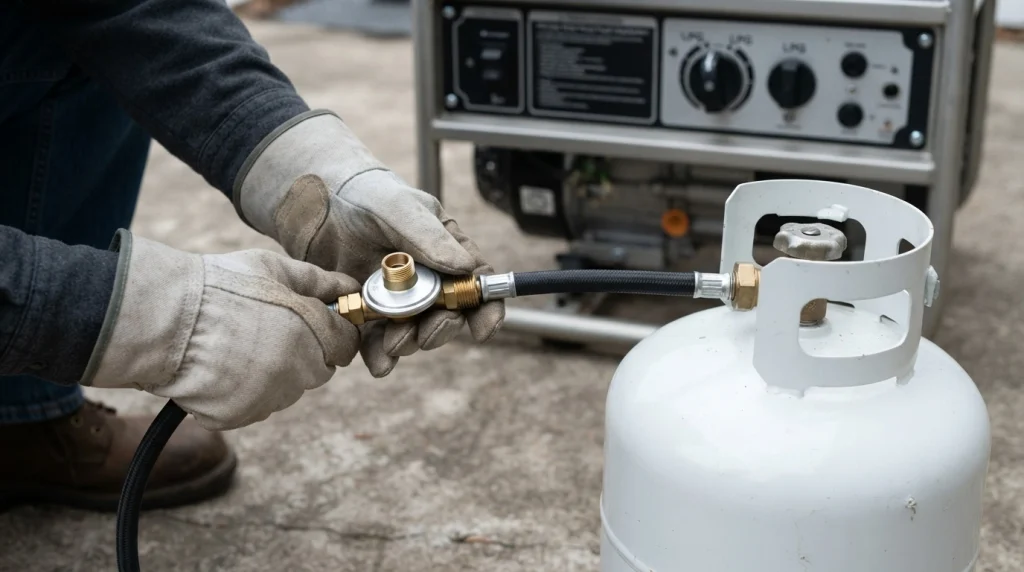
Switch with the engine off and cool, unless your manual says your model allows a hot switch. Most models do not, and a hot switch can cause a hard start or a fuel leak.
- Turn the unit off: Unplug loads first, then stop the engine and let it cool.
- Close the old fuel source: Turn the gasoline valve off, or close the propane cylinder valve.
- Move the selector: Turn the fuel selector to the new fuel, and check that it clicks into place.
- Connect the new fuel: For propane, attach the hose and regulator firmly, then open the cylinder valve slowly and check for leaks with soapy water.
- Start and test: Start the unit with no load, let it warm up, then add loads one by one.
Keep a spare propane hose and regulator seal in your kit. A cracked hose or a worn seal is a common cause of a propane start that fails at the worst time.
For house circuits, use a transfer switch or interlock installed by a licensed electrician. See the portable generator with a transfer switch guide for that setup. Never plug a generator into a wall outlet to backfeed a house panel, because that can injure utility workers.
Safety note: Run generators outdoors and well away from windows, doors, and vents, and use a transfer switch or interlock installed by a licensed electrician for house circuits. Check your owner’s manual before use.
Carbon monoxide is colorless and odorless, and it can kill. The CDC and the U.S. Consumer Product Safety Commission both warn against running fuel generators indoors or in a garage. Use a battery carbon monoxide alarm inside the house, and move the unit farther away if the alarm sounds.
Section Takeaway: Switch fuels with the engine off and cool, check the propane hose for leaks, and test the switch before an outage.
Is a Dual-Fuel Inverter Generator Worth It?
It is worth it if you value fuel choice more than peak watts. It is less worth it if you only ever run one fuel and you need the highest watts for the money.
Dual-fuel models cost more than single-fuel inverters of the same size. You pay for the selector, the propane regulator and hose, and the extra fuel system. That premium makes sense in three cases.
- Long outages: You can run gasoline first, then switch to stored propane when stations close or lines form.
- RV and camping: You already carry propane for cooking or heat, so one fuel serves two jobs.
- Infrequent use: You can store the unit dry, with propane as the ready fuel, and avoid stale gasoline in the carburetor.
It is less useful if you run a generator every week on gasoline, or if you need a large open-frame unit for heavy tools. In those cases, a single-fuel model may give you more watts for less money.
Maintenance still decides whether it starts when you need it. Change oil per your manual, check the air filter and spark plug, test the unit monthly, and run it under load for a short time. The EPA publishes general guidance on small-engine emissions and fuel care that supports the same habit: fresh fuel, clean air, and regular use.
Section Takeaway: Pay the dual-fuel premium for fuel choice in long outages, RV use, or infrequent use, not for peak watts alone.
Conclusion
A dual-fuel inverter generator gives you clean power and a second fuel choice. Gasoline gives you the highest rating, propane gives you long storage and a clean burn, and the inverter keeps both fuels safe for sensitive electronics.
Size it on the propane rating, test a fuel switch before an outage, and keep it at least 20 feet from the house. I am Michael Turner, and that propane-rating check is still the first one I do.
If you need clean, quiet backup with a fuel backup plan, a dual-fuel inverter generator is a solid place to start. Size it to your must-run list on propane, not to the biggest number on the box.
FAQ
Can a dual-fuel inverter generator run on propane only?
Yes, it can run on propane only, as long as you have a cylinder, hose, and regulator connected. You do not need gasoline in the tank to run on propane. Check the propane running watts first, because they are often about 10% lower than the gasoline rating.
Does propane give less power than gasoline?
Yes, in most models propane gives about 10% less running and starting watts than gasoline. A 3,000-running-watt unit on gasoline may give about 2,700 running watts on propane. Always check the spec sheet for both ratings before you size a load.
Can you switch fuels while the generator is running?
Most models require you to stop the engine first, let it cool, then move the selector. Some models allow a switch under load, but you must follow your manual. Never force a selector, and check the propane hose for leaks after any switch.
Is a dual-fuel inverter generator safe for laptops and CPAP machines?
Yes, in most cases, because inverter output is a clean sine wave with low total harmonic distortion, often under 3%. That is much closer to normal wall power than a rough conventional output. Check your device manual and the generator spec sheet, and keep a backup battery for medical devices.
How long will a dual-fuel inverter generator run on propane?
Runtime depends on load, tank size, and the model, so check the spec sheet for runtime at 25% and 50% load. A light load can run for many hours on a 20-pound cylinder, while a heavy load drains it much faster. Keep a spare cylinder for a long outage.
Is a dual-fuel inverter generator better than a tri-fuel generator?
It depends on your setup. A dual-fuel model is more portable, because it needs only gasoline and propane cylinders. A tri-fuel model adds natural gas, which suits a fixed home hookup. For RV use and camping, dual-fuel is usually the simpler choice.
If you need clean backup with a fuel backup plan, start with your must-run list on propane, then choose the smallest dual-fuel inverter that covers it with a margin. That list, not the headline watts, is the right buying guide.

Hi, I’m Michael Turner. I own a generator workshop in the United States and founded HomeGeneratorBlog to share practical, hands-on guidance about generator installation, maintenance, troubleshooting, safety, and backup power solutions. My goal is to help homeowners make smarter, more confident decisions through clear and reliable information