What Are the Advantages of Open-Frame Inverter Generators?
Quick Answer
Open-frame inverter generators give you clean, stable power at higher wattages and a lower price than enclosed inverter models. They pair inverter electronics with a simple steel tube frame, so you get more running watts per dollar, easier access for service, and better airflow around the engine. If you want to learn what an inverter generator is and how it works, that clean-power design is the starting point.
The biggest advantages at a glance
- More watts per dollar: Open-frame models often deliver 4,500 to 9,500 starting watts for less than a similar enclosed inverter.
- Clean power: The inverter holds voltage and frequency steady, with low total harmonic distortion for phones, laptops, and medical devices.
- Better cooling and access: The open frame lets heat escape and puts the oil fill, air filter, and spark plug within easy reach.
- Fuel savings at light load: Eco-throttle slows the engine when demand drops, so a light load can stretch a tank further.
- Parallel capability: Many models link two units together for double the power when one unit is not enough.
The trade-off to remember
- They are louder than enclosed inverters, so they suit job sites, RVs, and home backup better than a quiet campsite.
An open-frame inverter generator looks like a workhorse, because that is what it is.
I have run one through a two-day outage to keep a fridge cold and a CPAP running overnight, and the appeal was simple: plenty of clean power, without the premium price of a fully enclosed unit.
This guide explains what makes the design work, where it beats the alternatives, and where it falls short as of 2026.
In This Guide
- What Is an Open-Frame Inverter Generator?
- How Does an Open-Frame Inverter Differ From an Enclosed One?
- What Are the Main Advantages of Open-Frame Inverter Generators?
- Is the Power Clean Enough for Sensitive Electronics?
- Open-Frame Inverter vs Enclosed Inverter vs Conventional Generator
- Where Do Open-Frame Inverter Generators Work Best?
- What Are the Trade-Offs to Know Before You Buy?
- How Do You Choose the Right Size and Features?
- Frequently Asked Questions
What Is an Open-Frame Inverter Generator?
An open-frame inverter generator is a portable generator that uses inverter electronics to make clean, stable power, mounted on an exposed steel tube frame instead of a closed plastic case.
The engine still burns gasoline, and many models also run on propane. The difference sits downstream, in how the power is shaped.
A conventional generator spins at a fixed speed and sends raw power straight to the outlet. An inverter generator takes a different path, and that path protects your electronics.
The engine makes raw alternating current, the inverter turns it into direct current, then it rebuilds it as a smooth sine wave. Voltage and frequency stay steady as the load changes.
What does “open-frame” actually mean?
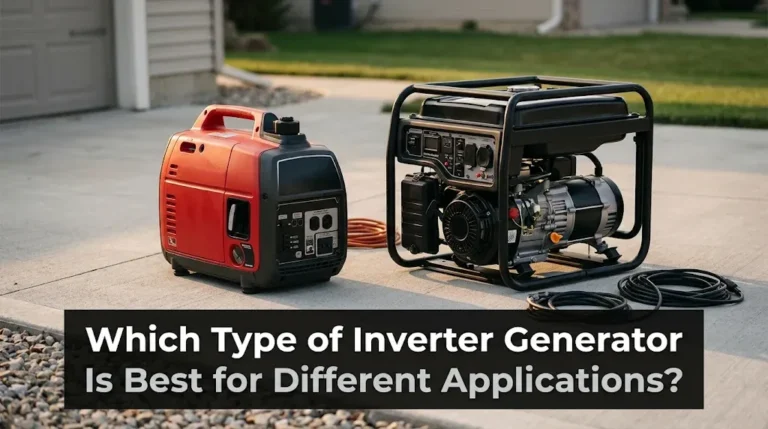
Open-frame means you can see the engine, alternator, and fuel tank through the steel frame. There is no sound-dampening shell around them.
That exposed design is why these units cost less and cool better than enclosed models. It is also why they sound louder.
Section Takeaway: An open-frame inverter generator is an inverter at heart and a work-site frame on the outside, so you get clean power without paying for a quiet enclosure.
How Does an Open-Frame Inverter Differ From an Enclosed One?
The power is the same idea in both designs. The case is what changes.
An enclosed inverter hides its engine inside a moulded plastic shell with insulation and baffled vents. An open-frame inverter leaves it out in the open air.
Noise, size, and weight
Enclosed models are built for quiet first. Open-frame models trade that hush for airflow and lower cost.
Cooling and maintenance
Heat is the enemy of a hard-working generator, and open frames shed it fast. Air moves freely around the engine instead of pooling inside a case.
Service is simpler too. You can reach the oil drain, air filter, and spark plug without removing panels.
Safety note: Never run any generator indoors, in a garage, or near open windows, doors, or vents. Carbon monoxide is colourless and odourless, and it can build up fast in an enclosed space.
Section Takeaway: Choose enclosed for quiet camping and close neighbours, and open-frame when you want more watts, easier service, and a lower price.
What Are the Main Advantages of Open-Frame Inverter Generators?
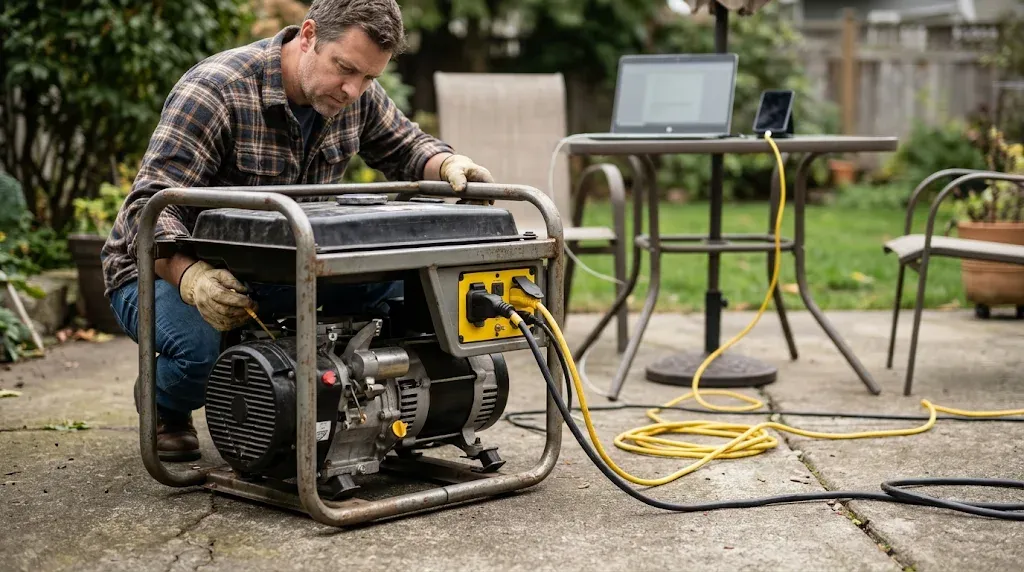
The main advantage is value. You get inverter-quality power at a conventional-generator price point.
1. Higher wattage for the money
Open-frame inverters commonly start around 3,500 starting watts and climb past 9,500. Enclosed inverters at the same price often stop lower.
That gap matters when you need to start a fridge, a well pump, or an RV air conditioner. Starting watts decide whether that load starts at all.
If budget is the deciding factor, an affordable inverter generator in an open frame is often the cheapest route to clean, high-output power.
2. Clean, stable power
Inverter power holds voltage and frequency far steadier than raw conventional power. That steadiness is what laptops, phones, routers, and CPAP machines need.
3. Better fuel economy at part load
Most open-frame inverters include an eco-throttle, sometimes called economy mode. It slows the engine when demand is light.
At a light load, that can stretch a tank noticeably. At full load, the advantage fades.
4. Easier service and better airflow
Oil changes, air-filter cleaning, and spark-plug checks take minutes when nothing blocks your hands.
Good airflow also helps on hot job sites and during long outage runs.
5. Parallel capability and useful outlets
Many open-frame inverters accept a parallel kit, which links two matching units for roughly double the output.
Outlets are usually generous too. Look for a 30-amp RV outlet, a twist-lock outlet, and GFCI-protected household outlets.
Section Takeaway: Open-frame inverters win on watts per dollar, clean power, and easy upkeep, which is why they suit home backup, RVs, and job sites so well.
Is the Power Clean Enough for Sensitive Electronics?
Yes, for most household electronics, provided you check the model’s THD rating first. THD stands for total harmonic distortion, and it measures how far the power wave strays from a perfect sine wave.
Lower is better. Many inverter generators advertise less than 3% THD, which suits laptops, phones, televisions, and medical devices such as CPAP machines.
Conventional generators often run far higher, sometimes above 20% THD. That rough power can stress sensitive circuits over time.
To see how that clean-power path works, read how inverter generator technology works from fuel to outlet.
If your loads are mostly electronics, also compare models built for sensitive electronics and for low THD. Both roundups focus on the same quality you need here.
Safety note: Clean power does not make a generator safe indoors. Keep it outdoors, at least 20 feet from your home, with the exhaust pointed away from windows and doors.
Section Takeaway: Check for low THD on the spec sheet, and an open-frame inverter will run most sensitive electronics safely.
Open-Frame Inverter vs Enclosed Inverter vs Conventional Generator
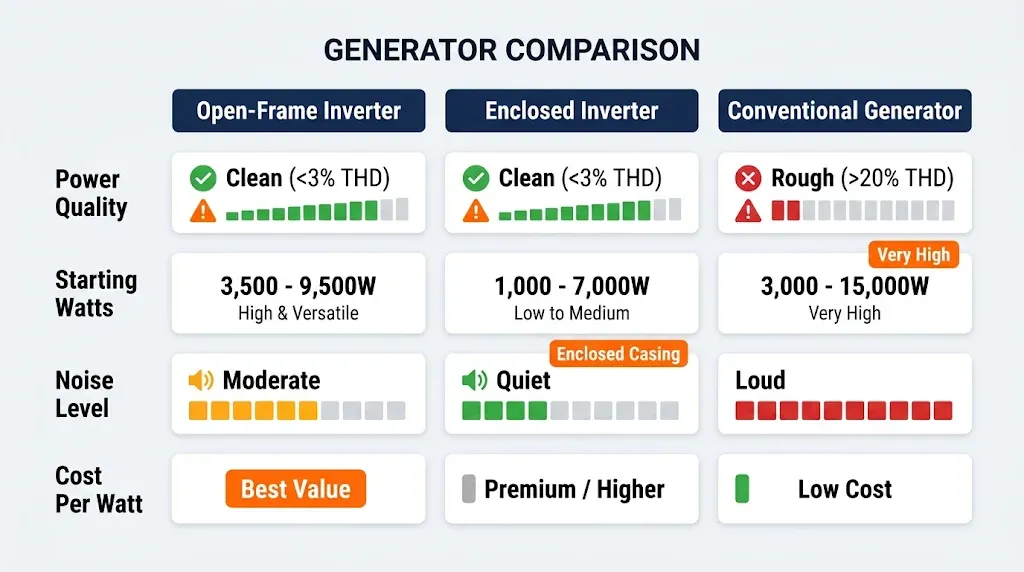
The table below sums up the real choice. No type wins on every row, so match the winner to your main use.
| Feature | Open-Frame Inverter | Enclosed Inverter | Conventional Generator |
|---|---|---|---|
| Power quality | Clean sine wave, low THD | Clean sine wave, low THD | Rough, higher THD |
| Typical output | 3,500–9,500 starting watts | 1,000–7,000 starting watts | 3,000–15,000 starting watts |
| Noise | Moderate to loud | Quietest of the three | Loudest at full load |
| Fuel use at light load | Good, with eco-throttle | Best, with eco-throttle | Poor, fixed engine speed |
| Price per watt | Lowest for clean power | Highest of the three | Low, but power is rough |
| Best for | Home backup, RV, job site | Camping, tailgating, quiet use | Heavy tools, rough loads |
Section Takeaway: If you need clean power and high watts on a budget, the open-frame inverter is the sweet spot between the other two types.
Where Do Open-Frame Inverter Generators Work Best?
Open-frame inverters shine where power demand is high and neighbours are not close. Home backup is the clearest example.
During an outage, one unit can run a fridge, a few lights, a router, and a phone charger at once. Add a second load carefully, and it can also cover a furnace blower or a sump pump.
Home backup and outages
Start with the loads that protect your home. A fridge keeps food safe, a sump pump keeps a basement dry, and a furnace blower keeps pipes from freezing.
Use outdoor-rated extension cords, or a transfer switch installed by a licensed electrician. Never backfeed power through a household outlet, since that can injure utility workers.
RV and camping with space
RV owners like open-frame inverters for one reason: they can start a rooftop air conditioner. A 13,500 BTU RV air conditioner often needs a large starting surge, and a small enclosed unit may stall.
That advantage fades at a crowded campground with quiet hours. There, an enclosed inverter earns its keep.
Job sites and power tools
Tools with motors, such as saws, compressors, and drills, need strong starting watts. Open-frame inverters deliver that surge while protecting battery chargers.
Safety note: On a job site, keep the generator clear of dust, debris, and flammable material, and follow OSHA guidance for outdoor power equipment. Let the engine cool before refuelling.
Section Takeaway: Pick an open-frame inverter when the job needs real watts and clean power, and the noise will not bother anyone nearby.
What Are the Trade-Offs to Know Before You Buy?
Every advantage above has a cost, and the cost is mostly noise. An open-frame inverter is not a quiet generator, even with eco-throttle on.
That matters more than buyers expect. Noise carries across a campsite, and it wears on you during a long outage too.
Noise is the main drawback
Without a sound-dampening case, engine and exhaust noise reach you directly. Distance helps, so place the unit as far from living areas as your cords allow.
Check the decibel rating on the spec sheet, and compare ratings measured at the same distance.
Weight and size
High-output open-frame models are heavy, and many need two people to lift safely. Wheels and a folding handle help, but they do not make the unit light.
Measure your storage space before you buy, wheels and handle included.
Weather exposure
An open frame leaves the engine exposed to rain and dust. That is fine in dry weather, but you need a proper open-sided shelter or running cover in a storm.
For authoritative safety guidance, see the U.S. Consumer Product Safety Commission and the CDC carbon monoxide guidance.
Both stress the same rule: outdoors, far from the house, every time.
Section Takeaway: Noise, weight, and weather exposure are the real trade-offs, so plan placement and storage before you commit.
How Do You Choose the Right Size and Features?
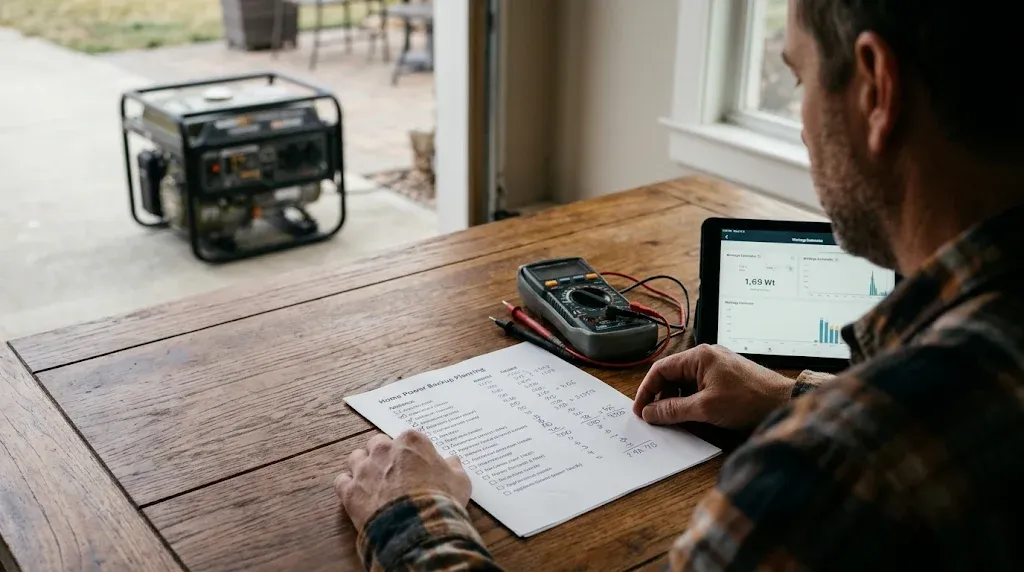
Size the generator to your starting watts, not just your running watts. Running watts keep a load going, while starting watts get its motor spinning in the first place.
A typical fridge may draw about 700 running watts but need about 2,200 starting watts. A window air conditioner shows the same pattern on a smaller scale.
Learn the difference in detail with our guide to running watts vs starting watts. That one distinction prevents most sizing mistakes.
Do the wattage math first
- List your must-run loads: Fridge, lights, router, phone charger, and any medical device come first.
- Add running watts: Total the steady draw of everything you will run at once.
- Add the largest starting surge: Add the highest single starting watts on top, not every surge at once.
- Leave headroom: Keep about 20% spare capacity so the generator is not pinned at its limit.
Features worth paying for
- Electric start: Helpful on cold mornings and for larger engines.
- CO shutoff sensor: Shuts the unit down if carbon monoxide builds up nearby.
- Fuel gauge and low-oil shutdown: Both protect the engine and prevent surprise shutdowns.
- Parallel ports: Let you add a second matching unit later.
- RV-ready outlet: A 30-amp outlet saves you from adapters on the road.
For broader context on home backup planning, see the U.S. Department of Energy and Consumer Reports guidance on generators and outage readiness.
Both cover sizing and safety without selling you a specific model.
Safety note: For a home hookup, use a transfer switch or interlock kit installed by a licensed electrician. Check your owner’s manual for grounding, oil type, and break-in steps before first use.
Section Takeaway: Add running watts, add the largest starting surge, leave headroom, and let that total pick the size.
Frequently Asked Questions
Are open-frame inverter generators quiet?
No, they are louder than enclosed inverter generators. The open frame has no sound-dampening shell, so they suit job sites, RVs, and home backup better than quiet campgrounds.
Can an open-frame inverter generator run sensitive electronics?
Yes, if its THD rating is low, usually under 3%. The inverter rebuilds power as a clean sine wave, which suits laptops, phones, routers, and CPAP machines.
How long can an open-frame inverter generator run?
Runtime depends on tank size and load, so check the spec sheet for figures at 25% and 50% load. Eco-throttle extends runtime at light load, while a heavy load shortens it.
Can I parallel two open-frame inverter generators?
Many models support it with a parallel kit, but only link matching, parallel-capable units from the same maker. The kit combines their output so you can run larger loads.
Is an open-frame inverter generator good for home backup?
Yes, it is one of the best value choices for home backup. It delivers clean power and enough starting watts for a fridge, furnace blower, or sump pump.
What size open-frame inverter generator do I need?
Add your running watts, add the largest starting surge, and leave about 20% headroom. A fridge, lights, and a router often fit a 4,500-watt class unit, while an RV air conditioner usually needs more.
If clean power, high watts, and a fair price matter most, an open-frame inverter generator is hard to beat. It gives up quiet for value, and for home backup, RV use, and job sites, that is often the right trade.
Size it to your starting watts, place it outdoors and well away from the house, and keep up with oil and filter care.

Hi, I’m Michael Turner. I own a generator workshop in the United States and founded HomeGeneratorBlog to share practical, hands-on guidance about generator installation, maintenance, troubleshooting, safety, and backup power solutions. My goal is to help homeowners make smarter, more confident decisions through clear and reliable information