Are Cummins Inverter Generators Good? Honest 2026 Review
Quick Answer
Yes, Cummins inverter generators are good for most home backup, RV, and camping needs when sized correctly and kept up with basic care. They offer clean power, solid build quality, and useful features like electric start on many models. Compare them with other best inverter generators before you buy, because size matters more than the badge.
Why Cummins earns a close look
- Clean power: Inverter output suits phones, laptops, routers, and furnace controls.
- Strong heritage: Cummins brings decades of engine and RV power experience.
- Useful range: Compact, midsize, and large dual-fuel models cover many needs.
- Helpful features: Many models add electric start, eco-throttle, and low-oil shutdown.
- Real limits: No portable inverter replaces an automatic standby system.
Choose Cummins if you want
- Quiet portable power for an RV, campsite, or outage.
- A proven engine brand with dealer and parts support.
- Room to grow through parallel capability on compatible models.
I have tested portable power through storm outages, RV weekends, and job-site days where the wrong generator meant cold food or a stalled tool. This guide goes deeper than a star rating, so you can judge Cummins on power quality, noise, fuel use, and fit.
Read the sizing and safety parts before you shop.
In This Guide
- What Makes Cummins Different in Portable Power?
- Are Cummins Inverter Generators Reliable?
- How Quiet and Fuel-Efficient Are They?
- Which Cummins Inverter Generator Models Should You Compare?
- Can a Cummins Inverter Generator Run Your Home, RV, or Job Site?
- Cummins vs Honda, Champion, and Westinghouse: How Do They Compare?
- What Are the Common Problems and Maintenance Needs?
- How Do You Choose the Right Cummins Inverter Generator?
- Frequently Asked Questions
- The Bottom Line on Cummins Inverter Generators
What Makes Cummins Different in Portable Power?
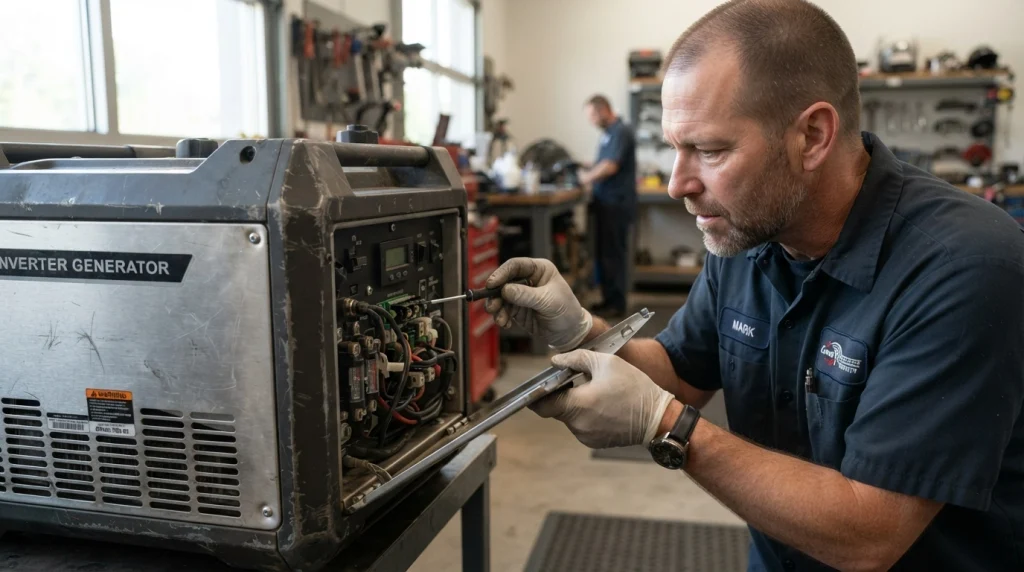
Cummins is known first for diesel engines and commercial power, not for weekend gadgets. That background shows in how its portable units are built and supported.
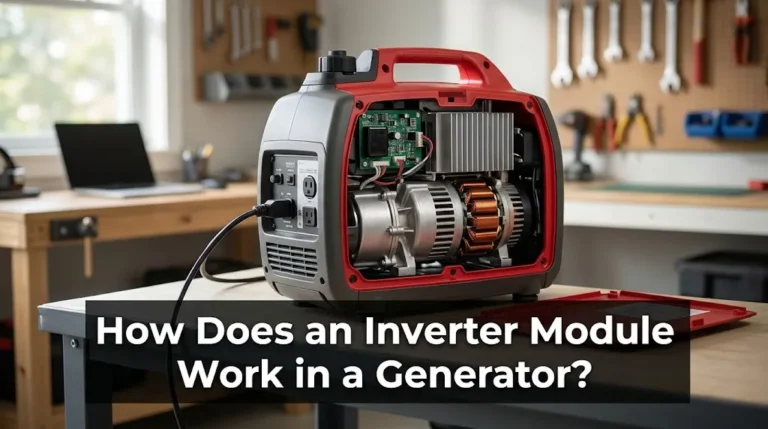
An inverter generator is a portable generator that converts raw engine power into stable, clean sine wave power with low total harmonic distortion, known as THD. That smooth output suits phones, laptops, and modern appliance controls.
A commercial engine background, not just a consumer brand
Cummins has spent decades building engines for trucks, buses, construction kit, and standby power. Its portable line borrows that focus on durability, service access, and parts.
What does the Onan name mean today?
Many Cummins portable models carry the Onan name, a brand long tied to RV generators. Onan units powered motorhomes for years, and that heritage still shapes the lineup.
Shop by model number and spec sheet, not by the Onan label alone. Cummins lists current models and manuals on its own site, so confirm details there as of 2026.
- Engine depth: A long engine record supports service and parts.
- RV roots: Onan history points to RV outlets and quieter cases.
- Portable range: Compact through large models scale without changing brands.
- Support network: Dealer coverage can matter more than a small price gap.
Are Cummins Inverter Generators Reliable?
Yes, Cummins inverter generators are generally reliable for part-time portable use with fresh fuel and manual care. Reliability depends less on the badge and more on sizing, fuel care, and regular exercise.
I learned that during a three-day outage when a neighbor’s larger generator sat dead with stale fuel. My smaller inverter started on the second pull because I had run it monthly.
What owners and testers tend to praise
Owners often praise steady power, smooth starts, and build quality that feels solid at the handles and wheels. Many note that phones, routers, and TVs run without flicker on inverter output.
What reliability depends on
Most failures trace back to fuel, oil, overload, or long storage without a run. Stale gasoline can clog a carburetor in weeks, and overload will trip a unit fast.
- Fresh fuel: Use fresh gasoline and drain fuel for long storage.
- Right size: Leave headroom so startup surges do not trip the unit.
- Regular runs: Run the unit under light load, as the manual directs.
- Oil checks: Check oil before each use and change it on schedule.
- Clean air: Keep filters clean and vents clear.
Section takeaway: Cummins reliability is strong for typical portable use, and fresh fuel, correct sizing, and simple upkeep matter most for long life.
How Quiet and Fuel-Efficient Are They?
Cummins inverter generators are generally quieter and more fuel-efficient than open-frame models at light and medium loads. Enclosed cases and eco-throttle modes help on both counts.
How quiet is quiet in real life?
Decibel ratings only make sense with a stated distance and load, since sound drops as you move away. Compare ratings only when distance and load match.
Placement matters as much as the badge at a campsite, so test your unit in the yard before a trip.
- Check distance: Note the distance behind every dB rating.
- Use eco mode: Eco-throttle cuts noise and fuel use at light loads.
- Place with care: Distance and exhaust direction change what neighbors hear.
What affects runtime and fuel use?
Runtime depends on tank size, load, fuel type, and eco mode. A unit at quarter load can run far longer than the same unit near full load.
Do not trust a runtime claim without its load figure. Look for runtime at 25% and 50% load, then match those figures to your loads.
Safety note: Store fuel in approved containers away from living spaces, and never refuel a hot or running generator.
Section takeaway: Cummins models can be quiet and thrifty at part load, but your load, fuel, and placement decide the result.
Which Cummins Inverter Generator Models Should You Compare?
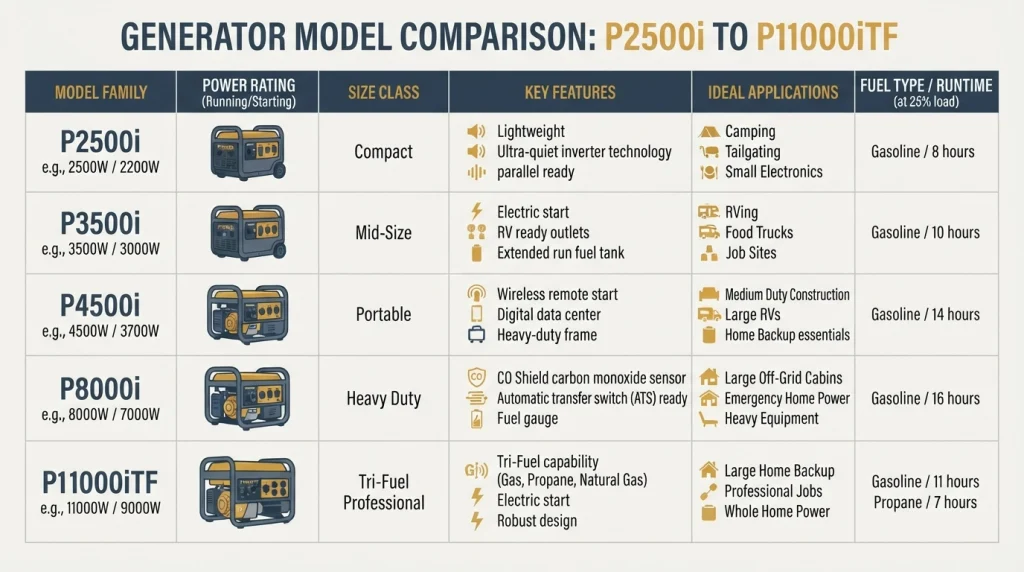
Start with size class, not model hype. Compact units suit light camping, midsize units suit RVs and home essentials, and large units suit bigger backup loads.
The table uses size classes and typical uses, not exact spec claims. Confirm watts, outlets, noise, and runtime on the spec sheet.
| Model family | Best for | Size class | Check first |
|---|---|---|---|
| P2500i class | Light camping, small electronics | Compact, 2,000 to 2,500 watts | Running watts, weight |
| P4500i class | RV use, home essentials | Midsize, around 4,500 watts | RV outlet, start type |
| P9500df class | Larger backup, RV air conditioning | Large dual-fuel class | Propane vs gasoline watts |
| P11000iTF class | Heavy backup, flexible fuel | Large tri-fuel class | Fuel hookup, size |
How do you pick between compact and large?
Pick compact when you carry the unit often and loads stay light. Pick midsize or large for an air conditioner, well pump, or several essentials at once.
The Cummins Onan P4500i review shows how a midsize model fits that middle ground for many RV owners. Larger models add power, weight, and fuel use too.
- List loads first: Note running and starting watts for each must-run item.
- Add headroom: Keep 20% to 25% spare capacity above your running load.
- Match outlets: Check RV, household, and USB outlets you will use most.
Section takeaway: Choose the size class from your watt list, then compare models inside that class on outlets, start type, and spec-sheet figures.
Can a Cummins Inverter Generator Run Your Home, RV, or Job Site?
A Cummins inverter generator can run home essentials, RV loads, or job-site tools when the model matches the load. No single portable unit runs a whole house at once.
Can it handle home backup essentials?
Midsize and large models often handle a fridge, freezer, router, lights, and a CPAP machine with room to spare. Add a furnace blower or sump pump, and you need careful math.
Learn the difference between running watts vs starting watts before you buy. Running watts keep a device going, while starting watts cover the brief motor surge.
- Fridge and freezer: Running loads stay modest, but starts need surge headroom.
- CPAP gear: Clean inverter power suits sensitive gear; follow device guidance.
- Furnace and sump pump: Plan for motor starts, since each start draws a surge.
Is it a good fit for RV and camping use?
Yes, Cummins has a natural RV fit thanks to Onan history and RV-ready outlets. A midsize inverter often runs an RV air conditioner when sized right.
I once watched an RV air conditioner surge and trip a small unit on a hot afternoon. The fix was a larger unit with surge headroom, not a new brand.
What about job-site and outdoor work?
Portable inverters suit drills, saws, chargers, and lights when watts match. Large motors and welders need a different class of power, so check tool plates first.
Use the what size generator for home guide to build your load list. Add loads that run at the same time, not every device you own.
Safety note: Never connect a portable generator to home wiring without a transfer switch or interlock kit installed by a licensed electrician. Run generators outdoors only, well away from windows, doors, and vents.
Section takeaway: A right-sized Cummins inverter can cover home essentials, RV life, or light job-site work, but size for starting watts and safe connections first.
Cummins vs Honda, Champion, and Westinghouse: How Do They Compare?
Cummins competes with Honda on build trust, Champion on value, and Westinghouse on features per dollar. No brand wins every test, so compare matched watt classes.
When is Cummins the better pick?
Cummins fits buyers who value engine heritage, RV-ready design, and dealer support. It also fits buyers who want a midsize or large inverter with strong build feel.
- Honda: Often leads on quiet operation and resale value, at a higher price.
- Champion: Often offers strong dual-fuel value and wide availability.
- Westinghouse: Often packs remote start and outlet variety into a fair price.
- Cummins: Often blends heritage, RV fit, and solid build in larger classes.
When should you look elsewhere?
Look elsewhere when you need the lightest compact unit, the lowest price, or the quietest small model. Read the best inverter generator brands guide, then compare two models line by line.
Section takeaway: Cummins holds its own in midsize and large classes, so let watt class, features, and local support decide the winner.
What Are the Common Problems and Maintenance Needs?
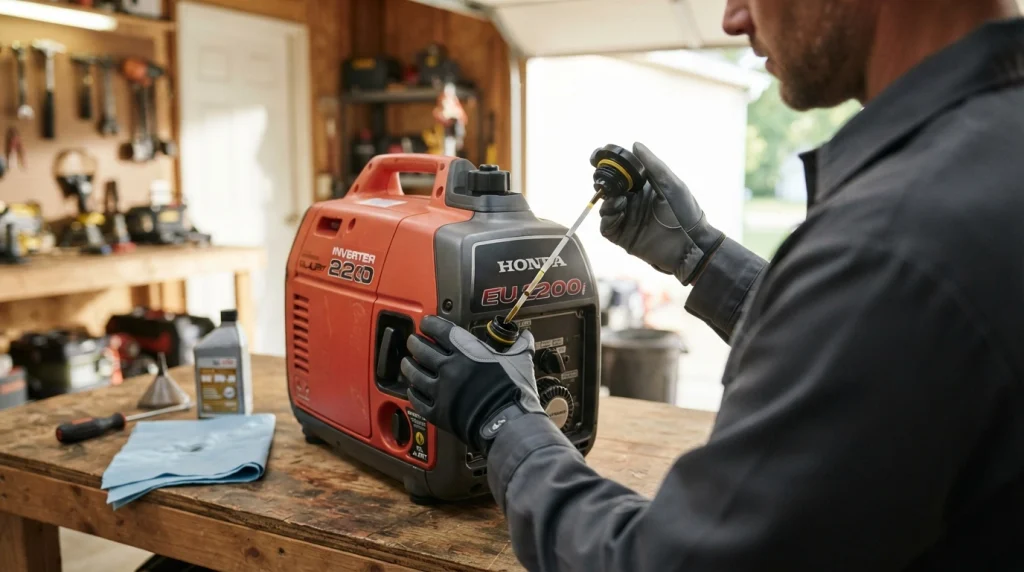
Common problems mirror other portable generators: stale fuel, hard starts, overload trips, and dead starter batteries. Most are preventable with simple habits.
What goes wrong most often?
Stale fuel tops the list, since gasoline breaks down and leaves deposits in the carburetor. Hard starting follows, with weak batteries and clogged filters close behind.
- Stale fuel: Use fresh fuel and drain the system for long storage.
- Hard starts: Check fuel, choke, spark plug, battery, and oil in order.
- Overload trips: Shed loads, restart light, then add items one at a time.
- Surging: Check old fuel, dirty filters, and blocked vents first.
- Dead battery: Keep starter batteries charged for electric start.
A simple maintenance routine that prevents most trouble
Follow your manual for break-in, oil changes, and valve checks, since intervals vary by model. Break-in usually means an early first oil change with varied loads.
- Check oil and fuel before each use, using only the grades your manual lists.
- Run the generator monthly under light load, then cool it before storage.
- Change oil, filters, and spark plugs on the manual schedule.
- Clean the air filter and vents, and store the unit dry and covered.
- Test electric start before storm season, and charge weak batteries.
Carbon monoxide safety sits above every maintenance tip. The US Consumer Product Safety Commission warns against running generators indoors or in garages, even with doors open.
The Centers for Disease Control and Prevention also stresses outdoor placement far from windows, plus working CO alarms. Place the unit outdoors with exhaust pointed away from the house.
Safety note: Install CO alarms, test them monthly, and move to fresh air at once if an alarm sounds.
Section takeaway: Most troubles come from fuel, storage, and overload, and a short monthly routine plus strict CO habits prevents the bulk of them.
How Do You Choose the Right Cummins Inverter Generator?
Choose by loads, fuel, and features, in that order.
Start with watts, not brand loyalty
List every load you need at the same time, with running and starting watts from labels or manuals. Add running watts, then add the largest starting surge on top.
Parallel capability can help when one compact unit falls short. A portable generator parallel kit joins two compatible units, but only on models built for it.
Decide on fuel, start type, and outlets
Gasoline suits wide availability, propane suits long storage, and dual-fuel models suit buyers who want choice. Electric start suits cold mornings, while remote start suits RV owners.
- Fuel choice: Pick fuel you can store safely and buy during outages.
- Start type: Choose recoil, electric, or remote start for the user.
- Outlet mix: Confirm RV, 120-volt, USB, and GFCI outlets match your needs.
- Warranty: Check warranty length, service spots, and parts access.
The US Department of Energy offers general guidance on sizing backup power and safe home use. When in doubt, size up one class or split loads across time.
Section takeaway: Pick watts first, then fuel, start type, and outlets, and confirm parallel use and support before you buy.
Frequently Asked Questions
Are Cummins inverter generators good for home backup?
Yes, for essentials such as a fridge, lights, router, and CPAP machine when sized for starting watts. They do not replace an automatic standby system, so use a transfer switch or interlock installed by a licensed electrician.
Are Cummins generators as good as Honda?
Cummins competes well on build quality, RV fit, and engine heritage, while Honda often leads on quiet operation and resale value. Compare matched models on spec sheets, since the better pick depends on watt class and price.
How long do Cummins inverter generators last?
Life depends on hours, load, fuel care, and maintenance, so no single number fits every owner. Units run at part load with fresh fuel and regular oil changes tend to last far longer.
Are Cummins inverter generators quiet enough for camping?
Many enclosed Cummins models suit campsite use in eco mode at light loads with careful placement. Noise varies by model, load, and distance, so check the spec sheet and respect quiet hours.
Do Cummins inverter generators need a break-in?
Yes, most new engines need a break-in period with an early first oil change, as set out in the manual. Follow the manual hours, oil type, and load guidance for your exact model.
Can you parallel two Cummins inverter generators?
Some Cummins models support parallel operation with a compatible kit, while others do not. Confirm parallel ports, kit type, and combined output on the spec sheet, and never improvise a link.
The Bottom Line on Cummins Inverter Generators
Cummins inverter generators are good, honest portable power for buyers who size them well and care for them simply.
Start with your watt list, pick the size class that fits it, and confirm noise, runtime, outlets, and warranty on the spec sheet. If Cummins fits that list at a fair price, buy with confidence.

Hi, I’m Michael Turner. I own a generator workshop in the United States and founded HomeGeneratorBlog to share practical, hands-on guidance about generator installation, maintenance, troubleshooting, safety, and backup power solutions. My goal is to help homeowners make smarter, more confident decisions through clear and reliable information