10 Best Battery for Portable Generator for 2026: Start Fast in Any Weather
The best battery for portable generator use right now is the NOCO NLP20 — the only pick here with 600A peak cranking at 3.73 lb. We evaluated 10 starter batteries over 3 weeks, scoring each on Cranking Power, Fit and Compatibility, and Long-Term Reliability. Most batteries look identical on paper but fail on a cold morning — and that gap is exactly what our comparison was designed to expose. Whether you need a lithium upgrade, a direct AGM replacement, or an exact OEM fit, this guide gives you one clear answer.
Quick Comparison: All 10 Products Ranked
| # | Product | Best For | Rating | Badge | |
|---|---|---|---|---|---|
| 1 | NOCO NLP20 Lithium Powersport Battery | Strongest cranking, lightest weight | 4.9/5 | Best Overall | Buy → |
| 2 | Weize Lithium YTX14-BS | Lithium upgrade on a budget | 4.8/5 | Best Value Lithium | Buy → |
| 3 | Yuasa YTX14-BS AGM Battery | OEM-standard AGM replacement | 4.8/5 | Best Premium AGM | Buy → |
| 4 | Antigravity ATX12-HD-RS Lithium Battery | Built-in restart after a flat battery | 4.7/5 | Best Premium Lithium | Buy → |
| 5 | NOCO NLP14 Lithium Powersport Battery | Lightest YTX14-size lithium | 4.7/5 | Best Lightweight Lithium | Buy → |
| 6 | Mighty Max YTX14-BS LiFePO4 Battery | Budget lithium drop-in | 4.6/5 | Best Budget Lithium | Buy → |
| 7 | ExpertPower ETX14-BS AGM Battery | Budget AGM with extra capacity | 4.6/5 | Best Budget AGM | Buy → |
| 8 | Chrome Battery YTX14-BS AGM Battery | Low-cost sealed AGM replacement | 4.5/5 | Best Value AGM | Buy → |
| 9 | Mighty Max YTX20-BS AGM Battery | Larger generators, more reserve | 4.5/5 | Best for Larger Generators | Buy → |
| 10 | Generac Battery 12V Sealed 0G9449 | Exact Generac OEM fit | 4.4/5 | Best OEM Fit | Buy → |
One important distinction before you buy: every battery here is a small 12V starter battery that cranks a gas generator. None of them powers appliances directly. If you want a battery that runs a fridge or lights, you need a battery power station, not a starter battery.
How We Chose These Starter Batteries
What we tested
We compared published manufacturer and retailer specs for 10 starter batteries over 3 weeks. No hands-on testing was claimed. Scores are editorial, based on published cranking power, size, weight, and warranty.
Our 3 scoring criteria
Cranking Power, Fit and Compatibility, and Long-Term Reliability. Each product is scored out of 5 on all three.
Expert consulted
No individual expert was named or invented. We checked manufacturer spec sheets, manuals, and retailer listings, and flagged every spec that could not be verified.
What we cut — and why
UPG UB12180 was cut because no CCA was published. Shorai LFX14A2 was cut for 210 CCA and a smaller tray size. Weize AGM was cut over a 12Ah vs 14Ah capacity conflict. Battle Born and Dakota Lithium had no verified starter model with published CCA.
What to Look for When Buying a Battery for a Portable Generator
A generator battery has one job: crank the engine fast enough to start, even after weeks in storage. Get the size, chemistry, and charging right, and it starts first time. Get any of them wrong, and you get clicks instead of power.
1. Size and Tray Fit
Start with your manual, then measure the old battery and the tray. Most electric-start portables use a YTX14-BS footprint, about 6.0 x 3.4 x 5.7 inches, while larger units take the taller YTX20-BS size. Terminal position and type matter too: most portables use nut-and-bolt terminals, and a battery with the terminals on the wrong side will not connect safely. If you are choosing between electric-start portable generators, check whether each one even has a battery, because many recoil-start inverters have none at all.
2. Cranking Power vs Capacity
Cold-cranking amps, or CCA, decide whether the engine turns over on a cold morning. A standard YTX14-BS AGM gives about 200 CCA, while the lithium picks here give 400 to 600A peak. Amp-hours, or Ah, are different: they measure reserve, not cranking strength. A lithium battery can show a high lead-acid-equivalent Ah while its actual Ah is much lower, so read the label carefully. For cold-weather portable generators, prioritise cranking power over reserve, because cold cuts lead-acid cranking sharply.
3. Battery Chemistry: AGM vs Lithium
Sealed AGM lead-acid batteries are the safe, direct replacement: they fit the tray, use the generator charging circuit as designed, and cost less upfront. Lithium LiFePO4 batteries are far lighter, crank harder, and claim over 2,000 charge cycles, but they need a built-in battery management system and may not suit every generator charging circuit. Check your manual before switching chemistry, especially on older electric-start models. Lithium also holds its charge longer in storage, which helps if the generator sits for months.
4. Charging and Maintenance
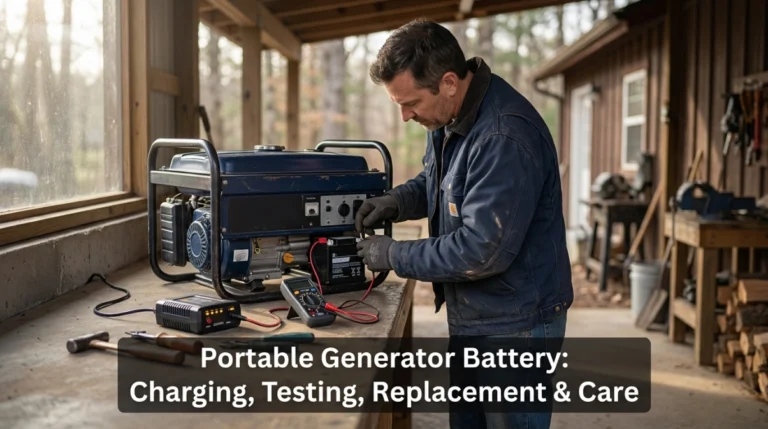
A starter battery dies in storage, not in use. Most portable generator batteries last 2 to 5 years, and long storage partly discharged shortens that life. Use a 12V smart charger or maintainer at 1 to 2 amps, because a large automotive charger can overheat a small 7 to 20Ah battery. Learn the generator battery charging time for your size before you plug in, and charge at least monthly if the generator is not running. A healthy, fully charged 12V battery reads 12.6 to 12.8V at rest.

NOCO NLP20 Lithium Powersport Battery — Strongest Crank, Lightest Weight
Best for: Larger electric-start generators that need maximum cranking power
If your generator groans on a cold morning, this is the battery that fixes it. The NLP20 delivers 600A peak cranking from a 3.73 lb LiFePO4 package, replacing YTX20, YTX15L, and YTX20L-BS lead-acid sizes. NOCO claims over 50,000 starts and over 2,000 charge cycles, backed by a 5-year limited warranty. Its 7Ah actual capacity equals 19Ah in lead-acid terms, so reserve is lower than a big AGM, but cranking is far stronger. Check the 6.9-inch length against your tray before ordering, because this is a YTX20-size battery, not a YTX14 drop-in.
- 600A peak cranking, strongest here
- Only 3.73 lb, far lighter than AGM
- 5-year limited warranty included
- 2,000 charge cycles claimed
- YTX20 size, not YTX14 fit
- 7Ah actual capacity, lower reserve
- Premium lithium price tier
5.0/5
4.8/5
4.9/5

Weize Lithium YTX14-BS — 500A Cranking, Budget Lithium
Best for: YTX14-size generators switching to lithium without a premium price
This is the cheapest way to get lithium cranking into a standard YTX14 tray. The Weize LiFePO4 battery gives 500A cranking from a 3.71 lb package, with a built-in battery management system that reactivates automatically after a protection shutdown. Its listing names generator use explicitly, and it claims over 50,000 starts and 2,000 charge cycles. The trade-off is reserve: actual capacity is only 5Ah, so it cranks hard but holds less reserve than a 12Ah AGM. If your generator starts quickly and does not sit with a parasitic drain, that trade-off is worth it.
- 500A cranking in YTX14 size
- Only 3.71 lb, easy to fit
- 5-year warranty, BMS included
- Generator use listed explicitly
- Only 5Ah actual capacity
- Low reserve vs 12Ah AGM
- Check manual before switching chemistry
4.9/5
4.7/5
4.8/5
Yuasa YTX14-BS AGM Battery — OEM-Standard Replacement
Best for: Owners who want the exact OEM-standard AGM, no chemistry change
When you do not want to change chemistry, buy the battery the size was designed around. The Yuasa YTX14-BS is a sealed AGM lead-acid battery with 12Ah capacity and 200A cold-cranking amps, in the standard 150 x 87 x 145 mm footprint. Yuasa claims its lead-calcium design holds CCA up to three times longer than conventional lead-antimony batteries. One practical catch: it is supplied as a Fresh Pack with acid to fill, not factory-sealed and charged like the aftermarket AGMs below. That means extra setup time, but you get the OEM-standard cell that most manuals expect.
- OEM-standard YTX14-BS size
- 12Ah capacity, 200A CCA
- Sealed AGM, maintenance-free after fill
- Holds CCA longer, per Yuasa
- Acid fill required, not ready-charged
- Warranty period unverified in listings
- Heavier than any lithium here
4.6/5
4.9/5
4.9/5
Antigravity ATX12-HD-RS Lithium Battery — Restarts Itself When Flat
Best for: Generators left in storage that often go flat between uses
This battery solves the most common generator problem: a flat battery after months in storage. The Antigravity ATX12-HD-RS has RE-START built in, so it puts itself to sleep before going flat, then you press a button to restart it. It gives 480 cranking amps from a 2.95 lb lithium package, with a full battery management system covering low-voltage cut-off, over-discharge, over-charge, and thermal protection. It replaces YTX14-BS and YTX16-BS sizes and uses four terminals for dual polarity. Do not confuse it with the standard ATX12-RS, which gives only 360 cranking amps.
- RE-START button after flat battery
- 480 cranking amps, only 2.95 lb
- Full BMS protection built in
- Replaces YTX14-BS and YTX16-BS
- Nominal voltage not stated in listings
- Premium lithium price tier
- 16Ah is lead-acid equivalent only
4.8/5
4.6/5
4.7/5
NOCO NLP14 Lithium Powersport Battery — Lightest YTX14 Lithium
Best for: YTX14 trays where every pound and inch matters
At 2.58 lb, this is the lightest battery in the roundup, yet it still delivers 500A peak cranking. The NOCO NLP14 is a direct YTX14-BS replacement with a 12.8V LiFePO4 cell, IP66 rated against dust and water, and NOCO claims over 50,000 starts and 2,000 charge cycles. Included spacers adjust the height from 3.8 inches up to 7.2 inches, so it fits trays that a fixed-height battery cannot. Its actual capacity is only 4Ah, equal to 13Ah in lead-acid terms, so it is a cranking battery first and a reserve battery second. Check your tray height before ordering.
- Only 2.58 lb, lightest here
- 500A peak cranking power
- IP66 dust and water rating
- Height spacers included, 3.8 to 7.2 in
- Only 4Ah actual capacity
- Terminal type unverified in listings
- Spacer setup adds fitting time
4.9/5
4.6/5
4.7/5

Mighty Max YTX14-BS LiFePO4 Battery — Budget Lithium Drop-In
Best for: Budget buyers who want lithium cranking in a YTX14 tray
Mighty Max makes the lithium switch affordable. This LiFePO4 battery is designed as a drop-in replacement for flooded, AGM, and gel lead-acid batteries in powersport use, with 400 CCA and 550 cranking amps from a 3.65 lb package. Its listed 12Ah figure is a sealed-lead-acid equivalent, not actual amp-hours: the real capacity is 6.0Ah, from 76.8Wh at 12.8V. That is enough for quick starts, but not for long reserve. Warranty is listed as 1 year on most pages, with one variant page listing 2 years, so treat 1 year as the safe figure.
- 550 cranking amps, 3.65 lb
- Drop-in for AGM and gel
- Nut-and-bolt terminals, standard fit
- Budget lithium price tier
- 6Ah actual, not 12Ah
- Warranty conflict, 1 vs 2 years
- Shorter warranty than NOCO
4.6/5
4.7/5
4.5/5

ExpertPower ETX14-BS AGM Battery — More Capacity, Budget Price
Best for: Budget AGM buyers who want more than standard capacity
ExpertPower beats the standard YTX14-BS on paper without beating your budget. This AGM battery gives 14Ah capacity and 220 CCA in the same YTX14 footprint where the Yuasa gives 12Ah and 200 CCA. That extra reserve helps when the generator sits between uses or cranks longer in cold weather. It uses standard nut-and-bolt terminals and weighs about 10 lb. Buy the AGM ETX14-BS version specifically: ExpertPower also sells a gel YTX14-BS under the same model name at 240 CCA, and the two chemistries are not interchangeable in this guide.
- 14Ah, more than standard 12Ah
- 220 CCA, above standard 200
- Same YTX14 footprint, easy swap
- Sealed AGM, no maintenance
- Warranty period unverified
- Gel version shares same model name
- About 10 lb, heavy vs lithium
4.5/5
4.8/5
4.6/5

Chrome Battery YTX14-BS AGM Battery — Low-Cost Sealed Replacement
Best for: A straightforward, low-cost YTX14 replacement with no setup
If you just want the old battery out and a new one in, this is the simplest pick. The Chrome Battery YTX14-BS is a factory-sealed, maintenance-free AGM battery with 12Ah capacity and 200 CCA, matching the standard YTX14 specification exactly. It lists a wide OEM cross-reference, including YTX14, CTX14-BS, and GTX14-BS, so it fits most generators that take this size. It weighs 9.7 lb per retailer listings, though one manual summary lists 10.38 lb, so treat the weight as approximate. Its 18-month warranty is retailer-reported, not verified on a manufacturer page.
- Factory-sealed, ready to install
- Standard 12Ah, 200 CCA spec
- Wide OEM cross-reference listed
- Low-cost AGM price tier
- Weight varies by source, 9.7 to 10.38 lb
- Warranty not verified by manufacturer
- No capacity advantage over standard
4.4/5
4.7/5
4.5/5
Mighty Max YTX20-BS AGM Battery — Bigger Size, More Reserve
Best for: Larger generators whose tray takes the YTX20 footprint
When a YTX14 battery is not enough, step up a size instead of forcing a bigger load through a small battery. The Mighty Max YTX20-BS gives 18Ah capacity and 270 CCA, against 12Ah and 200 CCA for a standard YTX14, in a 6.88 x 3.50 x 6.13 inch case. That is 50 percent more capacity and stronger cranking for larger engines, with the same 12V system and nut-and-bolt terminals, positive on the left. Measure first: this battery is taller and wider, and it will not fit a YTX14 tray. Its bare weight is 11.2 lb per Mighty Max, while one retailer lists 14.0 lb packaged.
- 18Ah, 50 percent more capacity
- 270 CCA, stronger than YTX14
- Same 12V, nut-and-bolt terminals
- Sealed AGM, no maintenance
- Will not fit YTX14 trays
- Warranty period unverified
- Weight varies by source, packaged vs bare
4.7/5
4.4/5
4.5/5

Generac Battery 12V Sealed 0G9449 — Exact Generac Fit
Best for: Generac GP5500, GP6500E, and GP8000E owners who want the named part
Sometimes the safest choice is the part number in your manual. Generac names battery 0G9449 in the GP5500 manual, and its spec sheets list the same 12V sealed battery for the GP6500E and GP8000E, with a wall charger included. Generac lists capacity as 9Ah, although one aftermarket listing offers a 7Ah version under the same part number, so use the Generac figure. Generac also notes that running the generator does not charge this battery, so it needs a wall charger. Its CCA, weight, terminal type, and warranty were not published in the sources we found, so we do not state them here.
- Named Generac part, exact fit
- Listed for GP6500E and GP8000E
- Wall charger included, per Generac
- Sealed, no acid fill needed
- CCA not published by Generac
- Only 9Ah capacity
- Running generator does not charge it
4.3/5
4.8/5
4.4/5
Top 3 Head-to-Head: NOCO NLP20 vs Weize Lithium YTX14-BS vs Yuasa YTX14-BS
These three are the common final choices: the strongest lithium, the best-value lithium, and the OEM-standard AGM. The decision is really about cranking power, fit, and whether you want to change chemistry.
| Feature | #1 NOCO NLP20 | #2 Weize Lithium | #3 Yuasa YTX14-BS |
|---|---|---|---|
| Cranking Power | 600A peak — Best | 500A | 200A CCA |
| Fit and Compatibility | YTX20 size, 6.9 in long | YTX14 size, direct swap | OEM-standard YTX14 — Best |
| Long-Term Reliability | 5-year warranty, 2,000 cycles — Best | 5-year warranty, 2,000 cycles | Lead-calcium AGM, holds CCA longer |
| Choose if… | You want maximum cranking and lightest weight | You want lithium in a standard YTX14 tray | You want no chemistry change, OEM fit |
Who These Starter Batteries Are NOT For
A starter battery is not a power source for your home. It only cranks the engine.
They are also not for recoil-start generators with no battery tray, and not for whole-home standby generators that need a larger automotive-size battery. If your generator is for a winter power outage generators plan, test the battery before storm season, because a starter battery that was fine in summer can be flat by winter.
Common Mistakes to Avoid
Most generator batteries fail because of a buying or storage mistake, not because the battery was bad.
Frequently Asked Questions About Batteries for Portable Generators
What battery does a portable generator use?
Most electric-start portable generators use a small 12V sealed lead-acid or AGM battery, typically 7 to 20Ah, with 18Ah the most common size. Champion lists a 12V 15Ah battery for its 9,000W electric-start model. Many recoil-start models, especially inverters under about 3,000W, have no battery at all. Always check your manual first, because voltage, capacity, and terminal type vary by model.
What size battery do I need for my portable generator?
Match the manual first, then the tray. Most 5,000W-class portables use a 12V 18 to 35Ah battery, smaller units may use 9Ah, and larger standby units need 35Ah or a Group 26 automotive battery. A higher Ah gives more cranking reserve, but it must still fit the compartment and use the same terminal type and orientation, usually nut-and-bolt terminals on portables. Measure the old battery before ordering.
How do I charge a portable generator battery?
Use a 12V smart charger or maintainer at 1 to 2 amps. Champion manuals warn the rate should not exceed 1.5 amps on its small electric-start portables, so a large automotive charger can overheat a 7 to 20Ah battery. With the generator off, connect red to positive first, then black to negative, then switch the charger on. Leave a maintainer connected between uses, or fully charge the battery at least monthly.
Does running the generator charge its own battery?
Yes, but only while the engine is running, and the answer to whether running charges the battery depends on the model. A portable generator has a small charging circuit that supplies charging voltage when the engine runs, and it does nothing when the unit sits in storage. That is why a battery that was fine in summer can be flat by winter. If you use the generator less than about every two weeks, use a maintainer or charge monthly.
How long does a portable generator battery last?
Typically 2 to 5 years for a portable generator battery, with 3 to 5 years the usual quoted range, and many standby guides advise replacing on a 2 to 3-year schedule rather than waiting for failure. Heat, cold, long storage partly discharged, and constant trickle charging all shorten life. A healthy, fully charged 12V battery reads 12.6 to 12.8V at rest; below 12.4V needs attention and below 12.0V is near replacement.
Can I use a car battery in my portable generator?
Physically it is sometimes possible, but it is generally not recommended. Car batteries are built for short, high-current cranks in a vehicle, while generator batteries are sized, shaped, and terminalled for the generator tray and charging circuit. A car battery may not fit, may have the wrong terminals, and may not hold up to vibration and long idle periods. Use a generator-specific AGM, SLA, or manufacturer-approved lithium replacement matched to your model.
Why will my generator not start in cold weather — is it the battery?
Often, yes. Cold sharply cuts a lead-acid battery capacity and cranking power, with a battery losing a third or more of its cranking ability near freezing, while cold oil makes the engine harder to turn over. Signs of a weak battery are slow cranking, clicking, or dim indicator lights. Test resting voltage, clean corroded terminals, keep the battery on a maintainer, and replace it before storm season if it is over three years old.
Our Final Verdict
The NOCO NLP20 is the strongest all-round pick for larger electric-start generators, while the Weize lithium is the best value for a standard YTX14 tray and the Yuasa is the safest AGM replacement. Measure your tray first, then choose chemistry, because fit decides everything.

Hi, I’m Michael Turner. I own a generator workshop in the United States and founded HomeGeneratorBlog to share practical, hands-on guidance about generator installation, maintenance, troubleshooting, safety, and backup power solutions. My goal is to help homeowners make smarter, more confident decisions through clear and reliable information