How Long Does It Take a Generator to Charge a 12 Volt Battery?
Quick Answer
A generator typically takes about 4–12 hours to recharge a partially discharged 12-volt battery using a 5–15 amp battery charger. A 60Ah battery at 50% charge may need approximately 4–7 hours with a 10A smart charger, while a 5A charger can take 8–12 hours. Actual time depends on battery capacity, charging current, battery condition, and charging method. Before charging, follow a proper generator maintenance schedule to keep your equipment ready.
Quick Charging Steps
- Check battery capacity: Find the amp-hour (Ah) rating printed on the battery.
- Identify battery type: Confirm whether it’s flooded lead-acid, AGM, gel, or lithium.
- Select charging current: Use a compatible charger with an appropriate amp rating.
- Connect the charger: Follow the charger and battery manufacturers’ connection instructions.
- Monitor charging: Watch the charge indicator and allow the charging cycle to finish.
Important Safety Reminder
- Use outdoor power: Keep fuel-powered generators outside, at least 20 feet from doors, windows, and vents.
- Prefer regulated charging: A compatible smart charger connected to the generator’s AC outlet is usually better than an unregulated 12V DC output.
When a battery runs low during a power outage, knowing how long it takes to recharge can save hours of uncertainty. I’ve found that the best starting point is understanding the battery’s capacity and the charger’s output, not just the generator’s wattage.
This guide explains realistic charging times, the calculation behind them, and safer ways to charge a 12V battery. I’ll also cover common mistakes that can waste fuel or damage a battery.
How Long Does a Generator Take to Charge a 12V Battery?
Most partially discharged 12V batteries need several hours of charging, although the exact duration varies considerably. A larger battery or lower charging current generally means a longer charging session.
A generator supplies the electrical power, but the attached charger usually determines the battery’s charging current. That’s the distinction many people overlook.
Estimated Charging Time by Charger Amperage
The following table assumes a healthy 60Ah lead-acid battery starting at approximately 50% state of charge. These are planning estimates, not guaranteed completion times.
| Charging Current | Estimated Time | Typical Application |
|---|---|---|
| 2 amps | 18–25 hours | Slow charging and maintenance |
| 5 amps | 8–12 hours | Small smart chargers |
| 8 amps | 5–8 hours | Some generator DC outputs |
| 10 amps | 4–7 hours | Automotive smart chargers |
| 15 amps | 3–5 hours | Higher-output compatible chargers |
Important: The 8A row assumes a suitably regulated charging system delivering that current. A generator’s unregulated DC outlet may behave differently and might not safely complete a full charging cycle.
These ranges also account for slower charging near full capacity. If the battery is almost empty, the total time can be substantially longer.
How Do You Calculate Generator Battery Charging Time?

You can estimate the minimum charging time by dividing the battery’s missing capacity by the charging current. Then allow additional time for charging losses and the slower final charging stage.
Amp-hour (Ah) measures electrical charge capacity. A 60Ah battery can theoretically deliver 3 amps for 20 hours under its specified rating conditions, although actual performance varies.
Step 1: Find the Battery Capacity
Look for the battery’s Ah rating on its label or specification sheet. Automotive starting batteries sometimes display only cold cranking amps (CCA), which cannot directly replace an Ah rating in this calculation.
- 12Ah: Common among smaller starting batteries.
- 35Ah: Found in some compact automotive and equipment applications.
- 60Ah: A useful example for a conventional car battery.
- 100Ah: Common in larger deep-cycle and backup battery systems.
Step 2: Estimate How Much Charge Is Missing
Suppose a 60Ah battery has 50% of its usable charge remaining. Approximately 30Ah must be replenished to return it to full capacity.
If that battery starts at 25% charge, the missing capacity increases to about 45Ah. The starting charge level makes a substantial difference.
Step 3: Divide by Charging Amps
Use this formula for an initial estimate:
Minimum bulk-time estimate = Missing capacity (Ah) ÷ Charging current (A)
For a 60Ah battery at 50% charge with a 10A charger, the simple calculation is 30 ÷ 10 = 3 hours. However, that isn’t the same as a full charging time.
Lead-acid batteries accept less current as they approach full charge. The final charging stage often adds several hours.
Step 4: Account for the Final Charging Stage
A smart charger commonly moves through bulk, absorption, and float charging. During absorption, charging current gradually decreases to help finish safely.
- Bulk stage: The charger supplies substantial current while battery charge increases.
- Absorption stage: Voltage stays controlled while current gradually falls.
- Float stage: The charger maintains a fully charged lead-acid battery at an appropriate lower voltage.
For deeper technical details, Victron Energy explains the process in its battery charger operation guide.
My practical rule is to treat the calculated number as a starting point, not a deadline. Waiting for the charger’s proper completion indicator provides a better answer.
Can You Charge a 12 Volt Battery Directly From a Generator?
Yes, some generators have dedicated 12V DC charging outlets designed for compatible automotive batteries. However, not every 12V outlet delivers regulated charging suitable for every battery type.
A generator with an AC outlet can also power a separate smart charger. For most general battery-charging situations, I prefer that arrangement.
Using a Generator’s Built-In 12V DC Outlet
Some portable generators offer DC charging outputs around 8 amps, although actual ratings vary. Other generators have no battery-charging outlet at all.
Honda notes in its generator safety guidance that its applicable 12V charging receptacles are intended for automotive-type batteries.
- Confirm that your generator explicitly supports battery charging.
- Check the DC output’s rated current and voltage behavior.
- Use only the specified charging cable and connection procedure.
- Follow instructions concerning polarity and battery disconnection.
- Don’t assume an unregulated DC outlet supports lithium batteries.
- Monitor charging according to the generator manual.
Important: Some generator DC charging outputs are unregulated. Never assume they automatically reduce charging voltage or stop when the battery is full.
Using an AC Outlet With a Smart Battery Charger
This is usually the more flexible approach. The generator supplies AC power while the smart charger controls battery charging.
- Place the generator outdoors in a manufacturer-approved operating position.
- Check the battery’s voltage, chemistry, and recommended charging current.
- Choose a smart charger compatible with those specifications.
- With charger power disconnected, attach the charging leads as instructed.
- Start the generator using its normal operating procedure.
- Connect the charger to the generator’s suitable AC outlet.
- Select the correct charging mode and monitor the process.
- Follow the charger’s shutdown and disconnection procedure when finished.
A 10A smart charger doesn’t necessarily draw 10 amps from the generator’s AC outlet. Its DC charging current and AC power consumption are different measurements.
For example, the NOCO GENIUS10 lists a maximum AC power consumption of 150 watts in its official specifications. That is far below the rated output of many portable generators.
Does Generator Size Affect Battery Charging Speed?
A larger generator doesn’t automatically recharge a 12V battery faster. Once the generator provides enough stable power, charger output and battery acceptance usually become the limiting factors.
A 5A charger will not suddenly become a 20A charger because you connect it to a 5,000-watt generator. Charging speed still follows the charger’s specifications.
| Generator Rating | 10A Smart Charger | Expected Charging Difference |
|---|---|---|
| 1,000 running watts | Generally sufficient | Normal charger-limited speed |
| 2,000 running watts | Generally sufficient | No automatic improvement |
| 5,000 running watts | Generally sufficient | No automatic improvement |
This comparison assumes a stable, compatible AC output with enough capacity for the charger and other connected loads. Always verify the exact equipment requirements.
If you’re running other devices simultaneously, understand running watts versus starting watts before connecting additional equipment.
How Does Battery Type Change Charging Time?
Battery chemistry affects charging voltage, current limits, and charging behavior. Using the wrong charger mode can damage the battery even when the generator supplies adequate power.
Flooded Lead-Acid Batteries
Traditional flooded lead-acid batteries use liquid electrolyte and typically require controlled multistage charging. Their absorption phase can make the final portion of charging noticeably slower.
- Use a charger approved for flooded lead-acid batteries.
- Observe the manufacturer’s voltage and current limits.
- Keep the charging area ventilated.
- Inspect the battery for leaks, swelling, or damage before charging.
AGM Batteries
Absorbent Glass Mat (AGM) batteries hold electrolyte inside fiberglass separators. They may support different charging settings from conventional flooded batteries.
A charger with a dedicated AGM mode makes selecting an appropriate charging profile easier. Still, check your exact battery’s specifications before selecting a higher current.
Gel Batteries
Gel batteries can be sensitive to incorrect charging voltage. Some chargers require a separate gel-compatible setting.
Never assume AGM, flooded, and gel charging profiles are interchangeable. The battery manufacturer’s instructions should control your choice.
Lithium Iron Phosphate Batteries
LiFePO4 batteries can accept higher charging currents than some lead-acid batteries, depending on their design. They also behave differently near full charge.
- Use a charger with a compatible lithium charging profile.
- Confirm the battery has the required battery management system (BMS).
- Check the maximum permitted charging current.
- Follow temperature restrictions, especially in freezing conditions.
- Don’t connect lithium batteries to an unregulated generator output unless the battery and equipment manufacturers explicitly approve it.
One important difference is that lithium batteries often spend less time in a prolonged absorption stage. However, that doesn’t remove their temperature or protection-system requirements.
Will a Generator Charge Its Own Starting Battery While Running?
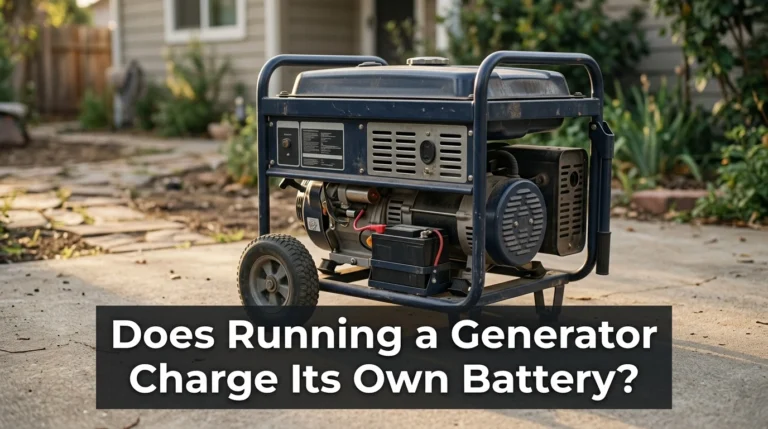
Some electric-start generators recharge their own starting batteries while operating, but this feature is model-dependent. A brief running session may not fully restore a battery that was already deeply discharged.
The starter battery is separate from the power supplied through the generator’s AC outlets. Its purpose is to crank the engine during startup.
For an explanation of these systems, see my electric-start generator guide.
Why Running the Generator May Not Fully Recharge It
- Limited charging output: The built-in system may deliver modest charging current.
- Short operating periods: A brief run might replace only the charge used during startup.
- Battery deterioration: An aging battery may no longer hold sufficient charge.
- Long storage periods: Self-discharge can reduce battery capacity between uses.
- Model limitations: Some generators require external battery charging or maintenance.
For a generator stored between emergencies, a compatible battery maintainer may be more useful than running the engine solely to recharge its battery. Follow the generator and battery manufacturers’ recommendations.
Why Is My Generator Taking So Long to Charge a Battery?
Slow charging usually points to low charging current, battery condition, a charging-system limitation, or an incorrect setup. Identifying the cause is more useful than simply running the generator longer.
1. The Charging Current Is Too Low
A 2A maintainer can take much longer than a 10A charger to restore the same battery. Confirm the actual charging current rather than relying on the generator’s maximum wattage.
2. The Battery Is Deeply Discharged
A battery at 20% charge needs considerably more energy than one at 70%. Deep discharge can also reveal battery damage or sulfation.
3. The Battery Has Deteriorated
Old lead-acid batteries can develop problems that reduce usable capacity and charging performance. A charger may report an error or spend an unusually long time attempting to complete its cycle.
If the battery repeatedly fails to hold charge, professional battery testing is more useful than repeated charging attempts.
4. The Charger Has Entered Absorption Mode
Charging often slows near full capacity because the charger intentionally reduces current. That behavior can be normal rather than a malfunction.
5. Battery Temperature Is Outside the Ideal Range
High and low temperatures can alter charging behavior. Some smart chargers reduce or suspend charging to protect the battery.
Never override those protections merely to shorten the charging time.
6. The Generator’s Output Is Incompatible
A charger may not operate correctly if the generator supplies power outside the charger’s accepted voltage or frequency range. Damaged connections can create additional problems.
For generator starting issues related to a weak battery, use this portable generator troubleshooting guide before replacing unrelated engine components.
How Can You Charge a 12V Battery Faster Without Damaging It?
The safest way to improve charging speed is to use a correctly sized charger that the battery manufacturer approves. Increasing current beyond the battery’s limits is not a shortcut worth taking.
- Confirm the Ah rating: Match charger current to battery capacity and specifications.
- Use the proper charging mode: Select flooded, AGM, gel, or lithium as required.
- Inspect the connections: Loose or corroded terminals can interfere with charging.
- Reduce unnecessary loads: Disconnect loads where appropriate and permitted by the equipment instructions.
- Observe temperature limits: Charge only within the battery’s approved temperature range.
- Let the charger finish: Don’t mistake a partially restored battery for a fully charged one.
For example, moving from a suitable 5A charger to an approved 10A charger can shorten the bulk stage. The full charging time won’t necessarily drop by exactly half because of charging taper.
For an automotive battery, I prioritize predictable charging and reliable starting over the fastest possible completion time. A healthy battery is more valuable than saving one hour.
What Safety Precautions Should You Follow?
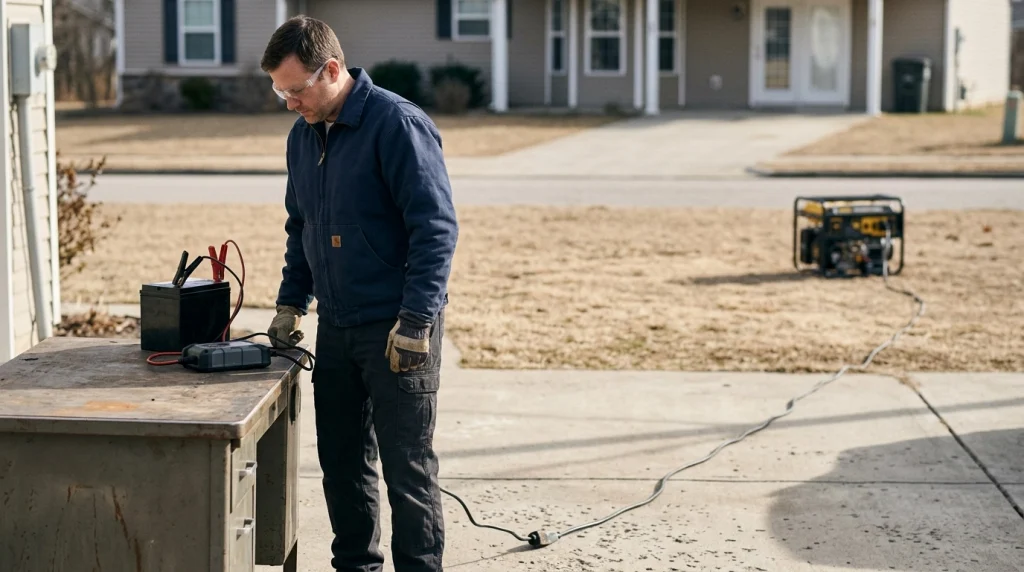
Generator exhaust and battery charging both introduce serious hazards. Carbon monoxide, sparks, flammable gases, and incorrect connections require careful attention.
The CDC’s carbon monoxide guidance recommends keeping portable generators outdoors, more than 20 feet from doors, windows, and vents.
- Prevent carbon monoxide exposure: Never run a fuel-powered generator in a garage, basement, home, or enclosed structure.
- Use CO detectors: Install working battery-powered or battery-backup carbon monoxide alarms inside your home.
- Avoid sparks: Keep flames, cigarettes, and ignition sources away from batteries.
- Wear protection: Use appropriate eye and hand protection when handling batteries.
- Inspect the battery: Never charge a frozen, leaking, visibly damaged, or swollen battery without professional assessment.
- Control moisture: Keep electrical equipment dry and follow generator weather-protection instructions.
- Refuel safely: Stop the generator and let it cool before adding fuel.
Lead-acid battery charging may release hydrogen gas, making proper ventilation essential. OSHA also emphasizes ventilation and protection against gas accumulation in its battery charging safety standard for workplaces.
Never connect a battery directly to an AC power outlet. Use a compatible battery charger or an explicitly approved DC charging connection.
Recommended Battery Chargers to Use With a Generator
If you regularly recharge batteries using generator power, a quality smart charger makes the process easier to manage. I would choose based on battery size, chemistry, and charging current rather than buying the highest-amperage model available.
The following are three practical options with different strengths. The ratings shown reflect my assessment of application fit, not verified customer review averages.
💰 Best for Low-Power Charging
NOCO GENIUS5 5A Smart Battery Charger
★★★★☆ 4.5/5
This 5A charger supports compatible 6V and 12V lead-acid and lithium batteries, with a maximum rated power consumption of 75 watts. I consider it a sensible choice for smaller batteries, maintenance, and owners who don’t need fast charging.
🏆 Best for Everyday 12V Charging
NOCO GENIUS10 10A Smart Battery Charger
★★★★½ 4.7/5
The GENIUS10 provides up to 10A of charging current and supports multiple battery types through dedicated modes. It’s my preferred general-purpose option for owners wanting a balance of charging speed, flexibility, and manageable generator power demand.
🔋 Best for Larger Compatible Batteries
Victron Blue Smart IP65 12V 15A Charger
★★★★½ 4.6/5
This 15A model offers configurable charging and Bluetooth monitoring through VictronConnect. I would consider it for appropriately sized deep-cycle or backup batteries when the battery manufacturer allows a 15A charging current.
Buying tip: Check the exact charger’s input voltage, supported battery chemistry, and maximum charging current before ordering. A good charger must suit both the battery and the generator’s available AC power.
Frequently Asked Questions
Can a 2,000-watt generator charge a 12V battery?
Yes. A 2,000-watt generator normally has enough capacity to operate a conventional 5A or 10A smart battery charger, assuming compatible AC output and sufficient remaining capacity. The generator’s size doesn’t directly determine charging speed; the charger and battery do.
How long does it take to charge a completely dead 12V battery?
A fully discharged 60Ah lead-acid battery may require roughly 8–20 hours or longer, depending on charger current and battery condition. A deeply discharged battery may also be damaged or rejected by a smart charger, so full recovery is not guaranteed.
Can I leave a 12V battery charging overnight with a generator?
I don’t recommend leaving a fuel-powered generator operating unattended overnight solely for battery charging. Use a compatible smart charger with appropriate protections, follow its instructions, and consider a safer established power source for long-term battery maintenance.
Will charging a battery use a lot of generator fuel?
Fuel consumption depends mainly on generator design, electrical load, engine efficiency, and operating duration. A small battery charger usually represents a modest electrical load, but running a large gasoline generator for several hours can still consume significant fuel.
How do I know when my 12V battery is fully charged?
A compatible smart charger’s completion indicator is usually the easiest practical guide. For lead-acid batteries, a rested open-circuit voltage around 12.6–12.8V often suggests a full charge, but temperature, battery design, and recent charging affect readings.
Final Takeaway
A generator can recharge a 12V battery in several hours, but there is no universal charging time. Battery capacity, starting charge level, chemistry, and charging current are the factors that matter most.
For a typical 60Ah battery at 50% charge, a 10A smart charger may take approximately 4–7 hours, while a 5A model could need 8–12 hours. Charging a deeply discharged battery can take substantially longer.
Before your next outage, check your battery’s condition and confirm that your generator and charger work together safely. A suitable smart charger and regular battery maintenance are often more useful than simply buying a bigger generator.

Hi, I’m Michael Turner. I own a generator workshop in the United States and founded HomeGeneratorBlog to share practical, hands-on guidance about generator installation, maintenance, troubleshooting, safety, and backup power solutions. My goal is to help homeowners make smarter, more confident decisions through clear and reliable information