Does Running a Generator Charge Its Own Battery?
Quick Answer
Yes, many electric-start generators charge their own batteries while running, but not all models do. Generators with built-in charging circuits can slowly replenish the starting battery as the engine operates. Others need an external charger, especially during storage. The charging method depends on the design of your electric-start portable generator.
What determines whether it charges?
- Built-in charging circuit: Some generators automatically recharge the starting battery while operating.
- Battery chemistry: Lead-acid, AGM, and lithium batteries require compatible charging systems.
- Running duration: Short operating periods might not replace much of the battery’s lost charge.
- Standby charging: Many home standby generators maintain their batteries using an integrated charger supplied with AC power.
- Battery condition: A severely discharged or damaged battery might not recover through normal generator operation.
Best way to confirm: Check your model’s manual and compare battery voltage before and during operation using an appropriate multimeter.
If your generator starts with a button or key, its battery needs attention. One common mistake is assuming every generator recharges that battery automatically.
I prefer checking the charging system before an outage instead of discovering a dead battery when power disappears. Here’s how generator battery charging works and what you should check.
How Does a Generator Charge Its Own Battery?
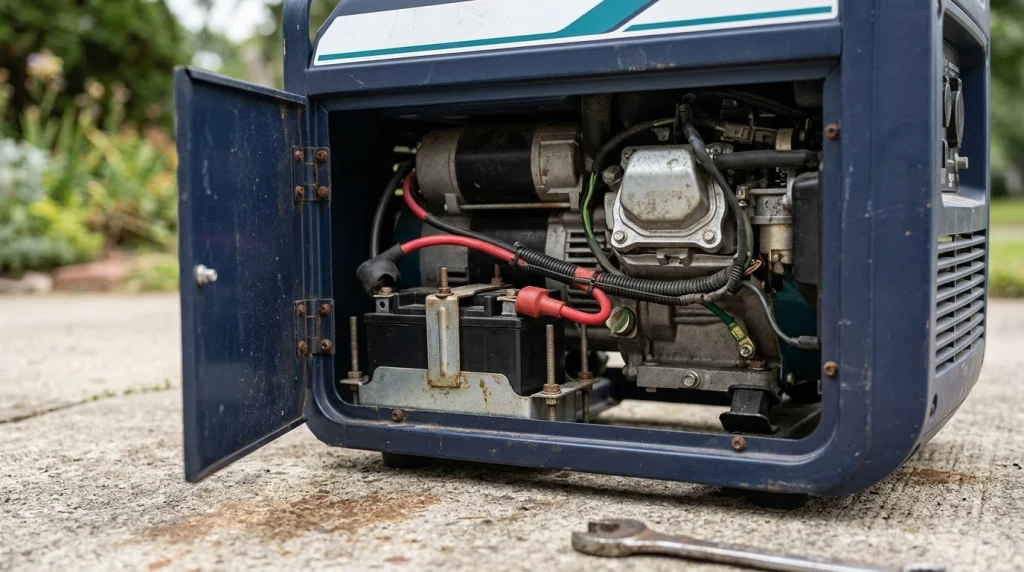
A generator with an automatic battery charging circuit uses some of the electricity produced during operation to replenish its starting battery. The exact charging components vary between models.
The generator’s battery starts the engine, while the running engine drives the electrical generating system. These are separate functions.
Understanding the charging process
- Starting: The battery supplies electricity to the starter motor, which turns the engine.
- Power generation: Once running, the engine drives the generator’s electrical generating components.
- Battery charging: On equipped models, a dedicated charging circuit delivers suitable DC power to the battery.
- Charge recovery: The battery gradually replaces energy consumed during starting and previous discharge.
- Shutdown: Internal charging normally stops when the engine stops, unless another charging power source remains connected.
A charging circuit typically includes components that convert or regulate electrical output for the battery. It should not be confused with the generator’s household AC outlets.
For example, the Westinghouse WGen6000 documentation confirms that its electric-start battery receives a small charging current while running. The Westinghouse owner’s manual describes this as a slow recharge.
Do All Generators Recharge Their Own Batteries?
No. Battery charging depends on the generator’s starting system and electrical design, not simply its wattage or fuel type.
As of 2026, both automatic-charging and externally charged designs exist. The manufacturer’s documentation remains the best source for confirming a specific model.
| Generator type | Battery charging | What to know |
|---|---|---|
| Electric-start portable | Model-dependent | Many recharge while running; some require external charging. |
| Recoil-start portable | Usually not applicable | Most traditional pull-start units have no starting battery. |
| Electric-start inverter | Model-dependent | Battery chemistry and charging arrangements vary. |
| Home standby | Usually automatic | Often uses an integrated charger supplied through the transfer-switch circuit. |
The important distinction is whether the generator has a charging system connected to its starting battery. Electric start alone does not guarantee automatic charging.
How Can You Tell if Your Generator Charges Its Battery?
Start with the owner’s manual. Look for instructions describing battery maintenance, automatic charging, or charging voltage during engine operation.
I would check the model number before buying additional equipment. Two generators from the same manufacturer can have different charging requirements.
Check these five things
- Owner’s manual: Look under battery, maintenance, charging system, or storage.
- Battery connections: Check for visible damage, loose terminals, or disconnected wiring.
- Charging accessories: Determine whether the manufacturer supplied an external charger.
- Battery specifications: Identify its rated voltage, chemistry, and charging-current limits.
- Voltage measurements: Compare resting and operating voltage when the manual permits testing.
If you cannot find a charging specification, contact the manufacturer’s support department with the complete model and serial number. Avoid assuming another model’s charging instructions apply.
How Do You Test Generator Battery Charging With a Multimeter?
A digital multimeter can help reveal whether charging voltage reaches the battery. This is one of the most useful checks when the electric starter gradually loses strength.
For a typical 12-volt lead-acid starting battery, I compare two measurements: engine off and engine running. The difference provides a helpful clue.
Step-by-step voltage test
- Identify the battery: Confirm its voltage and chemistry before testing.
- Inspect safely: With the engine off, check for damaged wiring, swelling, leakage, or corrosion.
- Set the meter: Select DC voltage and an appropriate range, usually 20 volts for a 12-volt battery on a manual-ranging meter.
- Measure resting voltage: Touch the red probe to positive and the black probe to negative, without shorting the terminals.
- Start the generator: Follow the manufacturer’s operating instructions and keep clear of hot or moving parts.
- Measure again: If the terminals remain safely accessible, check the voltage while the engine operates.
- Compare readings: Look for a voltage increase consistent with the manufacturer’s charging specification.
A healthy, rested 12-volt lead-acid battery commonly measures about 12.6–12.8 volts when fully charged. Charging systems may raise terminal voltage into the 13-volt or 14-volt range.
Those numbers are only general reference points, not universal pass-or-fail limits. Lithium batteries and specialized charging controllers can behave differently.
Example voltage readings
| Measurement | Example | Interpretation |
|---|---|---|
| Engine off | 12.3 V | Battery is below typical full resting voltage. |
| Engine running | 13.8 V | Suggests charging voltage is reaching the battery. |
| After shutdown | 12.6 V | A possible improvement, but not proof of battery health. |
These are illustrative readings, not measurements from a specific generator. Surface charge can temporarily increase voltage after charging.
A voltage increase suggests charging activity, but it cannot establish the battery’s usable capacity. If the meter readings look abnormal, stop testing and seek qualified assistance.
How Long Does a Generator Take to Charge Its Battery?
There is no universal charging time. Battery capacity, starting state of charge, charging current, and battery condition all affect the result.
Generator starting batteries are usually much smaller than automotive batteries. However, their onboard charging circuits may deliver only a modest current.
A simple charging example
Imagine a 12-volt, 10-amp-hour battery needs approximately 5 amp-hours restored. At a constant 1-amp charging current, five hours would be the theoretical minimum.
Actual charging usually takes longer because current can vary and batteries have charging losses. A deeply discharged battery might require a dedicated charger instead.
- Small discharge: Normal generator operation may restore the energy used during starting.
- Moderate discharge: Recovery could require several hours, depending on the circuit.
- Severe discharge: The internal charger might not recognize or recover the battery.
- Damaged battery: More running time cannot repair an internally failed battery.
I wouldn’t run a gasoline generator for hours solely to charge a small starter battery when grid electricity and a compatible maintainer are available. A dedicated charger is usually more practical.
Will Running a Generator Recharge a Completely Dead Battery?
Not necessarily. Some onboard charging systems cannot recover a battery that has fallen below their minimum operating voltage.
A battery may also show normal voltage without supplying enough current to crank the engine. Charging alone does not fix damaged cells or serious capacity loss.
What to do when the battery is dead
- Switch off the generator and inspect the battery for physical damage.
- Check the terminals and connections using the manufacturer’s procedure.
- Identify the battery type and approved charging current.
- Use a compatible external smart charger if the manual permits it.
- Test the battery’s condition after charging, including a suitable load test if needed.
- Replace the battery if it fails testing or cannot hold sufficient charge.
Some electric-start generators provide a manual recoil starter as a backup. Others depend entirely on battery power for starting or control-system operation.
If the engine still refuses to start, my next step is to separate battery symptoms from engine problems. This generator starting troubleshooting guide covers additional possible causes.
Does a Generator’s Battery Charge While It Is Turned Off?
For most portable generators with engine-driven charging circuits, no. The engine must operate for the onboard charging circuit to produce charging power.
That is why a generator can have a working charging system yet develop a dead battery during months of inactivity.
Keeping the battery charged during storage
- Use a smart maintainer: Choose one approved for the battery’s voltage and chemistry.
- Observe current limits: Small batteries may require low charging amperage.
- Keep terminals clean: Remove corrosion using the battery manufacturer’s directions.
- Check battery condition: Inspect periodically for swelling, damage, and poor connections.
- Follow storage instructions: Some manufacturers recommend disconnecting or removing the battery.
For example, certain Champion generator manuals recommend periodic use or a battery maintainer when the unit sits unused. Some also specify low maximum charging currents.
Before winter storage, I would handle the battery alongside the fuel and engine maintenance. Our portable generator storage guide explains the broader preparation process.
Do Home Standby Generators Charge Their Own Batteries?
Yes, many home standby generators maintain their starting batteries automatically. However, their charging arrangements can differ from portable generators.
For example, certain Generac standby systems use an integrated charger powered through a 120-volt charging circuit associated with the automatic transfer switch.
During normal utility service, that circuit can maintain the battery while the engine remains off. During an outage, generator-produced electricity may supply the charging circuit after transfer.
Important standby charging considerations
- Utility availability: The charger may receive power without the engine running.
- Transfer-switch operation: Charging during outages depends on the system design and transfer state.
- Controller monitoring: Some systems track battery voltage and charging faults.
- Professional servicing: Charging-circuit and transfer-switch repairs require qualified personnel.
Generac’s battery charging explanation describes these arrangements for supported standby models. Never open an automatic transfer switch to investigate charging without proper training.
Is a Generator’s 12-Volt DC Outlet the Same as Its Battery Charger?
No. A generator’s external DC outlet and its internal starting-battery charging circuit serve different purposes.
A 12-volt DC receptacle may support charging an external battery through an approved cable. Its presence does not prove the generator recharges its own starting battery.
Key differences
- Internal charging circuit: Supplies electricity to the generator’s installed starting battery on equipped models.
- External DC output: Provides a connection for compatible outside battery-charging equipment.
- AC outlet with smart charger: Powers a separate charger that controls voltage and current for its supported batteries.
Some generator DC outlets are not voltage-regulated like modern smart chargers. Using them with incompatible batteries can cause overheating or damage.
If you want to charge another battery safely, read our portable generator DC output guide before attaching any cables.
Why Is My Generator Battery Not Charging While Running?
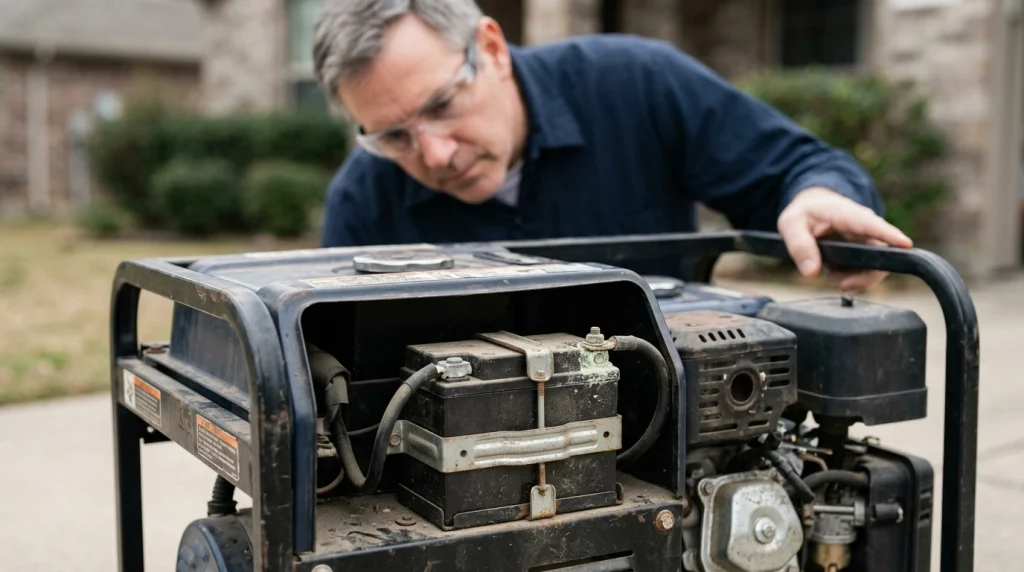
If the manufacturer confirms automatic charging but the battery keeps losing power, inspect the simplest causes first. The fault might involve the battery, connections, or charging circuit.
Common problems to investigate
- Loose connections: A poor terminal connection can prevent reliable charging.
- Corroded contacts: Resistance at the terminals may reduce charging effectiveness.
- Discharged battery: A severely depleted battery may need separate charging.
- Failed battery: Internal deterioration can prevent charge retention.
- Charging circuit fault: A damaged fuse, regulator, wire, or charging component may interrupt charging.
- Incorrect charger: An incompatible external maintainer can create further problems.
My troubleshooting order is battery condition first, connection quality second, and charging-system diagnosis third. That avoids unnecessary electrical repairs when the battery itself has failed.
For model-specific charging equipment, Generac’s portable generator FAQ is one example of manufacturer guidance worth consulting.
What Safety Precautions Matter When Charging a Generator Battery?
Battery work can involve electrical shorts, acid exposure, sparks, and explosive gas. Generator operation adds carbon monoxide, hot surfaces, and moving components.
The CDC’s carbon monoxide guidance recommends operating portable generators outdoors, more than 20 feet from doors, windows, and vents.
Essential safety rules
- Never run a fuel-powered generator inside a garage, shed, or other enclosed area.
- Keep generator exhaust pointed away from occupied buildings.
- Use appropriate eye protection when handling batteries.
- Keep metal tools from bridging battery terminals.
- Never charge a frozen, leaking, swollen, or visibly damaged battery.
- Use only chargers approved for the battery’s chemistry and voltage.
- Keep portable charging equipment away from rain, exhaust heat, and fuel.
Battery-powered carbon monoxide alarms also belong in a safe backup-power plan. Follow the CPSC’s generator safety guidance whenever operating a portable unit.
Helpful Tools for Generator Battery Maintenance
If your generator sits unused between outages, a suitable battery maintainer and a basic multimeter can make maintenance easier. I would prioritize compatibility and accurate diagnosis over unnecessary accessories.
The ratings below are editorial suitability assessments, not verified customer-review averages. Always check your generator’s maximum charging-current specification before choosing a charger.
🏆 Best for versatility
NOCO GENIUS1 Smart Battery Charger
★★★★½ 4.5/5
This 1-amp charger supports 6-volt and 12-volt batteries, including supported lead-acid and lithium types. It offers automatic charging and maintenance functions.
I like its versatility for owners maintaining different small batteries, provided the correct charging mode and current are suitable.
🔋 Best for lead-acid storage
Battery Tender Junior 12V 750mA
★★★★☆ 4/5
This automatic 0.75-amp charger is designed for compatible 12-volt lead-acid batteries, including AGM and gel types. Its maintenance mode helps support long-term storage.
I would consider it for a small lead-acid starter battery when the generator manual permits this charging current.
🔧 Best for troubleshooting
Klein Tools MM325 Digital Multimeter
★★★★½ 4.5/5
This manual-ranging multimeter measures AC/DC voltage and includes a backlit display. It can help compare resting and charging voltage at accessible battery terminals.
I recommend a proper voltage test before purchasing replacement batteries or charging-system components.
Frequently Asked Questions
Does a generator battery charge every time the engine runs?
Only if the generator has a functioning engine-driven battery charging system. Many electric-start portable models charge automatically during operation, while others require an external charger.
Check your owner’s manual before assuming the battery is being replenished.
Will running a generator for 30 minutes charge the battery?
Thirty minutes may replace some of the energy consumed during starting, but it does not guarantee a full charge. The result depends on charging current, battery capacity, and its starting condition.
Follow your manufacturer’s recommended exercise schedule rather than relying on a fixed charging time.
Can I charge my generator battery with a car battery charger?
Yes, in some cases, but the charger must support the battery’s voltage, chemistry, capacity, and charging-current limit. Small generator batteries can be damaged by excessive charging current.
Use a suitable smart charger and follow both manufacturers’ instructions.
Can a generator run with a dead starting battery?
Some generators with a manual recoil starter can run after being pull-started, even when their electric-start battery is discharged. Other models need battery power for electronic controls or ignition-related functions.
Check your model’s starting requirements before relying on manual backup starting.
Does a generator need a battery to produce electricity?
Most conventional fuel-powered portable generators do not need a battery to produce electricity once their engines are running. The starting battery primarily powers the electric starter and sometimes other electrical controls.
However, certain electronically controlled models may require battery power for normal operation.
Final Takeaway: Check the Charging System Before You Need It
Running a generator can recharge its own battery, but only when its charging system supports that function. Even an automatic system cannot guarantee recovery from a severely discharged or failing battery.
My advice is simple: confirm the model’s charging method, test the battery, and use a compatible maintainer during extended storage. That small amount of preparation can prevent an avoidable starting problem during your next outage.