What Size Inverter Generator Do I Need? Wattage Math, Appliance Chart & Sizing Examples for Home, RV, and Camping
Quick Answer
Most buyers need 2,000 to 3,500 running watts for camping and light home backup, and 3,500 to 4,500 running watts for a fridge, lights, and a small air conditioner together. Add up the running watts of everything you will run at once, add the largest starting surge once, then add 20% headroom. That simple math matters more than the big number on the box, and it is the same approach I use when I size a generator size for a power outage.
Quick sizing rules
- Shop running watts: Running watts are what a generator can sustain, so size from that number, not starting watts.
- Count starting surge once: Add only the largest motor surge to your running total, because motors rarely start at the same instant.
- Add 20% headroom: Headroom prevents overload trips when a fridge cycles on while other loads are already running.
- Stagger big loads: Start the largest motor first, let it settle, then add smaller loads one at a time.
- Check the label: Use the watts or amps on your appliance label when you can, because estimates vary by model and age.
Do this first
- List only the loads you will run at the same time, not every appliance you own.
- Circle the one motor load with the biggest surge, such as an air conditioner, well pump, or sump pump.
- Pick the next size up if your total lands close to a generator’s running-watt limit.
I’ve sized inverter generators for storm outages, RV trips, and quiet campsites, and the same mistake shows up every time. People buy the headline watts, plug in too much at once, and blame the generator when it trips.
This guide goes deeper than a simple chart. You’ll learn the wattage math, see real appliance estimates, and work through home, RV, and camping examples you can copy. By the end, you’ll know your number with confidence.
In This Guide
- What Size Inverter Generator Do I Need for Your Main Use?
- Running Watts vs Starting Watts: Why the Difference Decides Your Size
- How Do You Calculate the Size Inverter Generator You Need?
- What Can Each Inverter Generator Size Run?
- What Size Inverter Generator Do I Need for Home Backup?
- What Size Inverter Generator Do I Need for RV and Camping?
- Should You Buy One Bigger Generator or Two in Parallel?
- What Sizing Mistakes Cause Overloads and Wasted Fuel?
- Frequently Asked Questions About Inverter Generator Sizing
- The Right Size Fits Your Real Load, Not the Biggest Number
What Size Inverter Generator Do I Need for Your Main Use?
Start with your main use, not a generic size chart. A weekend camper and a homeowner riding out a three-day outage need different power, even if both buy an inverter generator.
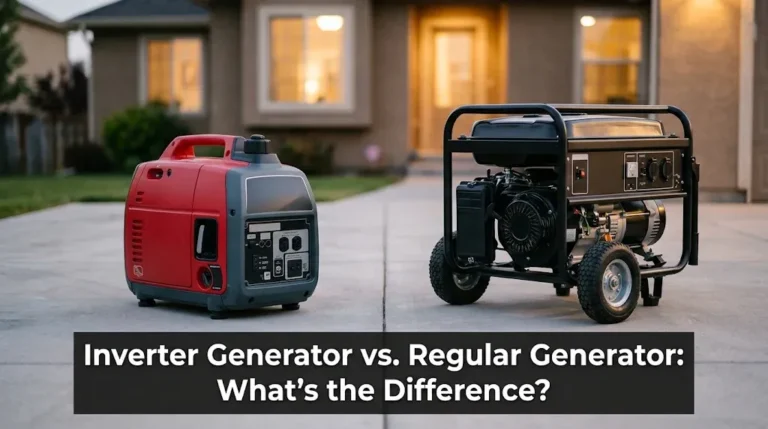
An inverter generator is a portable generator that creates clean, stable power through an inverter, which helps it run electronics safely and adjust engine speed to the load. That design also makes it quieter and more fuel-efficient at light loads than a conventional open-frame generator. Clean sine wave power means the output closely matches smooth utility power, which matters for laptops, phones, and medical devices.
Size ranges that fit most buyers
Use these ranges as a starting point, then check them with the math in the next sections. Your exact loads will move you up or down a size.
- 1,000 to 2,000 running watts: Phones, laptops, lights, a CPAP machine, and small fans for camping or tailgating.
- 2,000 to 3,000 running watts: A fridge, lights, chargers, a CPAP machine, and a small microwave used one at a time.
- 3,000 to 4,500 running watts: A fridge, freezer, furnace blower, sump pump, or a small RV air conditioner with careful load control.
- 4,500 to 7,000 running watts: Larger RV air conditioning, a window air conditioner plus a fridge, or broader home essentials during an outage.
I once ran a fridge, a CPAP machine, lights, and phone chargers through a multi-day outage on a mid-size inverter unit. It worked because I staggered loads and kept the microwave off while the fridge compressor cycled. The same setup would have tripped if I had tried to run everything at once.
As of 2026, most portable inverter models still cluster around 2,000, 3,000, and 4,500 running watts. That makes the math easier, because you can match your total to a common size instead of hunting for an exact number. Check the spec sheet for running watts, since two models with the same starting watts can differ by hundreds of running watts.
Section takeaway: Pick your size from the loads you will run together, and use these ranges only as a first filter before you do the math.
Running Watts vs Starting Watts: Why the Difference Decides Your Size
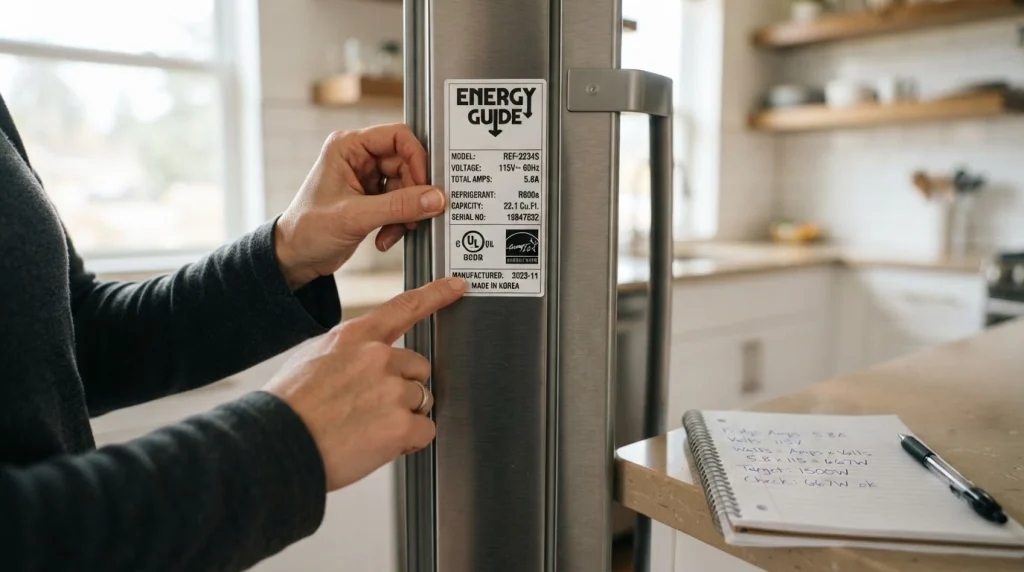
Running watts are the power a generator can supply continuously. Starting watts, also called surge watts, are the brief extra power it can supply for a few seconds when a motor starts.
Most sizing errors come from mixing up those two numbers. A box that says 4,500 starting watts might offer only 3,700 running watts, and that gap decides what you can run for hours.
What are running watts?
Running watts, or rated watts, describe steady power draw. A fridge that draws 150 watts while running, a laptop at 60 watts, and LED lights at 40 watts add up in running watts.
Size your everyday load from running watts alone. If your running total exceeds the generator’s running rating, it will overload even if the starting rating looks large enough.
What are starting watts?
Starting watts cover the short surge when a motor starts. Refrigerator compressors, air conditioners, pumps, and power tools can draw two to three times their running watts for a second or two.
That surge is brief, but it is real. A generator with too little surge headroom may stall, trip, or shut down when the compressor kicks in.
How do you use both numbers together?
Add all running watts first. Then add the extra surge for the largest motor only, not the surge for every motor at once.
That method mirrors real use. Motors rarely start in the same second, and you can stagger starts to keep the surge manageable.
- Running total: Every load running at the same time, added together.
- Largest surge: The starting watts minus running watts for your biggest motor.
- Headroom: An extra 20% on top of the total, to cover cycling and small loads you forgot.
Reading spec sheets gets easier once you know which numbers matter most, including how inverter generator ratings help you choose between similar models. Look for running watts, starting watts, THD, and runtime at 25% and 50% load. THD, or total harmonic distortion, measures how clean the power is, and lower THD is better for sensitive electronics.
Section takeaway: Buy for running watts, respect the largest starting surge, and keep 20% headroom so cycling motors do not trip your generator.
How Do You Calculate the Size Inverter Generator You Need?
You can size an inverter generator in about 10 minutes with a label check and simple addition. No electrician visit is needed for this first pass, though a licensed electrician should handle any home wiring or transfer switch work.
Work from labels first and estimates second. Labels beat memory, and a quick photo of each nameplate saves guesswork later.
Step 1: List what runs at the same time
Write down only the loads that will overlap. A fridge and a CPAP machine overlap all night, while a microwave and a hair dryer usually do not.
Be honest about habits. If your family will run the coffee maker while the fridge cycles, count both.
Step 2: Find running watts for each item
Check the label for watts first. If the label shows amps and volts only, multiply amps by volts to estimate watts.
Use the table in the next section when you cannot find a label. Estimates work for planning, but the label wins when the two disagree.
Step 3: Add the largest starting surge once
Find the motor with the biggest surge in your list. Add its extra starting watts to your running total, just once.
Common surge leaders include air conditioners, well pumps, sump pumps, and larger power tools. A fridge surge is smaller, but it still matters on a small generator.
Step 4: Add headroom and pick a size
Multiply your total by 1.2 for 20% headroom. Then choose a generator whose running watts meet or exceed that final number.
Here is a worked example you can copy. A fridge at 150 running watts, lights at 80 watts, a CPAP machine at 40 watts, and chargers at 50 watts total 320 running watts.
- Running total: 320 watts for fridge, lights, CPAP machine, and chargers.
- Largest surge: Add about 600 extra watts for the fridge compressor surge.
- With headroom: 920 watts times 1.2 equals about 1,104 watts, so a 2,000-watt-class unit leaves comfortable room.
Now try a heavier example. A fridge at 150 watts, a freezer at 150 watts, a furnace blower at 500 watts, lights at 100 watts, and chargers at 50 watts total 950 running watts.
Add about 1,000 extra watts for the blower surge, and the total reaches 1,950 watts. With 20% headroom, you need about 2,340 running watts, so a 3,000-watt-class unit fits better than a 2,000-watt-class unit.
Energy planning guidance from the U.S. Department of Energy stresses matching generator capacity to the loads you plan to power. That advice sounds simple, yet it prevents most overload problems. When you plan loads first, the right size usually becomes clear.
Think about what to look for in an inverter generator beyond watts as well, including outlets, fuel type, noise, and parallel capability. A 30-amp RV outlet, for example, matters more for an RV than a few extra starting watts. Dual fuel models add propane flexibility, but check the propane running watts, which are often lower than gasoline watts.
Safety note: Never plug a generator into a wall outlet to backfeed your home, and use a transfer switch or interlock kit installed by a licensed electrician for any hardwired home connection. Check your owner’s manual before use.
Section takeaway: List simultaneous loads, add running watts, add the largest surge once, add 20% headroom, and shop from running watts.
What Can Each Inverter Generator Size Run?
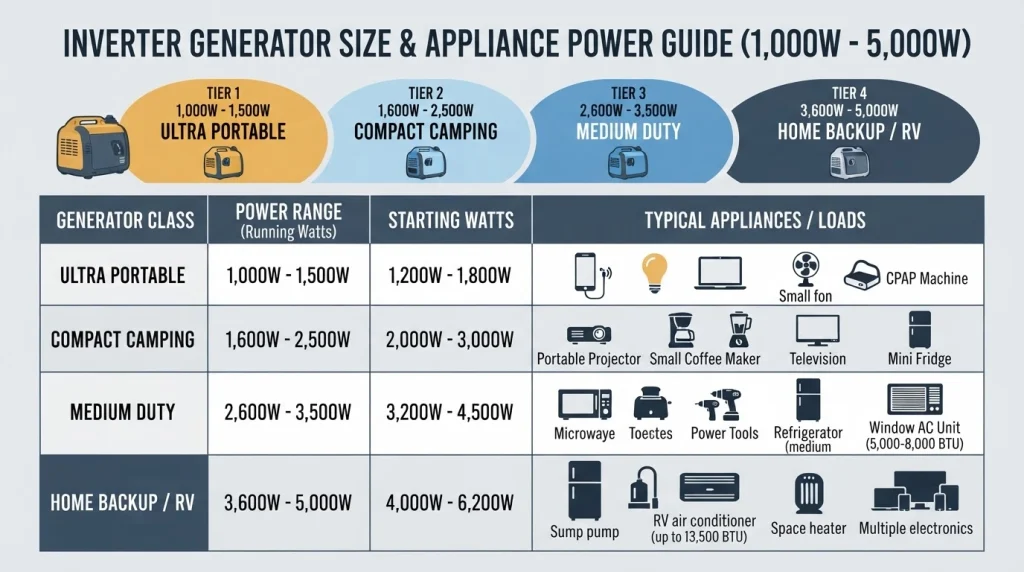
Tables help because wattage numbers feel abstract until you see them next to familiar appliances. Use these estimates for planning only, and check your own labels for the final decision.
Starting watts vary by motor type, age, and condition. A soft-start kit on an RV air conditioner can lower its surge, while an older pump may surge higher than the range shown.
Typical appliance running and starting watts
| Appliance or load | Running watts (typical) | Starting watts (typical) |
|---|---|---|
| Refrigerator | 120-200 | 800-1,200 |
| Freezer | 100-200 | 800-1,200 |
| CPAP machine | 30-60 | 40-90 |
| Laptop and phone chargers | 50-150 | 50-150 |
| LED lights, several rooms | 40-120 | 40-120 |
| Microwave, 1,000-watt model | 1,000-1,200 | 1,000-1,200 |
| Window air conditioner, 10,000 BTU | 900-1,200 | 2,000-2,800 |
| RV air conditioner, 13,500 BTU | 1,200-1,500 | 2,800-3,500 |
| Furnace blower, gas furnace | 400-800 | 1,200-2,000 |
| Sump pump, 1/3 HP | 700-900 | 1,500-2,100 |
| Well pump, 1/2 HP | 900-1,100 | 2,000-2,800 |
Notice how many loads draw little power once they are running. The surge is what forces buyers into a larger size, not the steady draw.
What each size class typically handles
| Running watts | Good fit for | Often too small for |
|---|---|---|
| 1,000-1,800 | Chargers, lights, CPAP machine, small fans | Fridge plus microwave, any air conditioner |
| 1,800-2,400 | Fridge, lights, CPAP machine, chargers | RV air conditioner, furnace blower plus fridge |
| 2,800-3,600 | Fridge, freezer, small window AC, or small RV AC with care | Large RV AC plus microwave, well pump plus AC |
| 3,600-5,000 | RV AC, fridge, lights, and chargers together | Whole-home electric heat, electric range, central AC |
I learned this lesson with a window air conditioner on a hot afternoon. The unit ran fine at steady load, then surged and tripped the overload when the compressor cycled while the fridge was also running. A larger size, or simply staggering the loads, would have avoided the trip.
Heating loads deserve special care. Electric heaters, electric ranges, and electric water heaters draw high steady watts and can overwhelm a portable inverter generator fast. Plan those loads separately, and do not assume a mid-size unit can carry them.
Section takeaway: Use the appliance table to build your running total, then match it to a size class with surge and headroom included.
What Size Inverter Generator Do I Need for Home Backup?
Home backup sizing starts with essentials, not whole-home power. Most portable inverter generators power a short list of essentials well, and they struggle when asked to run a full house like a standby unit.
Pick your essentials first. A fridge, a freezer, lights, a furnace blower or sump pump, chargers, and a CPAP machine cover most outage needs.
What does a typical essentials list need?
A light essentials list often needs 2,000 to 3,000 running watts. That covers a fridge, lights, chargers, and a CPAP machine, with room for a small load cycled in one at a time.
A heavier list with a furnace blower or sump pump often needs 3,000 to 4,500 running watts. The blower or pump surge pushes the total up, even though steady draw stays modest.
- Light essentials: Fridge, lights, chargers, CPAP machine, and a fan.
- Medium essentials: Fridge, freezer, lights, chargers, and a furnace blower or sump pump.
- Heavy essentials: Fridge, freezer, blower, sump pump, window AC, and a microwave used in rotation.
Rotation is your friend during a long outage. Run the microwave for a few minutes, then turn it off before the window AC cycles back on. That habit lets a smaller generator do more work.
Can an inverter generator run a refrigerator and freezer together?
Yes, in most cases, if you size for both running watts plus one compressor surge. Two cold appliances rarely surge at the same instant, but they can, so headroom matters.
A 2,000-watt-class unit can handle a fridge and freezer plus lights in many homes. A 3,000-watt-class unit gives more comfort when you add a blower, a pump, or a microwave in rotation.
For a deeper look at cold-food loads, see guidance on choosing a portable generator for a refrigerator and how fridge draw changes with size and age. Older fridges often draw more power than newer efficient models. Check your label before you lock in a size.
What about a furnace, sump pump, or well pump?
Motor loads need surge room and clean power. Inverter output helps electronics and furnace controls, but it does not erase the surge.
A gas furnace blower, sump pump, and well pump each need careful sizing. If two motor loads must run at once, size for both running watts plus the larger surge, and consider a larger unit or a standby system for well pumps with high surge.
Follow CDC carbon monoxide guidance for placement, and run the generator outdoors and well away from windows, doors, and vents. Carbon monoxide is colorless and odorless, and it can build up fast in a garage, even with the door open. Place the unit downwind when you can, and keep working CO alarms in your home.
Safety note: Run generators outdoors and well away from windows, doors, and vents. Use a transfer switch or interlock installed by a licensed electrician, and check your owner’s manual before use.
Section takeaway: For home backup, size for essentials plus the largest motor surge, rotate heavy loads, and step up a size when a blower or pump joins the list.
What Size Inverter Generator Do I Need for RV and Camping?
RV and camping sizing hinges on air conditioning. Without AC, most campers need far less power than they expect, and with AC, the surge decides the size.
Start by listing what you will run at the campsite. Battery charging, lights, phones, a small fan, and a coffee maker use modest power when you stagger them.
What size runs an RV air conditioner?
A 13,500 BTU RV air conditioner often needs 2,800 to 3,500 starting watts and 1,200 to 1,500 running watts. A 15,000 BTU unit needs more, so check your AC label and manual.
Many RVers use a 3,000-watt-class inverter generator for a 13,500 BTU AC, with other loads kept light. Others use two smaller units in parallel, or add a soft-start kit to lower the AC surge.
A soft-start kit reduces the inrush current when the compressor starts. It does not reduce running watts, but it can make a smaller generator viable for AC use.
See detailed options for a generator for an RV air conditioner before you buy, especially if your RV has a 30-amp or 50-amp service. Outlet type matters as much as watts, because an RV plug needs the right receptacle and adapter. Confirm the generator has a 30-amp RV outlet or a compatible parallel kit outlet.
What size works for camping without air conditioning?
Most tent and car campers do fine with 1,000 to 2,000 running watts. That range covers lights, chargers, a small fan, a CPAP machine, and a portable fridge used with care.
Quiet operation matters at a campsite. Eco-throttle, or economy mode, lets the engine slow down at light loads, which cuts noise and fuel use.
- Keep eco mode on: Eco mode helps at light loads, but turn it off for motor starts if the generator struggles.
- Charge in batches: Charge phones, lanterns, and batteries together, then shut the generator down.
- Respect quiet hours: Run the generator during allowed hours, and place it away from neighboring sites when you can.
I have watched a small inverter unit power a whole campsite kitchen for a weekend, simply because the owners staggered the coffee maker and the portable fridge. The generator stayed quiet, sipped fuel, and never tripped. That is the payoff for sizing to real habits, not worst-case guesses.
Does altitude, heat, or propane change the size you need?
Yes, all three can reduce usable power. Engines lose power at altitude, heat can lower performance, and propane often delivers fewer running watts than gasoline on the same model.
Check the manual for altitude and fuel derating. If you camp at high elevation or plan to run on propane, size up one step or test the load before a long trip.
Safety note: Run generators outdoors and well away from tents, RV windows, doors, and vents. Keep fuel in approved containers away from heat, and check your owner’s manual before use.
Section takeaway: For RV use, size for the air conditioner surge first, and for camping without AC, a smaller quiet unit with eco mode usually does the job.
Should You Buy One Bigger Generator or Two in Parallel?
Parallel capability lets you link two compatible inverter generators with a parallel kit to share the load. It is a popular option for RV owners who want AC power sometimes and light, portable power the rest of the time.
One bigger generator is simpler. Two smaller units are easier to lift, store, and run at light loads, but they add cost and a second engine to maintain.
When does parallel make sense?
Parallel makes sense when your peak load is occasional. You can run one unit for charging and lights, then link both for air conditioning.
It also helps when weight matters. Two 50-pound units are easier to load than one 100-pound unit, especially for one person.
- Choose parallel: You need AC power sometimes, you lift the unit alone, or you want a backup if one unit needs service.
- Choose one bigger unit: You run heavy loads often, you want one fuel tank to manage, or you want the simplest setup.
What should you check before you buy for parallel use?
Check that both units are parallel-capable and use the same parallel kit system. Mixing brands or incompatible models can cause problems, so follow the manual for your exact models.
Check the combined running watts, not just the combined starting watts. Two 2,000-watt-class units may offer about 3,600 running watts together, which fits many RV AC setups.
Look for a portable generator with parallel capability if this path appeals to you, and confirm outlet types and kit requirements before you buy. Some kits add a 30-amp RV outlet, while others do not. That detail decides whether the setup works for your RV without extra adapters.
Fuel use also matters. Two small units at light load can sip fuel in eco mode, while one large unit may burn more fuel to carry the same light load. Over a long outage or camping trip, that difference adds up.
Section takeaway: Parallel suits occasional peak loads and easier lifting, while one bigger unit suits frequent heavy loads and simpler operation.
What Sizing Mistakes Cause Overloads and Wasted Fuel?
Most overloads trace back to a few repeatable mistakes. Fix those, and even a mid-size generator feels more capable.
The first mistake is shopping by starting watts. The second is adding every appliance in the house, even ones that never run together.
Mistake 1: Ignoring the surge
Buyers add running watts, buy a unit that just fits, and trip on the first compressor start. The generator was not faulty, it was simply sized without surge room.
Add the largest surge once, plus headroom. That one step prevents most nuisance trips.
Mistake 2: Running everything at once
Starting a microwave, an air conditioner, and a fridge at the same moment stacks surges. Staggering starts by 30 seconds can make the same load work.
Start the largest motor first. Let it settle, then add smaller loads one at a time.
Mistake 3: Buying far too large
Oversizing wastes fuel, adds weight, and raises noise. A generator running at very light load for hours can also run less efficiently than a right-sized unit in eco mode.
Buy for your real simultaneous load plus headroom, not for a load you might run someday. If your needs grow later, parallel capability or a larger unit can fill the gap.
Mistake 4: Forgetting fuel, runtime, and maintenance
Size affects runtime, tank size, and refueling frequency. A larger unit with a small tank may need refills more often than a smaller unit sipping fuel in eco mode.
Check runtime at 25% and 50% load on the spec sheet. Plan fuel storage, use fresh fuel, and follow the break-in and maintenance schedule in your manual to avoid carburetor clogging from stale fuel.
- Fuel: Store fuel safely, use stabilizer as the manual directs, and rotate stored fuel.
- Oil: Check oil before long runs, and follow the manual for oil changes and low-oil shutdown checks.
- Test runs: Run the generator under load every few months, so it starts when you need it.
Guidance from the Consumer Product Safety Commission and other safety authorities stresses outdoor placement, CO alarms, and safe refueling. Turn the generator off and let it cool before refueling, and never refuel near an open flame. Independent testing notes from Consumer Reports also remind buyers to weigh noise, fuel use, and real capacity, not just headline watts.
Safety note: Run generators outdoors and well away from windows, doors, and vents. Use outdoor-rated extension cords, keep cords dry, and check your owner’s manual before use.
Section takeaway: Size for surge and simultaneous loads, stagger starts, avoid extreme oversizing, and plan fuel and maintenance for the size you choose.
Frequently Asked Questions About Inverter Generator Sizing
What size inverter generator do I need to run a refrigerator?
Most full-size fridges need a 2,000-watt-class inverter generator when paired with lights and chargers, because the compressor surge needs room even though running watts stay low. Check your fridge label, add the surge once, and keep 20% headroom for cycling.
Can a 2000-watt inverter generator run an air conditioner?
A 2,000-watt-class unit usually cannot start a 13,500 BTU RV air conditioner reliably, though it may run a very small window unit with all other loads off. For RV AC, plan on 3,000 watts or more, or use parallel units or a soft-start kit.
What size inverter generator do I need for a house?
For essentials like a fridge, lights, chargers, and a furnace blower or sump pump, most homes need 3,000 to 4,500 running watts with careful load rotation. Whole-home power with electric heat, a range, and central AC usually needs a standby system, not a portable inverter unit.
Is it better to oversize an inverter generator?
A little headroom helps, but extreme oversizing wastes fuel, adds weight, and raises noise for no gain. Aim for about 20% headroom above your calculated total, then pick the next common size that meets that number.
How many watts do I need for camping?
Most campers without air conditioning need 1,000 to 2,000 running watts for lights, chargers, a CPAP machine, and a small fan or portable fridge. Add air conditioning, and the need jumps to 3,000 watts or more, depending on the AC size and surge.
Do two inverter generators in parallel double the watts?
Parallel units add most of their running watts together, but the combined total is often slightly less than a simple doubling due to kit and outlet limits. Check the manual for the combined running watts and the kit outlet rating before you rely on the total.
The Right Size Fits Your Real Load, Not the Biggest Number
Your number comes from your loads, your habits, and your largest motor surge. Do the math once, and the choice gets simple.
List what runs together, add running watts, add the largest surge once, and add 20% headroom. Then pick a running-watt rating that clears that total, with the outlets and fuel type that fit your use.
If you sit between sizes, step up. That extra room costs less than repeated overload trips during an outage or a hot RV afternoon, and it keeps the generator running in a comfortable range.

Hi, I’m Michael Turner. I own a generator workshop in the United States and founded HomeGeneratorBlog to share practical, hands-on guidance about generator installation, maintenance, troubleshooting, safety, and backup power solutions. My goal is to help homeowners make smarter, more confident decisions through clear and reliable information