Can an Inverter Generator Run Multiple Appliances at Once? Sizing, Wattage Math & Safe Combos
Quick Answer
Yes, an inverter generator can run multiple appliances at once if their combined running watts stay below its rated watts and their starting surges do not trip the overload. Check what size inverter generator you need before you plug in a second heavy load. Stagger motor-driven items, and keep a 10-20% safety margin.
The 3-number rule
- Running watts: Add up what every appliance uses while it runs.
- Starting watts: Add the largest single surge on top of the running total.
- Rated watts: Keep the final total below this number, not the peak number.
- Stagger starts: Start one motor appliance, wait, then start the next.
- Watch the load: Use the panel meter or a plug-in watt meter when in doubt.
Safe starting order
- Start the fridge or freezer first, then add lights, chargers, and fans.
- Add a microwave, coffee maker, or window AC last, one at a time.
I have run a fridge, a CPAP, lights, and phone chargers from one inverter generator during a multi-day outage. It worked because I did the wattage math first, not because I got lucky.
This guide shows you how to run more than one appliance safely in 2026. You will learn the math, the best combos by generator size, and the mistakes that trip overloads.
In This Guide
- Can an Inverter Generator Run Multiple Appliances at Once?
- What Is an Inverter Generator, and Why Does It Handle Multiple Loads Well?
- How Do You Calculate Total Watts for Multiple Appliances?
- How Many Appliances Can Different Generator Sizes Run?
- Which Appliance Combinations Work — and Which Do Not?
- How Do You Run Multiple Appliances Safely, Step by Step?
- What Happens If You Overload an Inverter Generator?
- Can You Run More Appliances by Paralleling Two Generators?
- Frequently Asked Questions
Can an Inverter Generator Run Multiple Appliances at Once?
Yes, in most home, RV, and camping setups. An inverter generator is built to power several small loads at the same time.
The limit is total watts, not the number of outlets. Two low-watt items can be easier than one big motor load.
I learned this the hard way with a window AC and a microwave. Each one ran fine alone, but together they pushed my smaller unit into overload.
That is why a simple rule helps. Add running watts, add the biggest starting surge, and stay under rated watts.
What counts as “at once”?
“At once” means the loads overlap in time. A fridge cycling on while a coffee maker brews is a real overlap.
A fridge plugged in but idle is not the same load. Its compressor draws far more watts when it starts than when it runs.
- Steady loads: LED lights, laptops, phone chargers, fans, and CPAP machines draw a steady, predictable amount.
- Cycling loads: Fridges, freezers, and window AC units turn on and off, so their draw jumps.
- Heating loads: Microwaves, coffee makers, kettles, and space heaters draw high watts the whole time they run.
Section Takeaway: Yes, you can run several appliances together, but only if the combined running watts plus the largest starting surge stay under your generator’s rated watts.
What Is an Inverter Generator, and Why Does It Handle Multiple Loads Well?
An inverter generator is a portable generator that makes clean, stable power by converting raw AC power to DC, then back to AC through an inverter. That process gives it a steady sine wave, low total harmonic distortion (THD), and safe power for phones, laptops, and other sensitive electronics.
Clean sine wave means the power looks smooth and steady, like grid power. Low THD means less electrical noise that can harm delicate circuits.
Inverter models also adjust engine speed to match the load. That is called eco-throttle or economy mode, and it saves fuel at light loads.
At a campsite, that matters. A quiet generator at low speed is far easier to live with than an open-frame unit running flat out.
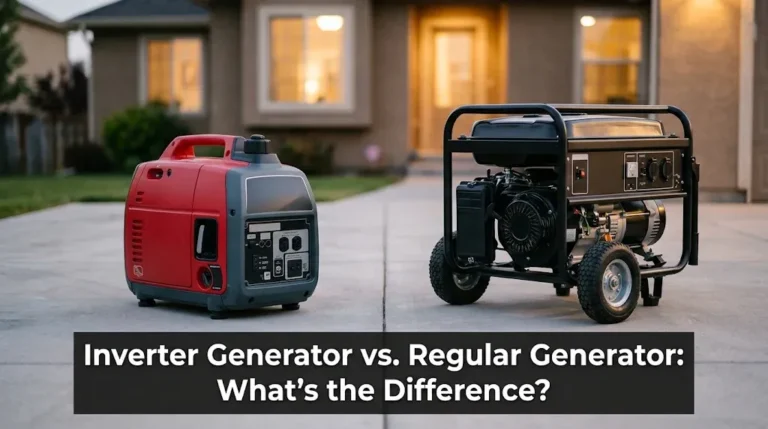
Inverter vs conventional for multiple appliances
A conventional generator also can run several appliances at once. It just does it with more noise, more fuel use at light loads, and rougher power quality.
An inverter generator is the better pick when your mix includes electronics. It is also the better pick for RV and camping use.
| Feature | Inverter Generator | Conventional Generator |
|---|---|---|
| Power quality | Clean sine wave, low THD | Rougher output, higher THD |
| Electronics | Safe for laptops, phones, CPAP | Use with care for sensitive gear |
| Noise | Quieter, speed follows load | Louder, fixed engine speed |
| Fuel use | Better at light and mixed loads | Uses more fuel at light loads |
| Parallel use | Many models are parallel-capable | Less common, check the manual |
Section Takeaway: An inverter generator handles a mixed load well because it makes clean power and adjusts its speed, but it still has a hard watt limit you must respect.
How Do You Calculate Total Watts for Multiple Appliances?

Use this simple formula first. Add all running watts, then add only the largest starting watts.
Running watts are what an appliance uses while it runs. Starting watts, also called surge watts, are the short spike when a motor starts.
Learn how to calculate the generator wattage you need with real appliance numbers before you buy or load up. A quick list on paper beats a guess in the dark.
A worked example
Say you want a fridge, lights, a laptop, and a fan. The fridge runs at about 150 watts, lights at 40 watts, a laptop at 60 watts, and a fan at 75 watts.
That running total is 325 watts. Add the fridge starting surge, often about 600 watts, and the peak need is about 925 watts.
A 2,000-watt inverter generator handles that mix with room to spare. A 1,000-watt unit still works, but the margin is thin.
Now add a 1,000-watt microwave. The running total jumps to 1,325 watts, and the peak is about 1,925 watts.
That is close to the limit on a 2,000-watt unit. You can do it for a short burst, but you should not add a coffee maker too.
Running watts vs starting watts
The key difference is simple. Running watts are steady, while starting watts are a brief spike.
Motor appliances have the biggest spikes. Fridges, freezers, sump pumps, furnace blowers, and AC units all surge at start.
See the full guide to running watts and starting watts if you want the full chart. It helps you avoid the most common sizing mistake.
- Check labels: Use the watts on the appliance label or manual, not a guess.
- Use amps x volts: Watts equal amps times volts when watts are not listed.
- Count the biggest surge once: Only add the largest starting watts, not every surge at once.
- Keep a margin: Aim to stay at 80% or less of rated watts for steady use.
The starting wattage for a fridge or AC can be two to three times its running watts. That is why two items that seem small can still trip a unit together.
Section Takeaway: Add running watts for everything, add the single largest starting surge, and keep the total under rated watts with a safety margin.
How Many Appliances Can Different Generator Sizes Run?
Size sets the ceiling. A bigger inverter generator does not just run more items, it runs bigger items together.
The table below uses typical watt ranges, not model specs. Always check your own appliance labels and your generator spec sheet.
| Generator size | Realistic combo | What to avoid together |
|---|---|---|
| 1,000 watts | Lights, laptop, phone chargers, small fan | Fridge plus microwave |
| 2,000 watts | Fridge, lights, CPAP, laptop, fan | Microwave plus coffee maker |
| 3,000 watts | Fridge, freezer, lights, TV, chargers | Window AC plus microwave |
| 5,000 watts | Fridge, freezer, furnace blower, lights, microwave in short bursts | Two large heating loads at once |
| 7,000+ watts | Several essentials plus a window AC or sump pump | Whole-home loads without a transfer switch plan |
A 2,000-watt unit is the sweet spot for camping and short outages. It covers food, light, and medical basics without much fuss.
A 3,000-watt unit adds breathing room for a second fridge or a TV. It still stays portable for most RV owners.
See what a 5000-watt inverter generator can provide if you need home backup with a furnace blower or a freezer too. That size changes what you can run at the same time.
Section Takeaway: Match the generator to your must-run list first, then add nice-to-have loads only if watts remain.
Which Appliance Combinations Work — and Which Do Not?
Good combos mix low steady loads with one motor load. Bad combos stack two high loads at the same moment.
Think in groups, not in single items. A fridge plus lights is a group, while a microwave plus a kettle is a different group.
Combos that usually work
- Fridge + lights + chargers: A classic outage combo on a 2,000-watt unit.
- CPAP + fan + phone chargers: Low, steady draw that suits a small inverter generator.
- Freezer + TV + lights: Works well on a 3,000-watt unit if you stagger the freezer start.
- Window AC + lights + laptop: Possible on a 3,000- to 5,000-watt unit, depending on the AC size.
Combos that often fail
- Microwave + coffee maker: Two heating loads can exceed 2,000 watts fast.
- Window AC + microwave: The AC surge plus microwave heat is a common trip.
- Sump pump + fridge starting together: Two motor surges at once are hard to absorb.
- Space heater + anything big: A 1,500-watt heater leaves little headroom.
Check what not to plug into an inverter before you add a new item. Some loads are a poor match for inverter power, even if the watts look fine.
Section Takeaway: Pair one heavy or motor load with several light loads, and never pair two heavy loads at the same time.
How Do You Run Multiple Appliances Safely, Step by Step?
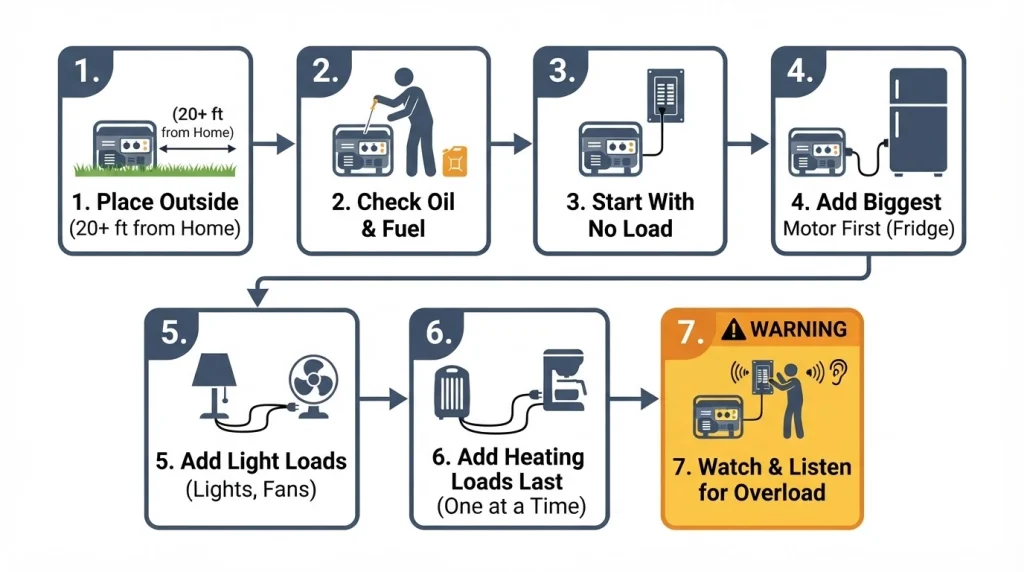
Start with placement and fuel, then add loads in order. A calm start prevents most overloads.
Safety note: Run generators outdoors and well away from windows, doors, and vents. Use a transfer switch or interlock installed by a licensed electrician for home circuits, and check your owner’s manual before use.
- Place it outside: Keep it at least 20 feet from the home, with exhaust pointed away.
- Check oil and fuel: Top up oil, use fresh fuel, and confirm the tank level.
- Start with no load: Let the engine warm up for a minute or two.
- Add the biggest motor first: Plug in the fridge or freezer and let it settle.
- Add light loads next: Add lights, chargers, fans, and a laptop.
- Add heating loads last: Add a microwave or coffee maker alone, for a short run.
- Watch and listen: If the engine strains or the overload light trips, shed a load at once.
Use heavy-duty, outdoor-rated extension cords in good condition. Keep cords dry, untangled, and away from walkways.
The U.S. Consumer Product Safety Commission and the CDC both stress outdoor placement and working carbon monoxide alarms. That advice applies even on a short run.
Section Takeaway: Place it safely outside, start it unloaded, add the biggest motor first, then add light loads and heating loads one at a time.
What Happens If You Overload an Inverter Generator?
Most inverter generators shut down output to protect themselves. The engine may keep running, but the outlets go dead.
You will often see an overload light or hear the engine surge. That is your cue to unplug a load, not to keep pushing it.
How to recover from an overload
- Unplug the last load: Remove the item you just added.
- Turn the unit off: Follow your manual to reset the overload, often by restarting.
- Restart with less load: Start the essentials first, then add one item at a time.
- Check for heat or smell: If you smell burning or see damage, stop and get help.
Repeated overloads can wear out the generator and shorten its life. They can also stress appliances that need stable voltage.
I once tripped a unit twice in one evening by adding a kettle while the AC cycled on. The fix was simple: brew, unplug, then let the AC run.
Section Takeaway: An overload usually cuts power to protect the unit, so shed a load, reset per the manual, and restart with fewer items.
Can You Run More Appliances by Paralleling Two Generators?

Yes, if both units are parallel-capable and you use the correct parallel kit. Two 2,000-watt units can give you close to 4,000 watts of combined power.
Parallel capability means the units can sync their output safely. It is not the same as plugging two random generators into one cord.
Use the kit made for your model, and follow the manual for start order. Mismatched units can damage each other and your appliances.
Paralleling is a smart RV move. You can run one small unit for light loads, then add the second when you need AC.
The U.S. Department of Energy offers general backup-power guidance, and Consumer Reports covers generator safety and sizing in its buying guides. Use both as a starting point, then follow your manual.
Safety note: Never backfeed a home panel with a suicide cord. Use a transfer switch or interlock installed by a licensed electrician.
Section Takeaway: Paralleling two compatible inverter generators can double your usable watts, but only with the right kit and manual-approved models.
Frequently Asked Questions
Can a 2000-watt inverter generator run a fridge and a microwave at the same time?
It can for a short burst if the fridge is already running and the microwave is small. The risk comes when the fridge compressor starts while the microwave runs, so stagger them when you can.
Can an inverter generator run a fridge and a freezer together?
Yes, on a 2,000- to 3,000-watt unit in most cases. Start one, wait for it to settle, then start the other to avoid two surges at once.
How many watts do I need to run multiple appliances?
Add all running watts, add the largest starting watts, then add a 10-20% margin. That total is the rated watts you should shop for, not the peak watts.
Can I plug a power strip into an inverter generator?
Yes, for low-watt electronics and lights, if the strip is rated for the load and in good condition. Do not use a cheap strip for a microwave, heater, or AC.
Does eco mode affect running multiple appliances?
Yes, eco mode can lag when a big load starts suddenly. Turn eco mode off before you add a motor or heating load, then turn it back on for light, steady use.
Can an inverter generator run a window AC and a fridge at once?
Yes, on a 3,000- to 5,000-watt unit, depending on the AC size and the fridge surge. Start the AC first, let it settle, then add the fridge.
What should I run first during a power outage?
Run food safety and medical gear first, such as a fridge, freezer, and CPAP. Add lights and chargers next, and save cooking loads for short, staggered bursts.
The bottom line is simple. List your must-run appliances, do the wattage math, and stagger the heavy starts.
Do that, and one inverter generator can keep your food cold, your lights on, and your phones charged through an outage in 2026.

Hi, I’m Michael Turner. I own a generator workshop in the United States and founded HomeGeneratorBlog to share practical, hands-on guidance about generator installation, maintenance, troubleshooting, safety, and backup power solutions. My goal is to help homeowners make smarter, more confident decisions through clear and reliable information