Can an Inverter Generator Power an Entire House? Sizing, 240V Power & Safe Setup
Quick Answer
Yes, a large inverter generator can power an entire house, but only if it is big enough, supplies 240V power, and connects safely. Most homes need 7,000 to 9,000 running watts for essentials, while a full normal load can need far more. Check what size inverter generator you need before you buy.
What it takes
- Right size: Add running watts first, then add the largest starting watts.
- 240V output: A 120V-only unit cannot run a 240V well pump, dryer, or central AC.
- Safe hookup: Use a transfer switch or interlock kit installed by a licensed electrician.
- Load choices: Run the fridge, lights, and furnace, then rotate the AC, microwave, and water heater.
- Fuel plan: Keep enough fresh fuel for the outage, plus oil for longer runs.
Fast rule to remember
- If your essentials total more than 80% of the running watts, size up or cut a load.
- Never plug a generator into a wall outlet, and never run it indoors or in a garage.
I’ve tested inverter generators through long outages, and the short answer always surprises people. A small quiet unit can save your fridge and phones, but it cannot carry a whole house on its own.
This guide goes deeper than a yes-or-no answer. You’ll learn what “entire house” means in watts, what size you need, how to connect it safely, and when a standby generator makes more sense.
In This Guide
- What Does “Power an Entire House” Really Mean?
- Can an Inverter Generator Power an Entire House?
- What Size Inverter Generator Do You Need for a Whole House?
- What Can an Inverter Generator Run — and What Should You Leave Off?
- Inverter Generator vs Conventional Generator vs Standby Generator for Whole-Home Backup
- How Do You Connect an Inverter Generator to Your House Safely?
- How Long Can an Inverter Generator Power a House?
- What Does It Cost to Power a House With an Inverter Generator?
- Common Mistakes That Overload or Damage Your Setup
- Frequently Asked Questions
What Does “Power an Entire House” Really Mean?
“Entire house” sounds simple, but it means three different things to three different homeowners. One person wants every light, outlet, and appliance running as normal. Another wants heat, water, food safety, and light during a storm.
The third wants a quiet backup that keeps a home livable, not a full copy of grid power. Your size, cost, and hookup all change with that choice.
An inverter generator is a portable generator that makes clean, stable power by converting raw engine power to DC, then back to smooth AC power. That clean sine wave protects phones, laptops, and modern furnace controls.
It also uses an eco-throttle, or economy mode, to slow the engine when the load drops. That saves fuel and cuts noise, which matters during a long night outage.
Three levels of whole-house power
Most buyers fall into one of three groups, and each group needs a different wattage range. Start here before you shop for a model.
- Essentials only: Fridge, freezer, lights, phones, Wi-Fi, sump pump, and furnace blower. This often needs 3,000 to 5,000 running watts.
- Comfort backup: Essentials plus a window AC or small heat pump, microwave in turns, and a well pump. This often needs 6,000 to 9,000 running watts.
- Near-normal use: Central AC, electric water heater, dryer, range, and all circuits at once. This can need 12,000 to 20,000 running watts or more.
A large portable inverter generator can handle the first two levels well. The third level is where a standby generator, or a very large parallel setup, starts to make more sense.
Safety note: Run any generator outdoors, at least 20 feet from your home, with the exhaust pointed away from windows, doors, and vents.
Section Takeaway: Define “entire house” as essentials, comfort, or near-normal use first, because that choice sets your wattage, voltage, and budget.
Can an Inverter Generator Power an Entire House?
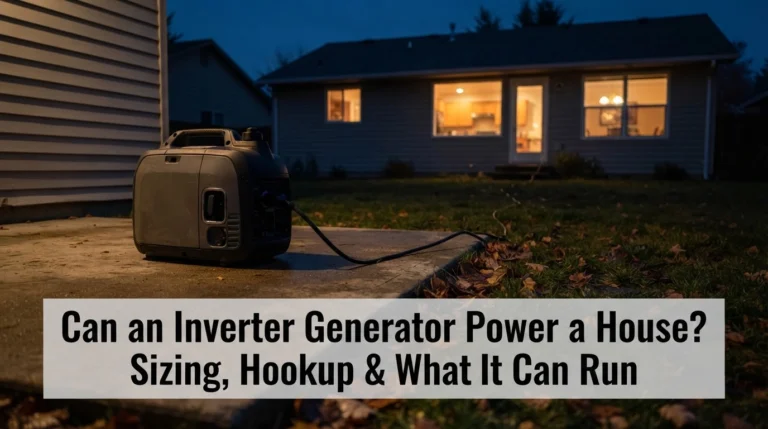
Yes, an inverter generator can power an entire house when the load fits its rated output. The key is the word “fits,” because a generator does not grow stronger when you plug in one more appliance.
A 2,000-watt inverter generator will run a fridge, lights, and phones with ease. It will not run a central AC, an electric dryer, and a well pump at the same time.
A 9,000-watt inverter generator is a different tool. It can run a fridge, freezer, furnace blower, lights, Wi-Fi, and a window AC, as long as you stagger the big starting loads.
Why voltage matters as much as watts
Watts tell you how much power you have. Voltage tells you what kind of circuits you can feed.
Most small inverter generators supply 120V only. That works for extension cords and most household outlets, but it cannot feed a 240V circuit.
- 120V loads: Fridge, freezer, lights, TV, laptop, CPAP machine, and phone chargers.
- 240V loads: Central AC, electric water heater, electric dryer, electric range, and many well pumps.
- What to check: Look for a 120/240V outlet, often a 30A or 50A twist-lock or RV outlet, on the spec sheet.
I learned this the hard way during a summer outage. My 3,500-watt inverter ran the fridge and fans fine, but my well pump never started. The pump needed 240V, and my unit only made 120V.
That night taught me to check voltage before watts. A bigger 120V unit would not have fixed the problem.
What about parallel inverter generators?
Parallel capability lets you join two matching inverter generators with a parallel kit. Two 4,500-watt units can give you about 9,000 watts of combined power, with a cleaner load and easier transport.
Parallel power still needs the right voltage. Two 120V-only units in parallel still make 120V, unless the kit and models support 240V output.
Check the manual before you plan a parallel whole-house setup. Some kits add watts only, while others add a 240V outlet for home backup.
Section Takeaway: A large 240V inverter generator can power a whole house in essentials or comfort mode, but a small 120V-only unit cannot, no matter how quiet it is.
What Size Inverter Generator Do You Need for a Whole House?

Size your generator from your real loads, not from a guess. A quick list on paper beats a hopeful purchase every time.
Start with running watts, which is the power an appliance uses while it runs. Then add starting watts, which is the short surge a motor needs to start.
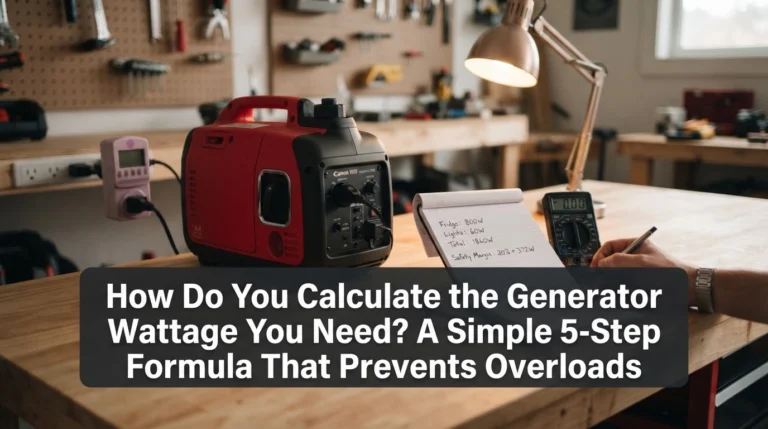
Learn how to calculate the generator wattage you need with your own appliance labels. That math turns a vague “big enough” into a clear number.
Step 1: List your must-run loads
Write down every appliance you want on at the same time. Use the nameplate watts when you can, and use typical ranges when you cannot.
- Refrigerator: 150 to 300 running watts, 800 to 1,200 starting watts.
- Freezer: 100 to 250 running watts, 800 to 1,200 starting watts.
- Furnace blower: 400 to 800 running watts, 1,000 to 1,500 starting watts.
- Sump pump: 800 to 1,200 running watts, 1,500 to 2,500 starting watts.
- Well pump: 1,000 to 2,000 running watts, 2,000 to 4,000 starting watts.
- Window AC, 8,000 BTU: 700 to 1,000 running watts, 1,800 to 2,500 starting watts.
- Central AC, 3-ton: 3,000 to 3,500 running watts, 6,000 to 9,000 starting watts.
Those are typical ranges, not model specs. Always check the label on your own fridge, pump, and AC before you buy.
Step 2: Add running watts, then add the biggest start
Add all the running watts for loads you will run together. Then add the starting watts for the largest motor only, not for every motor at once.
Here is a simple comfort-backup example. Fridge 200 watts, freezer 150 watts, furnace blower 600 watts, lights and Wi-Fi 300 watts, and window AC 800 watts total 2,050 running watts.
Add the AC starting surge of about 2,000 watts, and you need about 4,050 watts at that moment. A 5,000-watt inverter generator gives you a useful margin for that load.
Now try a harder example. Add a well pump at 1,500 running watts and a 3,000-watt starting surge, and the same list jumps past 7,000 watts. That is why well water and central AC change the size fast.
Step 3: Keep a 20% safety margin
Do not run a generator at 100% load for hours. Heat, altitude, and fuel quality can all cut real output.
Aim for 70% to 80% load in normal use. If your essentials total 6,000 watts, look for a unit rated near 7,500 running watts.
Understand the difference between running watts and starting watts before you compare models. Many buyers shop by the big surge number on the box, then find the running watts are far lower.
| House backup level | Typical running watts | Inverter size to consider | What it covers |
|---|---|---|---|
| Essentials | 3,000–5,000W | 4,000–5,500W | Fridge, lights, phones, sump pump |
| Comfort | 5,000–7,500W | 7,000–9,000W | Essentials plus window AC or well pump |
| Near-normal | 10,000W+ | 12,000W+ or standby | Central AC, dryer, water heater together |
Section Takeaway: Add running watts, add the largest starting surge, then keep a 20% margin — that total is your real whole-house size.
What Can an Inverter Generator Run — and What Should You Leave Off?
A large inverter generator can run most of a home in turns. It cannot run everything at once, and it should not run a few high-heat loads without a plan.
Think in groups, not in single appliances. Run one heavy group, stop it, then run the next heavy group.
Easy loads for a whole-house inverter setup
These loads are steady, low-surge, and safe for clean inverter power. They form the base of any outage plan.
- Fridge and freezer: Keep them cold, and limit door openings during an outage.
- Lights and fans: LED lights use very little power, and fans add comfort for few watts.
- Phones, laptops, and Wi-Fi: Clean sine wave power suits these devices well.
- CPAP machine: Low watts, but check the humidifier setting because heat adds load.
- Furnace blower: The blower uses far less power than electric heat, so gas heat is a good match.
- Sump pump: It cycles on and off, so plan for its starting surge each time.
Heavy loads that need rotation
These loads work, but they need timing and a size check. Run one at a time when your generator is near its limit.
- Window AC: Run it to cool a room, then turn it off before you run the microwave.
- Microwave: It draws 1,000 to 1,500 watts, so use it in short bursts.
- Electric water heater: It can draw 4,000 watts or more, so heat water in turns.
- Well pump: It needs a strong start, so avoid starting it with the AC at the same time.
- Washing machine: It works in most cases, but skip the dryer cycle on generator power.
Loads to leave off or treat with care
Some loads are poor fits for a portable inverter generator. They use too much power, or they risk damage if the load is wrong.
- Electric dryer: It can need 5,000 watts alone, so hang clothes or use a laundromat.
- Electric range: One burner can use 1,500 watts, and a full oven uses far more.
- Central AC without a soft start: The starting surge can trip a mid-size generator.
- Electric heat: Space heaters and baseboard heat eat watts fast, so use gas heat or layers instead.
During a three-day outage, I ran my fridge, freezer, furnace, lights, and phones on a mid-size inverter. I cooked with a small camp stove outside, and I ran the window AC for two hours in the evening.
That rotation kept the house livable. It also kept the generator near 60% load, which kept fuel use and noise down.
Section Takeaway: Run essentials all the time, rotate heavy loads one at a time, and leave electric heat, dryers, and full ovens off the generator.
Inverter Generator vs Conventional Generator vs Standby Generator for Whole-Home Backup
An inverter generator is the quiet, clean-power choice. A conventional generator is the loud, low-cost workhorse. A standby generator is the automatic, whole-home system.
Your choice depends on budget, noise, fuel, and how much of the house you want to run. There is no single best answer for every home.
| Feature | Inverter generator | Conventional generator | Standby generator |
|---|---|---|---|
| Power quality | Clean sine wave, low THD | Rougher output, higher THD | Stable, home-grade power |
| Noise | Quieter, often 50–65 dB range | Louder, often 70 dB or more | Moderate, fixed outdoor unit |
| Fuel use | Efficient at light loads | Uses more fuel at light loads | Natural gas or propane, no refills |
| Start | Manual or remote start | Manual, often pull start | Automatic when power fails |
| Best for | Essentials and comfort backup | High watts on a low budget | Full home, hands-free backup |
THD means total harmonic distortion, which is a measure of how clean the power wave is. Low THD suits laptops, phones, and modern furnace boards.
Check Consumer Reports for independent generator test notes before you compare brands. Their ratings can help you weigh noise, fuel use, and real output.
Compare whole-home portable generator options if you want a portable unit that can feed a panel. That list helps you see which sizes offer 240V output and parallel support.
Section Takeaway: Choose an inverter for quiet, clean backup; choose a conventional unit for cheap watts; choose standby for automatic, near-normal whole-home power.
How Do You Connect an Inverter Generator to Your House Safely?

How you connect the generator matters as much as its size. A safe hookup protects your family, your appliances, and utility workers outside.
Never backfeed a house through a wall outlet with a double-ended cord. That method, often called a suicide cord, can energize lines outside and can kill a line worker.
Safety note: Use a transfer switch or interlock kit installed by a licensed electrician, and follow your local code and your owner’s manual.
Option 1: Extension cords to key appliances
This is the simplest safe method for a small or mid-size inverter generator. You run heavy-duty outdoor cords from the generator to the fridge, freezer, and a few lights.
Use one cord per appliance when you can. Keep cords dry, clear of walkways, and away from heat.
This method works well for essentials, but it cannot power hard-wired loads like a furnace or well pump. Those loads need a panel connection.
Option 2: Transfer switch
A transfer switch lets you feed selected house circuits from the generator. An electrician wires it to your panel and to an outdoor inlet box.
You plug the generator into the inlet with a proper cord, flip the switch, and power only the chosen circuits. The switch blocks grid power and generator power from joining.
This is the best choice for most whole-house inverter setups. It is clean, safe, and easy to use during a dark, stressful outage.
Option 3: Interlock kit
An interlock kit is a metal plate on your main panel. It forces the main breaker off before the generator breaker can turn on.
It costs less than a full transfer switch in many homes. It still needs a licensed electrician and a code-approved kit for your panel model.
Read about safe hookup choices in this guide on powering a house without a transfer switch. It explains the safe limits of cords and inlet setups.
What size cord and inlet do you need?
Match the cord and inlet to the generator outlet. A 30A inlet suits many 7,000-watt units, while a 50A inlet suits larger 9,000-watt and parallel setups.
Use a cord rated for the amps and length you need. A long, thin cord can drop voltage and heat up under load.
Check the U.S. Department of Energy for general home energy and backup-power guidance. Their pages can help you plan loads and efficiency before an outage.
Section Takeaway: Use cords for a few appliances, or a transfer switch or interlock for panel circuits — and never backfeed through a wall outlet.
How Long Can an Inverter Generator Power a House?
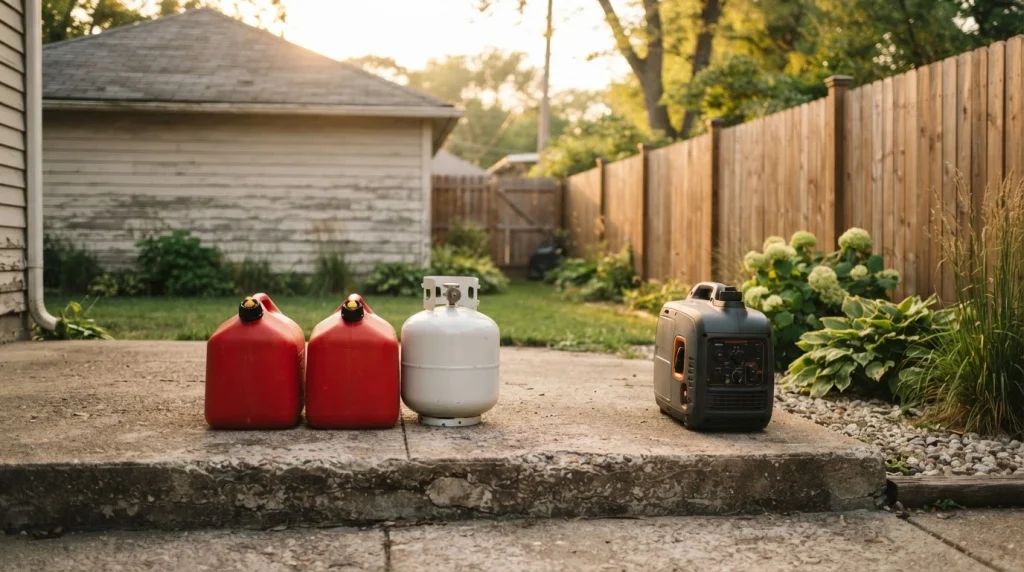
Runtime depends on tank size, load, and eco-mode. A generator at 25% load can run far longer than the same unit at 90% load.
Most mid-size inverter generators run 8 to 12 hours at 50% load on one tank. Larger units with bigger tanks can run 12 to 18 hours at 50% load, but check the spec sheet for your model.
Eco-mode helps a lot at light loads. The engine slows when the fridge cycles off, then speeds up when the AC starts.
How to stretch runtime during a long outage
Fuel is your real limit in a multi-day outage. Gas stations may close, and propane supply can run low.
- Run essentials at night: Turn off the AC and run only the fridge, lights, and phones.
- Use eco-mode: Keep it on for light loads, and turn it off only for big motor starts.
- Cool in blocks: Run the AC for two hours, then let the house coast for an hour.
- Keep fuel fresh: Use fuel stabilizer, rotate stored fuel, and never store fuel indoors.
- Change oil on schedule: Check the oil level each day, and follow the manual for oil-change hours.
A 7,000-watt inverter at half load can use roughly 0.5 to 0.8 gallons per hour in real use. That means 10 to 16 gallons per day, so plan storage before the storm.
Dual-fuel models add flexibility. Gasoline is easy to find in normal times, while propane stores longer and does not gum up a carburetor as fast.
Plan for outages with generator sizing for a power outage so your fuel and wattage plans match. That guide helps you size for the outage you expect, not just the appliance list.
Safety note: Let the generator cool before you refuel, and refuel outdoors away from the house.
Section Takeaway: Runtime is set by load and fuel, so run essentials at night, use eco-mode, and store enough fresh fuel for the whole outage.
What Does It Cost to Power a House With an Inverter Generator?
A whole-house inverter setup costs more than a camping unit, but less than a standby system in most cases. The total includes the generator, hookup, cords, fuel, and upkeep.
Small 2,000-watt inverter generators often cost $500 to $1,200 as of 2026. Mid-size 4,000 to 5,000-watt models often cost $1,200 to $2,500.
Large 7,000 to 9,000-watt inverter generators often cost $2,500 to $5,000. Parallel kits, cords, and a transfer switch can add $500 to $2,000 more.
Running costs to plan for
Fuel is the main running cost. A large unit at half load can burn $30 to $60 of gasoline per day at typical 2026 fuel prices, depending on local prices and load.
Oil, filters, spark plugs, and fuel stabilizer add a smaller yearly cost. A yearly test run and oil change keep the unit ready.
Propane can cost more per hour in some areas, but it stores well and avoids stale-fuel carburetor clogs. That trade-off matters if you store fuel for months.
When a standby generator is worth the extra cost
A standby generator often costs $8,000 to $15,000 installed, depending on size and fuel line work. It starts on its own, runs on natural gas or propane, and can power near-normal loads.
Choose standby if you have medical loads, frequent long outages, or a home that cannot lose heat or water. Choose a large inverter if outages are rare and you want portable power too.
Section Takeaway: Budget $2,500 to $5,000 for a large inverter, plus hookup and fuel, and compare that total with a standby system before you decide.
Common Mistakes That Overload or Damage Your Setup
Most generator problems come from simple mistakes, not bad equipment. A short checklist can save you a tripped breaker, a dead fridge, or a damaged motor.
I have seen a neighbor start a window AC, microwave, and well pump at once on a 5,000-watt unit. The overload shutoff tripped, the fridge warmed up, and the house went dark again.
Mistakes to avoid
- Starting everything at once: Start the largest motor first, then add loads one by one.
- Ignoring starting watts: A fridge that runs at 200 watts can still need 1,200 watts to start.
- Using a thin extension cord: A long 16-gauge cord can starve a motor and cause a hard start.
- Running indoors or in a garage: Carbon monoxide can build up fast, even with a door open.
- Storing stale fuel: Old gasoline can clog a carburetor and make the unit hard to start.
- Skipping the break-in: Follow the manual for break-in hours and the first oil change.
- Forgetting CO alarms: Keep battery-powered CO alarms in sleeping areas during generator use.
Learn carbon monoxide guidance from the CDC and generator safety guidance from the U.S. Consumer Product Safety Commission. Both stress outdoor placement, distance from the home, and working CO alarms.
Test your setup before an outage. Run your chosen loads for an hour, check the load meter, and note how much fuel you used.
Section Takeaway: Start loads one at a time, use the right cords, keep fuel fresh, and test the whole setup before the next storm.
Frequently Asked Questions
Can a 2000-watt inverter generator power a house?
No, a 2,000-watt inverter generator cannot power an entire house. It can run a fridge, lights, phones, and a CPAP machine, but it cannot run central AC, a well pump, or an electric water heater.
What size inverter generator do I need to run a whole house?
Most homes need 7,000 to 9,000 running watts for essentials and comfort loads. Add your running watts, add the largest starting surge, and keep a 20% margin before you choose a size.
Can an inverter generator run central air conditioning?
Yes, a large 240V inverter generator can run central AC if the starting surge fits its rated output. A soft-start kit can lower that surge, but check the AC label and the generator spec sheet first.
Can I run an inverter generator all night?
Yes, you can run it all night if the tank, oil level, and load allow it. Use eco-mode, keep the load near 50% or less, and place the unit outdoors far from windows.
Do I need a transfer switch for an inverter generator?
You need a transfer switch or interlock kit to feed house circuits safely. Extension cords work for a few appliances, but they cannot power a furnace, well pump, or hard-wired lights.
Can two inverter generators power a house together?
Yes, two matching parallel-capable inverter generators can power a house together. Check that the parallel kit supports your voltage needs, because two 120V units still make 120V unless the kit adds 240V.
Is an inverter generator better than a standby generator for a house?
An inverter generator is better for portable, quiet, lower-cost backup. A standby generator is better for automatic, hands-free, near-normal whole-home power during frequent or long outages.
Pick your backup level first, then size the generator to match it. A large 240V inverter generator can keep a home safe and livable through most outages, as long as you plan loads, fuel, and hookup in advance.
Test your setup this week, while the power is still on. Your future self, in the middle of a dark outage, will thank you for it.

Hi, I’m Michael Turner. I own a generator workshop in the United States and founded HomeGeneratorBlog to share practical, hands-on guidance about generator installation, maintenance, troubleshooting, safety, and backup power solutions. My goal is to help homeowners make smarter, more confident decisions through clear and reliable information