What Size Inverter Generator Can Run an RV Air Conditioner? Sizing, BTU & Soft Start
Quick Answer
What size inverter generator can run an RV air conditioner? A 3,000 to 3,500-watt inverter generator usually starts a 13,500 BTU unit, while a 15,000 BTU unit usually needs 3,500 to 4,000 watts. The startup surge decides the size, not the steady running watts. Check your air conditioner label first, then match the generator to its starting watts. For a full RV setup, see these best portable generators for RV camping.
The Short Sizing Rule
- 13,500 BTU unit: Plan for about 2,800 to 3,000 starting watts and 1,200 to 1,500 running watts.
- 15,000 BTU unit: Plan for about 3,300 to 3,500 starting watts and 1,500 to 1,800 running watts.
- Small 9,000 BTU unit: A 2,200 to 2,500-watt generator may work, but only if the starting watts fit.
- Two air conditioners: You need a much larger generator, a parallel kit, or a soft start kit on each unit.
- Hot weather and altitude: Both cut usable power, so leave a 20% safety margin.
Before You Buy
- Read the watts on your air conditioner nameplate, not a guess from a forum.
- Compare starting watts first, then running watts, then the other loads you want to run.
- Test the air conditioner alone before you add a fridge, charger, or microwave.
I’ve stood in a hot campground, generator humming, waiting to hear that compressor kick on. That first click tells you everything.
What size inverter generator can run an RV air conditioner? It depends on your BTU size, your starting watts, and what else you run at the same time. This guide walks through the real numbers, the soft start option, and the mistakes that trip up new RV owners in 2026.
In This Guide
- How Many Watts Does an RV Air Conditioner Use?
- What Size Inverter Generator Do You Need for a 13,500 BTU RV Air Conditioner?
- What Size Inverter Generator Do You Need for a 15,000 BTU RV Air Conditioner?
- Starting Watts vs Running Watts: Why the Startup Surge Decides It
- Can a 2,000-Watt Inverter Generator Run an RV Air Conditioner?
- How Does a Soft Start Kit Change the Size You Need?
- What Else Can You Run With the Air Conditioner?
- How to Size, Connect, and Test Your Setup Safely
- What Sizing Mistakes Should You Avoid?
- Frequently Asked Questions
How Many Watts Does an RV Air Conditioner Use?

An RV air conditioner uses far more power to start than it uses to keep running. That gap is the whole sizing problem.
Most rooftop RV units fall into three common sizes. The watts below are typical ranges, so always check your own nameplate.
- 9,000 BTU: About 1,000 to 1,200 running watts and 1,800 to 2,200 starting watts.
- 13,500 BTU: About 1,200 to 1,500 running watts and 2,800 to 3,000 starting watts.
- 15,000 BTU: About 1,500 to 1,800 running watts and 3,300 to 3,500 starting watts.
BTU stands for British Thermal Unit, and it measures cooling power. A higher BTU number means more cooling, and usually more watts.
Your air conditioner label is the best source. Look on the rooftop unit or inside the ceiling assembly for amps, volts, and watts.
How do you turn amps into watts?
Multiply amps by volts to get watts. For a 120-volt RV circuit, a 12-amp air conditioner uses about 1,440 watts while running.
That simple math helps when the label lists amps only. It still does not show the starting surge, so treat the result as a running-watt figure.
What is an inverter generator?
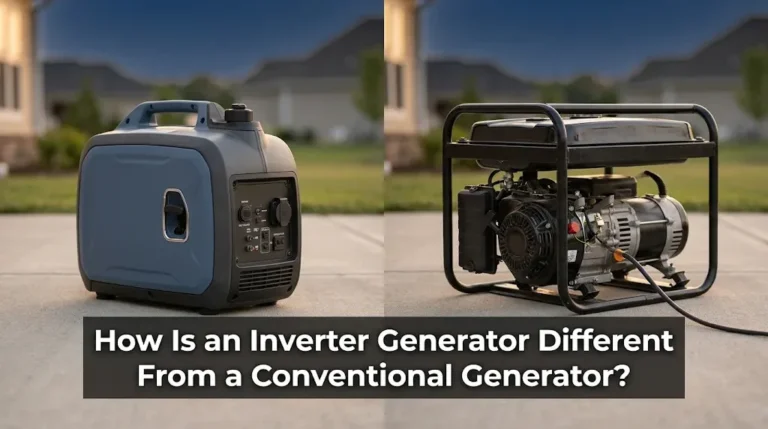
An inverter generator is a portable generator that makes clean, stable power by converting its output to DC and back to AC. That clean power suits sensitive electronics and modern RV air conditioner controls.
It also adjusts engine speed to match the load. That makes it quieter and more fuel-efficient at light loads than a conventional open-frame generator.
Section Takeaway: Size for starting watts first, because a generator that meets running watts alone will still stall when the compressor starts.
What Size Inverter Generator Do You Need for a 13,500 BTU RV Air Conditioner?
A 3,000 to 3,500-watt inverter generator is the safe pick for most 13,500 BTU RV air conditioners. A 3,000-watt model often works, but a 3,500-watt model gives you room for heat, altitude, and small extra loads.
I learned this the hard way on a 95-degree afternoon. My old 2,800-watt unit ran the fan fine, then tripped the moment the compressor tried to start.
The compressor needs a short burst of extra power. If the generator cannot supply it, the breaker trips or the engine bogs down.
- Minimum size: 3,000 starting watts, with running watts above 2,500.
- Comfortable size: 3,500 starting watts, with running watts near 3,000.
- With a soft start kit: A 2,500 to 3,000-watt generator may work, if the kit cuts the surge enough.
Check the generator label for both numbers. The big number on the box is usually starting watts, not running watts.
That detail matters. A “3,000-watt” generator may offer only 2,600 running watts, and that gap can decide whether your air conditioner stays on.
For context on what a mid-size unit can handle beyond the air conditioner, read what a 3,000-watt inverter generator can run. It helps you plan lights, charging, and small appliances around the cooling load.
Section Takeaway: For a 13,500 BTU unit, buy for 3,000 starting watts at minimum and choose 3,500 watts if you want a real margin.
What Size Inverter Generator Do You Need for a 15,000 BTU RV Air Conditioner?
A 15,000 BTU RV air conditioner usually needs a 3,500 to 4,000-watt inverter generator. A 3,500-watt model can work in mild conditions, but a 4,000-watt model is the safer choice for hot days.
These larger units draw about 1,500 to 1,800 running watts. Their starting surge often reaches 3,300 to 3,500 watts.
That surge leaves almost no headroom on a 3,500-watt generator. Add a battery charger or a fridge compressor at the same moment, and the generator can overload.
- Minimum size: 3,500 starting watts, with running watts above 3,000.
- Comfortable size: 4,000 starting watts, with running watts near 3,500.
- With a soft start kit: A 3,000 to 3,500-watt generator may work, but test it in real heat first.
Altitude makes this worse. Generators lose power as air gets thinner, so a unit that works at sea level may struggle in the mountains.
Heat matters too. An air conditioner works harder on a hot roof, and the generator engine also loses a little power in high heat.
Section Takeaway: For a 15,000 BTU unit, plan on 3,500 to 4,000 watts, and do not treat the minimum as a comfortable all-day setup.
Starting Watts vs Running Watts: Why the Startup Surge Decides It
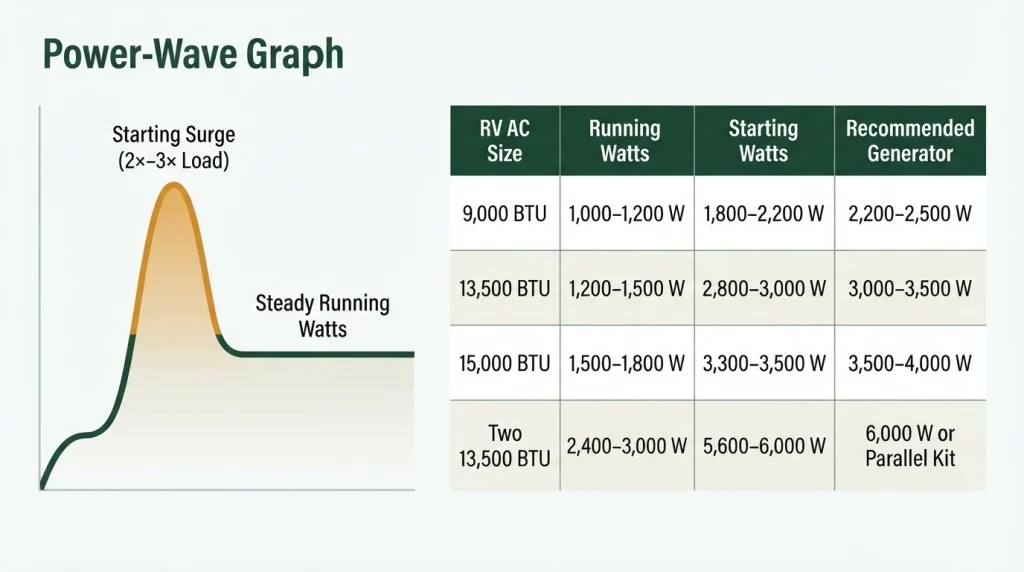
Starting watts are the short burst a motor needs to begin spinning. Running watts are the steady power it needs once it is up to speed.
An RV air conditioner compressor is a motor load. It can draw two to three times its running watts for a second or two at startup.
That is why a generator can run the fan with ease and still fail on the compressor. The fan is a light load, while the compressor is a hard start.
| RV Air Conditioner Size | Running Watts | Starting Watts | Recommended Inverter Generator |
|---|---|---|---|
| 9,000 BTU | 1,000–1,200 W | 1,800–2,200 W | 2,200–2,500 W |
| 13,500 BTU | 1,200–1,500 W | 2,800–3,000 W | 3,000–3,500 W |
| 15,000 BTU | 1,500–1,800 W | 3,300–3,500 W | 3,500–4,000 W |
| Two 13,500 BTU units | 2,400–3,000 W | 5,600–6,000 W | 6,000 W or parallel kit |
Use the table as a starting point, not a guarantee. Your exact model, age, and condition change the numbers.
An older compressor often draws more starting power than a new one. A dirty condenser coil can also raise running watts.
When in doubt, size up. A generator running at 70% load lasts longer and runs quieter than one pinned at 100%.
Section Takeaway: Match starting watts first, then check running watts, because the compressor surge is the test your generator must pass.
Can a 2,000-Watt Inverter Generator Run an RV Air Conditioner?
A 2,000-watt inverter generator usually cannot run a standard 13,500 or 15,000 BTU RV air conditioner. The starting surge is simply too high for most 2,000-watt models.
Some small 9,000 BTU units may start on a 2,200-watt generator. Even then, the margin is thin, and hot weather can break it.
A soft start kit changes the math for some owners. It lowers the startup surge, so a smaller generator has a real chance.
Do not count on that fix until you test it. Install the kit, then run the air conditioner in heat with nothing else on the generator.
- Without a soft start kit: A 2,000-watt generator is too small for most RV air conditioners.
- With a soft start kit: It may run a 13,500 BTU unit, but only if the reduced surge fits the generator rating.
- With two 2,000-watt units in parallel: You get about 4,000 starting watts, which can run a 13,500 BTU unit.
Paralleling is a practical middle path. Two light generators are easier to carry than one heavy 4,000-watt unit.
That setup still needs a parallel kit made for your generator model. Do not join two generators with a homemade cable.
For a clear view of the limits at this size, see what a 2,000-watt inverter generator can run. It shows why lights and charging fit, while a large compressor does not.
Section Takeaway: A 2,000-watt generator is not a safe default for RV cooling, unless you add a soft start kit or a second unit in parallel.
How Does a Soft Start Kit Change the Size You Need?
A soft start kit lowers the startup surge by ramping the compressor up slowly. It spreads the inrush over a longer moment instead of hitting the generator all at once.
Many owners report a 50% to 70% drop in starting watts after fitting one. Your result depends on the kit, the compressor, and the wiring.
That drop can move a 13,500 BTU unit from a 3,500-watt need down to a 2,500-watt need. It can also let a 15,000 BTU unit start on a 3,500-watt generator.
Is a soft start kit worth it?
It is worth it if you already own a smaller generator and want to keep it. It is also worth it if you want quieter starts and less strain on the compressor.
It is not a magic fix for a badly undersized generator. A 1,000-watt unit will not run a 15,000 BTU air conditioner, kit or no kit.
What should you check before you install one?
- Fitment: Confirm the kit matches your air conditioner brand and model.
- Wiring skill: The install touches 120-volt wiring, so follow the kit manual exactly.
- Warranty: Check whether the install affects your air conditioner or RV warranty.
- Professional help: Hire an RV technician if you are unsure about the wiring.
Safety note: Disconnect shore power and the generator before you open the air conditioner housing, and follow your owner’s manual. If you are unsure about 120-volt wiring, have a qualified technician do the install.
Section Takeaway: A soft start kit can cut the surge enough to drop one generator size, but it does not replace proper sizing.
What Else Can You Run With the Air Conditioner?
Once the air conditioner is running, you have only the leftover watts to share. A 3,500-watt generator with a 1,400-watt air conditioner leaves about 2,100 running watts in theory.
In practice, leave a margin. Aim to keep the total running load under 80% of the generator rating for steady use.
That margin keeps voltage stable and gives the compressor room to cycle. It also helps on hot days when the air conditioner draws more power.
- Easy together: LED lights, phone charging, laptop charging, and a small fan.
- Use with care: RV fridge on AC power, battery converter, and a TV.
- Wait your turn: Microwave, electric water heater, coffee maker, and hair dryer.
A microwave can draw 1,000 to 1,500 watts on its own. Run it while the air conditioner cycles on, and you may trip the generator.
The fridge is a common surprise. Its compressor can start at the same time as the air conditioner, and the combined surge can overload a mid-size generator.
For a full load plan, read can an inverter generator run multiple appliances at once. It explains how to add watts and stagger starts.
If you want more headroom for the whole RV, see what a 5,000-watt inverter generator can run. A larger unit makes it easier to cool the RV and still use a microwave or water heater.
Section Takeaway: Run the air conditioner first, then add small loads, and save big heat appliances for when the compressor is already running.
How to Size, Connect, and Test Your Setup Safely
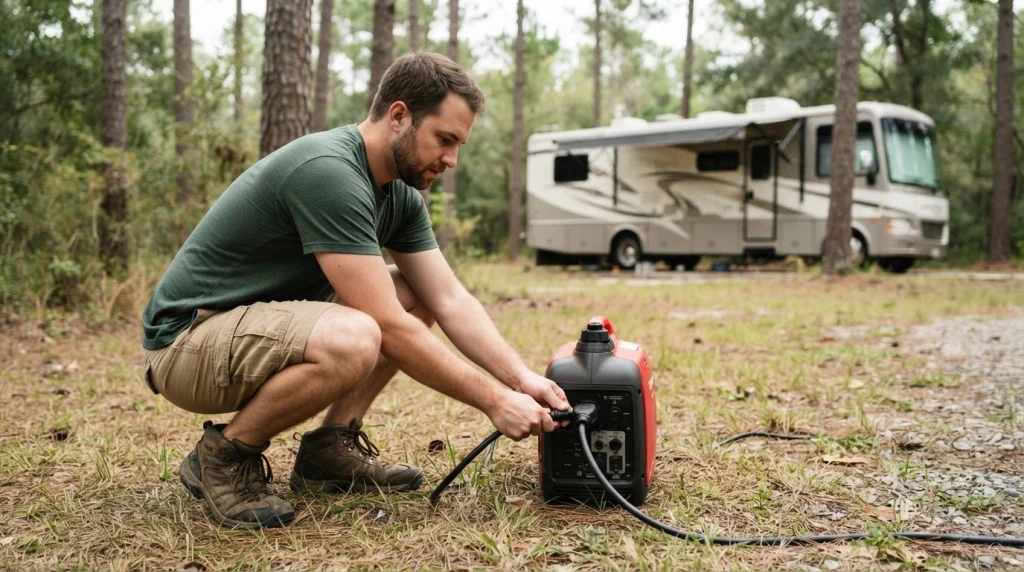
Sizing is a short checklist, not a guess. Work through it once, and you will know whether your generator fits.
- Find your air conditioner watts: Read the nameplate for running amps and any starting-watt figure.
- Convert amps to watts: Multiply amps by 120 volts for a standard RV circuit.
- Add a surge allowance: If no starting figure is listed, plan on two to three times the running watts.
- Add your other loads: List the watts for lights, charging, fridge, and any appliance you want at the same time.
- Compare both numbers: The generator must beat your total starting watts and your total running watts.
- Leave a margin: Keep steady use under 80% of the running-watt rating.
Connect the generator with the right cord and adapter. Use a heavy-duty RV cord rated for your amperage, and keep connections dry and off the ground.
Place the generator outdoors, away from windows, doors, and vents. Carbon monoxide is colorless and odorless, so never run a generator inside an RV, garage, or enclosed awning.
Test the setup before a trip. Start the generator, let it warm up, then switch the air conditioner fan on first.
Next, switch the compressor on and listen. A healthy start is a short dip in engine note, then a steady hum.
If the engine stalls, the breaker trips, or the lights dim badly, stop. You are undersized, or another load is starting at the same time.
For larger RVs with a 50-amp service, the outlet and adapter matter too. See best portable generator with a 50-amp outlet before you buy a bigger unit for a 50-amp rig.
Check guidance from the EPA on safe generator placement and fuel handling. Consumer guidance from Consumer Reports also helps you compare noise, runtime, and safety features.
Safety note: Run the generator outdoors only, keep it at least 20 feet from the RV when you can, and keep a working carbon monoxide detector inside the RV. Never refuel a hot generator.
Section Takeaway: Test the air conditioner alone in real heat before a trip, because a driveway test on a cool morning can hide a sizing problem.
What Sizing Mistakes Should You Avoid?
Most sizing failures come from the same few errors. They are easy to avoid once you know them.
- Buying by the box number: The headline watts are usually starting watts, not running watts.
- Ignoring altitude: Power drops with elevation, so a sea-level setup may fail in the mountains.
- Forgetting the fridge: A fridge compressor can start at the worst moment and push the total over the limit.
- Running on eco mode for startup: Eco mode can slow the engine response, so turn it off for the first compressor start.
- Using a thin extension cord: A long, light cord drops voltage and makes the compressor work harder.
- Skipping the nameplate: Two units with the same BTU rating can have different starting watts.
Eco mode is useful after the air conditioner is running. It saves fuel and cuts noise at steady load.
For startup, use full speed. Switch eco mode back on only after the compressor is running smoothly.
Fuel choice can also change output. Some dual-fuel models make less power on propane than on gasoline, so check the propane rating too.
Check road and vehicle safety notes from the NHTSA when you plan towing and campsite setup. General car-care guidance from AAA can also help with trip prep.
Section Takeaway: Size by the nameplate, test in heat, and leave a margin, because the cheapest fix is a bigger generator bought before the trip.
Frequently Asked Questions
What size inverter generator can run a 13,500 BTU RV air conditioner?
A 3,000 to 3,500-watt inverter generator usually runs a 13,500 BTU RV air conditioner. Choose 3,500 watts for hot weather, altitude, or small extra loads. A soft start kit may let a smaller generator work.
What size inverter generator can run a 15,000 BTU RV air conditioner?
A 3,500 to 4,000-watt inverter generator usually runs a 15,000 BTU RV air conditioner. A 4,000-watt model is the safer pick for heat and altitude. Check the starting watts on your exact unit first.
Can a 2,000-watt inverter generator run an RV air conditioner?
Usually no, a 2,000-watt generator cannot start a standard 13,500 or 15,000 BTU RV air conditioner. It may run a small 9,000 BTU unit, or a larger unit with a soft start kit. Two 2,000-watt units in parallel are a common workaround.
Will a soft start kit let me use a smaller generator?
Yes, a soft start kit can cut the startup surge by about 50% to 70% in many cases. That can drop your generator need by one size. It still will not make a badly undersized generator work.
Can I run two RV air conditioners on one inverter generator?
You need about 6,000 starting watts for two 13,500 BTU units, so a single mid-size generator will not do it. Use a large generator, a parallel kit, or a soft start kit on each unit. Stagger the starts so both compressors never start together.
Does altitude affect inverter generator size for an RV air conditioner?
Yes, altitude reduces generator output because the air is thinner. Heat also makes the air conditioner work harder. Leave a 20% margin if you camp above 3,000 feet or in very hot weather.
Should I run my generator on eco mode with an RV air conditioner?
Turn eco mode off for the compressor start, then turn it back on once the air conditioner is running smoothly. Eco mode saves fuel at steady load, but it can slow the engine response during startup.
Bottom line: For most RV owners in 2026, a 3,500-watt inverter generator is the sweet spot for a 13,500 BTU air conditioner, and a 4,000-watt unit is the safer pick for a 15,000 BTU unit.
Read your nameplate, size for starting watts, test in real heat, and leave a margin. Do that, and your next hot afternoon in camp will stay cool and quiet.

Hi, I’m Michael Turner. I own a generator workshop in the United States and founded HomeGeneratorBlog to share practical, hands-on guidance about generator installation, maintenance, troubleshooting, safety, and backup power solutions. My goal is to help homeowners make smarter, more confident decisions through clear and reliable information