Can an Inverter Generator Power a Food Truck? Sizing, Wattage & Safe Setup
Quick Answer
Yes, an inverter generator can power a food truck, if you size it to your real load. Most small to mid-size trucks need 5,000 to 9,000 running watts, and larger trucks with electric fryers or ovens may need more. See the best portable generators for food trucks to compare quiet, high-output options built for this job.
The Short Version
- Add running watts: List every appliance you run at once, then add a 20% safety margin.
- Check starting watts: Fridges, freezers, and AC units surge at startup and need extra headroom.
- Check voltage: Many trucks need 240V for larger cooking gear, not just 120V outlets.
- Pick clean power: Inverter power protects POS systems, card readers, and small electronics.
- Plan fuel and noise: A full service can burn through a small tank fast, and quiet matters near customers.
Do This First
- Read the wattage label on each appliance, add the running watts, then add the largest starting surge once.
- Test the full setup at home before your first paid service, with everything on at the same time.
I have watched a food truck stall mid-lunch rush because the generator tripped. The line was long, the fryer was hot, and the owner had no backup plan.
That moment is why sizing matters more than brand. This guide walks through real wattage math, 240V needs, runtime, noise, and safe hookup, so you can serve a full shift without guessing.
In This Guide
- Can an Inverter Generator Power a Food Truck?
- How Much Power Does a Food Truck Actually Use?
- What Size Inverter Generator Do You Need for a Food Truck?
- Inverter Generator vs Conventional Generator for a Food Truck
- Do Food Trucks Need 240V Power?
- How Long Will an Inverter Generator Run a Food Truck?
- Noise, Placement, and Health-Code Rules for Food Trucks
- How to Hook Up an Inverter Generator to a Food Truck Safely
- One Large Inverter vs Two in Parallel: Which Setup Is Better?
- Frequently Asked Questions
Can an Inverter Generator Power a Food Truck?
Yes, an inverter generator can power a food truck when it is large enough for the truck’s total load. The key is matching running watts, starting watts, and voltage to your actual equipment.
An inverter generator is a portable generator that converts raw engine power into stable, clean power. It produces a pure sine wave with low total harmonic distortion, or THD, which means safer power for sensitive electronics.
That clean output matters in a food truck. Your POS system, card reader, tablet, and LED lights all run better on stable power.
When an Inverter Generator Works Well
A large inverter works well for coffee trucks, sandwich trucks, ice cream trucks, and trucks that use propane for most cooking. These setups lean on the generator for fridges, freezers, lights, fans, and small appliances.
It also works well when quiet operation matters. Customers notice a loud open-frame generator, and many event sites have noise limits.
When It Might Not Be Enough
A single small inverter will not run a full electric kitchen. Electric fryers, ovens, griddles, and water heaters draw huge, steady power.
If you run several of those at once, you may need a very large inverter, two inverters in parallel, or a conventional generator. Some owners also split the load, using propane for cooking and the generator for cooling and power.
Section Takeaway: An inverter generator can power a food truck, but only if the running watts, starting watts, and voltage match your real menu and equipment.
How Much Power Does a Food Truck Actually Use?
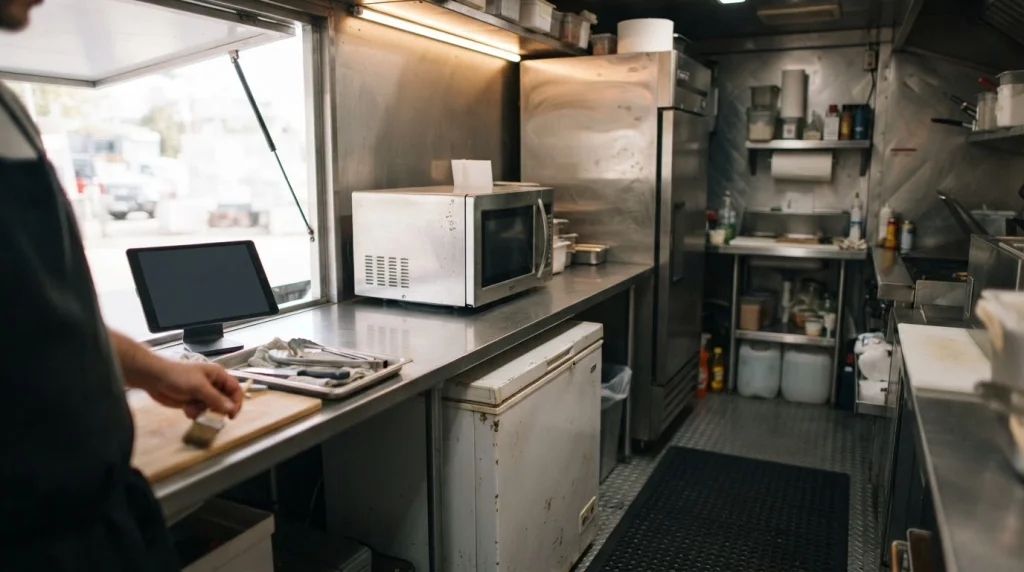
A food truck’s power use depends on its menu, not its size alone. A coffee truck and a fryer-heavy truck can look alike from the outside and draw very different power.
Running watts are the steady watts an appliance uses while it runs. Starting watts, also called surge watts, are the brief extra watts a motor needs to start.
Use the table below as a planning guide only. Always check the label on your own equipment, because models vary widely.
| Food Truck Appliance | Typical Running Watts | Typical Starting Watts |
|---|---|---|
| Commercial refrigerator | 400-800 | 1,200-2,400 |
| Chest freezer | 300-700 | 900-2,100 |
| Electric fryer, single basket | 3,000-5,000 | 3,000-5,000 |
| Electric griddle | 2,000-4,500 | 2,000-4,500 |
| Microwave, commercial | 1,200-1,800 | 1,200-1,800 |
| Espresso machine | 1,200-2,500 | 1,200-2,500 |
| Rooftop AC, 13,500 BTU | 1,200-1,600 | 2,800-3,500 |
| Water heater, small electric | 1,400-1,500 | 1,400-1,500 |
| Lights, fans, POS, and small electronics | 300-700 | 300-700 |
A Simple Food Truck Example
Take a sandwich truck with a fridge at 600 watts, a freezer at 500 watts, lights and POS at 500 watts, and a microwave at 1,500 watts. That adds up to 3,100 running watts before any surge.
Add the largest starting surge once, plus a 20% margin, and you land near 5,500 to 6,000 watts. That is why a 7,000-watt-class inverter often fits this type of truck.
Now add one electric fryer at 4,000 watts. Your total jumps past 9,000 running watts, and a single mid-size inverter will trip.
Section Takeaway: Add up what runs at the same time, not what you own in total, and size for your busiest 15 minutes.
What Size Inverter Generator Do You Need for a Food Truck?
Most food trucks I have helped size land in three clear groups. Your group depends on cooking fuel, cooling load, and whether you run AC all day.
Start with the sizing guide in what size inverter generator do I need, then apply the food truck math below. The same running-watt rules apply, but the loads are larger and more constant.
- Light truck, 3,500-5,000 running watts: Coffee, ice cream, pre-made food, propane cooking, one fridge, and lights.
- Mid-size truck, 5,000-7,500 running watts: Sandwiches, tacos, or burgers with propane cooking, fridge, freezer, AC, and small electric appliances.
- Heavy electric truck, 9,000-12,000+ running watts: Electric fryers, ovens, griddles, water heater, AC, and full refrigeration running together.
How Do You Calculate Food Truck Wattage?
Use this five-step method, and write the numbers down. Guessing from memory is how trucks end up overloaded.
For the full formula, see how do you calculate the generator wattage you need. It covers the same steps in more detail, with appliance examples.
- List every appliance that runs during service, including fridges that cycle on and off.
- Write the running watts from each label or manual.
- Add all running watts together.
- Add the largest starting surge once, usually from the fridge, freezer, or AC.
- Add 20% headroom, then choose a generator with at least that many running watts.
Learn the difference in what is the difference between running watts and starting watts if those terms still feel fuzzy. Running watts are steady power, while starting watts are the short surge at startup.
Section Takeaway: Size for your peak service load plus 20% headroom, and never size from the generator’s surge rating alone.
Inverter Generator vs Conventional Generator for a Food Truck
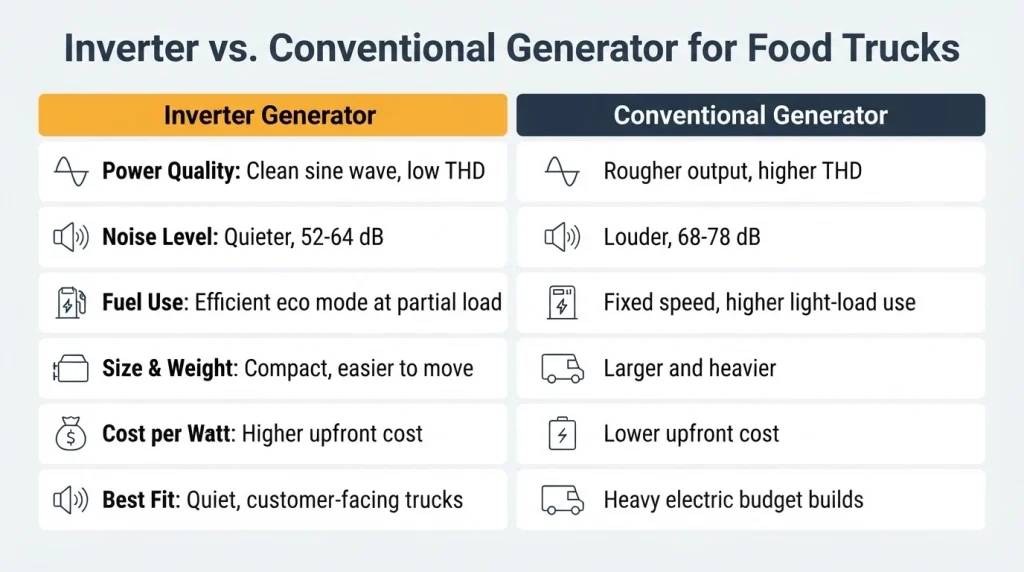
Both types can power a food truck, but they fit different trucks. The right choice depends on power quality, noise, fuel use, and cost.
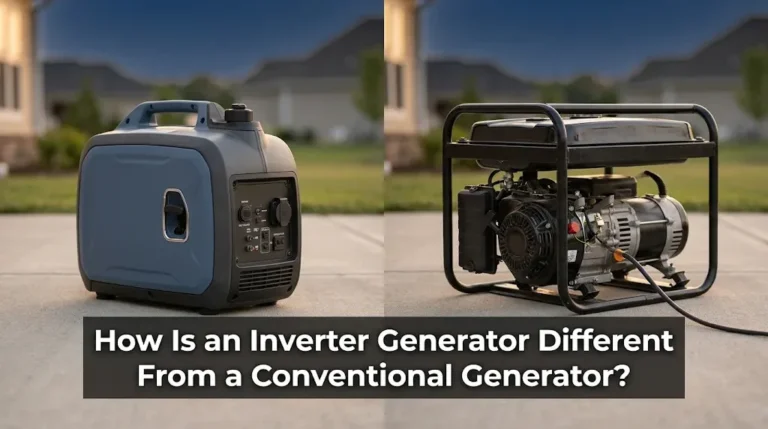
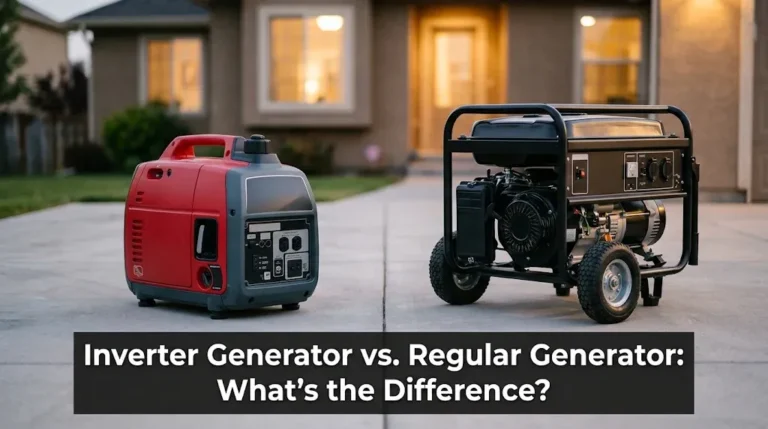
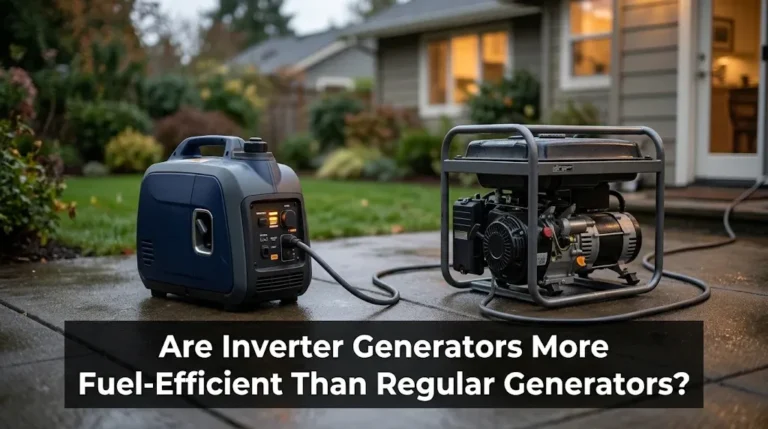
Inverter generators adjust engine speed to match the load. That saves fuel at partial load and keeps noise lower, which helps during long, slow services.
| Feature | Inverter Generator | Conventional Generator |
|---|---|---|
| Power quality | Clean sine wave, low THD, safe for POS and electronics | Rougher output, higher THD on many models |
| Noise | Quieter, often 52-64 dB at rated load | Louder, often 68-78 dB at rated load |
| Fuel use | More efficient at light and mid loads with eco mode | Runs at fixed speed, uses more fuel at light loads |
| Size and weight | Compact for the output, easier to move | Often larger and heavier for the same watts |
| Cost per watt | Higher upfront cost | Lower upfront cost |
| Best fit | Customer-facing trucks, quiet sites, electronics-heavy setups | Heavy electric loads, budget builds, remote sites |
I lean toward an inverter for most food trucks. The quieter sound and cleaner power pay off every day, especially near homes, offices, and outdoor events.
A conventional generator can still make sense for a heavy electric truck on a tight budget. Just protect sensitive electronics with care, and check the spec sheet for THD before you buy.
Section Takeaway: Choose an inverter for quiet, clean power near customers, and a conventional unit only when raw watts per dollar matter more.
Do Food Trucks Need 240V Power?
Some food trucks need 240V power, and some do not. It depends on your largest appliances and how your truck’s panel is wired.
Most small appliances run on 120V. Larger electric fryers, ovens, water heaters, and some AC units may need 240V, often through a 30A or 50A inlet.
Check your truck’s inlet plug and breaker panel first. A 50A inlet usually signals a 120/240V setup, while a 30A inlet is often 120V only.
Many small inverters offer 120V only. Larger inverters, often 5,000 watts and up, may offer a 120/240V outlet, but not every model does.
If your truck needs 240V, confirm it in the spec sheet before you buy. Look for a 240V outlet and the right plug type in best portable generator with 240V outlet options, and match the outlet to your inlet cord.
Safety note: Never use a homemade adapter to force 240V from a 120V-only generator. Have a licensed electrician check your truck’s panel, inlet, and grounding before your first service.
Section Takeaway: Match the generator’s voltage and outlet to your truck’s inlet, and confirm 240V in the spec sheet before you buy.
How Long Will an Inverter Generator Run a Food Truck?
Runtime depends on tank size, load, and eco mode. A food truck at high load will run far shorter than the same generator at 25% load.
Most large inverters list 8 to 12 hours at 25% load. At 75% to 100% load, that can drop to 4 to 7 hours, depending on tank size and engine efficiency.
A 7,000-watt-class inverter with a 5 to 6 gallon tank, for example, may run a mid-size truck for a full lunch service. A heavy fryer truck may need a midday refuel, which is not ideal during a rush.
How to Stretch Runtime During Service
- Pre-cool overnight: Chill fridges and freezers on shore power before service, so the generator does less work.
- Stagger startups: Start the AC first, then add the fridge, then cooking gear, to avoid stacked surges.
- Use propane where you can: Propane cooking cuts electric load and extends generator runtime.
- Turn off idle gear: Switch off the microwave, water heater, or extra lights when they are not in use.
- Carry spare fuel safely: Keep approved fuel cans outside the cooking area, away from heat and customers.
For a sense of what a 7,000-watt unit can carry, read how much power does a 7000 watt inverter generator provide. It helps you see how that size fits a mid-size truck load.
Safety note: Let the generator cool before refueling, and never refuel a hot or running generator near customers or open cooking flames.
Section Takeaway: Plan fuel for your busiest load, not the spec sheet’s 25% runtime, and pre-cool on shore power when you can.
Noise, Placement, and Health-Code Rules for Food Trucks
Noise is a business issue, not just a comfort issue. A loud generator can push customers away and break event rules.
Inverter generators are usually quieter than open-frame models, often by 10 dB or more at the same load. That difference is easy to hear at a serving window.
Place the generator downwind, away from the serving window, and away from seating. Keep the exhaust pointed away from customers, staff, and nearby buildings.
What About Permits and Health Codes?
Rules vary by city, county, and event site. Some sites limit generator noise, fuel storage, or generator placement near food service areas.
Check your local health department and event organizer before you book a spot. Ask about generator hours, noise limits, and whether shore power is available.
Carbon monoxide safety is non-negotiable. The CDC warns that generators must run outdoors, far from windows, doors, and vents, and the CPSC shares generator safety guidance for the same reason.
Safety note: Run the generator outdoors only, at least 20 feet from the truck and any occupied space, with exhaust pointed away. Install a working CO alarm inside the truck and check it before every service.
Section Takeaway: Put the generator downwind and outdoors, keep exhaust away from people, and confirm local noise and permit rules before you serve.
How to Hook Up an Inverter Generator to a Food Truck Safely
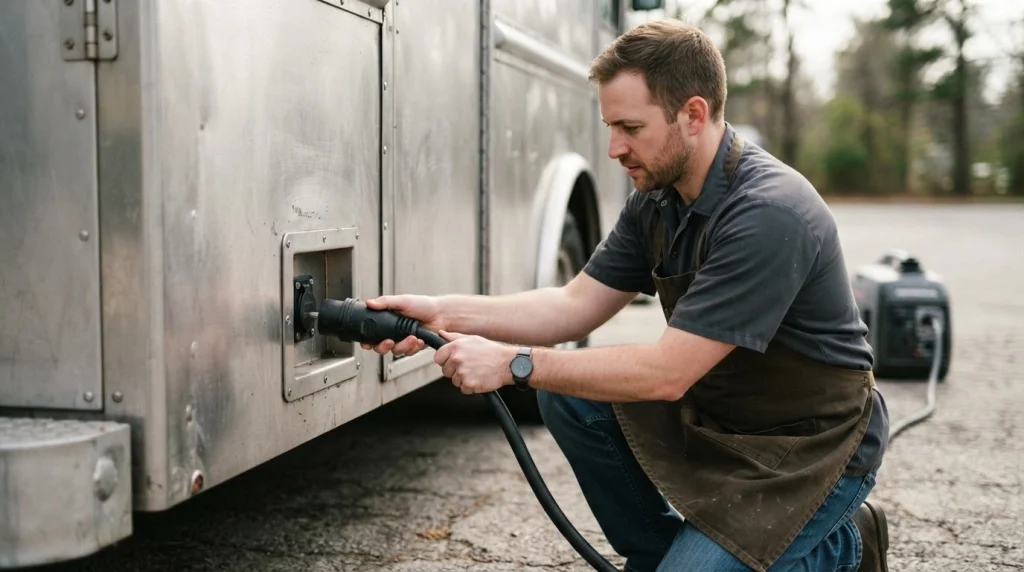
A safe hookup starts before you plug anything in. Check the cord, the inlet, and the generator’s grounding needs in the owner’s manual.
Most food trucks use a shore-power inlet cord, often 30A or 50A. Use a heavy-duty cord rated for your inlet, with no damage, cuts, or melted plugs.
- Place the generator outdoors, level, and at least 20 feet from the truck.
- Check oil and fuel, then start the generator with no load.
- Plug the shore cord into the truck inlet first, then into the generator.
- Switch the truck panel to generator power, if it has a selector switch.
- Turn on loads one at a time, starting with the largest motor load.
- Watch the generator display for overload warnings during the first 10 minutes.
Do not use a standard household extension cord for a whole truck. It can overheat, drop voltage, and trip the generator under load.
For job-site and outdoor power safety, OSHA guidance covers safe generator use, grounding, and cord care. The U.S. Department of Energy also shares general guidance on safe portable generator use.
Safety note: Never backfeed power through a household outlet, and never plug a generator directly into a building outlet. Use the truck’s proper inlet and a transfer or selector switch installed by a licensed electrician.
Section Takeaway: Use the right shore cord and inlet, start loads one at a time, and never backfeed power.
One Large Inverter vs Two in Parallel: Which Setup Is Better?
Two smaller inverters in parallel can match one large inverter. Parallel capability lets you link two compatible units with a parallel kit to add their watts together.
A single large inverter is simpler to run and refuel. You have one engine, one tank, and one cord to manage during a busy service.
A parallel pair is more flexible. You can run one unit on a slow day and add the second unit for a festival or a fryer-heavy menu.
A parallel pair also gives you a backup. If one unit fails, the other can still run fridges and lights while you sort out a fix.
The downside is weight, cost, and setup time. Two units, two fuel tanks, and a parallel kit take more space and more steps at setup.
Check the EPA for emissions and fuel guidance when comparing models, and always use the manufacturer’s own parallel kit. Mixing brands or using a generic kit can damage the units.
Section Takeaway: Pick one large inverter for simplicity, and a parallel pair for flexibility and backup on variable menus.
Frequently Asked Questions
Can a 2000-watt inverter generator power a food truck?
No, a 2,000-watt inverter is too small for most food trucks. It may run lights and a small fridge alone, but it will trip once you add a freezer, AC, or cooking gear.
What size inverter generator is best for a food truck?
Most trucks need 5,000 to 9,000 running watts. Light propane-cooking trucks can use less, while heavy electric trucks may need 9,000 watts or more, or two units in parallel.
Can an inverter generator run a food truck fryer?
Yes, if the generator has enough running watts for the fryer plus your other loads. A single electric fryer can draw 3,000 to 5,000 watts, so propane fryers are often a smarter choice for smaller trucks.
Is an inverter generator quiet enough for a food truck?
Yes, most large inverters are quiet enough for customer-facing service. They are usually much quieter than open-frame generators, but still place the unit downwind and away from the serving window.
Can I use a dual fuel inverter generator for a food truck?
Yes, a dual fuel inverter can run on gasoline or propane. Propane burns cleaner and stores longer, but it usually gives slightly less power than gasoline, so check both ratings.
How do I keep food cold if the generator stops?
Keep fridge and freezer doors closed, and do not open them to check. Pre-cool on shore power, carry a backup plan for fuel and overloads, and check food temperatures before you serve again.
Yes, an inverter generator can power a food truck, and the best trucks treat power like a menu item. Size it right, test it under a full load, and keep it quiet, fueled, and safely placed.
Do the wattage math this week, before your next event. Your future self, standing in a long lunch line with everything running, will be glad you did.

Hi, I’m Michael Turner. I own a generator workshop in the United States and founded HomeGeneratorBlog to share practical, hands-on guidance about generator installation, maintenance, troubleshooting, safety, and backup power solutions. My goal is to help homeowners make smarter, more confident decisions through clear and reliable information