How Does Inverter Generator Parallel Operation Work? Sync 2 Units, Double Watts & Power an RV AC
Quick Answer
How does inverter generator parallel operation work? A parallel kit links two inverter generators so their electronics sync voltage, frequency, and phase, then share one load as a single source — which is why you can run multiple appliances at once without buying a bigger, heavier unit.
How Parallel Operation Works in 30 Seconds
- Sync first: The inverter boards match 120V, 60Hz, and waveform phase before sharing power.
- Kit connects: Parallel cables join the parallel ports, plus a ground wire between both frames.
- Load shares: Both engines carry the load together, not one unit doing all the work.
- Power adds: Two 2,000W running units give about 4,000W running in parallel, minus a small loss.
- One outlet: You plug into the kit, often a 30-amp RV or L5-30 outlet, not into one generator alone.
Before You Try It
- Use only parallel-capable models and the kit made for them, and check your owner’s manual first.
I’ve paired two small inverters at a campground when one alone would not start the AC. That first click, when both units settled into the same hum, taught me more than any spec sheet.
This guide explains the sync process in plain language. You’ll see the steps, the kit, the limits, and the mistakes that trip people up.
In This Guide
- What Is Inverter Generator Parallel Operation?
- How Does the Synchronization Actually Work?
- What Does a Parallel Kit Do?
- How Much Power Do You Really Get in Parallel?
- How Do You Connect Two Inverter Generators Step by Step?
- Can You Parallel Different Brands or Sizes?
- Parallel Pair vs. One Bigger Generator: Which Is Better?
- What Mistakes and Safety Risks Should You Avoid?
- Frequently Asked Questions
What Is Inverter Generator Parallel Operation?
Parallel operation means two inverter generators work as one power source. Their outputs combine into a single feed for your RV, tools, or home essentials.
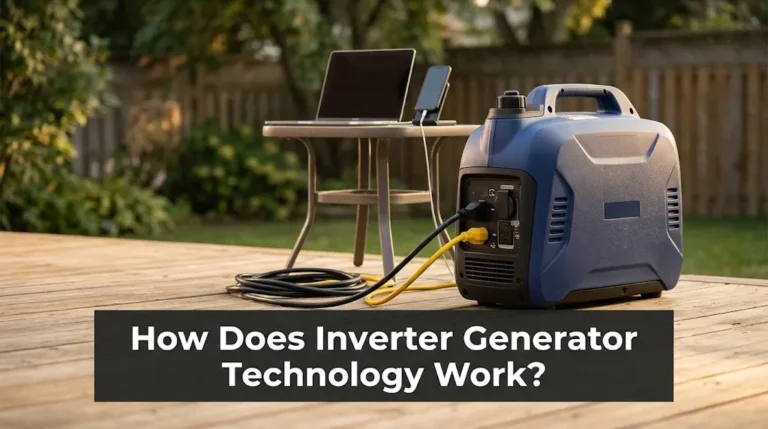
An inverter generator is a generator that makes raw AC, converts it to DC, then inverts it back to clean AC. That electronic step is what makes paralleling possible.
A conventional generator cannot do this safely. Its output is tied directly to engine speed, so two units drift out of sync.
- Parallel-capable: The model has parallel ports and sync electronics built in.
- Not just jumper cables: You never tie two standard outlets together with a homemade cord.
- Designed system: The kit, ports, and control boards work as one system.
I learned that distinction the hard way early on. A friend wanted to use a suicide cord between two old open-frame units, and we stopped before anyone plugged it in.
Section Takeaway: Parallel operation is a built-in electronic feature, not a wiring trick. If the ports and kit are not on the unit, it is not parallel-capable.
How Does the Synchronization Actually Work?

Synchronization means both inverters agree on voltage, frequency, and phase at the same instant. When they agree, their sine waves line up and add together cleanly.
That process builds on how inverter generator technology works inside each unit. The board constantly samples the output and adjusts.
What has to match?
- Voltage: Both units target the same 120V output.
- Frequency: Both units target 60Hz in North America.
- Phase: The peaks and zero-crossings of each sine wave line up.
- Waveform: Both produce a pure sine wave with low total harmonic distortion.
When you connect the parallel cables, the boards talk through them. One unit effectively follows the other’s timing signal.
This is also why inverters convert AC to DC and back to AC in the first place. The DC stage frees the output from raw engine speed.
What happens when a big load starts?
A motor start pulls a short surge of watts. Both boards sense the dip and raise engine speed together.
Load sharing keeps one unit from overloading first. The kit splits current draw across both inverters.
As of 2026, most major brands use this same basic approach. The cables and port shapes differ, but the sync idea does not.
Section Takeaway: The inverter boards, not the engines alone, lock voltage, frequency, and phase together. That lock lets two small sine waves become one larger, clean output.
What Does a Parallel Kit Do?
A parallel kit is the bridge between the two generators and your load. It carries the sync signal, combines the outputs, and gives you a higher-amp outlet.
Some kits are a simple cable set with plugs built in. Others are a small box with an RV TT-30, L5-30, or standard outlet on the front.
- Parallel cables: Connect to the parallel ports on each generator.
- Ground wire: Links both frames so they share a ground reference.
- Combined outlet: Delivers the joined power in one place.
- Breaker protection: Many kit boxes add a circuit breaker for the combined outlet.
Do not plug your main load into one generator while paralleled. Use the kit outlet, as the manual directs.
I keep my kit in the same bin as the RV cord. That habit stops me from arriving at a site with two generators and no way to join them.
For broader safety guidance on portable generators, the U.S. Consumer Product Safety Commission covers carbon monoxide and placement risks. The U.S. Department of Energy also publishes general home energy and backup power guidance.
How Much Power Do You Really Get in Parallel?
You get close to the sum of both running watts, not quite double the starting watts forever. Running watts are what matters for a load that stays on.
Check each unit’s spec sheet for running and starting watts. Then add the running figures and allow a small margin.
| Pair Example | Single Running | Parallel Running* | Typical Use |
|---|---|---|---|
| 2 x 2,000W units | 2,000W | About 3,600-4,000W | RV AC plus fridge and lights |
| 2 x 2,500W units | 2,500W | About 4,500-5,000W | Larger RV, microwave in turns |
| 1 x 2,000W + 1 x 3,000W | Mixed | About 4,500-5,000W if brand allows | Only if manual confirms mixing |
| Two units, 240V kit | 120V each | 240V only with specific kit/models | Select household circuits |
*Exact combined output varies by brand and kit. Always use the kit rating and your owner’s manual, not this chart alone.
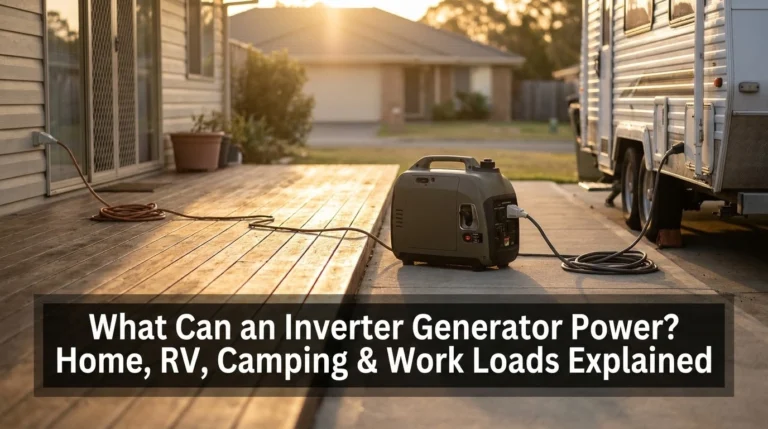
That math explains the classic RV case. One 2,000W unit struggles with a 13,500 BTU AC, but a paired set handles the start and the run.
If AC sizing is your main goal, see what size inverter generator can run an RV air conditioner for BTU-by-BTU numbers. It pairs well with this guide.
Section Takeaway: Add running watts, keep a 20% headroom for surges, and trust the kit rating over hopeful math. Parallel power is real, but it is not magic.
How Do You Connect Two Inverter Generators Step by Step?
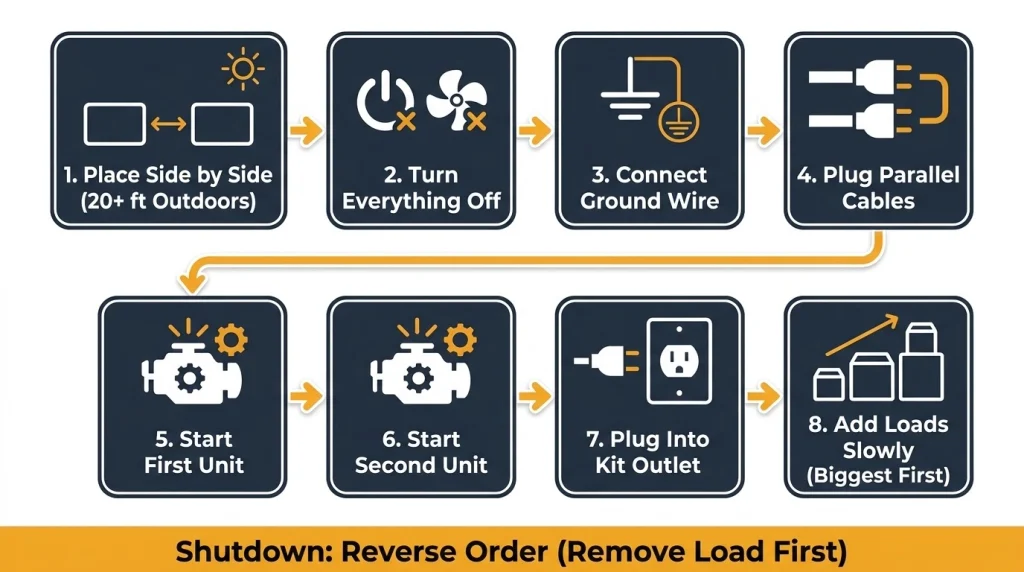
Connect the kit while both generators are off, then start them in the order the manual states. Never connect or disconnect parallel cables under load.
Safety note: Run both generators outdoors, at least 20 feet from doors and windows, with exhaust pointing away. Never run them in a garage, and let them cool before refueling.
- Place side by side: Set both on flat, dry ground with space for airflow.
- Turn everything off: Engines off, Eco mode as manual directs, and no loads plugged in.
- Connect ground wire: Join the ground terminals on both frames first.
- Plug parallel cables: Push each cable firmly into its parallel port and into the kit.
- Start first unit: Start one generator and let it stabilize for a minute.
- Start second unit: Start the second generator and let both settle.
- Plug into kit: Connect your RV or load to the kit outlet only.
- Add loads slowly: Turn on the biggest load first, then add smaller loads one by one.
Shut down in reverse. Remove the load, turn off both engines, then unplug the parallel cables.
I always do a short test at home first. Running the AC for ten minutes in the driveway beats troubleshooting at a dark campsite.
Section Takeaway: Kit first, engines second, load last — and reverse that order at shutdown. That sequence protects the boards and your appliances.
Can You Parallel Different Brands or Sizes?
Sometimes you can parallel different sizes from the same brand. Mixing brands is rarely supported, even if the plugs look similar.
The sync signal is not a universal standard. Each brand uses its own port wiring and communication method.
- Same brand, same family: Most likely to work, and most manuals list approved pairings.
- Same brand, different watts: Often allowed, with output limited as the manual states.
- Different brands: Do not assume it works — check both manuals, and expect a no.
- Conventional + inverter: Never parallel these together.
If you are still shopping, choosing from the best inverter generators with clear parallel support saves headaches later. Buy the kit from the same brand at the same time.
Keep both manuals together. The pairing chart in one book may differ from the other.
Parallel Pair vs. One Bigger Generator: Which Is Better?

A parallel pair gives flexibility, while one bigger unit gives simplicity. Your lifting, storage, and usual load decide which fits better.
| Factor | Two in Parallel | One Bigger Unit |
|---|---|---|
| Weight to lift | Two lighter lifts, one at a time | One heavy lift |
| Flexibility | Run one for small loads, both for big loads | Always run the full unit |
| Fuel and noise | One unit in Eco is quiet and sips fuel | Bigger engine may use more at light load |
| Maintenance | Two oil changes, two filters | One engine to maintain |
| 240V access | Only with specific 240V parallel models/kits | More models offer 240V directly |
That 240V point matters for home backup. Read whether an inverter generator can provide 240V power before you count on a pair for a well pump or dryer.
For camping, I prefer the pair. For a fixed home setup with a transfer switch, I often prefer one larger unit.
The Consumer Reports generator guidance is a useful second check on sizing. It stresses buying for your actual loads, not the biggest number on the box.
Section Takeaway: Choose a pair for portability and flexible, quiet power. Choose one bigger unit for simplicity and easier 240V access.
What Mistakes and Safety Risks Should You Avoid?
Most parallel problems come from the wrong kit, a loose cable, or overloading the combined outlet. Those are all preventable with a slow setup.
Safety note: Carbon monoxide is odorless and deadly. Keep both generators outside and far from openings, and use a battery CO alarm inside your RV or home, as the EPA and safety agencies advise for indoor air risks.
- Wrong kit: A kit for another brand may fit loosely and sync poorly.
- Connecting under load: Plugging parallel cables in while running can damage the boards.
- Skipping ground: The frame ground wire is part of the system, not optional.
- Overloading one outlet: The kit outlet has a limit, even if total watts look higher.
- Uneven fuel: One unit running dry drops the pair under load.
- Backfeeding: Never plug a generator into a house outlet — use a transfer switch or extension cords properly.
Check fuel in both tanks before a long run. I top both off together, even if one looks half full.
If one unit faults or shuts down, remove the load right away. The remaining unit cannot carry the full parallel load alone.
Section Takeaway: Use the right kit, connect while off, ground both frames, and watch fuel in both tanks. Those four habits prevent most parallel failures I see.
Frequently Asked Questions
Do you need a parallel kit, or can you just use cables?
You need the proper parallel kit for your models. It does sync, combining, and outlet protection in one system, and homemade cords that join outlets are dangerous and can destroy both inverters.
Can you run only one generator after they are paralleled?
Yes, you can shut down, disconnect the kit, and run one unit alone for small loads. That flexibility is a main reason people choose a pair for camping and light home backup.
Does parallel operation double starting watts too?
It raises surge capacity close to the combined total, but running watts are the safer number to plan on. Motor starts are brief, so size for the running load and keep surge headroom.
Will paralleling give you 240 volts?
Not by default, because most small inverters are 120V only in parallel. Only specific models with a dedicated 240V parallel kit provide 240V, so check the manual before you buy.
Can you parallel two different size inverter generators?
Many brands allow different sizes within the same family, such as a 2,000W and a 3,000W unit. Total output and sharing follow that brand’s chart, not a simple full addition in every case.
What happens if one generator runs out of fuel in parallel?
The other unit will try to carry the load and will likely overload or shut down. Remove the load quickly, refuel the empty unit after it cools, and restart using the full sequence.
Is parallel power still clean power for electronics?
Yes, if both units are pure sine wave inverters and are properly synced. The combined output keeps low distortion, so laptops, TVs, and CPAP machines run as they would on one inverter.
Parallel operation changed how I pack for trips. I bring one unit for quiet evenings and both for hot afternoons with AC.
Start with your manual’s approved pairing and kit, do a driveway test, and size by running watts. That simple plan gives you double power without double weight.

Hi, I’m Michael Turner. I own a generator workshop in the United States and founded HomeGeneratorBlog to share practical, hands-on guidance about generator installation, maintenance, troubleshooting, safety, and backup power solutions. My goal is to help homeowners make smarter, more confident decisions through clear and reliable information