Firman Tri Fuel Portable Generator 9400w Review: Is It Worth Buying?
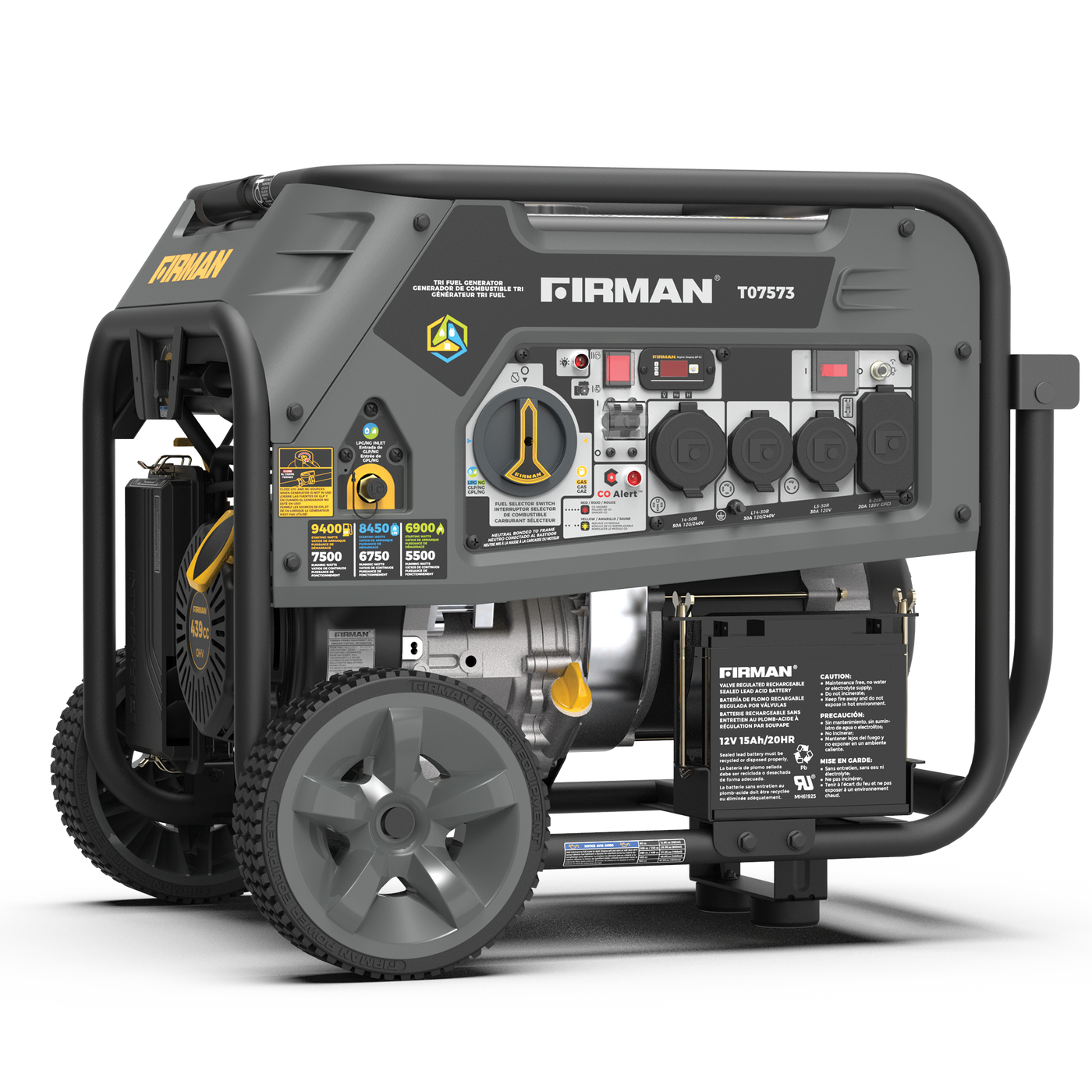
The FIRMAN T07573 9400W tri-fuel portable generator is an open-frame, 120/240V generator that operates on gasoline, propane, or natural gas.
It is built for emergency household backup and demanding outdoor work where fuel flexibility matters. This FIRMAN tri fuel portable generator 9400W review examines its published specifications, practical limitations, and suitability for real backup-power plans.
🏆 My Quick Verdict
💡 Best For: Homeowners planning selected-circuit backup with access to more than one fuel source.
⚡ Key Specs:
9,400 starting/7,500 running watts on gasoline; 439cc engine; electric and recoil start; CO Alert; 120/240V.
✅ Bottom Line: Three fuel options make this a versatile outage companion. However, its 211-pound weight and lower natural-gas output make load planning essential.
FIRMAN T07573 at a Glance
- Gasoline provides the highest published power output.
- Propane and natural gas expand fuel availability during outages.
- Electric start is backed up by a recoil starter.
- CO Alert and low-oil shutdown add protective features.
- The 8-gallon gasoline tank supports extended operation.
- Professional transfer equipment is necessary for home-circuit connections.
FIRMAN T07573 Specifications
The following figures come from FIRMAN’s published information for the T07573 model.
| Specification | Verified details |
|---|---|
| Fuel types | Gasoline, propane (LPG), natural gas (NG) |
| Gasoline output | 9,400 starting / 7,500 running watts |
| Propane output | 8,450 starting / 6,750 running watts |
| Natural-gas output | 6,900 starting / 5,500 running watts |
| Engine / voltage | 439cc / 120–240V |
| Gasoline tank | 8 US gallons |
| Published runtime | Up to 12 hours at 50% load |
| Weight / noise | 211 lb / 74 dB at quarter load |
| Warranty listing | 3 years for new generators; check terms |
Design & Build Quality
The T07573 prioritizes service access and durability over compact packaging. Its open frame exposes the engine, fuel connections, and outlets for inspection.
FIRMAN specifies a 439cc engine with a cast-iron sleeve. That construction suits a substantial utility generator, although routine maintenance remains necessary.
At 211 pounds, this is not a lift-and-carry camping machine. Plan a level storage location and a clear route to your outdoor operating area.
- The manufacturer lists a 74 dB sound level at quarter load, so nearby conversations may be affected.
- Covered receptacles help protect connections when the unit is stored correctly.
Setup, Installation & Ease of Use
- Unbox the unit and confirm that the listed accessories and manual are present.
- Fit the wheel and handle hardware as directed in the manual.
- Add the specified engine oil before the first start.
- Position the generator on firm, level ground outdoors.
- Keep it at least 20 feet from doors, windows, and vents.
- Connect only the approved hose and regulator for the selected fuel.
- Have a qualified professional verify natural-gas supply and connection suitability.
- Use a properly installed transfer switch or interlock for home wiring.
- Disconnect loads before shutdown and allow the engine to cool before storage.
Core Performance & Feature Breakdown
The T07573’s useful capacity depends on which fuel you choose. Its advertised 9,400W figure describes starting surge on gasoline, not sustained output.
Gasoline: Maximum Rated Output
Gasoline provides 7,500 continuous watts with 9,400 watts available for starting surges. That offers room for several essential circuits when appliance demand is properly calculated.
The manufacturer’s up-to-12-hour figure applies at half load, not every loading condition. Actual runtime varies with demand, conditions, and maintenance.
Propane: A Practical Stored-Fuel Option
Propane delivers 6,750 running watts and 8,450 starting watts. It can simplify emergency fuel planning when cylinders are stored and handled correctly.
Available runtime depends on cylinder size and electrical load. Confirm regulator compatibility rather than improvising fittings or adapters.
Natural Gas: Convenient but Lower Capacity
Natural gas offers 5,500 running watts and 6,900 starting watts. That is considerably less continuous capacity than gasoline provides.
A residential gas connection still requires sufficient pressure, flow, and professional verification. Never assume an existing outdoor gas connection can supply this generator.
Expert Insight
Size your backup system against 5,500 running watts if natural gas will be your primary fuel. Add appliance starting surges separately, and use a portable generator wattage guide to prioritize loads.
Key Features Explained
Three Selectable Fuel Types
Tri-fuel operation lets owners prepare more than one potential energy source. It improves flexibility, but switching fuels still requires the manufacturer-approved procedure.
Electric Start with Recoil Backup
Electric starting makes repeated outage deployment easier. A recoil starter provides another starting method, provided the engine and fuel system are ready.
CO Alert and Low-Oil Shutdown
CO Alert can stop operation when dangerous carbon monoxide accumulates near the generator. It does not make enclosed or near-house operation safe.
Multiple 120V and 240V Outlets
The control panel includes household-style and locking receptacles plus a 120/240V 50A-format outlet. A receptacle’s physical rating does not increase the generator’s actual power output.
Real-World Usability & Maintenance
Ownership requires regular oil changes, filter checks, spark-plug inspection, and periodic exercise. Follow the T07573 maintenance schedule rather than estimating service intervals.
Run test loads before storm season and practice the approved changeover sequence. Keep suitable outdoor cords and a documented load plan together.
Store the cooled unit dry and follow the manual’s fuel-storage instructions. Our generator fuel-safety guide explains common storage and refueling hazards.
Pros & Cons
Pros
- Three supported fuels improve contingency planning during prolonged outages.
- 120/240V output supports appropriately designed home backup connections.
- Electric and recoil starters provide convenient starting options.
- CO Alert and low-oil protection address important operating hazards.
Cons
- Natural-gas running output falls to 5,500 watts.
- Its 211-pound weight complicates movement and storage.
- The open-frame engine is relatively loud for quiet residential settings.
Common Issues & Fixes
Engine Will Not Start
An engine may fail to start when fuel selection, oil level, or startup procedure is incorrect. Check the manual’s troubleshooting steps and verify the selected fuel supply.
Breaker Trips Under Load
Too many simultaneous appliances or motor starting surges can overload the generator. Disconnect loads, reset only as directed, and restart appliances in stages.
Natural-Gas Performance Seems Weak
Owners sometimes plan around gasoline power figures while operating on natural gas. Recalculate against 5,500 running watts and ask a qualified technician to verify supply capacity.
What to Know Before You Buy
The most important purchase check is your household’s required continuous and starting wattage. Prioritize refrigerators, pumps, heating-system controls, and necessary lighting rather than assuming whole-house coverage.
A 50A-format outlet does not mean the generator supplies 12,000 watts. Its published gasoline continuous output is 7,500 watts, and an electrician must match the connection system accordingly.
Household wiring requires approved transfer equipment that isolates utility power. Review our portable generator transfer-switch guide before scheduling installation.
Choose a site that stays safely ventilated and protected from wet electrical conditions. This outdoor generator placement guide covers separation and positioning.
Who Should Buy It / Who Should Skip It
✅ Who Should Buy It
- Homeowners seeking selected-circuit emergency power.
- Properties with an approved natural-gas connection.
- Users wanting gasoline and propane as alternative fuels.
✗ Who Should Skip It
- Buyers needing quiet campsite or apartment-compatible equipment.
- Households demanding more than 5,500 running watts on natural gas.
- Anyone unable to arrange safe outdoor operation.
Alternatives to Consider
Westinghouse WGen9500TFc
Best For: Households needing higher output.
Main Advantage: More running power on all three fuels.
Trade-off: Its larger capability may exceed your actual needs.
Key Spec: 9,500W gasoline / 7,500W natural-gas running output.
Champion 100416 Tri-Fuel
Best For: Users prioritizing higher natural-gas output.
Main Advantage: 7,000W continuous natural-gas rating.
Trade-off: Confirm its dimensions, handling, and price against your space.
Key Spec: 8,000W gasoline / 7,000W natural-gas running output.
Is the FIRMAN T07573 Worth It?
The T07573 is worth considering when multiple fuel choices have practical value for your property. Its strongest case is a prepared household with realistic essential-load expectations.
Compare the total cost of safe electrical installation, gas-line work, and maintenance—not just the generator’s purchase price. A simpler dual-fuel machine may be sufficient if natural gas is unavailable.
Final Verdict
The FIRMAN T07573 is a capable tri-fuel backup generator for carefully selected loads. Buy it for adaptable fuel planning, not the assumption that 9,400 peak watts can run an entire home continuously.
Frequently Asked Questions
Can the FIRMAN T07573 power a whole house?
Not necessarily; it depends on simultaneous household demand. Select essential circuits using the fuel-specific wattage rating and a qualified electrician.
Can it run directly from a natural-gas line?
Yes, with a suitable professionally verified supply connection. Gas pressure, line capacity, approved hoses, and applicable rules must all be satisfied.
What size transfer switch does it need?
Use transfer equipment matched to the actual generator connection and installation. A licensed electrician should verify the inlet, wiring, protection, and neutral arrangement.
What warranty does the T07573 include?
FIRMAN’s product text lists a three-year warranty for new generators. Check the current written terms, registration requirements, and seller conditions before purchase.
How should I maintain this tri-fuel generator?
Follow the T07573 manual’s oil, filter, spark-plug, and inspection intervals. Run periodic operational checks and never service a hot engine.
Can it operate inside a garage with the door open?
No, never operate this generator in a garage or other enclosed space. Keep it outdoors at least 20 feet from openings, point exhaust away, and maintain indoor carbon-monoxide alarms.
Affiliate disclosure: HomeGeneratorBlog earns a small commission when you purchase through links on this page — at no extra cost to you. Our editorial process is independent: affiliate relationships never influence which products we recommend or how we rank them.

Hi, I’m Michael Turner. I own a generator workshop in the United States and founded HomeGeneratorBlog to share practical, hands-on guidance about generator installation, maintenance, troubleshooting, safety, and backup power solutions. My goal is to help homeowners make smarter, more confident decisions through clear and reliable information