What Is the Quietest Home Generator? 2026 Guide
Quick Answer
The quietest gasoline generators are small inverter models, but the best quiet generator for home backup depends on how much power you need. The Honda EU2200i runs at about 48–57 dBA, while the larger Honda EU7000iS produces about 52–58 dBA and offers far more useful home-backup capacity. If low noise is your priority, start with an inverter portable generator rather than a conventional open-frame model.
Quietest options at a glance
- Quietest overall: Honda EU1000i, about 42–50 dBA, but only 900 rated watts.
- Quiet small backup: Honda EU2200i, about 48–57 dBA with 1,800 rated watts.
- Best home balance: Honda EU7000iS, about 52–58 dBA with 5,500 rated watts.
- Budget alternative: Champion 4500W inverter, rated around 61 dBA from 23 feet.
- Whole-house standby: Expect more noise because these units produce much more power.
My practical pick
- For several essential household circuits without the noise of a typical open-frame generator, I would start my comparison with the Honda EU7000iS.
Generator noise becomes a much bigger issue when an outage lasts all night. A machine that seems acceptable for ten minutes can become irritating after several hours.
I look at noise and usable wattage together. The lowest decibel number means little if the generator cannot start the appliances you need.
What Is Considered a Quiet Home Generator?
A quiet home generator is generally an enclosed inverter generator designed to reduce engine speed and sound when electrical demand drops. Many quiet inverter models operate somewhere in the 50-to-low-60-dBA range under lighter operating conditions.
Definition: A decibel, written dB or dBA, measures sound intensity. The dBA scale adjusts the measurement to better represent how human hearing responds to different frequencies.
- Around 40–50 dBA: Exceptionally quiet for a gasoline generator.
- Around 50–60 dBA: A strong target for residential inverter-generator use.
- Around 60–70 dBA: Common territory for larger portable and standby generators.
- Above 70 dBA: Usually more noticeable around neighboring homes and outdoor living areas.
Noise specifications aren’t perfectly interchangeable. Manufacturers can measure sound at different distances, loads, and operating conditions.
That is why I compare both the published decibel figure and the testing condition whenever possible.
What Is the Quietest Gas Generator You Can Buy?
Among Honda’s current Super Quiet lineup, the EU1000i reaches the lowest published figures at approximately 42 dBA at one-quarter load and 50 dBA at rated load. Its limitation is power: Honda rates it for only 900 continuous watts.
The Honda EU2200i is more useful for emergency essentials. Honda rates it at 1,800 running watts and 2,200 maximum watts, with a published noise range of 48–57 dBA.
| Generator | Running watts | Published noise | Best use |
|---|---|---|---|
| Honda EU1000i | 900W | 42–50 dBA | Small electronics and light loads |
| Honda EU2200i | 1,800W | 48–57 dBA | Refrigerator, lights and electronics |
| Honda EU3000iS | 2,800W | 50–57 dBA | Larger essential-load setup |
| Honda EU7000iS | 5,500W | 52–58 dBA | Serious home essentials |
| Champion 4500W Inverter | 3,500W | 61 dBA | Budget home and RV backup |
| Generac Guardian 26kW | Up to 26,000W on LP | 67 dBA at normal load | Automatic whole-house backup |
For pure noise level, the EU1000i wins this comparison. For useful emergency capacity, however, I would move higher in the range.
What Is the Quietest Generator That Can Run a House?
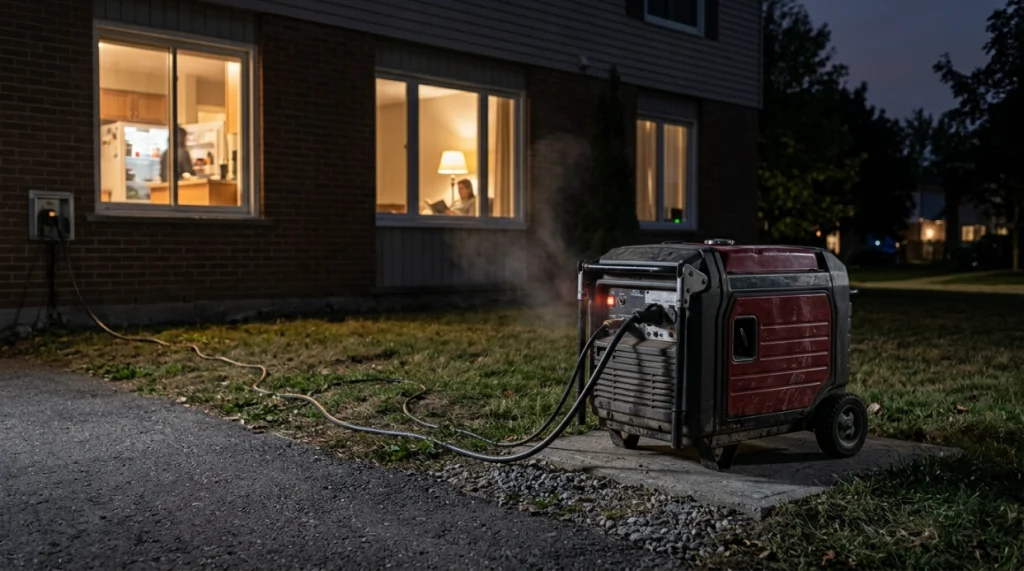
For practical home backup, the Honda EU7000iS is one of the strongest quiet-generator choices I would consider. Honda lists 5,500 rated watts, 7,000 maximum watts, 120/240V output, and noise of 52 dBA at one-quarter load to 58 dBA at rated load.
You can confirm the current figures in Honda’s EU7000iS specifications. Its enclosed inverter design and load-dependent engine speed help explain why it stays comparatively quiet despite its larger output.
It still isn’t a true unlimited whole-house generator. Five thousand five hundred running watts calls for selective load management in many houses.
- Refrigerator or freezer
- Gas-furnace blower
- Sump pump
- Selected lighting circuits
- Internet equipment
- Television and chargers
- Some smaller air-conditioning loads when properly sized
If those are your priorities, this power class makes sense. If you want central air, electric water heating, electric cooking, and nearly every circuit available, you’ll need considerably more capacity.
My home generator sizing guide explains why your appliance load matters more than square footage.
Is 5,500 running watts enough for home backup?
It can be enough for a carefully managed essential-circuit system. It usually isn’t enough to operate a modern all-electric house as though the utility were still connected.
A useful way to think about it is to separate survival loads from convenience loads.
- Survival loads: Refrigeration, heating blower, water or sump pumps, lights, communication, and necessary medical equipment.
- Convenience loads: Large central AC, electric dryers, electric ovens, multiple high-draw appliances, and electric water heaters.
If you’re considering this power range, my breakdown of what a 5,000W generator can run in a house provides a useful comparison.
Why Are Inverter Generators So Much Quieter?
Inverter generators can reduce engine speed when the electrical load falls. Conventional generators commonly operate much closer to a fixed engine speed regardless of whether you’re using a little power or a lot.
That variable-speed behavior is important during an overnight outage. A refrigerator, router, furnace blower, and several LED lights may require far less power than the generator’s maximum capacity.
- Enclosed body: Panels help contain mechanical and exhaust noise.
- Variable engine speed: The engine can slow when demand drops.
- Improved muffling: Quiet models use exhaust systems designed around sound reduction.
- Lower vibration: Better isolation prevents the frame and surrounding surfaces from amplifying noise.
- Smaller engines: Low-output inverter units can use smaller engines than large conventional generators.
This is also why you should compare generators at similar electrical output. A 900-watt inverter naturally has an easier noise-control job than a 20,000-watt standby unit.
Are Standby Generators Quiet?
Standby generators are often quieter than large open-frame portable generators, but they generally aren’t as quiet as small enclosed inverters. Their advantage is automatic operation and much higher power output.
For example, Generac publishes 67 dBA at 23 feet under normal load for its 26kW Guardian model. Its low-speed exercise mode is rated at 57 dBA.
Those numbers illustrate the tradeoff. The generator can supply dramatically more power than a small inverter, but moving that much energy requires a larger engine.
| Priority | Best generator type | Main tradeoff |
|---|---|---|
| Lowest possible engine noise | Small inverter | Limited wattage |
| Quiet home essentials | Large inverter | Higher purchase price |
| Maximum automatic coverage | Standby generator | More noise and installation |
How Can You Make a Home Generator Quieter?
You can reduce how noticeable a generator sounds without blocking its cooling airflow or exhaust. Safe placement matters more than improvised soundproofing.
- Start with a quiet generator. Reducing 75 dBA after purchase is harder than buying a 55–60-dBA machine in the first place.
- Keep it away from reflecting surfaces. Hard walls can bounce sound back toward the house.
- Use approved vibration isolation. A stable surface helps prevent rattling and vibration amplification.
- Keep the generator maintained. Loose panels, worn mounts, and exhaust problems can increase noise.
- Reduce unnecessary electrical load. An inverter generator can often slow down when fewer appliances are connected.
Never build a sealed homemade box around a gasoline generator. The engine needs cooling airflow, and the exhaust contains deadly carbon monoxide.
How Far Should a Generator Be From the House?
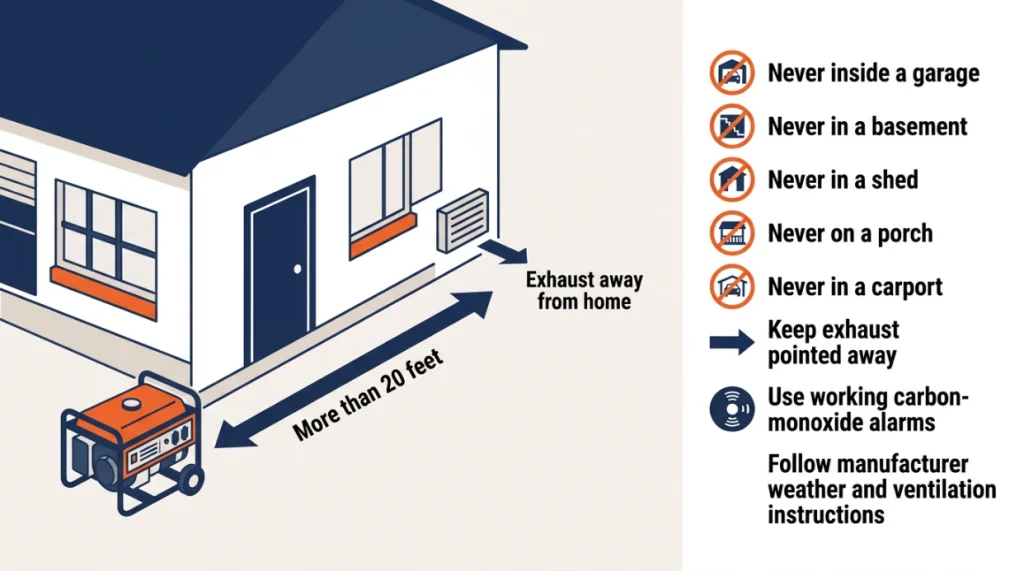
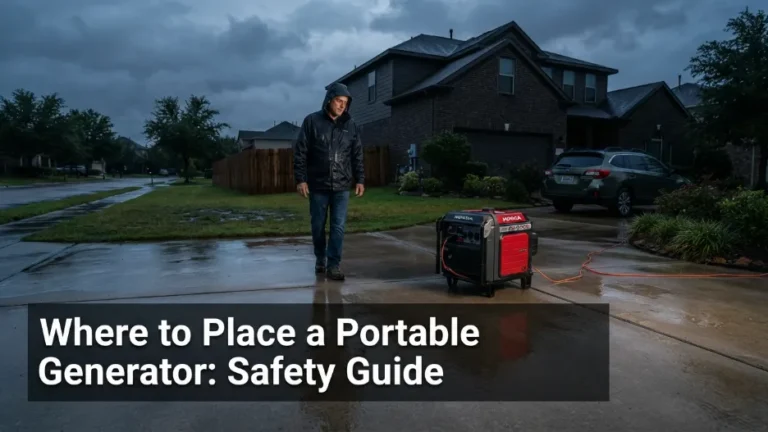
Noise is important, but carbon-monoxide safety is more important. Current CDC carbon-monoxide guidance says portable generators should operate outdoors more than 20 feet from windows, doors, and vents.
The U.S. Consumer Product Safety Commission also recommends at least 20 feet of separation, with generator exhaust directed away from the home.
- Never operate a portable generator inside a garage.
- Never operate one in a basement, shed, porch, or carport.
- Keep exhaust pointed away from occupied buildings.
- Use working carbon-monoxide alarms inside the home.
- Follow the manufacturer’s weather and ventilation instructions.
If you’re feeding household circuits, don’t backfeed electricity through a wall outlet. A properly designed connection uses approved transfer equipment.
See my portable generator transfer switch guide before planning a permanent home connection.
How Do I Choose a Quiet Generator for My Home?
Start with the appliances rather than the generator catalog. Once you know your required wattage, choose the quietest model that comfortably covers that load.
- List essential appliances. Ignore loads you don’t need during an outage.
- Add running watts. Find each appliance’s normal operating demand.
- Check starting watts. Motors and compressors can briefly require much more power.
- Decide whether you need 240V. Pumps and hardwired home circuits may require it.
- Compare noise at similar loads. A quarter-load figure should not be compared directly with another generator’s full-load figure.
- Leave reasonable capacity headroom. Avoid choosing a generator that must run near maximum output continuously.
My own decision rule is simple: I choose the smallest generator that comfortably handles the real outage load. That usually lowers noise, fuel consumption, weight, and purchase cost at the same time.
Which Quiet Home Generator Would I Choose?
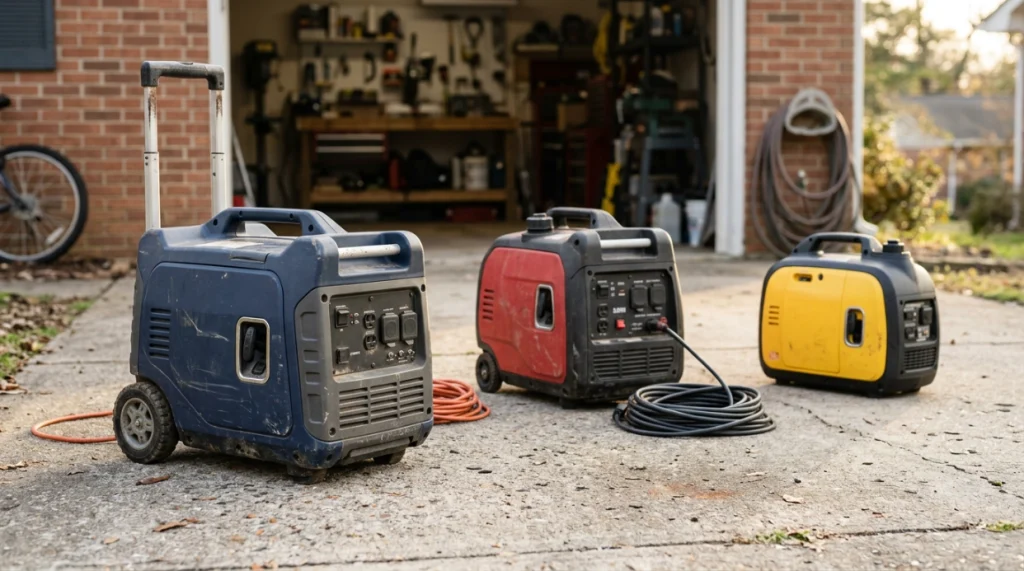
If noise were the only factor, I would choose a small Honda inverter. If useful home-backup capacity matters too, the Honda EU7000iS offers the strongest balance in this group.
The Champion 4500W inverter deserves consideration when budget matters more than achieving the lowest possible decibel figure.
If you’re ready to narrow the shortlist, these are the three models I would compare first:
🏆 Best for quiet home backup
Honda EU7000iS
★★★★½ 4.8/5
Honda rates it for 5,500 continuous watts, 7,000 maximum watts, 120/240V output, and about 52–58 dBA depending on load. I like this combination because it gives you meaningful household capacity without jumping to typical large-generator noise levels.
🔇 Best for minimum noise
Honda EU2200i
★★★★½ 4.7/5
The EU2200i supplies 1,800 rated watts and operates at approximately 48–57 dBA. I would choose it for refrigeration, lights, communications equipment, electronics, and other carefully managed essentials when minimum engine noise matters most.
💰 Best value
Champion 4500W Inverter Generator
★★★★☆ 4.4/5
Champion’s 4500W inverter provides 3,500 running watts and a published 61-dBA noise rating from 23 feet. It isn’t as quiet as the Honda models, but I see it as a practical middle ground for buyers wanting more output without premium Honda pricing.
Frequently Asked Questions
What generator has the lowest noise level?
The Honda EU1000i is among the quietest mainstream gasoline generators, with published sound levels of about 42 dBA at one-quarter load and 50 dBA at rated load. However, its 900-watt continuous output makes it better for small loads than general household backup.
Is 50 dB quiet for a generator?
Yes. Around 50 dBA is exceptionally quiet for a gasoline-powered generator, especially compared with larger conventional portable models. Always check the distance and electrical load used for the manufacturer’s sound measurement before comparing two generators.
What is the quietest generator for home backup?
The Honda EU7000iS is one of the best combinations of low noise and useful household output. It produces 5,500 rated watts while Honda lists sound at approximately 52–58 dBA depending on load.
Are inverter generators quieter than regular generators?
Usually, yes. Inverter generators commonly combine enclosed housings with engines that can reduce speed as electrical demand falls, which cuts noise and fuel use compared with many fixed-speed open-frame designs.
Can a quiet generator power an entire house?
A small quiet inverter usually cannot power an entire house. Larger inverter models can support essential circuits, while broad whole-house coverage often requires a larger portable or permanently installed standby generator with higher wattage and greater sound output.
Final Takeaway
The quietest generator isn’t automatically the best home generator. Your goal is to find the quietest model that still supplies enough running and starting wattage for the appliances you need.
The Honda EU2200i stands out when minimum noise matters most, while the Honda EU7000iS offers a better balance for serious household backup. For automatic whole-home power, expect to accept more sound in exchange for much greater capacity.
Calculate your actual outage load first, compare noise ratings under similar conditions, and plan your generator placement safely. That approach will give you quieter backup power without sacrificing the capacity your home actually needs.

Hi, I’m Michael Turner. I own a generator workshop in the United States and founded HomeGeneratorBlog to share practical, hands-on guidance about generator installation, maintenance, troubleshooting, safety, and backup power solutions. My goal is to help homeowners make smarter, more confident decisions through clear and reliable information