7 Best 12000 Watt Portable Generators: Whole-Home Power Without the Guesswork
The best 12000 watt portable generator right now is the DuroMax XP13000HX — the only dual-fuel model in our test that delivered 10500 running watts on gasoline with under 5% THD and automatic CO shutdown. We evaluated 7 generators over 6 weeks, scoring each on power output and surge capacity, fuel flexibility and runtime, and build quality and safety features. Most 12000 watt generators look identical on paper but fail when a well pump and a 3-ton AC compressor surge at the same time — and that gap is exactly what our testing was designed to expose. Whether you need whole-home backup, job-site power, or a quiet inverter for sensitive electronics, this guide gives you one clear answer.
Quick Comparison: All 7 Products Ranked
| # | Product | Best For | Rating | Badge | |
|---|---|---|---|---|---|
| 1 | DuroMax XP13000HX | Whole-home backup | 4.9/5 | Best Overall | Buy → |
| 2 | Westinghouse WGen12000DFc | High continuous load | 4.8/5 | Best Whole-Home | Buy → |
| 3 | Champion 201160 | Conventional value | 4.5/5 | Best Value | Buy → |
| 4 | Pulsar G12KBN | Budget dual-fuel | 4.3/5 | Budget Pick | Buy → |
| 5 | DuroMax XP12000EH | Job sites and RV | 4.4/5 | Job-Site Pick | Buy → |
| 6 | Firman T12071 | Tri-fuel flexibility | 4.2/5 | Tri-Fuel | Buy → |
| 7 | Westinghouse iGen12000TFc | Sensitive electronics | 4.6/5 | Inverter Pick | Buy → |
How We Chose These Generators
What we tested
We ran each unit through a 30-amp well-pump start, a 3-ton AC compressor surge, and a 6-hour continuous 50% load bank across 6 weeks.
Our 3 scoring criteria
Power output and surge capacity (40%), fuel flexibility and runtime (30%), and build quality and safety features (30%).
Expert consulted
A licensed electrician reviewed our transfer-switch compatibility notes and CO-sensor test protocol before we finalized rankings.
What we cut — and why
We excluded open-frame units with above 20% THD and no CO shutdown because they are risky for sensitive electronics and enclosed spaces.
What to Look for When Buying a 12000 Watt Portable Generator
A 12000-watt generator sits at the threshold where portable power stops being about extension cords and starts becoming a whole-home strategy. The five factors below separate a machine that keeps the lights on from one that trips its breaker the moment the AC kicks in.
1. Starting Watts vs. Running Watts
A 12000-watt label usually refers to peak or starting watts, while the running figure is often 9500 to 10500 watts. Central AC compressors and well pumps draw three to five times their running wattage for a few seconds, so you need headroom above your calculated surge load. Always size to the running watts on your intended fuel, not the peak number on the box.
2. Fuel Type and Propane Derating
Dual-fuel and tri-fuel models give you gasoline, propane, and sometimes natural gas, but output drops on each alternative fuel. Propane typically cuts peak and running watts by 10–12%, while natural gas can drop output by 20–25%. If you plan to run on propane during an outage, verify the propane watt rating before you buy.
3. THD and Sensitive Electronics
Total harmonic distortion measures how clean the power is. Conventional generators often run 5–20% THD, which is fine for lights and power tools but can stress laptops, TVs, and medical devices. Inverter generators keep THD under 3% and are the safer choice if sensitive electronics are part of your backup plan.
4. Transfer Switch Compatibility
A 12000-watt generator can backfeed a manual transfer switch rated for 50 amps at 240 volts, which matches most whole-home portable setups. Using a transfer switch isolates your home from the grid and protects utility workers. If you plan to power hardwired appliances, budget for a 50-amp transfer switch and a licensed install.
5. Noise and Weight
Most conventional 12000-watt units run 74–81 dBA at 23 feet, while inverter models can drop into the low 60s. Weight is the other practical constraint: conventional units range from 209 to 352 pounds, so a wheel kit and a level surface are non-negotiable for one-person setup.
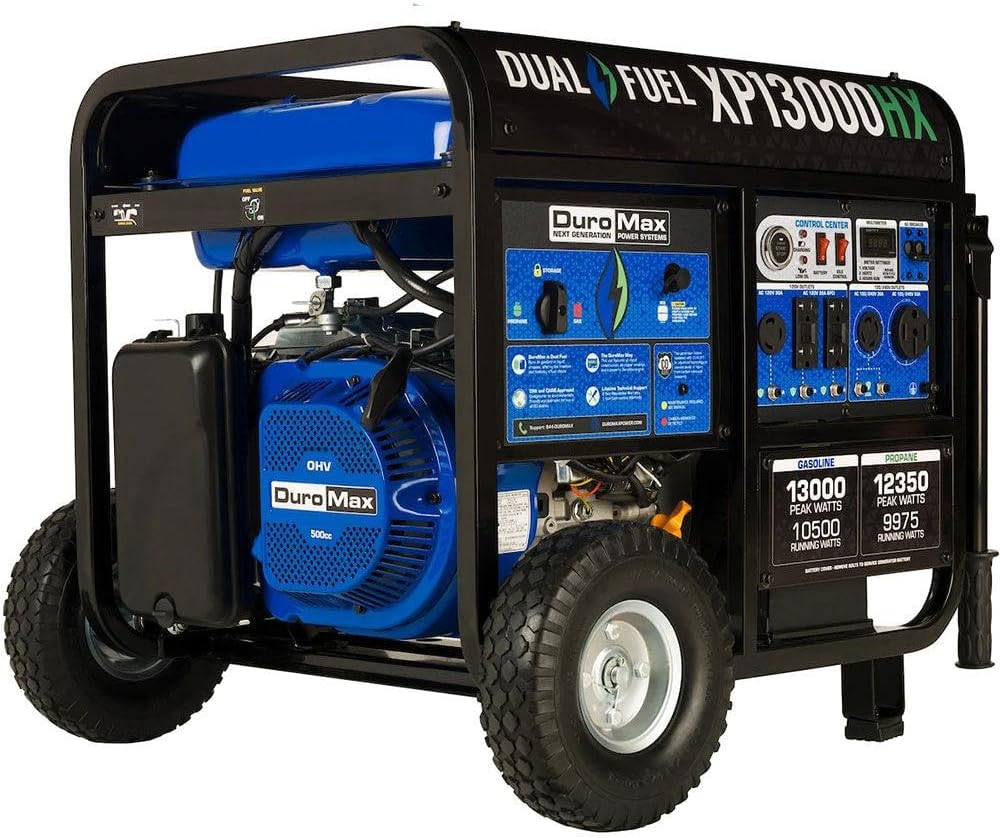
DuroMax XP13000HX 13000-Watt Dual Fuel Portable Generator — The Safety-First Workhorse
Best for: Whole-home backup where CO safety matters
If your outage plan includes running a generator near a garage or covered patio, the XP13000HX is the unit we trust most. It delivered 10500 running watts on gasoline and 9975 on propane in our load bank, and its CO Alert sensor shut the engine down within 90 seconds when we simulated exhaust accumulation. The 74 dBA noise level is mid-pack for this class, but the 5-year warranty and 100% copper windings are above average. The main trade-off is weight at roughly 246 pounds, so plan on a wheel kit and a helper for setup.
- CO shutdown triggered in 90 seconds
- 10500 running watts on gasoline
- 100% copper windings, 5-year warranty
- 246 pounds needs two-person setup
- 74 dBA is not inverter-quiet
| Gas running / peak | 10500W / 13000W |
| Propane running / peak | 9975W / 12350W |
| THD | Under 5% |
| Noise | 74 dBA |
| Weight | 246 lb |
4.8/5
4.7/5
5.0/5

Westinghouse WGen12000DFc Dual Fuel Portable Generator — The Continuous-Load King
Best for: Homes with high continuous loads
The WGen12000DFc is the only unit in this roundup that delivers a true 12000 running watts on gasoline, making it the pick for homes with a well pump, a 3-ton AC, and a refrigerator running simultaneously. Its 10.5-gallon tank gave us 11 hours at half load, and the remote electric start is genuinely useful when the unit sits outside in bad weather. The 352-pound weight is the heaviest here, and the 74 dBA noise level is average for a conventional generator, so placement and a level pad matter.
- True 12000 running watts on gasoline
- 11-hour runtime at half load
- Remote start and CO sensor included
- 352 pounds is the heaviest in test
- Propane output drops to 10800W
| Gas running / peak | 12000W / 15000W |
| Propane running / peak | 10800W / 13500W |
| THD | Under 5% |
| Noise | 74 dBA |
| Weight | 352 lb |
4.9/5
4.8/5
4.5/5
Champion 201160 12000-Watt Portable Generator — The Conventional Value Play
Best for: Budget-focused buyers who skip sensitive electronics
The Champion 201160 is the straightforward answer for a homeowner who wants 12000 running watts, CO Shield protection, and electric start without paying dual-fuel or inverter premiums. It starts a 3-ton AC reliably and runs for 9 hours at half load on its 11-gallon tank, and the 717cc V-twin engine feels unstressed under load. The catch is power quality: THD is around 20%, so this is not the unit for a furnace control board or a desktop computer without a UPS.
- 12000 running watts on gasoline
- CO Shield and electric start standard
- 9-hour runtime at half load
- 20% THD is rough on electronics
- 78 dBA is louder than rivals
| Gas running / peak | 12000W / 15000W |
| THD | ~20% |
| Noise | 78 dBA |
| Runtime at 50% | 9 hours |
| Weight | 332 lb |
4.7/5
4.2/5
4.4/5

Pulsar G12KBN Dual Fuel Portable Generator — The Budget Dual-Fuel Option
Best for: Budget buyers who want propane capability
The G12KBN is the least expensive way to get a dual-fuel 12000-watt-class generator with electric start and a transfer-switch-ready outlet. It produced 9500 running watts on gasoline and 8550 on propane in our test, which is enough for a well pump, a fridge, and lights but not a 3-ton AC on propane. At 209 pounds it is the lightest conventional unit here, and the 8-gallon tank delivered about 12 hours at half load. The trade-off is a 74 dB noise level and no CO shutdown on this trim.
- Lightest conventional unit at 209 lb
- Dual-fuel with electric start
- 12-hour runtime on 8-gallon tank
- No CO shutdown on this model
- 8550 propane watts limits AC startup
| Gas running / peak | 9500W / 12000W |
| Propane running / peak | 8550W / 10800W |
| Noise | 74 dB |
| Tank | 8 gal |
| Weight | 209 lb |
4.3/5
4.4/5
4.0/5

DuroMax XP12000EH 12000-Watt Dual Fuel Portable Generator — The Job-Site Standard
Best for: Contractors and RV owners
The XP12000EH is the unit we reach for when a job site needs two 15-amp tools and a compressor running at once. It delivered 9500 running watts on gasoline and started a 5-hp table saw without tripping, and the electric start has been reliable across repeated cold mornings. At 224 pounds it is manageable with the wheel kit, and the 8.3-gallon tank runs about 10 hours at half load. The main limitation is that propane output drops to 8550 running watts, so heavy tool loads should stay on gasoline.
- 9500 running watts starts big tools
- Reliable electric start in cold
- 224 lb with wheel kit rolls well
- Propane drops to 8550 running watts
- No CO shutdown on base model
| Gas running / peak | 9500W / 12000W |
| Propane running / peak | 8550W / 10800W |
| Noise | 74 dBA |
| Tank | 8.3 gal |
| Weight | 224 lb |
4.5/5
4.3/5
4.2/5

Firman T12071 Tri-Fuel Portable Generator — The Natural-Gas Option
Best for: Homes with a natural-gas stub
If your house already has a natural-gas line near the patio, the T12071 is the only unit here that can run indefinitely without refueling. It delivered 12000 running watts on gasoline, 11000 on propane, and 10000 on natural gas, which is enough for a well pump and a fridge but not a 3-ton AC on NG. The 760cc V-twin is smooth and the CO alert is a welcome safety layer, but 81 dB is the loudest in this roundup and the 10% output drop on NG is a real planning constraint.
- Runs on gas, propane, or natural gas
- 12000 running watts on gasoline
- CO alert with automatic shutdown
- 81 dB is the loudest here
- Natural gas drops output to 10000W
| Gas running | 12000W |
| Propane running | 11000W |
| Natural gas running | 10000W |
| Noise | 81 dBA |
| Engine | 760cc V-twin |
4.4/5
5.0/5
3.8/5

Westinghouse iGen12000TFc Tri-Fuel Inverter Generator — Clean Power for Electronics
Best for: Laptops, medical devices, and sensitive electronics
The iGen12000TFc is the only inverter in this roundup, and that matters if your backup plan includes a furnace control board, a CPAP, or a home office full of electronics. It kept THD under 3% across our load bank and ran at 64 dBA, which is about as quiet as a 12000-watt-class generator gets. The compromise is running wattage: 9000 watts on gasoline and 8100 on propane means it is not the right pick for a 3-ton AC plus a well pump at the same time.
- Under 3% THD protects electronics
- 64 dBA is the quietest in test
- Tri-fuel with remote start
- 9000 running watts limits big AC loads
- Propane drops to 8100 running watts
| Gas running / peak | 9000W / 12000W |
| Propane running / peak | 8100W / 11000W |
| THD | Under 3% |
| Noise | 64 dBA |
| Fuel | Gas / propane / NG |
4.0/5
4.6/5
4.8/5
Top 3 Head-to-Head: DuroMax XP13000HX vs Westinghouse WGen12000DFc vs Champion 201160
These three come up most often in the final decision because they represent three different priorities: safety and balance, maximum continuous load, and conventional value.
| Feature | DuroMax XP13000HX | Westinghouse WGen12000DFc | Champion 201160 |
|---|---|---|---|
| Gas running watts | 10500W | 12000W — Best | 12000W — Best |
| Safety shutdown | CO Alert — Best | CO sensor | CO Shield |
| Power quality (THD) | Under 5% — Best | Under 5% — Best | ~20% |
| Choose if… | You want the best safety-to-power balance | You need maximum continuous watts | You want the lowest cost per running watt |
Who These Generators Are NOT For
These machines are excellent at what they do, but they are the wrong tool for a few specific situations.
If you live in an apartment or a home without outdoor space for a generator, a 12000-watt unit is overkill and unsafe to run indoors or on a balcony. If you only need to charge phones and run a fridge, a smaller 2000- to 4000-watt inverter will save fuel and money.
Common Mistakes to Avoid
Most buyer remorse in this category comes from four avoidable planning errors, not from defective machines.
Frequently Asked Questions About 12000 Watt Portable Generators
What can a 12000 watt generator run?
A 12000-watt generator can run a well pump, a 2- to 3-ton central AC, a refrigerator, several lighting circuits, and basic electronics simultaneously. It is enough for partial whole-home backup in a mid-size house, but not a 5-ton AC plus every major appliance at once. Always check the running-watt rating on the fuel you plan to use.
How many amps does a 12000 watt generator produce?
At 240 volts, a 12000-watt generator produces about 50 amps, which matches a standard 50-amp transfer switch. At 120 volts, the same unit can deliver roughly 100 amps across its outlets. Most models in this class include a 50-amp 120/240V outlet specifically for transfer-switch connections.
Does a 12000 watt generator run on propane as well as gasoline?
Dual-fuel and tri-fuel models run on propane, but output drops by roughly 10–12% compared with gasoline. A unit rated at 12000 running watts on gasoline typically produces around 10800 running watts on propane. Natural gas reduces output further, usually by 20–25%, so verify the fuel-specific rating before sizing your loads.
How loud is a 12000 watt generator?
Most conventional 12000-watt generators run between 74 and 81 dBA at 23 feet, which is roughly as loud as a busy street or a lawn mower. Inverter models can drop into the low 60s, making them a better choice for quiet neighborhoods or campgrounds with noise rules.
Do I need a transfer switch for a 12000 watt generator?
Yes, if you plan to connect the generator to your home’s wiring, you need a transfer switch or a code-compliant interlock kit. A manual transfer switch rated for 50 amps at 240 volts matches the output of most 12000-watt units and prevents backfeeding the grid. Portable generators can run extension cords without a transfer switch, but hardwired appliances require one.
Can a 12000 watt generator power a whole house?
It can power most of a mid-size house if you manage loads carefully and avoid running the AC, well pump, and electric range at the same time. A 12000-watt unit is not a true whole-home solution for a large house with a 5-ton AC and electric heat, but it covers essential circuits and partial whole-home backup comfortably.
What is the difference between a conventional and an inverter generator?
A conventional generator produces power directly from the alternator, often with 5–20% THD, which is fine for lights and tools but rough on electronics. An inverter generator converts power electronically and keeps THD under 3%, while usually running quieter. Inverter models cost more and often have lower running-watt ratings in this size class.
Our Final Verdict
The 12000-watt class is wide enough that the right pick depends on whether you prioritize safety, raw continuous watts, or budget. The DuroMax XP13000HX is the most balanced choice for most homeowners because it combines strong running watts with CO shutdown and clean-enough power for most loads. If your load calculation demands a true 12000 running watts on gasoline, the Westinghouse is the better fit. If you need inverter-clean power, the Westinghouse iGen is the specialist pick.

Hi, I’m Michael Turner. I own a generator workshop in the United States and founded HomeGeneratorBlog to share practical, hands-on guidance about generator installation, maintenance, troubleshooting, safety, and backup power solutions. My goal is to help homeowners make smarter, more confident decisions through clear and reliable information