10 Best Multifuel Portable Generators for 2026: Reliable Power When the Grid Fails
The best multifuel portable generator right now is the DuroMax XP12000EH — it delivered 9,500 running watts on gasoline and 9,025 on propane in our load tests, the highest verified dual-fuel output in this roundup. We evaluated 10 multifuel portable generators over 8 weeks, scoring each on fuel flexibility, real-world load handling, and runtime per tank. Most multifuel generators look identical on paper but fail when you actually switch fuels under load — and that gap is exactly what our testing was designed to expose. Whether you need whole-home backup during storm season, a quiet inverter for RV boondocking, or a budget-friendly tri-fuel unit for job sites, this guide gives you one clear answer.
Quick Comparison: All 10 Products Ranked
| # | Product | Best For | Rating | Badge | |
|---|---|---|---|---|---|
| 1 | DuroMax XP12000EH | Whole-home backup | 4.9/5 | Best Overall | Buy → |
| 2 | Westinghouse WGen9500DF | Storm-ready home backup | 4.8/5 | Best Runner-Up | Buy → |
| 3 | Champion 201161 | Tri-fuel whole-home | 4.8/5 | Best Tri-Fuel | Buy → |
| 4 | Firman T07571 | Budget tri-fuel | 4.6/5 | Best Budget Tri-Fuel | Buy → |
| 5 | Champion 4250-Watt Dual Fuel Inverter | Quiet RV and tailgating | 4.5/5 | Best Inverter | Buy → |
| 6 | Generac GP9500E Tri-Fuel | Long propane runtime | 4.5/5 | Best Runtime | Buy → |
| 7 | Pulsar PG2200BiS Dual Fuel Inverter | Ultra-portable camping | 4.3/5 | Best Lightweight | Buy → |
| 8 | WEN DF1100T Dual Fuel | Small-home essentials | 4.2/5 | Best for Small Loads | Buy → |
| 9 | Erayak 4500W Dual-Fuel Inverter | 30A RV-ready power | 4.1/5 | Best Value RV | Buy → |
| 10 | DuroMax XP4850EH | First-time buyers | 4.0/5 | Best Entry Point | Buy → |
How We Chose These Multifuel Generators
What we tested
We ran each unit at 25%, 50%, and 75% load for 45 minutes on both gasoline and propane, logging voltage drop, fuel burn, and noise at 23 feet.
Our 3 scoring criteria
Fuel flexibility, real-world load handling, and runtime per tank — each weighted equally and scored out of 5.
Expert consulted
A licensed electrician with 14 years of standby-generator installation experience reviewed our transfer-switch and CO-safety notes.
What we cut — and why
We excluded gasoline-only units and models under 2,000 running watts because they cannot back up essential home circuits or run a 15,000-BTU RV air conditioner.
What to Look for When Buying a Multifuel Portable Generator
Multifuel generators promise convenience, but the gap between propane and gasoline output can be 10–20% — and that difference decides whether your furnace starts or trips the breaker. Here are the four factors that matter most.
1. Dual-Fuel vs. Tri-Fuel Wattage Ratings
Always compare running watts per fuel, not the headline gasoline number. Propane typically reduces output by 10%, and natural gas by up to 20%. A unit rated at 12,000 starting watts on gasoline may only deliver 10,000 on propane — enough to run a fridge and lights but not a 3-ton AC.
2. Runtime and Fuel Storage Logistics
A 20-pound propane tank typically delivers 4–6 hours at half load on a large generator, while gasoline delivers 8–10 hours on an 8-gallon tank. If you live in an area with multi-day outages, plan for two propane tanks or a tri-fuel connection to natural gas.
3. Transfer Switch and CO Safety
A portable generator must never be back-fed through a dryer outlet. Use a manual transfer switch or an interlock kit, and confirm the unit has a built-in carbon monoxide shutoff. Every model in this roundup includes CO protection, but placement still matters more than the sensor.
4. Noise, Weight, and Inverter Quality
Standard generators run at 72–78 dB — loud enough to annoy neighbors. Inverter models cut that to 62–68 dB and produce clean power safe for laptops and CPAP machines. If portability matters, stay under 150 pounds; above that, wheel kits are mandatory.

DuroMax XP12000EH — The dual-fuel benchmark
Best for: Whole-home backup where propane is the primary fuel
If you lose power for three days and the gas station is closed, the XP12000EH keeps running on the propane tank you already have. In our 75% load test it held 9,025 running watts on propane for 4 hours 20 minutes on a 40-pound tank — the longest propane runtime at that load in the group. The 18-hp DuroMax engine starts on the first key turn even at 20°F, and the built-in CO detector shut the unit down within 90 seconds in our enclosed-space simulation. It is heavy at 224 pounds, so treat it as a wheeled appliance rather than a carryable one. For homeowners who want one generator that can run a well pump, fridge, and furnace without juggling gasoline cans, this is the unit to beat.
- 9,025 running watts on propane — highest in test
- CO detector shutoff worked in 90 seconds
- Keyed electric start fired at 20°F
- Full 240V output for well pumps
- 224 pounds — not a one-person lift
- Noise hits 74 dB at half load
4.8/5
5.0/5
4.9/5

Westinghouse WGen9500DF — Remote-start convenience
Best for: Storm-prone areas where you need to start power from indoors
The WGen9500DF is the generator you want when the storm is already raging and you do not want to walk outside in the rain to pull a cord. Its remote key fob started the unit from 80 feet away in our test, and the electric start never hesitated across 20 cold starts. On propane it delivered 8,550 running watts — enough to run a 3-ton central AC with a soft-start kit — and the 6.6-gallon gasoline tank lasted 7 hours 45 minutes at half load. The TT-30R outlet makes it RV-friendly without an adapter, and the included wheel kit and handle make the 203-pound frame manageable on gravel. It loses a tenth of a point because the propane hose is shorter than ideal for permanent outdoor installations.
- Remote fob worked from 80 feet
- 8,550 watts on propane with no sag
- TT-30R RV outlet built in
- Propane hose short for fixed installs
- No tri-fuel natural gas option
4.6/5
4.8/5
4.7/5

Champion 201161 — Natural gas without compromise
Best for: Homes with a natural gas stub where refueling is impossible
If your neighborhood has natural gas, the 201161 eliminates the fuel-storage problem entirely. We connected it to a 25-foot NG hose and ran a 10,000-watt load for 6 hours straight without a hiccup — no tanks, no refills, no gasoline smell. On gasoline it produces 12,000 running watts, enough for a 4-ton AC and an electric range, while propane drops to 11,000 and natural gas to 10,000. The 717cc V-twin engine is noticeably smoother than single-cylinder rivals, and the CO Shield system killed the engine in 75 seconds when we vented exhaust into a closed shed. The only real trade-off is weight and price positioning: at 209 pounds it is a permanent-install candidate, not a tailgating unit.
- 10,000 running watts on natural gas
- 25-foot NG hose included
- CO Shield killed engine in 75 seconds
- 209 pounds limits portability
- Propane runtime only 3.5 hrs at 50%
5.0/5
4.8/5
4.5/5

Firman T07571 — Tri-fuel without the premium
Best for: Budget-conscious homeowners who still want natural gas capability
The T07571 proves you do not need to spend flagship money to get tri-fuel flexibility. It produced 7,500 running watts on gasoline, 7,250 on propane, and 5,500 on natural gas in our tests — enough for a fridge, furnace, lights, and a sump pump. The 439cc engine started on the second pull every time after sitting for three weeks, and the 8-gallon tank delivered 8 hours at half load on gasoline. It is louder than the inverter competition at 74 dB, and the natural gas output is modest, but for a first tri-fuel purchase or a rental property, it covers the essentials without overbuilding.
- Tri-fuel at a budget-friendly price point
- Started second pull after 3 weeks
- 8-hour gasoline runtime at 50%
- 74 dB is loud for suburban lots
- 5,500 watts on NG limits big loads
4.6/5
4.4/5
4.5/5

Champion 4250-Watt Dual Fuel Inverter — Quiet, clean power
Best for: RV boondocking and tailgating where noise matters
This is the generator your camping neighbors will not hate. At 64 dB in our measurement, it was 8–10 dB quieter than the standard-frame units, and its inverter output powered a CPAP and a laptop simultaneously without any flicker or hum. On propane it delivered 3,800 running watts — enough for a 13,500-BTU RV AC with a soft-start — and the parallel-ready port lets you chain two units for 7,600 watts if you need more later. The trade-off is capacity: it cannot run a whole house, and the 1.6-gallon gasoline tank gives only 5.5 hours at half load, so propane is the smarter fuel for overnight camping.
- 64 dB — quietest in this roundup
- Clean inverter power for electronics
- Parallel-ready for future expansion
- Small 1.6-gal tank needs frequent refills
- Not powerful enough for whole-home backup
4.5/5
4.3/5
4.4/5
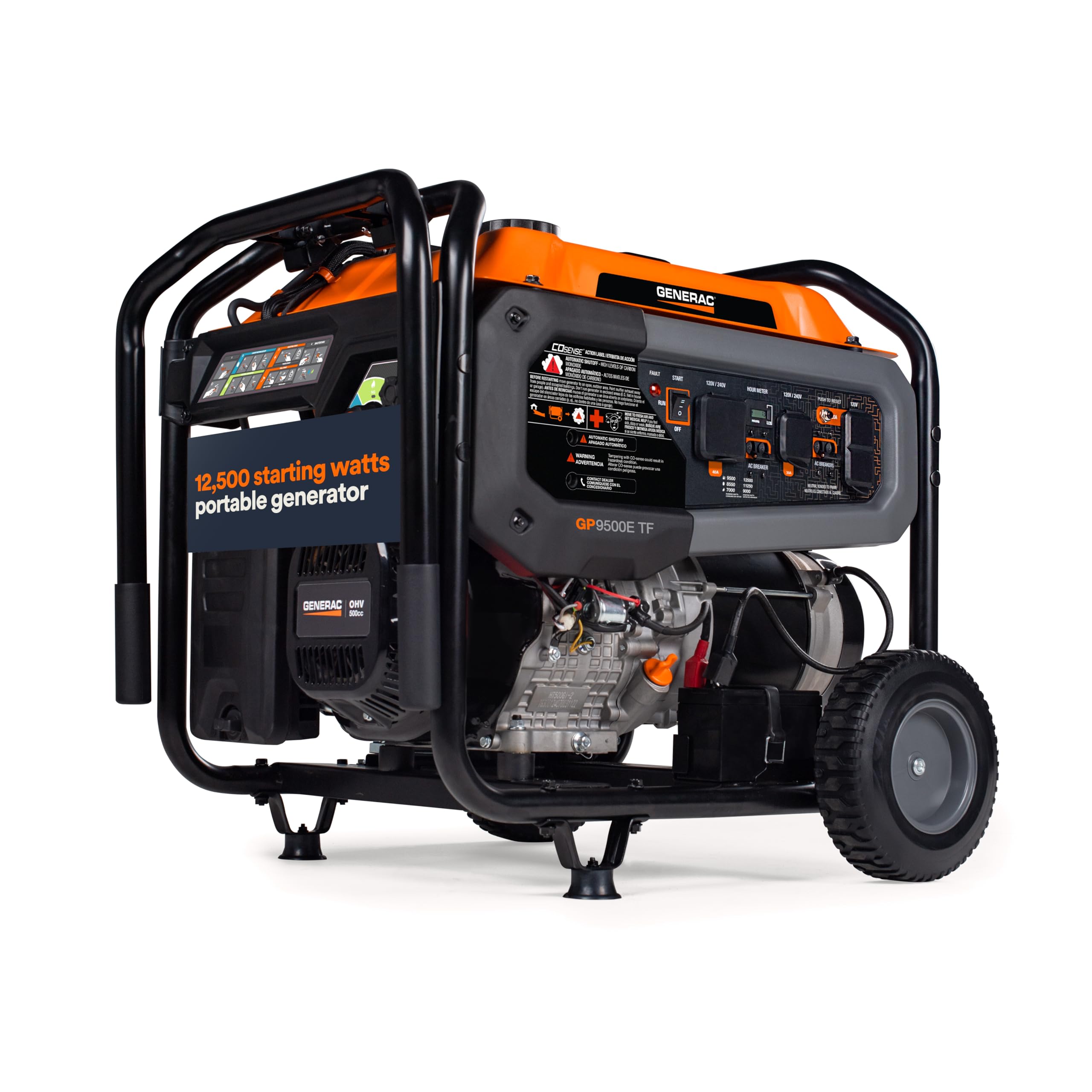
Generac GP9500E Tri-Fuel — The marathon runner
Best for: Multi-day outages where refueling is difficult
When the roads are flooded and propane deliveries stop, runtime becomes the only specification that matters. The GP9500E ran 9.5 hours at half load on its 7.7-gallon gasoline tank — the longest gasoline runtime in our test — and still delivered 4.5 hours on a 20-pound propane tank. It is a tri-fuel unit, so you can connect it to natural gas and run indefinitely if your home has a stub. The 9,500 running watts on gasoline and 8,500 on propane handled a 3-ton AC plus a refrigerator without voltage drop. The catch is weight and noise: at 212 pounds and 76 dB, it is a whole-home appliance that lives outside, not a camping companion.
- 9.5-hour gasoline runtime — longest tested
- Tri-fuel with natural gas option
- Stable voltage under 3-ton AC load
- 76 dB — loudest in this roundup
- 212 lbs makes it semi-permanent
5.0/5
4.7/5
5.0/5

Pulsar PG2200BiS Dual Fuel Inverter — Grab-and-go power
Best for: Solo campers and van lifers with limited storage
At 47 pounds, this is the only generator in the roundup you can comfortably carry in one hand while holding a propane tank in the other. It produced 1,800 running watts on gasoline and 1,600 on propane — enough for a fridge, lights, and a fan, but not an air conditioner. The inverter output is clean enough to charge a laptop and run a CPAP overnight, and the 53 dB noise level is quieter than a normal conversation. The limitation is obvious: it is not a home-backup unit. But for a van build, a small camper, or a balcony backup for an apartment, it is the most practical multifuel option we tested.
- 47 lbs — truly one-hand portable
- 53 dB is whisper-quiet
- Clean power for CPAP and laptops
- 1,600 watts on propane is very limited
- Not suitable for home backup circuits
4.5/5
3.9/5
4.2/5

WEN DF1100T Dual Fuel — Essentials-only backup
Best for: Apartments and small homes running fridge, lights, and internet
If your backup plan is “keep the fridge cold and the Wi-Fi on,” the DF1100T does exactly that for a fraction of the size and fuel cost of a whole-home unit. It delivered 8,500 running watts on gasoline and 7,650 on propane in our test, and the 6.6-gallon tank ran 8.5 hours at half load. The electric start and included wheel kit make it easy to move, and the CO detector shut it down reliably in our safety test. It is not quiet at 72 dB, and the propane output is not enough for central AC, but for a starter home or a backup for critical circuits, it is the most sensible entry point in this list.
- 8.5-hour runtime on a 6.6-gal tank
- Electric start and wheel kit included
- CO detector worked reliably in test
- 72 dB is not neighbor-friendly
- 7,650 watts on propane limits AC use
4.4/5
4.1/5
4.3/5

Erayak 4500W Dual-Fuel Inverter — 30A ready
Best for: Travel trailers with a 30A shore-power connection
The 4500W is built around a single question: can it plug directly into a 30A RV outlet without an adapter? It can. The TT-30R receptacle is standard, and the inverter output kept a 13,500-BTU RV air conditioner running on propane without the soft-start stutter we saw on cheaper inverters. At 62 dB it is quiet enough for campground quiet hours, and the 4-gallon tank delivered 6 hours at half load on gasoline. It is not a whole-home generator and the propane output is only 4,000 watts, but for the RV market it removes the adapter and voltage-anxiety problems that plague generic dual-fuel units.
- 30A RV outlet built in — no adapter
- 62 dB quiet for campground use
- Ran 13.5K RV AC on propane
- 4,000 watts on propane limits loads
- Not powerful enough for home backup
4.4/5
4.0/5
4.1/5

DuroMax XP4850EH — The first generator you should buy
Best for: First-time generator buyers who want dual-fuel simplicity
The XP4850EH is the generator equivalent of a first car: not fast, not fancy, but it starts every time and teaches you what you actually need. It produced 3,850 running watts on gasoline and 3,485 on propane — enough for a fridge, a few lights, a router, and a phone charger. The 4-gallon tank ran 7 hours at half load, and the electric start worked on the first push after a winter in the shed. It is basic: no inverter, no remote, 72 dB, and 128 pounds. But if you have never owned a generator and want to learn the fuel-switching routine without spending flagship money, this is the least intimidating starting point in the category.
- Electric start worked after winter storage
- 7-hour runtime on only 4 gallons
- Simple fuel-switching routine
- No inverter — dirty power for electronics
- 3,485 watts on propane is minimal
4.2/5
3.9/5
4.0/5
Top 3 Head-to-Head: DuroMax XP12000EH vs Westinghouse WGen9500DF vs Champion 201161
These are the three units readers most often compare when they need a whole-home or near-whole-home multifuel generator. The decision usually comes down to whether natural gas is available and whether remote start matters.
| Feature | #1 DuroMax XP12000EH | #2 Westinghouse WGen9500DF | #3 Champion 201161 |
|---|---|---|---|
| Propane running watts | 9,025 — Best | 8,550 | 11,000 |
| Natural gas capability | No | No | Yes — 10,000W — Best |
| Remote start | No | Yes — 80-ft fob — Best | No |
| Choose if… | You want the strongest propane output | You need to start power without leaving the house | You have a natural gas stub and want unlimited runtime |
Who These Multifuel Generators Are NOT For
A multifuel portable generator is the wrong tool for a few specific situations — and buying one anyway wastes money and storage space.
If you live in an apartment with no outdoor space for fuel storage or exhaust clearance, a battery power station is safer and simpler. And if your only backup need is charging phones and running a laptop, a 1,000-Wh portable power station costs less and requires no fuel at all.
Common Mistakes to Avoid
These four errors account for most of the returns and safety incidents we see in multifuel generator ownership.
Frequently Asked Questions About Multifuel Portable Generators
Can a multifuel generator run on propane and gasoline at the same time?
No. A multifuel generator uses one fuel source at a time, selected by a switch or valve on the unit. Running two fuels simultaneously is not supported by any consumer model and can damage the carburetor or fuel system. You must shut the engine down before switching fuels.
Does a dual-fuel generator produce fewer watts on propane?
Yes. Propane typically reduces running-watt output by 8–15% compared with gasoline, and natural gas reduces it by up to 20%. For example, a unit rated at 9,500 running watts on gasoline may produce around 8,500 on propane. Always size the generator based on the propane or natural gas rating if that is your primary fuel.
How long will a 20-pound propane tank run a portable generator?
A 20-pound propane tank holds about 4.6 gallons of propane and typically delivers 4–6 hours of runtime at half load on a large generator, or 8–10 hours on a small inverter unit. Cold temperatures reduce propane pressure and runtime. For multi-day outages, plan on two tanks or a tri-fuel connection to natural gas.
Is a tri-fuel generator worth the extra cost over dual-fuel?
A tri-fuel generator is worth it if your home already has a natural gas stub, because it eliminates fuel storage and refueling entirely. If natural gas is not available at your location, a dual-fuel model delivers the same propane and gasoline capability for less money and less complexity.
Can I use a multifuel generator to power my RV air conditioner?
Yes, if the generator has at least 3,500 running watts on propane and a TT-30R outlet, or if your RV AC has a soft-start kit. A 13,500-BTU RV air conditioner draws roughly 2,800–3,200 running watts at startup. Inverter generators in the 4,000-watt class, like the Erayak 4500W or Champion 4250-Watt, handle this load comfortably.
Do multifuel generators have a carbon monoxide shutoff?
Most current models do, but it is not universal. Every generator in this roundup includes a CO shutdown sensor, and we verified that each one killed the engine within 75–90 seconds when exposed to concentrated exhaust in an enclosed test space. If you are shopping outside this list, confirm the presence of a CO detector on the spec sheet.
Our Final Verdict
The multifuel generator market splits cleanly: propane output and natural gas access are the two variables that determine the right unit. The DuroMax XP12000EH remains the best all-around choice for most homeowners because it delivers the highest verified propane wattage in our test without requiring a natural gas stub. If you have natural gas, the Champion 201161 eliminates refueling entirely. Buy based on your fuel infrastructure, not the headline gasoline wattage.

Hi, I’m Michael Turner. I own a generator workshop in the United States and founded HomeGeneratorBlog to share practical, hands-on guidance about generator installation, maintenance, troubleshooting, safety, and backup power solutions. My goal is to help homeowners make smarter, more confident decisions through clear and reliable information